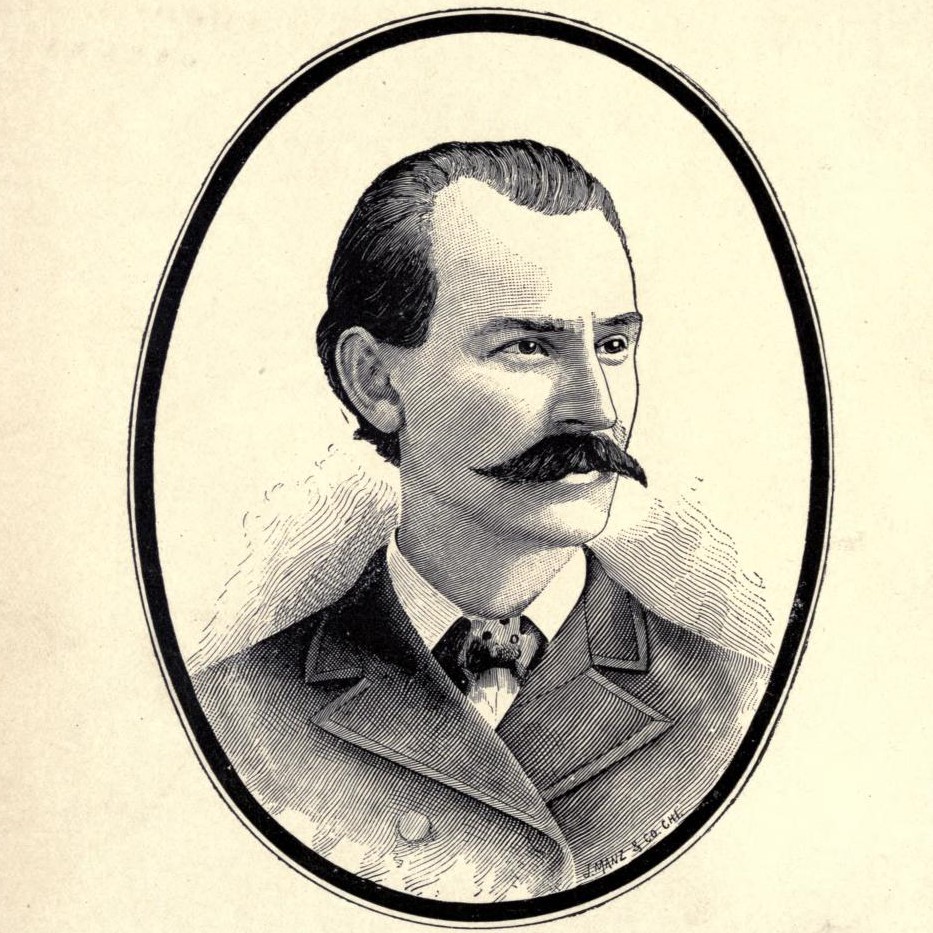
An extraordinary letter from the deathless Albert R. Parsons written just days before his judicial murder on November 11, 1887. In what could be an appendix for Du Bois’ ‘Black Reconstruction,’ Parsons recounts his transformation from young, former Confederate soldier to a militant Radical Republican in Reconstruction-era Waco, Texas organizing newly-emancipated Black proletarians. Parsons would later marry Lucy Parsons, a Black women he met during this time in which he displayed the same fearless sense of duty as when he walked to the gallows. In the person of Parsons is not only a heroic actor, but keen observer who straddled two epochs in the struggle for human freedom. A must read for students of the Reconstruction Era and the U.S. revolutionary tradition.
‘Reconstruction in Texas: Letter to George Schilling’ by Albert R. Parsons from Life of Albert R. Parsons, edited by Lucy Parsons, Chicago. 1889.
Cook County Jail, Dungeon No. 7,1 Chicago, November 7, 1887. 1
My Dear Friend, George Schilling:
It is at your request I pen these lines, and I cheerfully do so.
Concerning my early life, say from 1868-72, there are some things of passing interest. Between the ages of 19 and 20 years (1867-b) I became interested in the question of “reconstruction,” then agitating the Southern States. Born in Alabama, reared in Texas, living at that time in “Waco, and though a stripling youth, I had served through the rebellion as a soldier, mainly in Gen W.H. Parsons’ cavalry brigade. Gen. Longstreet, a man dear to “Southern” hearts, made bold to declare about this time (1868) his adherence to the Union and the terms of surrender as embodied in the reconstruction measures. These questions, involving the civil and political enfranchisement of the recently emancipated chattel slaves, were the all absorbing topic around the hearthstone and upon the rostrum.
It was during the Congressional campaign of 1868 that an elaborate campaign document, of a statistical character, relating to the progress and prosperity of the two sections, “North” and “South,” fell into my hands. From this document I learned the merits of the free school system, free labor (wage) system, etc., etc., together with the fact that all the Government (which was then the Republican party) required of the “South” was loyalty to the Union and compliance, in good faith, with the laws of the country. This newly found information, together with the fact that I had always been at heart a rank abolitionist, led me to conscientiously espouse the principles of the Republican party. To resolve was to act. And, though the step I was about to take would, I knew, hurl me from the social precipice of neighbors and friends, conscience and duty, as I saw it, made my action imperative. I took up, I espoused the cause of those who were then powerless to defend themselves or reward their friends. For this I was branded a Benedict Arnold—a traitor—by the whole community, save here and there a timorous white Republican and a multitude of ignorant but devoted blacks. Young men, with whom I had played as a boy, my old army comrades, with whom I had slept under the same blanket in war campaigns, cut me short. Some, with tears streaming down their cheeks when we met, bemoaned my apostasy. But there was that in me which these things served to fasten all the deeper—my conviction and resolution to perform my duty, as I understood it, fearlessly.
In 1868 I began the publication of a weekly newspaper, called the Spectator. It advocated, in a most conciliatory manner, the acceptance of the proposed “reconstruction measures” as the basis of peace and prosperity. The paper was short-lived, in a community of overwhelming opposition. The elections were frequent of county, city, State, Legislative, and Congressional officers, and here the new-born freemen were brought face to face with the enmity of their former owners. Only those who lived amid these scenes can understand the bitterness and hostility which was provoked by the efforts of the blacks to exercise their political freedom. Out of it grew ku klux klans and a feeling of reprisal among the blacks. I soon found myself completely ostracized from my former associates, and during the political campaigns was not permitted shelter and lodging in a white man’s house in my travels over a large extent of territory, which sometimes included several counties. On horseback, over prairie, or through the swamps of the Brazos river, accompanied generally by one or two intelligent colored men, we traveled. At noontime or nightfall our fare was only such as could be had in the rude and poverty-stricken huts of the colored people. I ate at their table with them, and slept in the same room, as the huts rarely had but one room. This was a degree of self-degradation in the eyes of the whites, which rendered me odious. Around or through the plantations we would give out the time and place where a public meeting was to be held to discuss the issues of the campaign. And often have I, amid the rows of slave huts, at night, stood upon a bale of cotton as a platform, and by the faint light of a tallow dip harangued the hundreds assembled around me. What a scene! The stars shone brightly above; a somber, heavy darkness covered the earth’s surface—peculiar to Southern swamp regions; the flickering light of the tallow dip; the mass of upturned, eager faces, coal black, with shining black eyes imbedded in sparkling white, with uncovered heads (but few possessed hats) . The kinky hair was curled or tied around strips of cornshucks about the size of a finger, the lint of the gin or cotton field, in which they had worked all day, clung to their worn and tattered garments, making altogether a grotesque, strange, weird scene. Such was my audience, such their school and teacher in the first lessons of political economy. But on great occasions the meetings were held in the court-house at the county seat, where persons from all portions of the county attended. On these occasions the meeting had an effect upon the whites similar to a red rag in the face of a wild bull. Fear was often entertained that a wholesale massacre of blacks would take place, but this was offset by the counter fear that the blacks might in retaliation burn the town, etc. A garrison of United States troops was stationed for two or three years during this period at certain centers, Waco being designated for this region. I remember vividly one of these general meetings held at Marlin, the county seat of Falls county, some forty-five miles distant from Waco. This meeting had been arranged two weeks ahead to be held on Saturday in the court-house. Marlin contained a population of probably 500, and, like most Southern towns, possessed the inevitable public square with a court-house in the center. These court-houses were always two stories high, the upper floor generally being a hall where the citizens could assemble to the number of a thousand on great occasions. The day finally arrived, and from 9 a.m. until 2 p.m. the blacks gathered from all over the county to the meeting. They came, some of them from long distances, on horseback, mules, in ox or horse wagons, and on foot. When, at 2:30 p.m., the meeting opened, there were about 1,000 present, among them a few women. Dressed in every conceivable garb, some with and some without shoes, some with “Sunday” clothes, others in patched and tattered work-day garb, a few with head wrapped in striped bandanas, but most with hats. When the meeting was called to order they removed their hats, disclosing an immense number with hair tied up or curled round strips of corn-shucks. The hall was crowded. I was the principal orator—in fact, the only one—of the day. My remarks were congratulatory of their awakening interest in their own welfare, etc. I told them they now no longer had to call any man “master”; they could work for themselves, and vote for themselves. I exhorted them not to be intimidated; that the United States Government was their friend and protector. I told them to be men. To
“Snatch Fear’s cold hand from off their palsied hearts,
And send the intrepid shudder through their veins;
Arise, and front the blessed light of Heaven
With tyrant-quailing manhood in their looks.”
During my speech an occasional menace and threat came from some fifteen or twenty white men who, on the outer edge of the crowd, hung to the side of the wall and shook their fists at me with muttered curses, and hate gleaming out of their eyes. But the immense throng of blacks, who might be goaded to madness, prevented them from doing anything. At the close of this meeting colored men gathered around me, thanking me, etc., and one old, intelligent man, whose hair was as white as full-blown cotton in the fields, fell upon his knees, and, clasping me in his arms, with upturned face streaming with tears, said: “Bless God that I should ever live to see this day. I never thought a white man could be so good and kind to us poor colored folks.” I rode out of town that afternoon and stopped with old “Uncle Monday,” a famous Baptist preacher, 80 years of age. I can never forget the heartfelt hospitality of this simple-hearted, naturally intelligent old man. At such meetings as these the new-born manhood was aroused and they were stirred with new sensations of independence and self-respect. It was a characteristic of the blacks to be kind and confiding to a degree, and I always found them obliging and true-hearted. Amid such scenes as these I labored for about two years (1870). The Republican party was to them essentially a labor party, since all the wealth and power of the community was arrayed against these poor wage-workers—these proletariat. I engaged in this work with the ardor and disinterestedness of an apostle. I knew nothing of politics in the sense in which that word is now employed. In 1870 I was appointed by President Grant Assistant United States Internal Revenue Assessor. In the election of members of the Legislature a colored man named Shep Mullens, of Waco, a very intelligent blacksmith, was successful over his Democratic competitor. One day John T. Flint, a banker, met me in the hallway of his building and began to upbraid and denounce me for aiding the election of a “n***r.” He was a powerful man of 200 pounds, my weight being about 135. I held a walking-cane in my hand, and told him to let me alone. He stooped down, and, picking up a five-pound piece of broken iron cog-wheel, used to prop open the door, made a motion to throw it at me. I told him not to do it, as it would kill if it struck me. Walking up to him, he suddenly drew back and struck me in the temple with the iron, making a cut of two inches, from which rushed a stream of blood that drenched my clothing. He was bound over to keep the peace under bonds, but was never prosecuted. This was the only difficulty I ever had with any one. And, though it was the custom of many to go heavily armed, I never carried a weapon—not even when traveling, of which I did a great deal. Shotgun or pistol fracases were quite frequent occurrences, generally on the public square, when all but the combatants would retire within the stores and leave them an open field. In nearly every neighborhood there was usually a gang of desperados, who, as kuklux, made life a terror to the defenseless blacks. In some instances these gangs took to the highway and began to depredate upon the whites. Such gangs usually became emboldened with their easy terrorization at first, until in sheer desperation the peaceably-disposed portion of the community would combine, and in a frenzy kill them or drive them off. Many Texans will remember the noted outlaw, Bickerstoff, who terrorized a vast region of country till he was finally slain by merchants and people of Alvarado, Johnson county. I have seen his grave often where he is buried on the roadside in the “Cross-timbers,” near that town. In those days it could be said truly
“Oh, that bread should be so dear,
And flesh and blood so cheap.”
In the year 1870, E.J. Davis, now dead, was elected Republican Governor of Texas. On the organization of the State Senate I was elected reading secretary. During this term I was commissioned Colonel of State militia by the Governor. I was not an “ornamental” Colonel, either. On the occasion of an election held in 1871, I was ordered from Austin to Belton, county seat of Bell county, to preserve order and protect the citizens at the polls on election day. I was in command of some twenty-five men, and it was a most warlike and dangerous undertaking. The blacks had no rights which (as Justice Taney had said) the whites should respect. But at the muzzle of revolvers I protected the poor blacks in the exercise of their elective franchise.
Thus, over a very extensive region of country, among cotton, corn, and sugar plantations, I became somewhat famous as a champion of political liberty. Beloved by the blacks, I was hated and scorned by the whites. I then believed that the colored people were truly freemen, and that they only needed courage to assert it. But I did not then understand or know that economic dependence, i.e., industrial servitude, made political liberty impossible. I did not know, nor did the blacks, they had been merely emancipated from chattel to wage servitude. I did not then know that economic freedom must be the basis for political liberty, and that the wage-labor system created classes, antagonisms, and class servitude.
And now, as the helots of old, the so-called “free” blacks, in common with their white brethren, work and die like beasts in the unceasing treadmill of wage-slavery.
A.R. PARSONS.
1. It will be observed that from November 6 Mr. Parsons dated his communications from “Dungeon No. 7,” while the eighteen previous months they had been dated from “Cell No. 29.” The reason of this was that the five who refused absolutely to sign any document asking Oglesby (then Governor) “clemency,” claiming they had committed no crime to ask “clemency” for, were placed into dungeons, while the three who signed the petition were left in the same cells they had occupied all the time. On my inquiry of a deputy sheriff why this distinction was made, he roughly told me : “It’s because they won’t recognize the Governor.” LUCY E. PARSONS
PDF of full book: https://archive.org/download/lifeofalbertrpar00pars/lifeofalbertrpar00pars.pdf
 Revolution's Newsstand