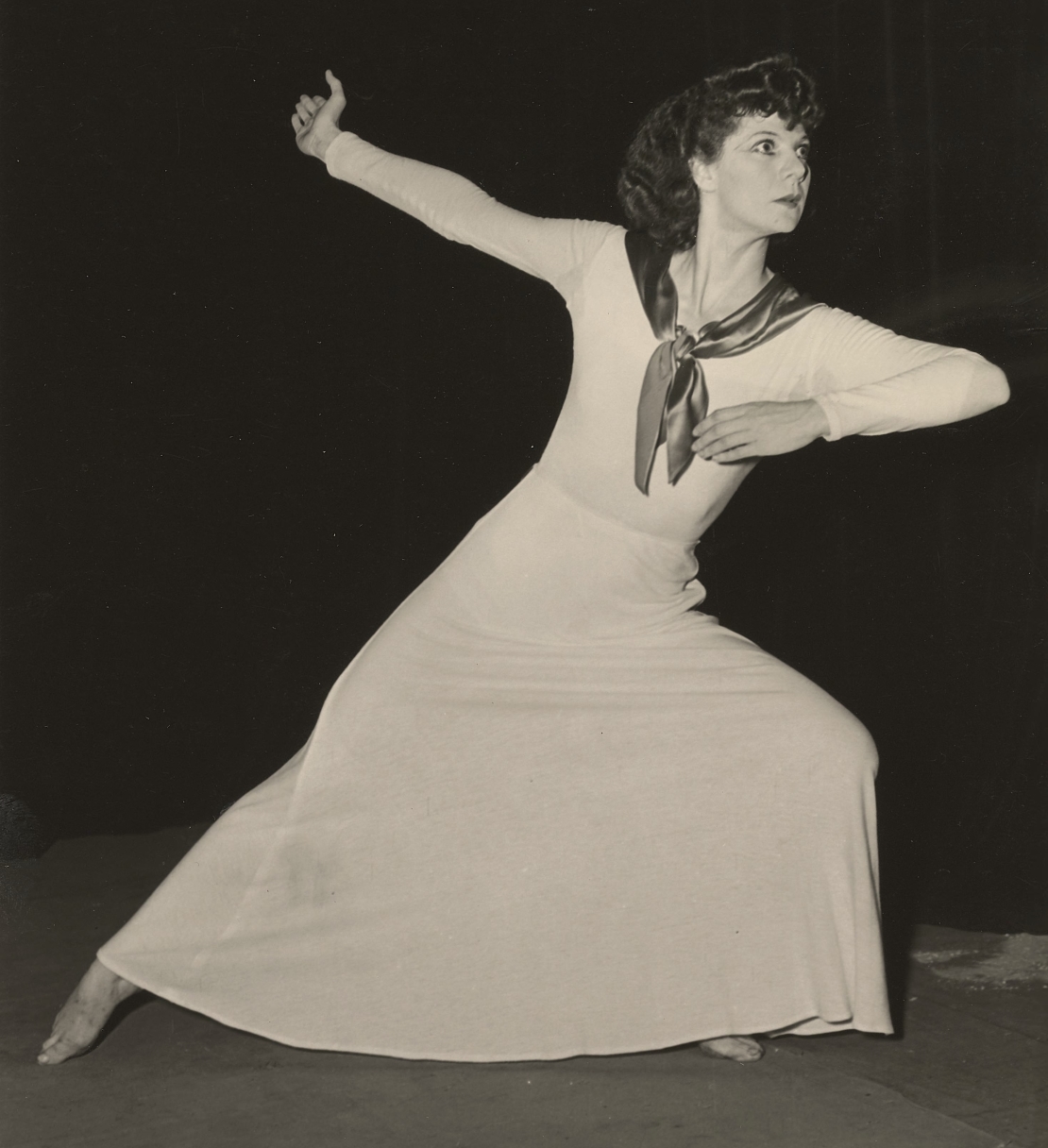
A review of a Helen Tamiris recital. A major figure in 20th century U.S. dance Tamiris was born Helen Becker in the Lower East Side to an artistic, political family of Jewish immigrants; her brother was the legendary radical cartoonist Maurice Becker.
‘Tamiris and Group in Revolutionary Dance Recital’ by Mignon Verne from The Daily Worker. Vol. 12 No. 15. January 16, 1935.
TAMIRIS, assisted by her group, gave her first recital of the season at the Civic Repertory Theatre on Sunday night and showed that she is shedding her bohemianism of an earlier era and continuing to create dances expressing American social life.
Years ago Tamiris commenced to compose revolutionary dances as a contribution to the American Dance. She has the distinction of being the only one of a group of concert dancers who have come to the front in the past five years, and who has progressed by infusing her dances with vital ideas. Her program on Sunday showed that there is nothing mystic, nothing sterile, nothing dead about her content, and this new content has given her work a new strength. Tamiris’ direction of her group is also an achievement and a noteworthy contribution to the revolutionary dance movement.
One of the most effective numbers on the program was “The Mass and the Individual” from “Cycle of Unrest,” presented for the first time. With interesting choreography and convincing gestures, Tamiris satirically depicted a character who superciliously disdains to become part of a proletarian group. This dance was an integrated composition expressing the sterility of individualism.
Another impressive revolutionary group dance was “Conflict.” Here the antagonism was shown between the bourgeoisie—in the persons of three evening-gowned ladies —and three proletarians—in sweaters and skirts. When this vanguard brought forward their forces and a mass of workers appeared on the stage defying the decadent finery and power of the bourgeoisie, the perfumed ladies sat down and rose up in ludicrous fashion only finally to wilt away before the strength and militancy of the masses.
“Well,” said a needle trades worker sitting near me as she applauded this dance enthusiastically, “If it were this way in real life, it wouldn’t be so bad. But the workers feel the struggle more, and the bourgeoisie are not so easy to defeat.”
Aside from this, the grouping was good and the music highly appropriate, with its fugal form of bourgeois waltzing and proletarian marching.
A CONVINCING solo dance by Tamiris was “Hypocrisy,” satirizing the treachery behind piety. There were on other effective dances the program; the audience was most appreciative of those numbers which sought to deal with vital ideas.
It must have been evident to Tamiris’ audience Sunday night that she is slowly but definitely maturing as a revolutionary artist, although she is reluctant to leave behind her some of the inconsequential numbers of previous years. What Tamiris needs in order to become a genuinely effective revolutionary artist is an emotional intensity which can come only from an integrated absorption with the stirring class issues confronting millions today.
Genevieve Pitot ably assisted Tamiris with her own compositions and accompaniment.
The Daily Worker began in 1924 and was published in New York City by the Communist Party US and its predecessor organizations. Among the most long-lasting and important left publications in US history, it had a circulation of 35,000 at its peak. The Daily Worker came from The Ohio Socialist, published by the Left Wing-dominated Socialist Party of Ohio in Cleveland from 1917 to November 1919, when it became became The Toiler, paper of the Communist Labor Party. In December 1921 the above-ground Workers Party of America merged the Toiler with the paper Workers Council to found The Worker, which became The Daily Worker beginning January 13, 1924.
PDF of full issue: https://www.marxists.org/history/usa/pubs/dailyworker/1935/v12-n014-not-15-Nat-jan-16-1935-DW-LOC.pdf
 Revolution's Newsstand