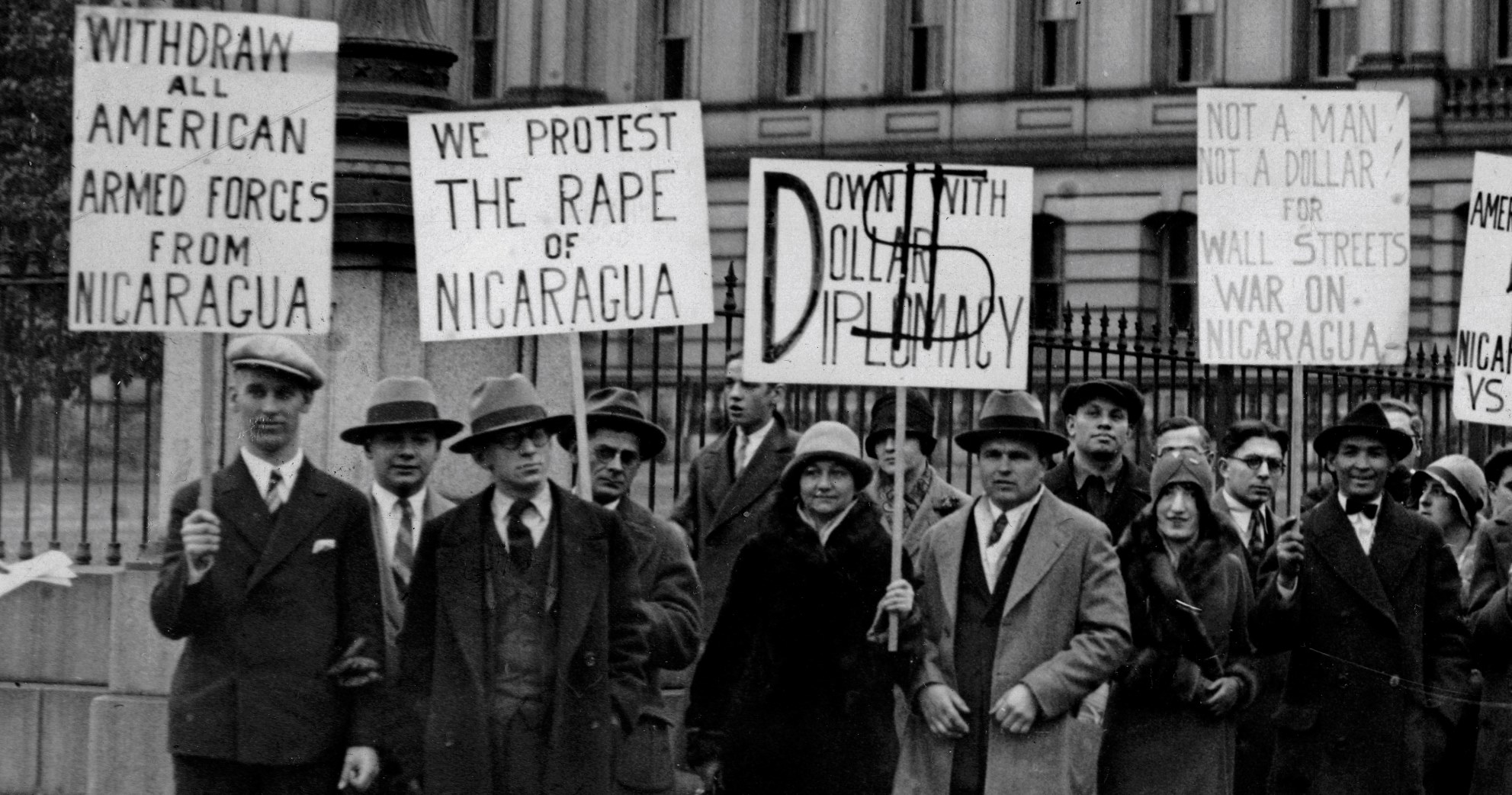
Within days of writing this U.S. marines would formally invade Nicaragua in the interests of those exploiters identified by Engdahl below.
‘Fight the Exploiters at Home By Aiding Fight of Nicaraguan People’ by J. Louis Engdahl from the Daily Worker. Vol. 3 No. 301. January 6, 1927.
PRESIDENT Coolidge claims the United States is maintaining a huge fleet of warships in Nicaraguan waters to “protect American lives and property.” Secretary of State Kellogg supports this claim and gives all possible aid, thru his department, in support of the actual intervention by Rear Admiral Latimer, who has been busy establishing “neutral zones” throughout that harassed Central American republic.
It is perfectly clear, however, that whatever U.S. property exists in Nicaragua is there for the purpose of exploiting the native population and resources. The “American lives” endangered are those of the agents of the exploiters who themselves remain at a safe distance here at home in “the states.”
The Washington government, being the instrument of the profit takers, is organized and maintained to protect the interests of the exploiters. But that is exactly the reason why all American labor should develop its fight against the exploiters at home by opposing the attack of this same class of pillagers of the Nicaraguan people.
Workers and farmers join in combat against the mine owners, railroad barons, bankers at home. They can develop this struggle by joining forces with those combatting these same interests abroad.
It is shown that fruit companies, railway and banking interests constitute the principal connections between the United States robber interests and the Nicaraguan people. It is the same connection that produced the historic strike of textile workers at Passaic, New Jersey, when the police, with poison gas and armored tanks were ordered out, instead of warships and the marines, to do the fighting for the master class.
Robert W. Dunn, in his book “American Foreign Investments,” details American imperialist “interests” in Nicaragua.
He shows that the United Fruit Co. has 171,000 acres of unimproved land with an approximate investment of $170,000 according to its own report.
The Atlantic Fruit Co. has 132,000 acres under cultivation, while the Cuyamel Fruit Co. imports bananas which are grown by the New Orleans and Bluefields Fruit & Transportation Co. (a subsidiary of Cuyamel) the latter company holding in its own name about 150,000 acres of land in Nicaragua.
The Central American Exploitation Co. has a “concession” covering four million acres. The La Luz and Los Angeles Mining Co., owned by Mellon’s friends in Pittsburgh, has been producing since 1901. The Gold Mines Co. has carried on some exploration work. Contracts for the exploration of petroleum lands were signed in 1923 between an American company and a subservient Nicaraguan government, the territory covered being about 200,000 hectares. The Tonopah Mining Co., a large American concern owing a majority of the $1,000,000 stock of the Eden Mining Co., has also carried on construction work in the gold fields. It owns a controlling interest in the Tonopah Nicaragua Co., operating the Santa Rita mines.
The Pacific Railway or National Railway of Nicaragua, in which American bankers formerly shared control, is again nominally in the hands of the government, but under the management of J.G. White & Co., bankers. The fruit companies have short branch lines. New railroad extensions are being contracted for between the “government” and an American corporation, notably the pan-American railway. The Brangmann’s Bluff Lumber Co., in 1923, obtained a concession thru Leroy T. Miles for 20,000 hectares of nationally-owned land. An oil concession was granted Robert J. McKinley of Kansas in 1924. The Central American corporation owns 24,000 acres in lands devoted to banana, sugar cane and pineapple cultivation.
Although the National Bank of Nicaragua, formerly controlled by Brown Bros, & Co., and J. and W. Seligman & Co., was bought back by the Nicaraguan government in 1924, nevertheless, the new directorate includes three “Americans,” Robert F. Loree, president of the Bank of Central and South America; Abram F. Linberg, financial expert, and Jeremiah Jenks.
Dunn then gives a long list of additional American firms reported as operating in Nicaragua, including the following: Cia. Mercantil de Ultramar, the Grecia Mines, San Albino Mines, Casa Commercial and Moravian Mission, Bluefields Tanning Co., Samuel Well & Co/, Astor Mohogany Co. (thru its subsidiary, the Nicaragua Mohogany Co.), I.T. Williams & Sons., Wawa Commercial Co., Friedlander Commission Co., H.F. Springer, A. Fagot & Co., Central American Sawmills, Constancia Gold Mines, Nicaragua Mining Co., and Mengel & Co. As a result over 70 per cent of the foreign trade of the country is conducted with the United States.
Some of these names may sound native to Central America. But that is no doubt camouflage to offset local prejudice. It would be interesting for American workers, victims in this country of mining companies operating in Central America, to tell of conditions under which they are forced to toil in the United States. The metal mining industry at home is nearly 100 per cent unorganized. No more vicious attack against labor has been made in this country than that launched by metal mine owners against the metal mine workers. It is the same breed that invades Nicaragua and calls on the United States government “to protect its property.”
American labor can develop its fights against the exploiters at home by declaring their solidarity with the oppressed people of Nicaragua and the other Central and South American countries.
Nicaragua, though a small country, is a typical victim of American investments abroad that totaled nearly two billions of dollars $1,906,705,101) during the year just closed. These are the figures compiled for 1926 by Dr. Max Winkler, vice president of Moody’s Investors’ Service, who declares that “the export of American capital during the coming year (1927) is not likely to be interrupted.” Dr. Winkler continues: “It would seem that the American dollar is becoming the mainstay of world finance, public and private. Our total investments abroad aggregate at the end of 1926 the impressive total of more than $13,000,000,000, clearly reflecting the steady expansion of American finance and industry into every section of the civilized world.”
It was on July 1, 1925, that the New York Times carried the headline, “See Loans Abroad 12 Billions by 1926.” But the actual figures have surpassed that mark by one billion dollars.
The significant fact revealed by the figures is that the greater part of these foreign investments have gone into Latin-America, that is now flaring into open rebellion against the tyranny imposed by the United States in protection of these investments. Foreign investments at the end of 1926 were distributed as follows:
1926—1925—1913.
Canada–$3,515,000,000–$3,027,000,000–$750,000,000
Europe–3,837,600,000–3,025,000,000–350,000,000
Latin America–4,814,000,000–4,306,000,000–1,300,000,000
Miscellaneous–1,086,000,000–998,000,000–225,000,000
In 13 years American investments in Latin-America have nearly quadrupled while during the past year they have increased by more than half a billion dollars. That is why American warships patrol Nicaraguan waters today. They are immediately rushed everywhere that the American dollar is threatened. Workers and farmers are blind to their own interests if they join in the profit struggle to protect “the lives and property” of American dollars invested abroad.
The Daily Worker began in 1924 and was published in New York City by the Communist Party US and its predecessor organizations. Among the most long-lasting and important left publications in US history, it had a circulation of 35,000 at its peak. The Daily Worker came from The Ohio Socialist, published by the Left Wing-dominated Socialist Party of Ohio in Cleveland from 1917 to November 1919, when it became became The Toiler, paper of the Communist Labor Party. In December 1921 the above-ground Workers Party of America merged the Toiler with the paper Workers Council to found The Worker, which became The Daily Worker beginning January 13, 1924.
PDF of full issue: https://www.marxists.org/history/usa/pubs/dailyworker/1927/1927-ny/v03-n301-NYE-jan-06-1927-DW-LOC.pdf
 Revolution's Newsstand