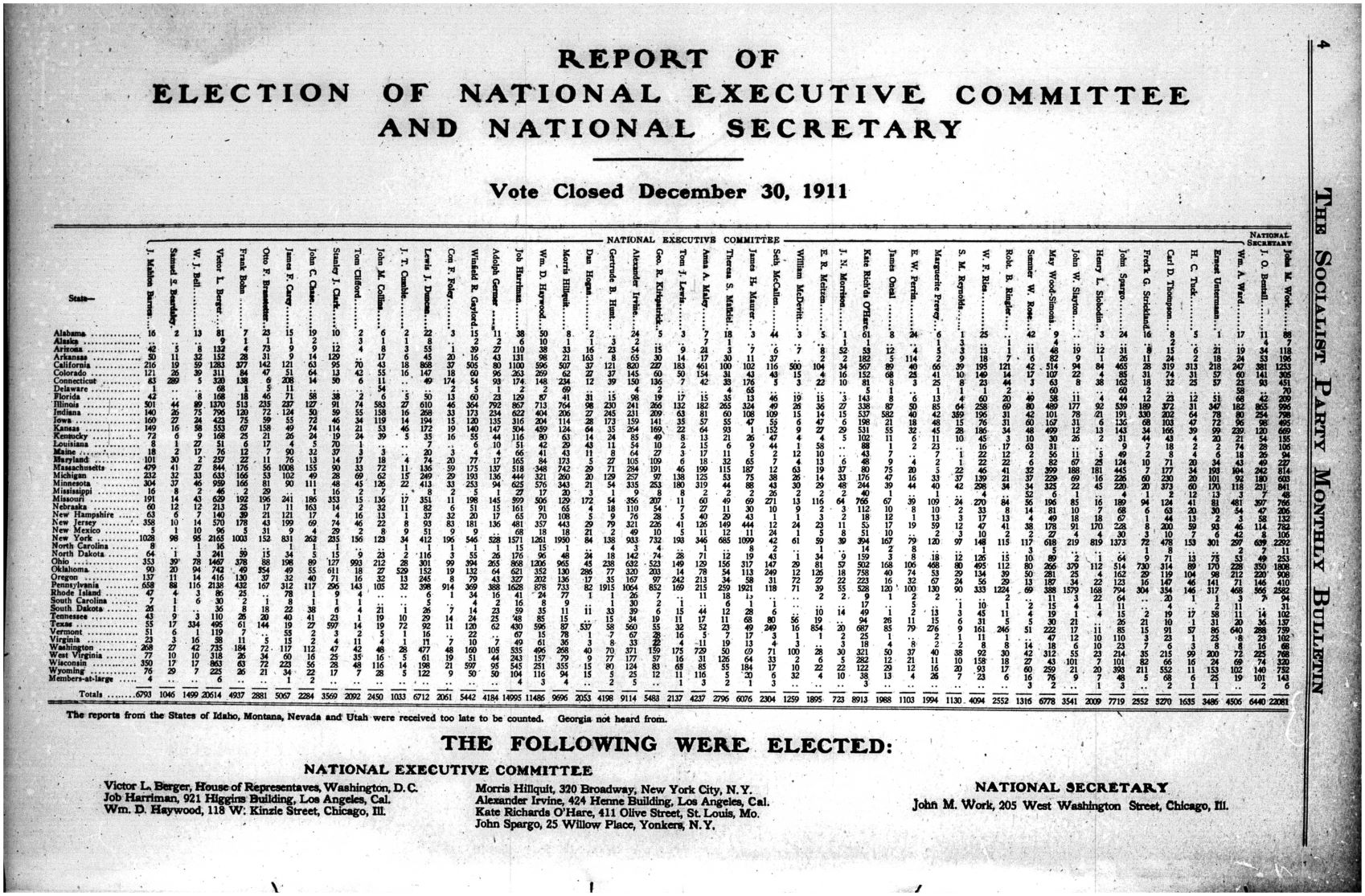
William D. Haywood and Frank Bohn ran for the Socialist Party’s leading National Executive in December, 1911 as part of an organized left-wing campaign. Haywood was elected with 11,486 voted while Bohn received 4937. Other leftists candidates also ran, but none came near Haywood’s numbers, which were below grandees Berger, Harriman, and Work, but well above his chief antagonists Hillquit and Spargo. Below are Bohn and Haywood’s statements to the membership on their candidacies.
‘Haywood and Bohn Candidates for N.E.C.’ from Revolt (San Francisco). Vol. 2 No. 21. November 18, 1911.
To the Members of the Socialist Party:
Comrades:
The membership of the Socialist Party may at this time rightfully expect a statement from those who have accepted nominations for the National Executive Committee.
In my opinion a great many of the difficulties which of late have aroused turmoil within the party organization have been due to an error in administration. It was undoubtedly the intention of the party membership that the National Committee and not the National Executive Committee should be primarily responsible for the administration of the National Office. But the National Committee has not met and hence during years of inactivity has almost ceased to function. Therefore the National Executive Committee, undoubtedly acting from a sense of duty, has to a large extent taken upon itself the duties which the party membership intended that the National Committee should perform. If the National Committee will meet once, and perhaps twice, a year it will do away with the necessity of biennial party congresses and the National Executive Committee can then be left to fulfill its purely executive functions.
In so far as the National Executive Committee directs the national propaganda and organization work, it should be guided by certain fundamental principles.
During the coming year we shall witness the almost complete break-down of the Democratic and Republican party organizations. Already hopelessly divided, the organizations of the two capitalist parties will undoubtedly further disintegrate. There will be formed either from within or without these parties a new radical party which will voice the interests of the decadent middle class on the political field. The Socialist Party must not in the least degree compete with any such middle class party or faction for votes or power. Its present mission is one chiefly of propaganda and education. It should present to the working class the revolutionary principles of solidarity, class action and the abolition of the private property system. Of course, it is impossible to confine these great principles to the narrow range of political action. The Socialist Party should advocate industrial as well as political solidarity. Wherever in municipalities and states, power comes to it, that power should ever be subordinated to its great primary purpose. That purpose is the preparation of the working class for the social revolution.
Even more dangerous than co-operation with the reform political movements of the middle class are the efforts, which we constantly see repeated, of allying the Socialist Party with, cliques of trade union politicians. The splendid success of the Socialist Party has been due to its independent position, its clear view and its sound policies. The worst kind of a defeat which could befall our party would be a spurious victory obtained through an alliance with another organization of any kind whatever.
FRANK BOHN.
To the Members of the Socialist Party:
Comrades:
Having accepted the nomination for membership on the National Executive Committee I feel it my duty to state to the membership of the party my position with reference to the functions of the Committee.
Conforming always to the provisions of the Socialist Party Constitution, the N.E.C. should not assume to be an Appellate or Supreme Court of the party relative to matters of a local or personal nature.
It is always my view that the powers of party management should not be centralized in the hands of the National Executive Committee. The N.E.C. is an executive committee. As a member of that body I would oppose its assumption of all legislative as well as judicial functions. These powers must rest with the membership of the party.
The N.E.C. should act as a Bureau to collect information which would be useful in the propaganda and educational work of the party.
As a candidate I do not wish to be elected under a misapprehension. The Socialist Party in conventions has proclaimed a neutral position as regards the labor movement. It is well known. that this neutrality is not observed. There are members vigorous in their effort to co-operate with the decadent craft unions. The Socialist Party being a working class organization, it is my belief that our purpose will never be fully achieved until we carry to the working class the message of industrial unionism which means that the productive workers shall be organized as the capitalists have assembled them in the industries. Therefore, the work directed by the National Committee and its executive committee should include the education of the working class to the end of industrial as well as political solidarity.
WILLIAM D. HAYWOOD.
Revolt ‘The Voice Of The Militant Worker’ was a short-lived revolutionary weekly newspaper published by Left Wingers in the Socialist Party in 1911 and 1912 and closely associated with Tom Mooney. The legendary activists and political prisoner Thomas J. Mooney had recently left the I.W.W. and settled in the Bay. He would join with the SP Left in the Bay Area, like Austin Lewis, William McDevitt, Nathan Greist, and Cloudseley Johns to produce The Revolt. The paper ran around 1500 copies weekly, but financial problems ended its run after one year. Mooney was also embroiled in constant legal battles for his role in the Pacific Gas and Electric Strike of the time. The paper epitomizes the revolutionary Left of the SP before World War One with its mix of Marxist orthodoxy, industrial unionism, and counter-cultural attitude. To that it adds some of the best writers in the movement; it deserved a much longer run.
PDF of full issue: https://www.marxists.org/history/usa/pubs/revolt/v2n21-w30-nov-18-1911-Revolt.pdf
 Revolution's Newsstand