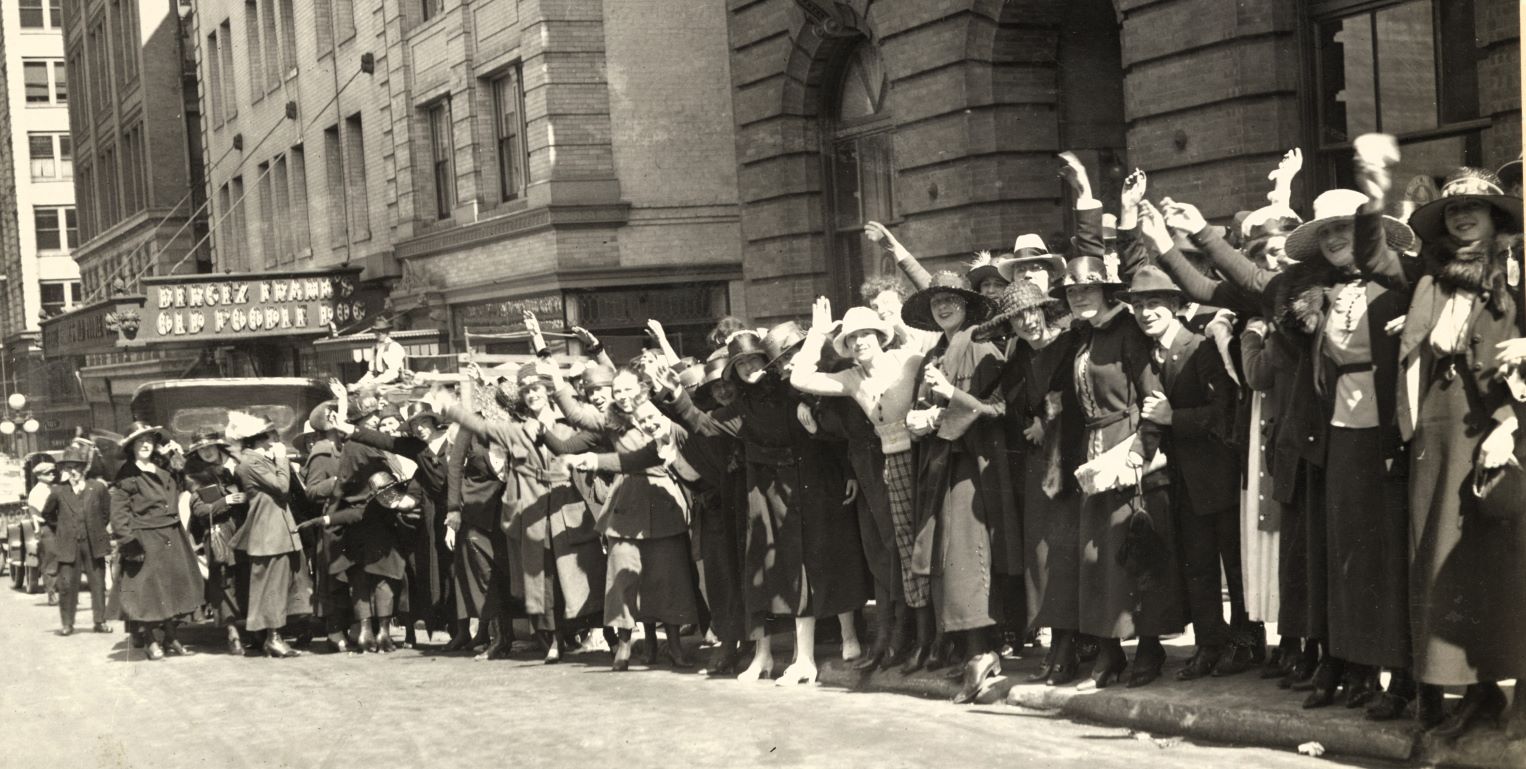
Despite enormous technological changes since; the plight of a call center worker has not changed in over one hundred years. A report on the ‘hello girls’ of San Francisco.
‘A Close-up of The Frisco Telephone Exchange’ by Mercedes Mercier from The Toiler. No. 142. October 23, 1920.
Flash, flash, flash! Quickly I plug-in. “Asleep at the switch again, Central”, booms the angry subscriber in my ear, “Gimme 875 Main, and make it snappy for a change!” I hasten to give him his number. Flash, flash, flash, flash! Twelve more lights appear on my board. I rush to plug-in one, and others take its place!
“Miss Mercier, a little more pep there,” yells the supervisor (oh, god, how I hate that woman’s voice!), always at my back, always urging me to be quicker, quicker, and still quicker!
Such is the life of a hello-girl! She first starts in at a school, where she is trained in the operation of a switch board, and to learn parrot-like (mechanically if you prefer) the fixed sentences that you hear her greet you with whenever you have an occasion to use the telephone. This takes about two weeks to a month, according to the aping ability of the slave-girl, as I insist she never has to use her head, but to follow directions which she has learned mechanically! Next she is taken to the exchange to “listen-in” and to practically learn the ropes, so to speak, and to wear off nervousness.
The “Regular Operators”
Then she graduates proudly to the position of a “regular operator.” (Time was when there were “regular operators” and “substitutes”, but that time has past, but the former name still lingers and retains that “superior” sound.) An operator must sit at the edge of her chair and there plug-in, plug-out, and listen, plug-in, plug-out, and L-I-S-T-E-N all day long!
How monotonous! How nerve wracking! How boresome! Coupled within this continuous strain, they have the watchful eye of the supervisor on them all day, reproving them for this and that, nagging at them to speed-up, and continually listening-in to hear if the slaves parrot their sentences correctly, if not they lose demerits and a chance for advancement, to where, I know not! Maybe they will have a chance to marry the president’s weak chinned son, as per the movies, who knows?
The life of a telephone operator at her trade is not long. Her nerves soon give out and she must go! A common sight is to see girls fainting at their work. and also seeing them crying hysterically in their reliefs. Only a strong girl can stand the grind, then only to her sorrow.
A Strike That Failed
A steady flow of girls come and go. A standing ad is in the Oakland and San Francisco papers asking for help, but there are few takers, as the slaves can find more lucrative wages, and easier work elsewhere and as a result the telephone company is always short handed.
A year ago the girls struck for higher wages and better working conditions. Male and female workers were out a 100% strong, but they lost and went back to worse conditions, thanks to the A.F. of L. and craft unionism.
If the girls want to get better conditions on the job and to better their wages of $16.50-20.00 dollars per week they will have to organize as a CLASS in a ONE BIG UNION OF WORKERS, and then to show a little mass solidarity in their fight against their masters as a class. Then and only then can we, the telephone girls and the rest of our fellow wage slaves get what we want, less work, more leisure, food and clothing and still better life, life, and still more life that is free!
The Toiler was a significant regional, later national, newspaper of the early Communist movement published weekly between 1919 and 1921. It grew out of the Socialist Party’s ‘The Ohio Socialist’, leading paper of the Party’s left wing and northern Ohio’s militant IWW base and became the national voice of the forces that would become The Communist Labor Party. The Toiler was first published in Cleveland, Ohio, its volume number continuing on from The Ohio Socialist, in the fall of 1919 as the paper of the Communist Labor Party of Ohio. The Toiler moved to New York City in early 1920 and with its union focus served as the labor paper of the CLP and the legal Workers Party of America. Editors included Elmer Allison and James P Cannon. The original English language and/or US publication of key texts of the international revolutionary movement are prominent features of the Toiler. In January 1922, The Toiler merged with The Workers Council to form The Worker, becoming the Communist Party’s main paper continuing as The Daily Worker in January, 1924.
PDF of full issue: https://www.marxists.org/history/usa/pubs/thetoiler/142-oct-23-1920-Toiler-LOC.pdf
 Revolution's Newsstand