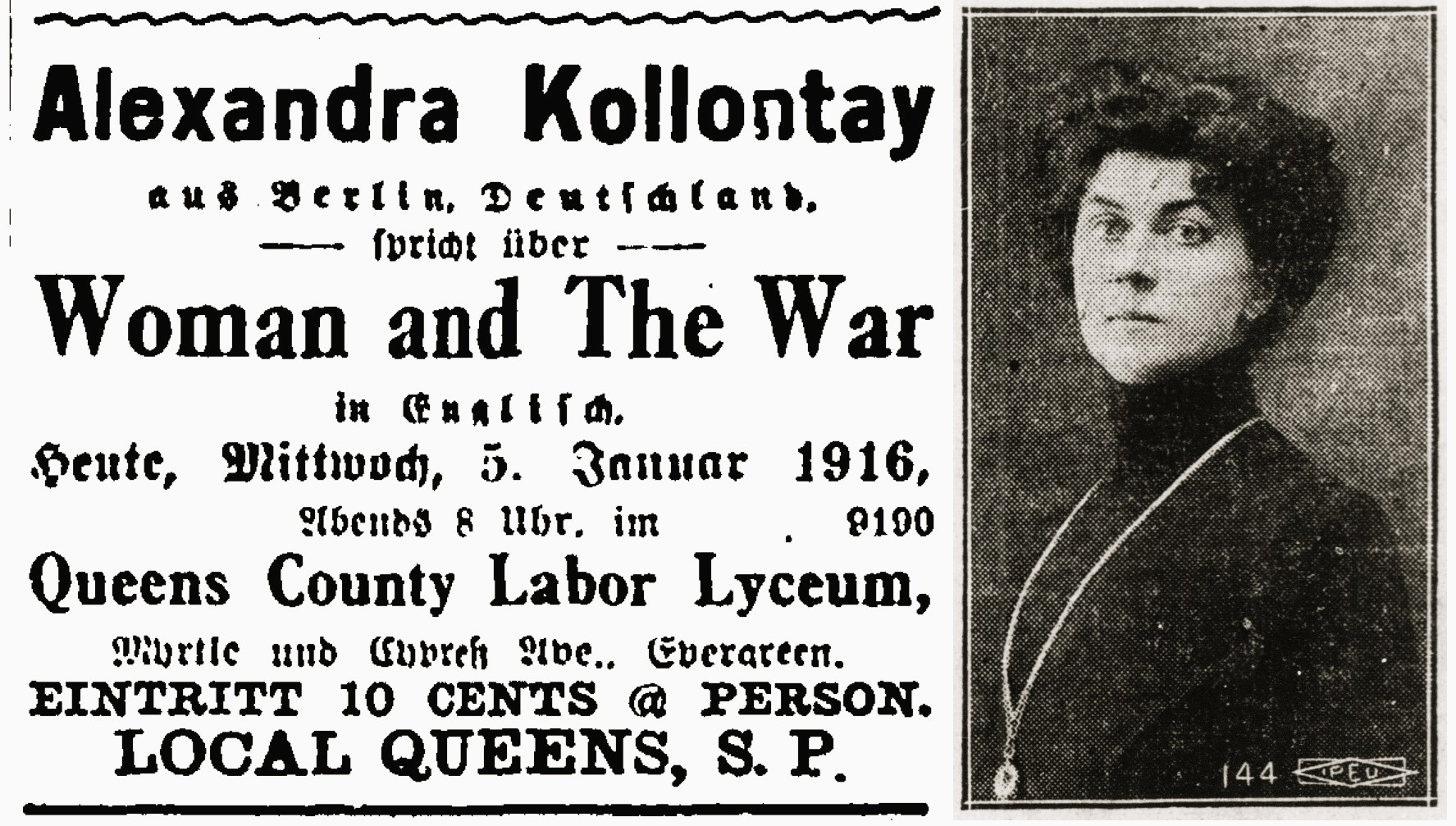
Alexandra Kollontai was in the United States twice for two extended stays, one a country-wide tour. Invited by Ludwig Lore and the German Socialist Federation of the Socialist Party of America to come to speak against the war, and with her own agenda working with Lenin and European internationalists, she arrived in September, 1915. For three and a half months, until early 1916, she toured the country from coast to coast. In late 1916, she returned to New York indefinitely to renew contacts and act as Bolshevik envoy, but also to be near her son Misha, living in Patterson, New Jersey. In addition, her former partner Alexander Shliapnikov was living in New York, with Nikolai Bukharin and Trotsky soon to arrive. All would unite in the ‘New International’ project in January, 1917 and return to Russia with the fall of the Tsar in March, 1917. Here an interview from the start of her tour with William M. Feigenbaum.
‘Mme. Kollontay Brings Socialists’ Message from War-Mad Europe to U.S.’ from The Milwaukee Leader. Vol. 4 No. 266. October 16, 1915.
Mme. Kollontay, Linguist, Traveler, True Internationalist, Declares Great War Alone Stopped Russian Revolt That Would Have Overthrown Power of Czar—Awaited Word From Germany.
Alexandra Kollontay, who will speak in Freie Gemeinde hall Sunday afternoon and night, is described as a remarkable linguist and international revolutionist in an interview by William M. Feigenbaum in The New York Call.
“Mme. Kollontay is the kind of a person that Europe sends to us occasionally as an ambassador of love, a real internationalist,” says The Call.
“She is at home in the German language, as she is at home with German Socialists.
“She is perfect in French because the French Socialists are as much to her as her native Russians. English comes to her with ease. Italian, the Scandinavian tongues, and possibly whatever else there is in Europe, is hers, as are the people who speak those languages her brothers and sisters in the revolution.
“Mme. Kollontay is the mother, I have been told, of a son of 26. But she looks scarcely 35. I had heard much of her beauty. I found that there are no words to do justice to that radiant face, to those wonderful eyes, to a serenity, a beauty of poise that hers is.
“She is a Russian, reputed a child of the nobility. But for the better part of her life she has been identified with the internationalist Socialist movement, and to assign her a country would be as futile as to assign one to Rosa Luxemburg or to Karl Marx.
“She has lived in Germany for many years, and, I believe, holds her party membership there. But she has lived in Italy, in Finland, in England, in Denmark and on the Scandinavian peninsula. She is thoroughly familiar with conditions in all those countries.
ASKS ABOUT WAR.
“She asked us if we, in America, were obsessed with the war. In Europe, she said, there is nothing else of Interest. Berlin makes believe to carry on ordinary business; the theaters are open and the ordinary forms of life obtain.
“But the people are sad. There is much black seen on the streets. As for the mass of the people outside of the capital, they are tired of the war, and are fervently hoping for its speedy termination.
“Paris is dead. It is as if a pall had fallen over the city. The old life and gayety are as if they had never been. London is shivering in its boots, and Moscow is also affected.
“Only Petrograd has not yet been affected by the clammy hand of death. There, life and gayety go on as if nothing had happened. Because, she said, Hindenburg is not yet near.
SOCIALISTS ARE FREED.
“Mme. Kollontay was in Berlin when the war broke out. The first day all Russians in the German capital were arrested. But the second day all Russian Socialists were released. That is a peculiar byproduct of the war.
“The kaiser had always been the best defender of Russian autocracy, even using his troops to assist his cousin, the czar, in putting down the revolt in 1915. But today the kaiser is a Russian Socialist, and the czar is a German Socialist.
“The utterance of Rusa Luxemburg who is a bitter enemy of the German government, is widely circulated by the Russian government.
“The Russian government is eager to see the overthrow of kaiserism in Germany. Karl Liebknecht is now a hero to Nicholas.
“And the Russian Socialists, who never bent the knee, who have fought against the war from the first, are the pets of Wilhelm. He is sighing for the time that the people will arise and establish a republic in Russia.
WHEN WAR BROKE.
“To the kaiser a Russian is a person worthy of death; a Socialist is a homeless animal. But a combination of the two is a hero, a darling and somebody to be coddled. That is why Russian Socialists were made much of, in addition to being promptly released, at the outbreak of the war.
“From Germany Madame Kollontay went to Russia; from Russia to Sweden, whence she was expelled to Denmark. In Russia she learned the state of affairs in the last week of July, 1914.
“There was a real general strike. Seventy thousand workers were building barricades in St. Petersburg. The time of the workers had come. In Moscow there were tens of thousands more. There was but one thing lacking, the guns.
“Then came the war clouds, and guns were put in their hands by their government. They were ready to strike. They were eager to be led. They waited one word, the word from the German Socialists. The moment that word came that the Germans were ready to strike, too, the end of the Russian government would have come.
FATAL DAY ARRIVES.
“Then came Aug. 4, the day of the meeting of the reichstag. That day thousands of telegrams were given out by the government, free, on the streets of Moscow, that the German Socialists had stood by their government.
“It was all off; the revolution was not to come. Madame Kollontay spoke of the sadness that came over the Russians when they realized that that message was not a government bluff, but the truth.
“On the other hand, the situation in Germany was different. The rank and file of the Social-Democracy expected that the 111 Socialist members of the reichstag would vote against the war credits.
“But when the credits were voted the decision was accepted as a declaration of war against Russian barbarism.
“Madame Kollontay told me of a Socialist clad in his uniform who came to her with tears in his eyes Aug. 6, 1914, telling her with what rapture he was going out to die for the freedom of the Russian people.
“She said that the feeling that the war was a people’s war against Russian autocracy was widespread; that the masses felt that they were delivering the Russian Socialists from slavery. That is the only reason that they supported the government instead of striking at it.”
The Social Democratic Herald began as the Social Democrat. The Social Democrat was the paper of Eugene Debs’ pioneering industrial union, the American Railway Union. Begun in 1894 as the Railway Times, in July of 1897 it was renamed The Social Democrat and served as the paper of the Chicago based Social Democratic Party. First published in Terre Haute and then Chicago, the paper was produced weekly. After a split with Utopians who retained the paper, Debs’ published The Social Democratic Herald. When they joined with the Springfield, Massachusetts based Social Democratic Party in 1901, the Socialist Party was born. Victor Berger took over the paper in 1901 and moved it Milwaukee where it ran until 1913. It was supplanted by the Milwaukee Leader, also edited by Berger. The Herald, and later the Leader, is most important historically for the weekly coverage of Milwaukee’s city Socialist government, by far the most successful electoral socialist experience in US history. Emil Seidel was elected as mayor in1910, the first (only?) city in the US of any size to do so and became Eugene Debs’ running mate in 1912. Victor Berger, historic leader of the SP’s right wing, became the first socialist to be elected to the U.S. House of Representatives, also in 1910. Daniel Hoan was elected the second socialist mayor in 1916, and reelected each term until 1940. Frank P. Zeidler, was elected the city’s third socialist mayor in 1948, serving three terms before retiring in 1960.
PDF of issue: https://chroniclingamerica.loc.gov/lccn/sn83045293/1915-10-16/ed-1/seq-1/
 Revolution's Newsstand
They sowed wind and reaped a hurricane
LikeLike