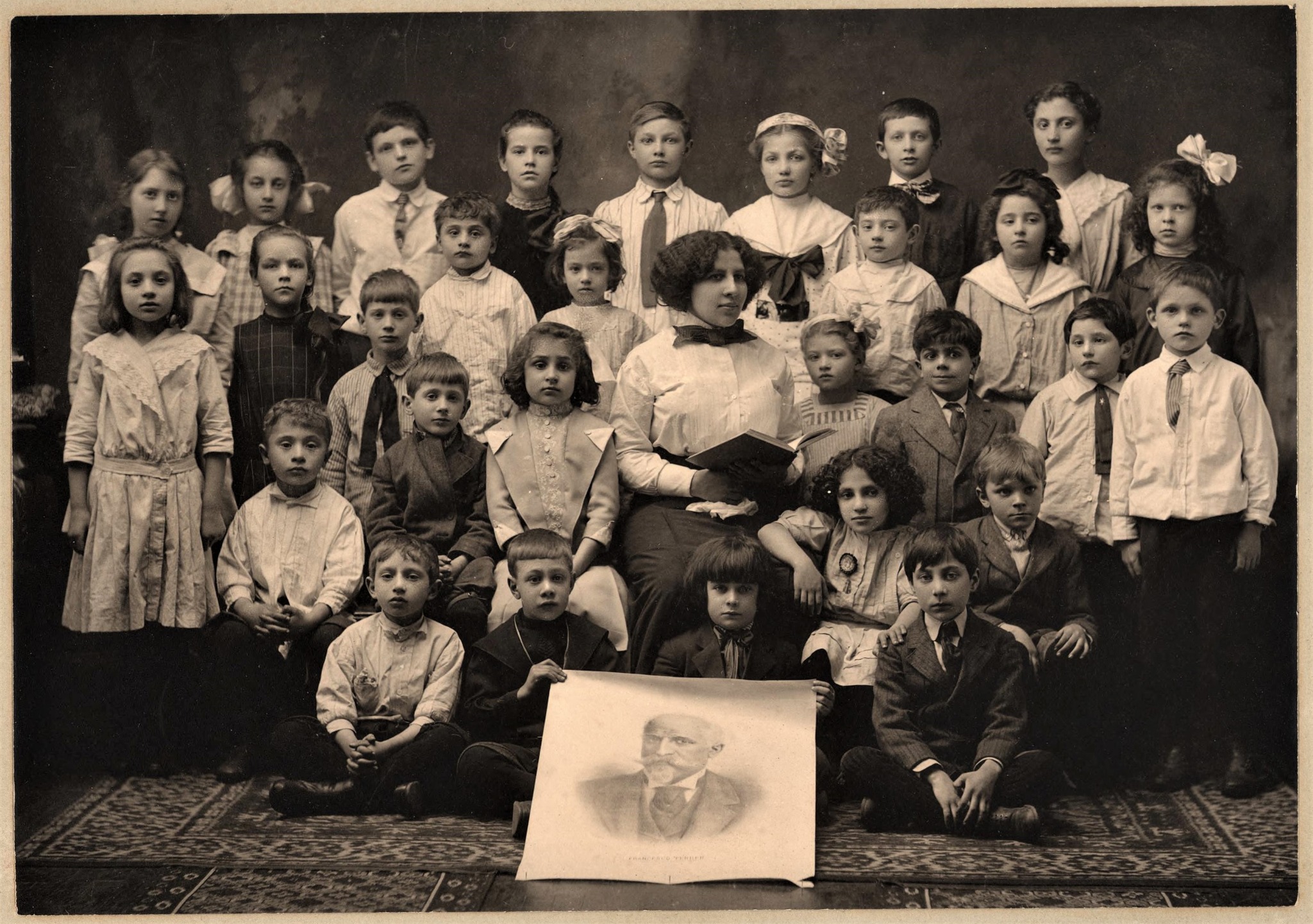
The ‘Modern School’ inspired by the martyred Spanish educator Francisco Ferrer became an institution for anarchist-leaning radical communities in the 1910s.
‘Francisco Ferrer and His Modern Schools’ by William Heaford from St. Louis Labor. Vol. 6 No. 455. October 23, 1909.
From The Progressive Journal of Education.
Prof. Ferrer was first arrested by the Spanish government in 1906, which claimed that in some mysterious way he might possibly have been connected with the bomb outrages of that year. The government also attempted to suppress all educational movements of a liberal nature in Spain, even going so far as to seize moneys intended for the treasury of the modern school of Barcelona, which Ferrer founded in 1901.
Heaford Tells of Ferrer.
Under the title of “The New Movement in Spain,” William Heaford, writing in the Progressive Journal of Education last January, told of Ferrer’s first arrest and of general educational conditions in Spain as follows:
“Ferrer was in prison thirteen months and the government showed no intention of letting him go. He was there without having had any opportunity to make a defense. He was charged with no crime except that of trying to educate the Spanish people along modern lines, and there has never been any formal statement of a charge against him.
“Finally, after thirteen months of absolutely illegal imprisonment, the government was forced by pressure from the outside to bring his case to trial, and the prosecution went to pieces so badly that Ferrer was released. And so strong were the liberal influences growing out of the schools which Ferrer had founded in Spain that the costs of the trial were forced upon the clerical government.
“It was quite evident that Ferrer, who had been the giant of the new educational movement in Spain, was destined from the beginning to a drumhead, court martial and death. It was only the force of public opinion, created in large measure by the modern schools which he had founded, that saved him from that fate.
“The campaign which resulted in his freedom was started by La Libre Pensee, a Parisian journal, but it was immediately taken up by all the liberal and radical papers of Europe, and a storm of indignation gathered above the Spanish authorities. A number of imposing manifestations were made, reflecting the horror of Europe at the contemplated crime of the clericals. In Italy Lombroso, Sergi. Odin and Buen, all noted scientists, protested against the incarceration of the great Spanish teacher. Such politicians as Rochefort, Vandervelde, the Belgian Socialist, Naquet and others roused the people. And a delegation from the universities of Europe was sent to the Spanish government with a message in behalf of the great scholar.
His Message From Prison.
“Even from the prison of Modelo Ferrer continued his writings and continued to send messages to the outside world. In a humorous vein he wrote at one time: ‘All the world knows that I will be acquitted except the chief justice, Beccera del Toro. It is laughable. Think of such a question as this, “Who will be the victor, the truth or Becerra del Toro and his Jesuits?”!
“In the world of darkness, of ignorance, which the clericals and Jesuits are fighting to maintain in Spain, Ferrer is a great and shining light. His introduction of the Modern School and modern methods into Spanish education has made him one of the greatest fighting educators of his time. It is for this reason that the clericals hate him; they know that he is a light which must at all costs be extinguished. But that extinction has not yet come.
“The condition of things which Ferrer tried to remedy, and this condition was horrible; by the founding of sanitary central schools, with provision for recreation, is set forth in La Espagnola.
Schools Foster Ignorance.
“This journal shows the dreadful condition under which the schools of Spain found themselves under the clerical regime. It appears that there were in Spain during the month of July, 1907, 24,000 government schools, all of which were in a shocking condition, without light or ventilation–the abodes of death, ignorance and poor education.
“Each year there are fifty thousand children who die of maladies contracted in these schools. Two hundred and fifty thousand come out of these schools broken in health. Besides this there are 480,000 children running the streets without any instruction whatever, given up to habits which make for their mental and moral deterioration. Thirty thousand blind children, 37,000 deaf-mutes, 67,000 children afflicted with mental disorders, and 45,000 delinquents are absolutely without any provision of any kind for their care or maintenance.
“Add to this that the instructors are so ill paid that they often have to eke out their meager salaries–by outside work, and the fact that there are in Spain ten million illiterates and 50,000 conscripts who enter the army every year unable to read and write, and you have the picture of what clericalism has done for the schools of Spain. There are only sixty institutes and ten universities in the whole country, and, as in the case of the common schools, the hygienic conditions of these schools is simply frightful. The contemplation of this sordid condition of education in Spain fixed the purpose of Ferrer to found the Modern School, an example to a government at once negligent, ignorant and superstitious.
School Is Founded in 1901.
“The Modern School was founded in Barcelona in 1901. It at once absorbed or reorganized a number of other schools throughout Catalonia and in other parts of Spain. So thoroughly was this work done that in the fourth year of its existence forty schools had copied its methods and manuals. At this same time its influence began to make itself felt in other countries. For example, at San Paulo, in Brazil, at Lausane, in Switzerland, and at Amsterdam the books published by Ferrer were adopted by the schools which had been founded in these cities on the principles of the Modern School.
“When the troubles of 1906 broke out there were about fifty such schools. At the end of the government persecutions a dozen were suppressed, chiefly the weaker schools; but new institutions and stronger ones sprang up everywhere. One of the most remarkable of these was the school known as La Nueva Humanidad at Valencia, which was founded while Ferrer was in prison, thanks to the enthusiastic efforts of Dr. Samuel Torner. This school, which counted 150 members last December and forty candidates for admission, is provided with all that is most modern in the way of hygienic and educational facilities.
A Rational Education.
“The system of co-education of the sexes is a thorn in the side of the authorities. Writing from his prison on this subject Ferrer said: “We will have real men and women when we give the children a rational and scientific education, not before. It is a pleasure to watch the boys, and girls grow up in a spirit of comraderie, with feelings of respect and friendship for each other. This has always been to me a touching spectacle. My whole aim has been to produce an education which should base society on affection and fraternity. To this end the most cordial relations have always existed in my schools between the master and the pupil. The master must be more than a personal instructor. He must be a personal friend.” At Valencia, as elsewhere, the parents participate in the benefits from the Modern School; for example, on Sunday the lectures on health and hygiene are open to the parents of the pupils. “The Nueva Humanidad” school at Valencia publishes a paper which has a circulation of 3,000 and which is spreading the idea of modern education in Spain.
One Hundred and Fifty Schools Established.
At the present time there are about 150 modern schools in Spain, and the ten schools in Barcelona alone have more than a thousand pupils. The libraries in the schools are spreading the modern idea far and wide. ‘La Castilla,’ one of the books published by the Modern Schools, has run through three editions of ten thousand copies each, which for Spain is a most remarkable thing.
“The Rational Press Association of England is assisting the Modern School in the publication of the various works bearing on the new idea.
“Beaten in the attempt to suppress the rationalist schools in Spain the government, headed by Maura, and forgetting the fate of France, under the cover of a new law, directed ostensibly against terrorism, is attempting to destroy the intellectual and liberal movement in Spain. Several explosions of bombs have taken place in Barcelona, and under pretext of guarding the public safety the government has delegated exceptional powers to the local authorities. The right to trial has been abolished and the attempt is made to put Catalonia again under the heel of the clericals.
Outrages Work of Clericals.
“There is almost certain proof that the bomb outrages were the work of thugs in the employ of the clericals. An Englishman who was present at the time of certain of the outrages has even gone so far as to print an article entitled ‘Clericalism and Crime in Barcelona.’
“It is not without the bounds of possibility that these criminal clericals will yet succeed in persuading the government to suppress all modern schools in Spain, throwing the blame of their own acts upon the rationalists.
“To fight the movement a society known as the International League for Rational Education has been founded, with Ferrer for president and Prof. Haeckel for one of the vice-presidents. The league numbers among its members such well-known men as Prof. Sergi and Alfred Naquet, the great rationalist.
“The Modern School and its founder have every faith in the rationalist principle in education and in the value of the co-education of the sexes, and they look to the freer nations of the world for help in the struggle against the benighting influence of clericalism.”
A long-running socialist paper begun in 1901 as the Missouri Socialist published by the Labor Publishing Company, this was the paper of the Social Democratic Party of St. Louis and the region’s labor movement. The paper became St. Louis Labor, and the official record of the St. Louis Socialist Party, then simply Labor, running until 1925. The SP in St. Louis was particularly strong, with the socialist and working class radical tradition in the city dating to before the Civil War. The paper holds a wealth of information on the St Louis workers movement, particularly its German working class.
PDF of full issue: https://www.marxists.org/history/usa/pubs/missouri-socialist/091023-stlouislabor-v06w455.pdf
 Revolution's Newsstand