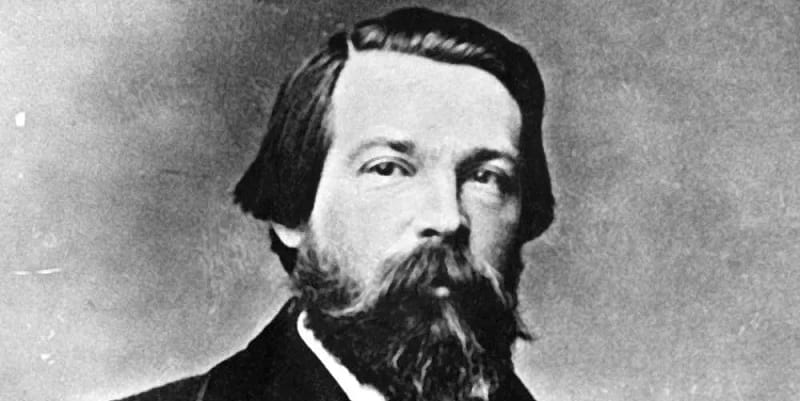
What we now know as ‘The Dialectics of Nature’ are mostly rough notes of an unfinished work published after Engels’ death. He began his formal investigation of the natural sciences while writing Anti-Durhing. Here, Engels wakes to an epiphany and immediately writes Marx to ask if there’s anything to it. In the margins of the letter were written a few notes by Carl Schorlemmer, their chemist comrade.
‘Dialectical Ideas’ (1873) by Frederick Engels from Karl Marx and Friedrich Engels, Selected Correspondence, 1846-1895. International Publishers, New York. 1936.
May 30, 1873.
In bed this morning the following dialectical ideas on the natural sciences came into my head:
The subject of natural science-moving matter, bodies. Bodies cannot be separated from motion, their forms and kinds can only be known through motion, of bodies apart from motion, apart from any relation to other bodies, nothing can be asserted. Only in motion does a body reveal what it is. Natural science therefore knows bodies by considering them in their relation to one another, in motion. The knowledge of the different forms of motion is the knowledge of bodies. The investigation of these different forms of motion is therefore the chief subject of natural science.1
(1) The simplest form of motion is change of place (in time–to please old Hegel)–mechanical motion.
(a) There is no such thing as the movement of a single body, but relatively speaking, falling can be treated as such. Motion towards a centre common to many bodies. But as soon as an individual body moves in a direction other than towards the centre, while it is still subject to the laws of falling, these undergo modification.2
(b) in the laws of orbits and lead directly to the reciprocal motion of several bodies–planetary etc., motion, astronomy, equilibrium–a modification temporarily or apparently in the motion itself. But the real result of this kind of motion is always ultimately–the contact of the moving bodies, they fall into one another.
(c) Mechanics of contact–bodies in contact, ordinary mechanics, levers, inclined planes, etc. But the effects of contact are not exhausted by these. Contact is directly manifested in two forms friction and impact. Both have the property that at given degrees of intensity and under certain conditions they produce new, no longer merely mechanical effects: heat, light, electricity, magnetism.
(2) Physics proper, the science of these forms of movement, after investigation of each individuality, establishes the fact that under certain conditions they pass into one another, and ultimately discovers that all of them–at a given degree of intensity which varies according to the different bodies set in motion–produce effects which transcend physics, changes in the internal structure of bodies–chemical effects.
(3) Chemistry. For the investigation of the previous forms of movement it was more or less indifferent whether this was applied to animate or inanimate bodies. The inanimate bodies even displayed the phenomena in their greatest purity. Chemistry, on the other hand, can only distinguish the chemical nature of the most important bodies in substances which have arisen out of the process of life itself; its chief task becomes more and more to prepare these substances artificially. It forms the transition to the organic sciences, but the dialectical transition can only be accomplished when chemistry has either made the real transition or is on the point of doing so.3
(4) Organism. Here I will not embark on any dialectic for the time being.4
You being seated there at the centre of the natural sciences will be in the best position to judge if there is anything in it.
NOTES
1. In the margin beside this paragraph Carl Schorlemmer wrote: “Very good; my own view. C.S.”
2. Marginal note by Carl Schorlemmer: “Quite true.”
3. Marginal note by Carl Schorlemmer: “That’s the point.”
4. Marginal note by Carl Schorlemmer: “Neither will I.”
International Publishers was formed in 1923 for the purpose of translating and disseminating international Marxist texts and headed by Alexander Trachtenberg. It quickly outgrew that mission to be the main book publisher, while Workers Library continued to be the pamphlet publisher of the Communist Party.
PDF of later edition of book: https://archive.org/download/in.ernet.dli.2015.227457/2015.227457.Selected-Correspondence.pdf
 Revolution's Newsstand