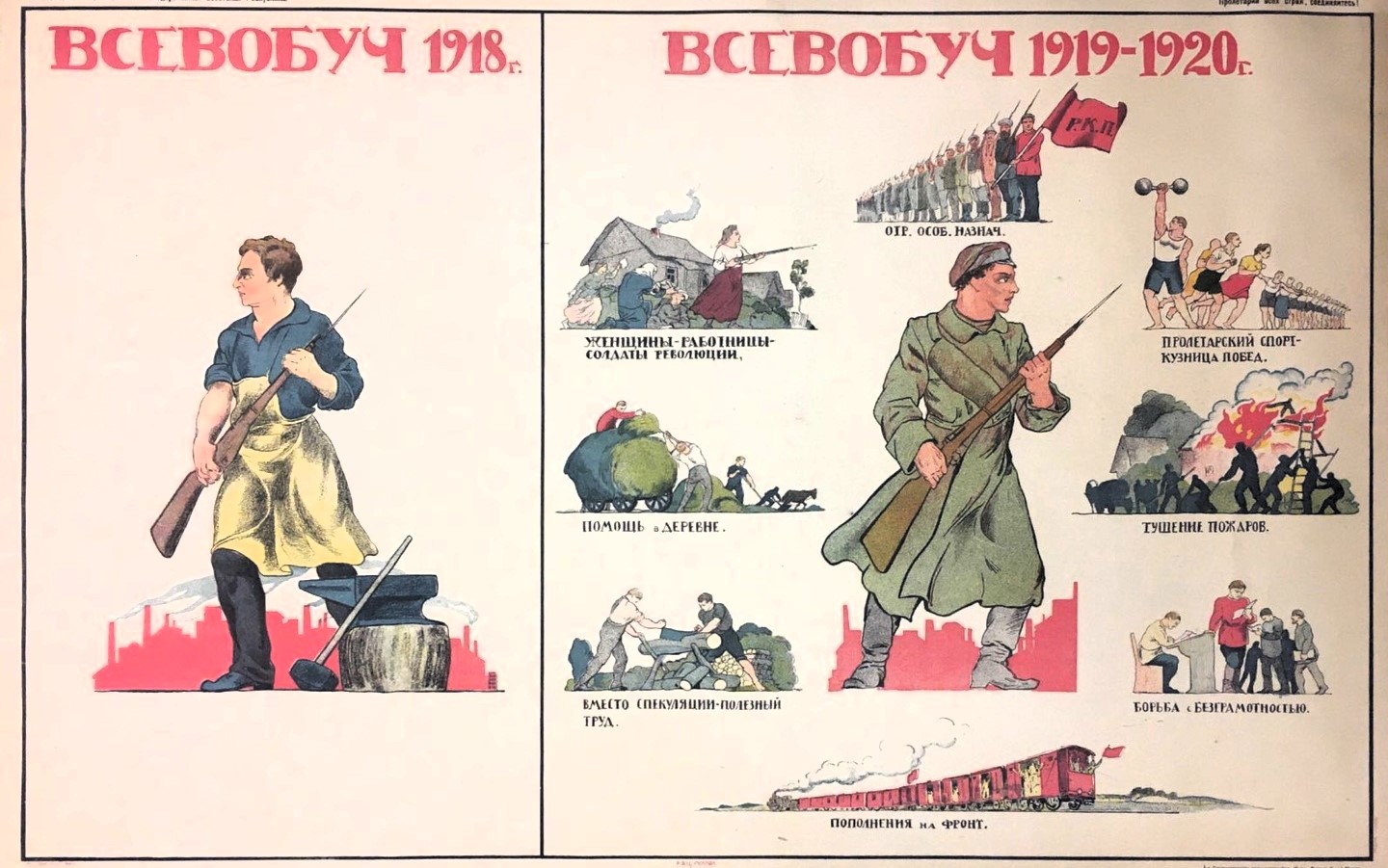
During the Civil War the Soviet government began issuing daily international wireless communiques on events, conditions, and revolutionary work in Soviet-controlled territories. Becoming an irregular feature of ‘Soviet Russia,’ the New York-based publication of the Friends of Soviet Russia, the reports are a unique record of the period. A dozen or so notices each day, often just a paragraph or two, and covering items from epic battles of the Red Army to a small village’s lecture on astronomy. Below, the war is the main news.
‘Official Soviet Wireless of October 7, 1919’ from Soviet Russia (New York). Vol. 2 No. 8. February 1, 1920.
SOVIET WIRELESS OF OCTOBER 7
NORTHERN FRONT. Local engagements in the vicinity of Archangel and Murman, WESTERN FRONT. Red troops have won new successes against the enemy in the vicinity of Gdov. Region of Kiev, Red troops after a violent combat drove the enemy from their positions. Region of confluence of River Telereva. We captured an armored enemy ship and sank another. Region of Chemigov. The enemy were repulsed beyond the river Oster in the vicinity of Kozelets. SOUTHERN FRONT. Red troops, overcoming violent enemy resistance, took the city of Sievsk. In the vicinity of Kursk we have made a new advance. Region of Livny. An enemy attack was repulsed. Engagements favorable to us are in progress in the vicinity of Kastomaia. Region of Voronezh. Violent engagement being fought. Region of Klietssaia. Attempted enemy attack was repulsed. Region of Arbantsev. Enemy attacked Red troops in the vicinity of Tsaritsyn but were repulsed. TURKESTAN FRONT. Vralik Region. Fighting continues. EASTERN FRONT. Enemy attack on Tobol was repulsed. Red troops have been successful along the Ishim railway, capturing numerous prisoners and materials. Our advance continues on the Northern railway.
Opinion in the Provinces
The congress of village Soviets of the Zaborov canton unanimously passed a resolution denouncing the White guard assassins of Moscow and calling for an implacable war against the counter-revolution.
At Viatka the day set aside for the collection of reading matter for the Red army has been most successful. The Section of Public Instruction had organized seven joint conferences in addition to numerous meetings. Lectures on the history of books, the social regime and education, the revolution and public instruction, etc., were given in the motion picture theatres, with free admission to all.
The vessel, “The Red Star,” was stationed for two days at die capital of the district of Pokrovsk, and at the village of Zolotoye. During the day the instructors visited the city institutions, at night all the work was transferred to the vessel, where there was a cinematograph that was visited by 25,000 spectators. Enormous quantities of publications were sold or distributed. At the same time on the shore and in the city four meetings attracted an immense crowd of citizens, soldiers and young people. The representatives of the central executive committee were warmly applauded. They organized a conference open to all the parties, in the course of which the program of the Communist Party was explained. The local institutions were inspected and the needs of the population carefully studied. In the village of Zolotoye there was held a meeting of peasants, who showed the liveliest interest in the question of Socialist agriculture. From there the instructors went to a large village of the interior. Then the “Red Star,” finding itself on the first of October at the village of Balyklei, received a visit from numerous Cossack peasants, and its orators were applauded at several meetings, which brought together about six thousand participants. Everywhere the local needs were studied and noted down for transmission to Moscow.
The Provinces and the Front
Immediately after Petrograd and Moscow, the Communists of Nizhni-Novgorod began a new mobilization for the Southern front. All the members of the party are advised that the first task of the Republic at present is the annihilation of Denikin with the shortest delay. At the same time the Communist Party is constantly increasing its ranks in his place. Thus the Communist groups are multiplied among the commercial flotilla.
News of General Nikolayev’s Funeral
The fifth of October all the proletariat of Petrograd performed fitting obsequies for the general who died at his post for the Soviet Republic. All the garrison units and the city corporations were assembled with their orchestras and standards. Zinoviev pronounced a few words with great emotion. “The day that we had to defend ourselves against an audacious enemy Comrade Nikolayev placed at our service his knowledge and experience to defend the cause of the workers and peasants. He was a general of the ancient regime, but that did not keep him from coming to die defense of the Proletariat republic. It is for this that our enemies hated him. He died a hero with faith in the work which he defended. His name will shine as a star for the future generations.” Tens of thousands followed the procession to the roar of cannon and the music of orchestras.
Denikin’s Support
Journals of the Don district announce that in the government of Stravropol a monopoly of whiskey will shortly be introduced. Sale will be authorized even to private dealers.
In the Azerbeidjan
According to journals of the Don district there is furious fighting in the Azerbeidjan between those who want to keep peace with Denikin and those who, like the Minister of War, Makhmendarov, are for war with him. The detachments of partisan Reds in the region of Touapse are supported by the workingmen, and the Denikin commandment finds itself unable to fight against them. The commandant of the city threatens to bombard the workingmen’s quarters. In the country of Tchechene the insurrections are incessant despite the bloody reprisals of the volunteer army.
The English at Lenkoran
At Lenkoran the power of the Soviets was proclaimed by the local population. The English troops after a bloody battle succeeded in overturning the instituted government, arrested the leaders and turned them over to the volunteer army at Petrovsk.
The Crimean Massacres
The massacre of arrested Communists continues in the Crimea. Numerous victims are mentioned at Yalta. Among them it seems very probable was the famous writer, Veresayev, who was accused of sympathy for Bolshevism.
At Kusiamd On the ruins which cover the common grave of the seven thousand Red peasants shot by Kolchak several meetings have been organized which have brought together tens of thousands of peasants. In the village and the district the revolutionary enthusiasm is indescribable. It has penetrated even the intellectuals, who have offered their services to the Soviet power.
Last Efforts of Kolchak
Kolchak is trying to use to the maximum the Cossack population of the Irtish. An order of mobilization called all the classes from seventeen to fifty-five years, but the Cossacks flee in order not to obey, the attempted mobilization of the Cossacks of Irkutsk has been just as unsuccessful.
In Siberia
Following the continual revolutionary outbreaks among the peasants and workers, Koltchak has proclaimed a state of siege in the entire region of Irkutsk.
Against Denikin
The sixth of October the majority of the Communists of Borovitchi, mobilized immediately after the Central Committee circular was issued, are leaving for the Southern front There remain in the city only those who have been judged absolutely indispensable.
At Moscow
The general assembly of Hat Factory No. 4 places itself without reserve at the service of the Red army. The general assembly of the Kakhman factory declares that all the workers without exception should either be at the front or employ all their efforts to increase production in the interests of the Red army. The general assembly of Confectionery Factories No. 5 has decided that all must as one man work for the success of the Soviet power and the Red army. A numerous assembly of the Besmanny quarter unanimously adopted a resolution inviting all the citizens to redouble their energy and abandon all negligence in the defense of the Republic. In the Zamoskvorietchie quarter meetings and reunions were held which brought together thousands of workers from various factories. Everywhere were adopted resolutions showing once more the ardor with which the proletariat of the quarter are ready to defend the Soviet power and the Communist Party.
The Best Agitators
Thousands of fugitives, eye-witnesses of the atrocities of the Whites, who narrate the bad treatment which they have had to suffer, create among the populations the farthest removed from the front an inflexible desire to fight against Denikin. Thus in the government of Moscow, fugitive peasants from Ukraine, formerly indifferent to the Soviet power, tell the peasants of the pillage, the massacres and the hangings by the White bands. They recount how the unfortunates are quartered, living, how the Whites when they attack form their first line of women, aged, and children, then the Red prisoners, and advance themselves only behind this living shield. The peasants unanimously curse this modem invasion of Tartars.
On the Railroads
A special commission has established the following principles for the constitution of disciplinary tribunals for the railroads. These tribunals are permanent, and are formed of delegates from the syndicate for labor inspection, and the extraordinary commission for transports. The investigation of affairs is to be immediate.
Manufacture of School Material
The factories for the manufacture of school material at Viatka, long known in Russia, have been increased since the establishment of the Soviet power by numerous additions connected with agricultural information, hygiene and medicine, the popular theatre, etc. In five months these factories have turned out for the schools articles to the value of more than two and a half million roubles.
Life of the Workers
The summer season in the peat-bogs is described in Pravda by the committee of peat factories of Chatoura. Numerous expedients have increased the light among the workers and the peasants of the neighboring villages. A theatre has disclosed unknown talent and presents at the same time both original and classic works with great success. A troupe from Moscow gave a concert of music and song consecrated to Russian authors. The cinematograph, working at least once a week, has given pictures by Tourgenev and Tolstoi. Before each performance a member of the factory committee or of the syndicate bureau gave an exposition of the situation, or treated of questions of literature or art. The library attracts many readers, of whom seventy out of a hundred are workingmen. In the hall of the theatre political or economic meetings are held. The organization of a people’s house is planned for November or December.
The Communist Youth
On the fifth of October was opened the second All-Russian Congress of Communist Youth with three hundred delegates representing about six hundred organizations. Trotsky took the platform, showing that the hope of the revolution was in the youth of the country, either in the war or in the work of peace which remains the principal object of the Soviet power, although since its birth it has not known a single day of tranquility, so to speak. Through war we are advancing towards that new regime that the bourgeois tried desperately to prevent If the English, French or American bourses left us in repose, all the enemies of the Soviet power, deprived of their own force, would be seen to fall immediately. But we have not wrested the power from the bourgeoisie to yield to the menace of foreign imperialism. At the least danger we turn to the young generation, who reply to us, “We are here, ready for the combat.” Petrograd has just sent us hundreds and hundreds of proletariat tried in the revolutionary battle. The grandeur of our epoch lies, indeed, in the fact that it tempers the character of the Russian people. We live in a smithy where thousands of hammers are striking. The sparks may here and there burn us, take away such and such from our ranks, bat in our womb are conceived tens of thousands of fighters forged of the same steel. That is why despite hunger, despite cold, we have not weakened, that is why we go firmly to our goal in the pure confidence that there can be no return to the past We shall humble Denikin as we have humbled Kolchak.
Firemen’s Service
The Supreme Council for National Economy has decided to place all the local fire brigades under charge of the State. This requires a credit of almost eight hundred million roubles per semester. It is planned to establish five hundred new fire brigades this year in the cities and towns.
Public Hygiene
The Commissariat of public hygiene is holding at Moscow a conference of the bacteriologists of all Russia. Their program is published in Izvestia.
Soviet Russia began in the summer of 1919, published by the Bureau of Information of Soviet Russia and replaced The Weekly Bulletin of the Bureau of Information of Soviet Russia. In lieu of an Embassy the Russian Soviet Government Bureau was the official voice of the Soviets in the US. Soviet Russia was published as the official organ of the RSGB until February 1922 when Soviet Russia became to the official organ of The Friends of Soviet Russia, becoming Soviet Russia Pictorial in 1923. There is no better US-published source for information on the Soviet state at this time, and includes official statements, articles by prominent Bolsheviks, data on the Soviet economy, weekly reports on the wars for survival the Soviets were engaged in, as well as efforts to in the US to lift the blockade and begin trade with the emerging Soviet Union.
PDF of full issue: https://www.marxists.org/history/usa/pubs/srp/v1v2-soviet-russia-Jan-June-1920.pdf
 Revolution's Newsstand