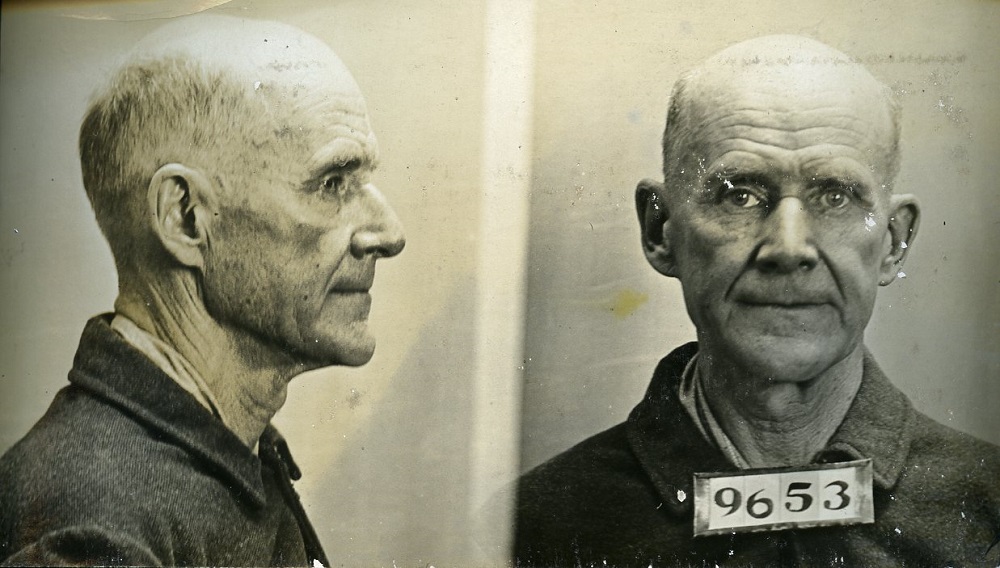
Debs, convicted felon and former inmate, as prison abolitionist. A chapter from Debs’ only full length book, and his last work, is both a personal memoir from his times served in prison and an attack on the society which produces and requires such institutions. Here he looks at the relations of capitalism to crime.
‘Capitalism and Crime’ (1922) by Eugene V. Debs from Walls and Bars. Published by the Socialist Party, Chicago. 1927.
Crime in all of its varied forms and manifestations is of such a common nature under the capitalist system that capitalism and crime have become almost synonymous terms.
Private appropriation of the earth’s surface, the natural resources, and the means of life is nothing less than a crime against humanity, but the comparative few who are the beneficiaries of this iniquitous social arrangement, far from being viewed as criminals meriting punishment, are the exalted rulers of society and the people they exploit gladly render them homage and obeisance.
The few who own and control the means of existence are literally the masters of mankind. The great mass of dispossessed people are their slaves.
The ancient master owned his slaves under the law and could dispose of them at will. He could even kill his slave the same as he could any domestic animal that belonged to him. The feudal lord of the Middle Ages did not own his serfs bodily, but he did own the land without which they could not live. The serfs were not allowed to own land and could work only by the consent of the feudal master who appropriated to himself the fruit of their labor, leaving for them but a bare subsistence.
The capitalist of our day, who is the social, economic and political successor of the feudal lord of the Middle Ages, and the patrician master of the ancient world, holds the great mass of the people in bondage, not by owning them under the law, nor by having sole proprietorship of the land, but by virtue of his ownership of industry, the tools and machinery with which work is done and wealth produced. In a word, the capitalist owns the tools and the jobs of the workers, and therefore they are his economic dependents. In that relation the capitalist has the power to appropriate to himself the products of the workers and to become rich in idleness while the workers, who produce all the wealth that he enjoys, remain in poverty.
To buttress and safeguard this exploiting system, private property of the capitalist has been made a fetish, a sacred thing, and thousands of laws have been enacted and more thousands supplemented by court decisions to punish so-called crimes against the holy institution of private property.
A vast majority of the crimes that are punished under the law and for which men are sent to prison, are committed directly or indirectly against property. Under the capitalist system there is far more concern about property and in finitely greater care in its conservation than in human life.
Multiplied thousands of men, women and children are killed and maimed in American industry by absolutely preventable accidents every year, yet no one ever dreams of indicting the capitalist masters who are guilty of the crime. The capitalist owners of fire traps and of fetid sweating dens, where the lives of the workers are ruthlessly sacrificed and their health wantonly undermined, are not indicted and sent to prison for the reason that they own and control the indicting machinery just as they own and control the industrial machinery in their system.
The economic-owning class is always the political ruling class.
Laws in the aggregate are largely to keep the people in subjection to their masters.
Under the capitalist system, based upon private property in the means of life, the exploitation that follows impoverishes the masses, and their precarious economic condition, their bitter struggle for existence, drives increasing numbers of them to despair and desperation, to crime and destruction.
The inmates of an average county jail consist mainly of such victims. They also constitute the great majority in the state prisons and federal penitentiaries. The inmates of prisons are proverbially the poorer people recruited from what we know as the “lower class”. The rich are no to be found in prison save in such rare instances as to prove the rule that penitentiaries are built for the poor.
Capitalism needs and must have the prison to protect itself from the criminals it has created. It not only impoverishes the masses when they are at work, but it still further reduces them by not allowing millions to work at all. The capitalist’s profit has supreme consideration; the life of the workers is of little consequence.
If a hundred men are blown up in a mine a hundred others rush there eagerly to take the places of the dead even before the remnants of their bodies have been laid away. Protracted periods of enforced idleness under capitalism have resulted in thousands of industrious working men becoming tramps and vagabonds, and in thousands of tramps and vagabonds becoming outcasts and criminals.
It is in this process that crime is generated and proceeds in its logical stages from petty larceny to highway robbery and homicide. Getting a living under capitalism—the system in which the few who toil not are millionaires and billionaires, while the mass of the people who toil and sweat and produce all the wealth are victims of poverty and pauperism—getting a living under this inexpressibly cruel and inhuman system is so precarious, so uncertain, fraught with such pain and struggle that the wonder is not that so many people become vicious and criminal, but that so many remain in docile submission to such a tyrannous and debasing condition.
It is a beautiful commentary on human nature that so little of it is defiled and that so much of it resists corruption under a social system which would seem to have for its deliberate purpose the conversion of men into derelicts and criminals, and the earth into a vast poorhouse and prison.
The prison of capitalism is a finished institution compared to the cruder bastilles of earlier periods in human history. The evolution of the prison has kept pace with the evolution of society and the exploitation upon which society is based.
Just as the exploitation of the many by the few has reached its highest cultivation and refinement under present day capitalism, and is now carried on more scientifically and successfully, and is yielding infinitely richer returns than ever before, so has the prison under this system been cultivated and refined in the infliction of its cruelty, and in its enlarged sphere and increased capacity.
Externally, at least, the prison under capitalism presents a beautiful and inviting appearance, but behind its grim and turreted walls the victims still crouch in terror under the bludgeons of their brutal keepers, and the progress of the centuries, the march of Christian civilization, mean little to them, save that the prisons of capitalism are far more numerous and capacious, and more readily accessible than ever before in history. They signalize the civilization of our age by being composed of steel and concrete and presenting a veritable triumph in architectural art.
Capitalism is proud of its prisons which fitly symbolize the character of its institutions and constitute one of the chief elements in its philanthropy.
I have seen men working for paltry wages and other men in enforced idleness without any income at all sink by degrees into vagabondage and crime, and I have not only found no fault with them, but I have sympathized with them entirely, charging the responsibility for their ruin on the capitalist system, and resolving to fight that system relentlessly with all the strength of mind and body that I possess until that system is destroyed root and branch and wiped from the earth.
During my prison years I met many men who were incarcerated as the victims of capitalism. Let me tell of one in particular. This will typify many other cases with variations, according to the circumstances.
This man has spent nearly forty-eight years in reformatories and prisons. His father died when he was a child and his mother was poor and could ill provide for her offspring. At the tender age of seven years he found himself in a so-called House of Correction. There he was starved and beaten and learned to steal.
Escaping from that institution, he was captured and returned. From that time on he was marked and his life was a continuous battle. He was dogged and suspected and the little time that he was out of jail was spent in dodging the detectives who were ever on his track like keen-scented hounds in pursuit of their prey. They were determined that he should be inside of prison walls. In this cruel manner his fate was sealed as a mere child. The House of Correction for poor boys and girls comes nearer being a House of Destruction.
I spent many hours talking with this victim of the sordid social system under which we live. Despite the cruelties he had suffered at its hands, he was as gentle as a child and responded to the touch of kindness as quickly as anyone I ever knew. Society, which first denied him the opportunity to acquire a decent means of living and subsequently punished him for the crime which it had committed against him and of which he was the victim, could have won an upright and useful member in this man.
As I have already stated in a foregoing chapter, I declined to attend the prison chapel exercises. There were many other convicts who lent their presence to the mockery of religious worship over which guards presided with clubs because they were compelled so to do. The particular prisoner to whom I have referred addressed a letter to the warden protesting that he did not wish to attend devotional exercises and stated the reason for his attitude. He wrote and gave to me a copy of the letter and I introduce it here as indicating that this victim of the brutality of the capitalist system, in spite of the fact that he had spent nearly half a century behind prison bars, still possessed sufficient manhood and courage to assert himself in face of his cruel captors.
The letter follows as he wrote it:
“Sir:
“I desire to be excused from attendance on all religious services here which no longer appeal to my curiosity or sense of obligation. I need practical assistance not spiritual consolation.
“My imagination has already been overworked to the impairment of my other mental faculties.
“I do not believe in the Christian religion. I have formulated a creed agreeable to my mind.
“I have always been fearful of those to whom government grants the special privilege to furnish a particular brand of theology.
“I deny the right of government to compel me to attend any kind of religious service. I claim and proclaim my religious freedom under the U.S. constitution.
“In reformatory and penal institutions I have attended religious service every Sunday for forty odd years—to what purpose?”
The entire career of this unfortunate prisoner was determined by his imprisonment in his childhood, and as well might he have been sentenced for life in his cradle. The system in which he was born in poverty condemned him to a life of crime and penal servitude in which he typifies the lot of countless thousands of others doomed to a living death behind prison walls.
Walls and Bars by Eugene Victor Debs. Published by the Socialist Party, Chicago. 1927.
Contents: Foreword, Acknowledgements, Introduction by Debs (July 1, 1926), The Relation of Society to the Convict, The Prison as an Incubator of Crime, I Become U.S. Convict, No. 9653, Sharing the Lot of Les Miserables, Transferred From My Cell to the Hospital, Visitors and Visiting, The 1920 Campaign for President, A Christmas Eve Reception, Leaving the Prison, General Prison Conditions, Poverty Populates the Prison, Creating the Criminal, How I Would Manage the Prison, Capitalism and Crime, Poverty and the Prison, Socialism and the Prison, Prison Labor Its Effects on Industry and Trade, Studies Behind Prison Walls, Wasting Life. 248 pages.
PDF of book: https://archive.org/download/wallsbars00debs/wallsbars00debs.pdf
 Revolution's Newsstand