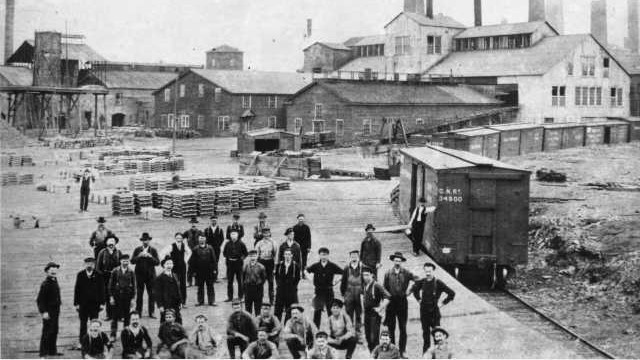
Class war at the Ruston smelter works outside of Tacoma, Washington in the winter of 1914.
‘Militant Strikers Start War on Scabs at Ruston’ from The Commonwealth (Everett). No. 157. January 8, 1914.
Strike-Breakers Plentiful.
President Rust of the Tacoma smelter, in Ruston, a suburb or Tacoma, is having a taste of the class struggle just now. This distinguished “captain of industry,” taking advantage of the prevailing hard times, with its millions of unemployed men decided last week that a nine-hour workday is not long enough for his so-called “unskilled” wage-slaves. So he ordered them to stay on the job a round ten hours daily, at the previous pay for nine hours. The idea was a very good one—for Mr. Rust. But it didn’t meet with the heartfelt approval of the “pauper labor from Europe.”
TWO hundred or more Austrian laborers refused to take advantage of “the better condition of wage-earners” in this glorious land of the free and home of the brave. Very brave. A gang of true “patriotic” American workmen was soon found ready to “lower the standard of living” of the much-talked of “pauper labor of Europe.” says the capitalist press, in point, under date of January 3:
Unable to gain entrance to the works because of the opposition of armed strike pickets, 800 employes of the Tacoma smeller at Ruston were thrown out of work today when the plant temporarily closed down by order or President W.R. Rust. Two men were seriously injured in a riot early this morning.
Two hundred Austrian workers went out on strike Thursday morning but the other workmen refused to join them. When the men reported for duty yesterday they were met by armed pickets, who had been organized by Joe Ettor, an I.W.W. worker, and denied admittance to the smelter yard. Strike-breakers engaged to take the places of the Austrians were assaulted and driven away. John Butoski and Mike Melinski, brought from Seattle by the company, were seriously injured by rocks hurled by the strikers.
The little town of Ruston and the northern section of Tacoma was in terror last night as the result of frequent clashes between the strikers and strikebreakers. An automobile, said by the strikers to have been occupied by two deputy sheriff and three strikebreakers was fired upon and the front lamps and tires shot off.
The machine was compelled to retreat through the smelter gates on flat wheels. No one was injured in the fusillade.
President Rust declared this afternoon that he would reopen the smelter Monday, when he promised to have a sufficient number of deputies on hand to prevent tile pickets from interfering with the men who wanted in return to work at the smelter,
“Shoot to Kill.”
On January 4 we were informed by the capitalist, press that following a mass meeting attended by several hundred strikers and sympathizers, at which Sheriff Jamieson publicly warned the men he had given orders to his men to kill the first man who pointed a gun toward the smelter, a day of almost absolute peace reigned at the Tacoma Smelting company’s plant. Taking advantage of conditions, the company increased its guard, continued to bring in strikebreakers by the water entrance, together with bedding and commissary supplies.
The steamer Cordova came to the smelter dock with 3,000 tons of copper ore from Alaska and joined the small fleet now awaiting there to be discharged, and on each It is said, the smelter company must pay heavy demurrage charges every day the vessel is detained. Demurrage charges since the strike began, it is thought, have amounted to more than $5,000.
Following the lead of the I.W.W., an attempt is now being made to organize the unskilled workers of Ruston into a section of the A.F. of L.
Will Form Union.
Charles Perry Taylor, general organizer for the, American Federation of Labor, advised the men to go about their cause peacefully by the formation of a union which would have to apply for membership in the Western Federation of Minors. The men agreed to stop all violence and do nothing further until Tuesday, when they expect to meet an organizer for the Western Federation at another mass meeting.
Free-for-AII Fight on Street Monday
Tacoma, Jan. 5. Fifty armed deputy sheriffs went to the car line today to escort 100 strikebreakers to the smelter plant at Ruston. The strikers, with women and girls lining the way, cried “scab.” Soon a free-for-all fight ensued.
Most of the laborers quit and would not go Into the smelter. Men and supplies are being landed by steamers at the smelter dock.
An exchange of shots occurred last night between strikers, barricaded in a house, and deputies.
Do Not Want Trouble.
Lee Reckler, chairman of the strikers’ committee, said any attempt of deputies to escort skilled workmen through the lines would be met by the strikers.
“We do not want trouble,” said Chairman Reckler, “but if the sheriff’s men or if the company’s guards menacingly display firearms we will be ready for them. That is all I care to say.”
The Commonwealth was a Socialist Party-aligned paper based in Everett, Washington that began in February, 1911. First edited by O.L. Anderson, the weekly paper was quickly involved in the state’s very fractious inner Socialist Party life. Editors followed the changing political fortunes with Anna A. Maley directing The Commonwealth from September, 1911 until May, 1912, who also focused the paper nationally. Maley left the paper to run for governor in 1912, the first woman and first Socialist in the state to run for that office, winning a respectable 12% of the vote. Six more editors followed Maley, including Maynard Shipley. The paper’s orientation was left and supported the I.W.W. when many S.P. papers were denouncing them. The Commonwealth struggled, like nearly all left publications in history, with money financially and sold to the Socialist Party of Snohomish County in April, 1914 to be reborn as The Washington Socialist.
Access to PDF of original issue: https://chroniclingamerica.loc.gov/lccn/sn84025731/1914-01-08/ed-1/seq-1/
 Revolution's Newsstand