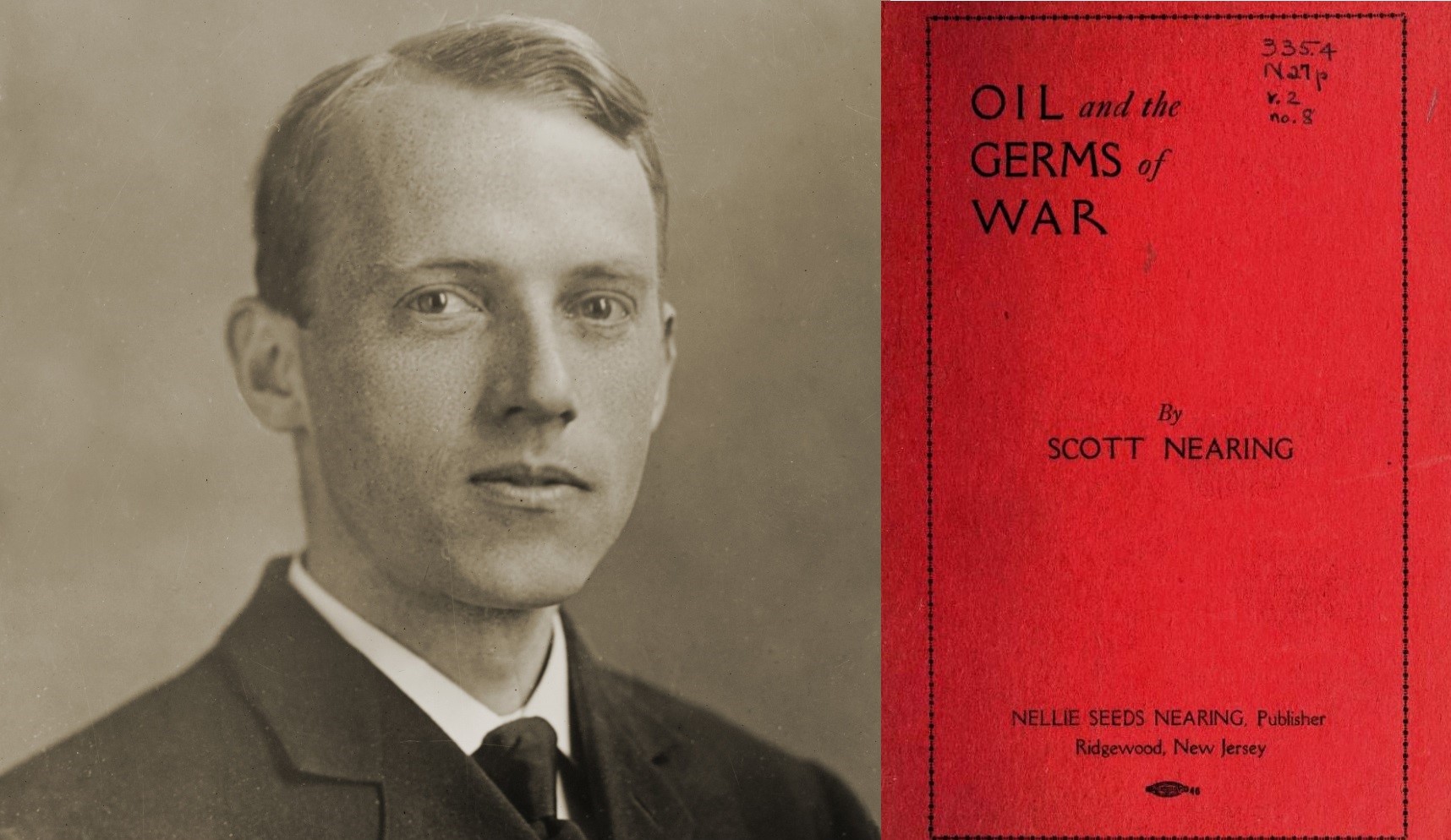
One of Nearing’s fine popularly written pamphlets on political economy, tracing the rise of oil and oil imperialism.
‘Oil’ by Scott Nearing. Nellie Seeds Nearing Publishers. Ridgewood, New Jersey, 1923.
1. An Economic Prodigy.
Oil is one of the most vitally important of all the resources, yet it is scattered capriciously over the various continents. Its products find a ready sale in every corner of the globe, and its refining, transport and retailing have proved one of the most lucrative of modern businesses. Oil profits, heaped up in a comparatively few hands, have added immensely to the investable surpluses that drive the masters of modern business toward financial imperialism. Furthermore, and this is the essential point, oil has lately become the very latch-key to imperial power, so that its possessor literally has the riches of the world at his feet. The struggle for oil-bearing lands has therefore reached a stage so acute that it has actively involved every nation seeking to qualify in the race for world supremacy.
The oil industry is the infant prodigy of the industrial world. Barring the automobile industry, with which it is intimately connected, none has developed in a more spectacular manner.
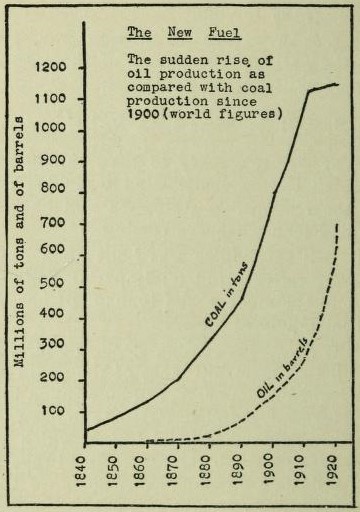
There was no oil industry prior to 1860, when the world’s total production was about half a million barrels. (Detailed figures page 31.) Production for 1870 reached nearly six million barrels; for 1880, 30 million barrels; for 1890, 76 million barrels. As lately as 1900, world production was only 150 million barrels. By 1910, however, production had climbed to 327 millions, and in 1922 it passed the 850 million barrel mark. Oil has been one of the major industries only during the past 25 years.
Between 1860 and 1900 petroleum was used mainly for illumination and for lubrication. In the cities it was forced to compete first with gas and later with electricity, but in the villages, and across the sparsely settled farming regions where dwell most of the inhabitants of the earth, kerosene provided, for the first time, a cheap and reliable form of canned sunlight. The farmer was no longer compelled to retire at nightfall. The villager sat long after dark in his lamp-lighted kitchen, reading or talking over the business of the day.
Inexpensive and easily handled, kerosene became a popular fuel in less than a generation. The marvelous rapidity of its spread through Europe, across Asia and into Latin America and Africa affords a striking illustration of the readiness with which even supposedly backward peoples seize upon economic improvements which are of evident advantage.
A natural resource that ran out of the ground, that could be pumped across mountains and plains in pipes, that was refined at a low cost, yielding over two hundred products such as lubricating oils, gasoline, kerosene, benzine, parahne, etc., many of which met a universal demand, was well calculated to make its possessors rich.
The oil industry of the United States (the United States produced 90 per cent, of the world’s oil as lately as 1880, and is to-day producing about 65 per cent.) fell into the hands of a small group of men who have probably made more money, dollar for dollar, out of their oil investments, than have the investors in any other major industry.
2. Oil Empires.
John D. Rockefeller and a number of his associates set up one of the most important landmarks in the economic history of the United States when they organized the Standard Oil Company in 1870. The business atmosphere of the time was dominated by the idea of competition—the common assumption being that competition was not only inevitable, but that it was “the life of trade.”
Mr. Rockefeller held a different view. His ideal was a large, well organized, efficiently managed industrial unit, based on the principle of co-operation rather than of competition, and from his first investment in an oil refinery in 1862, through the organization of the Standard Oil Company, and during the succeeding years, Mr. Rockefeller did his best to get his potential competitors to come inside and share the benefits of joint effort. He never insisted on playing a lone hand, but surrounded himself with such men as William Rockefeller, S.V. Harkness, and H.M. Flagler. For the motto: “Producers compete!” Mr. Rockefeller substituted: “Producers unite!” and acting on this principle, within ten years he had under Standard Oil control more than nine tenths of the oil refining business of the country. This was the first great demonstration, in the American business world, of the precept: “In union there is strength.”
The position of the Standard Oil Co. was rendered still more secure by its control of the pipe lines through which the oil was transported, by its rebate contracts with the railroads, by its ruthless wars on stubborn competitors, and by the very efficient way in which its business aff airs were conducted.
Standard Oil profits were large from the outset. A number of government investigations show that between 1882 and 1906 the total of cash dividends paid by the company was $551 millions, which was an average of 24 per cent, per year on the outstanding stock. In addition to the dividends, there were surpluses that made the total profit account for the period about $7 1 4 millions. The figures are well summarized in Chapter 5 of “The Trust Problem” (Eliot Jones. New York, Macmillan, 1921).
Here was a fateful combination: a valuable and very limited natural resource; the principle of industrial co-operation; enormous profits on a rapid turn-over, heaped up in great surplus funds. The result was inevitable. Standard Oil quickly became one of the masters of American public life, and those who questioned its sway or crossed its path made a quick exit from public office. Public investigations followed attacks by private “muck-rakers,” and so insistent was the public demand for action that on May 11, 1911, the United States Supreme Court handed down a decree declaring the Standard Oil Co. a trust in restraint of trade, and ordering its dissolution into a number of constituent companies, such as the Standard of New Jersey, the Standard of Indiana, and the like. The events that followed throw an interesting side-light on the relative power of the Supreme Court and of Standard Oil.
Standard Oil stock, at the time of the Supreme Court decree, had a paper value of about $98 millions. During the next ten years, the entire cash and stock dividends paid by the “dissolved” companies (The Standard Oil Properties, as they are now called) had a market value, in 1921, of $1,833 millions—more than eighteen times the capital value of the property ten years before. The market value of the stock of the dissolved companies in 1921 was $3,276 millions, or about 35 times the capital value in 1911. Then, too, the volume of dividends has been steadily mounting year after year.
This is merely the profit side of the problem. The really significant development is the widespread control exercised by the Standard interests over the productive machinery of the United States and of the world. This matter has recently been covered in great detail, and the results published in the “Hearings on the High Cost of Gasoline” conducted before the United States Senate Committee on Manufactures. Space permits only of a brief summary of the organization of one of the Standard companies—the Standard of New Jersey.
The Standard Oil Company of New Jersey drills oil wells, pumps them, refines the crude oil into many forms and sells the product—mostly abroad. It has three refineries in New Jersey; one each in Maryland, Oklahoma, West Virginia, Louisiana, British Columbia, Nova Scotia, Peru and Mexico. Its pipelines cover the important oil territories of eastern United States; it has over half a million tons of ocean-going tank steamers; it makes its own cans, cases, barrels, etc. Among its subsidiaries are five companies doing business in France; three each in Holland, Norway and Switzerland; two each in Belgium, Germany, Poland, Italy and England, and one each in Canada, Peru, the West Indies, Czechoslovakia, Mexico, Denmark, Finland, Canada, Spain, Hungary, Austria, Roumania, Jugo-Slavia, Danzig, the Azores, Bolivia and Venezuela. Details regarding this vast organization, which literally covers the earth, may be found in the Senate Committee Report.
The Standard of New Jersey is only one of the Standard Oil Properties, and the Standard Oil Properties is only one of the many oil empires that have been built in the United States and in Europe during the brief period in which oil has mounted to a position of such supreme industrial and diplomatic importance.
3. The Oil Revolution.
Meanwhile the oil industry itself had been revolutionized. In the early years it provided light and heat and lubricants. To-day its strategic contribution is power.
This transformation was brought about primarily by the invention of the internal combustion engine. The steam engine developed power by applying heat to water and admitting the steam thus produced into the ends of an enclosed cylinder. The internal combustion engine developed power by dropping an explosive gas directly into the cylinder and igniting it with an electric spark. The steam engine, coal driven, required a relatively large and cumbersome equipment. The gas engine could be tucked away in a buggy, in a row-boat, or a balloon. The essential improvements which were embodied in the internal combustion engine (made for the most part between 1900 and 1910) yielded new means of land, water and air transportation in the form of the motor car, the motor boat, the submarine and the heavier-than-air flying machine.
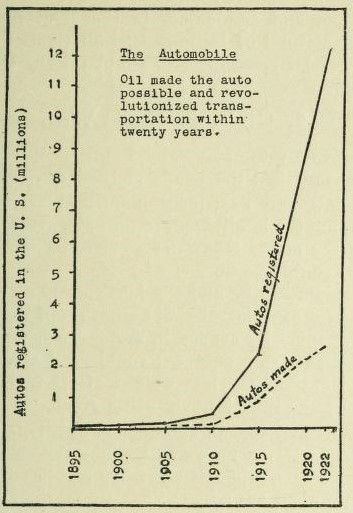
It is not yet possible to measure the economic and social effects of these new means of transport. So recent are the inventions, and so sudden has been the development of these new human activities that their ultimate results are still a matter for speculation. The facts themselves are well illustrated by the phenomenal rise of the automobile industry in the United States. In 1900, there were 13,824 registered autos in the United States; in 1910, there were 468,497, while in 1922 there were 12,239,140. The automobile industry has literally been created within the past fifteen years.
The engines which drove motor boats, airplanes and automobiles used refined and high-grade oils. At about the same time that they were being brought on the market, an engineer named Diesel produced an engine that subjected crude oil to great pressure and thus made it usable, particularly in heavy engines. Refined oils were expensive. Crude oil was dirt cheap.
Still the Diesel engine did not supplant the coal driven machinery in the ocean liner and the battle-ship. That result was accomplished by a device which sprayed crude oil, mixed with compressed air, under the boilers of ocean-going ships. The result was immediate. Coal burning ships were doomed while oil was available.
Ton for ton, oil contains more fuel value than coal, and in a more available form. Oil, as a fuel for ships, thus enlarges the cruising radius of ships about fifty per cent, while it reduced the amount of bunkerage space by thirty per cent. The oil burning ship therefore sails farther without refueling, and carries a greater net tonnage of freight. Beside that, oil is more economical to handle than coal, since it can be sent aboard through a pipe, and conducted, in the same manner to the boilers. This method of burning fuel-oil compelled all of the leading commercial companies to adopt oil for their new and their fast ships.
4. Oil in the Great War.
But this was only the commercial side of the oil revolution. The new fuel modified the whole method of warfare.
The four new and decisively important transport factors developed during the late war were the submarine, the airplane, the tank and the motor transport service. The country which had only coal could use no one of these devices, but was confined to the steam-engine and the horse on land, and the coal burning ship at sea. The oil-rich nation could make war in the air; could transport its armies in motor cars, which are much more mobile than steam engines; could fight with land battleships and, because of the less weight of oil fuel, could mount heavier naval guns than its coal-using rival.
The Germans had coal in abundance, but little oil. German armies moved in trains or walked. The Allies had an abundance of oil. Their armies were more mobile; their air fleets were better supplied with fuel; their submarines had an abundance of motive power, and their battle fleets were being rapidly transformed to the oil-burning basis.
Thus Francois Delaisi in his “Oil” describes the position of France: “In December, 1917, when the cartel of our ten oil merchants which had undertaken to supply our armies, admitted that it was powerless to fulfil its engagements and that its stocks would be exhausted in March, 1918, on the eve of the Spring Campaign, M. Clemenceau addressed a despairing appeal to President Wilson.
“Upon the orders of the latter—and in spite of certain intrigues on the part of the French group—the War Service Committee, consisting of the great heads of the American industry, immediately placed all the required tankers at the disposal of France. Thanks to the reserves thus built up at the time of the great German push in Picardy, Marshal Foch was able to bring up heavy reinforcements in motor lorries and fill the gaps where the British front had been broken…it has been well said that ‘the victory of the Allies was the victory of the lorry over the locomotive.” (p. 29.)
Lord Curzon, at a dinner to the Inter-Allied Petroleum Council (Nov. 21, 1918) put the matter thus: “The Allies floated to victory on a wave of oil.” The multitude ascribed the triumph to the soldiers. The more experienced statesmen, who were on the inside of the national councils, understood that the triumph of the Allies was the triumph of superior airfleets, naval units, and of superior army mobility due to the use of motor cars. The men in the trenches fought equally well on both sides, as anyone who was at the front over a long period of time is ready to admit.
The World War was thus an oil-won war, proving conclusively that the national supremacy of the future rested on oil as a source of military and naval power.
5. Oil Sweeps Into Politics.
No Great War was necessary to show thinking people the direction in which the economic wind was blowing. As far back as 1910 the responsible statesmen and business men of Great Britain had seen what was coming.
The modern British Empire was built upon coal. As one writer has very effectively put it: Imperial Britain owes her supremacy, not to the number and tonnage of her ships alone, but also to her monopoly of fuel.
“Thanks to the numerous coaling stations which Britain has scattered over all the steamship lanes of the world not a single ship, whether of war or commerce, can move upon the seas save by her grace. Her coal, moreover, assures to her vessels, large and small, a cargo of outward-bound freight which is certain to find sale in any land; British steamers can always sail, therefore, with full holds—a fortunate circumstance that enables them to give lower return freight rates than the ships of any other country. For this reason merchandise consigned to England pays lower transportation charges than freight distributed to any other land, and English industry benefits correspondingly by this genuine advantage in the purchase of raw materials abroad. This is the great advantage in the British campaign for the conquest of international markets, and it may be said that the whole commercial and industrial prosperity of England, for a century past, has rested on this heritage of coal.” (E. Eberlin in La Grande Review. Living Age. Vol. 311, pp. 693-4.)
By 1910 it was apparent to far-seeing men that the control of land and sea and air in the future would follow the control of oil—a material “more precious, more complete in its dominating power over the planet than gold itself.” (“La Lutte Mondiale pour le Petrol.” Pierre I’Espangnol de la Tramereye. Paris, La Vie Universitaire, 1921, pp. 16-17). Before the power which oil gives to its possessors, all else must give way. “Armies, navies, money, and even entire populations count for nothing as against the lack of oil.” (the same p. 100.)
The British Empire had been built upon coal. A series of simple inventions, made for the most part between 1900 and 1910 had substituted oil for coal as the strategic fuel of industry. Great Britain had ample coal reserves, estimated at 189,553 million tons, which constituted about a quarter of the reserves of all Europe. She had no oil,
Commerce, naval supremacy, insurance, banking, the securing of raw materials on favorable terms, surplus investment funds—all hung in the balance. Without oil, they must all be lost to her oil-rich rivals. The economic plight of Britain was critical. A few men including Sir Marcus Samuel, Chairman of the Shell Transport Co., Lord Cowdray, head of the Pearson Interests, Lord Curzon, and Sir John Cadman, went to work, silently and with true British zeal.
6. Save the Empire!
Never had British resourcefulness, strategy and courage been more sharply tested. Never was Britain’s boast of her ability to take care of herself more justified.
The British Isles are oil-poor. With the exception of some unimportant oil-shale deposits in Scotland, they contain no commercially available oil. The same thing is true of all Northwestern Europe. The center of modern industrialism has not been supplied by nature with enough oil to meet its needs for one month in the twelve.
Where, then, is the world’s oil?
Roughly speaking, the apparent reserves of oil which are now commercially available total a little more than 40 billions of barrels. Of this amount North America is credited with 12.5 billion barrels (United States, seven billions, Mexico, five billions, Canada, half a billion) ; Asia is credited with 10 billions, of which six billions are in Persia and Mesopotamia ; South America is credited with 10 billions (three billions in Argentina and Bolivia, six billions in Colombia, Venezuela and Peru), and Russia with six billions of barrels. The scattering remainder is in the East Indies, the Balkans, in the Philippines, in Australia and so on. The bulk of the world’s oil, however, is concentrated in a very few comparatively small areas. In Europe, almost all of the reserve oil is in the southeast corner of the continent.
The British Empire of 1910 was not an oil empire. Quite the contrary, it was notably lacking in oil. Britain was the ostensible mistress of the world, but fully nine-tenths of the world’s oil resources lay outside of her territories. To get an adequate supply of oil for the Empire would be a master stroke of commercial enterprise and of diplomacy.
It was apparent from the beginning that the British could not work in the open without arousing their competitors. Therefore they went to work under a number of disguises. The Shell Transport Co., for example, which was engaged in the mother-of-pearl business, was used as a likely agency for the British control of oil in the East. The Royal Dutch, a company ostensibly controlled in Holland, furnished another admirable cover. The Mexican Eagle Oil Co., handled the interests of the Pearson group in Mexico. Within a few years these companies had secured important oil concessions in Roumania. Russia, California, Oklahoma, Texas, Trinidad, Mexico, The Dutch East Indies, and Egypt. The apparent diversity of these interests made it possible for the British Admiralty to drop a hint to the effect that self-protection demanded British participation in oil development. The power of the Crown was therefore placed behind the Burma Oil Co. and the AngloPersian Oil Co. So quickly was the work done that in March, 1920, Sir E. Mackay Edgar was able to give an interview to the London Times, in which he said:
“I should say that two-thirds of the improved fields of Central and South America are in British hands. In Guatemala, Honduras, Nicaragua, Costa Rica, Colombia, and Ecuador, a decisive and really overwhelming majority of the concessions are held by British subjects…The Shell group owns exclusively or controls interests in every important field in the world, including the United States, Russia, the Dutch East Indies, Roumania, Egypt, Venezuela, Trinidad, India, Ceylon, the Malay States, North and South China, Siam, the Straits Settlements and the Philippines.

“If their present curve of consumption is continued, Americans, in ten years will be under the necessity of importing 500 million barrels of oil yearly, at $2 a barrel—a very low figure—and that means an annual payment of $1,000,000,000 per annum, most, if not all of which will find its way into British pockets.”
After pointing out the immense economic advantage held by the British as a result of this situation, the statement adds: “The British position is impregnable.”
Ten years before, Britain controlled practically no oil. In 1920 she was independent. With the rapid exhaustion of the American fields, the British oil interests will dominate the oil industries of the world.
7. The Oil Stampede.
The statement came as a revelation to the American people. For fifty years the oil wells of the United States had supplied from two-thirds to nine-tenths of the world’s oil; the reserves of the southwest seemed inexhaustible; the American position was deemed secure, and yet here was a statement from a responsible source tint within ten years, the American people would be dependent on Britain for their oil.
Resolutions of inquiry were introduced into Congress, the newspapers took up the cry, and on May 2, 1920, the Geological Survey issued a report showing that the world, outside of the United States, was consuming 200 million barrels of oil per year. At this rate of consumption, the reserves of the remainder of the world would last approximately 250 years. The United States, with its consumption (1920) of 400 million barrels per year could expect its reserves to last only 18 years.
Acting Secretary of State Polk intensified the situation by submitting a report which went to Congress May 17, 1920, in which he asserted that; “The policy of the British Empire is reported to be to bring about the exclusion of aliens from the control of the petroleum supplies of the Empire, and to endeavor to secure some measure of control over oil properties in foreign countries…
“1. By debarring foreigners and foreign nationals from owning or operating oil producing properties in the British Isles, Colonies and protectorates.
“2. By direct participation in ownership and control of petroleum properties.
“3. By arrangements to prevent British oil companies from selling their properties to foreign owned or controlled companies.
“4. By orders in Council that prohibit the transfer of shares in British oil companies to other than British subjects or nationals.”
This statement was confirmed and strengthened by subsequent communications from the State Department. The British were not content to get concessions that gave them the control of the bulk of the world’s oil. They were apparently determined that no stone would be left unturned to prevent British subjects from disposing of their oil properties. Despite the fact that British companies had obtained free access to the oil fields of the United States, the American investor was excluded from British territory.
At almost the same time an agreement was reached at San Remo between France and Britain (April 24, 1920) under which it was arranged that all except British and French subjects should be excluded from oil territory in certain French and British possessions.
8. A World Oil Trust.
Later investigations showed that practically the entire oil industry of the world was in the hands of two great combines—the Royal Dutch-Shell Combine and the Standard Oil Combine. The most recent statement of the facts regarding the former group is contained in a “Report of the Federal Trade Commission on Foreign Ownership in the Petroleum Industry. Feb. 12, 1923.”
Royal Dutch was organized in 1890; Shell Transport in 1897. Both companies have paid handsome dividends. Royal Dutch, between 1910 and 1921 averaged 42 per cent, to the common stock holders; Shell Transport paid average dividends, between 1909 and 1921, of 31 per cent. Both are holding companies, and their profits are merely the net returns from the underlying concerns. The two organizations were affiliated in 1907, Royal Dutch taking 60 per cent, of the stock in subsidiaries and Shell Transport taking 40 per cent.
At the present time there are about 103 of these subsidiaries operating in Egypt, Russia, Dutch East Indies, Malay States, India, China, Korea, Manchuria, Philippines, Siam, Straits Settlements, Roumania, Australia, New Zealand, South Africa, Venezuela, Mexico, Denmark, Finland, Holland, Jugoslavia, Italy, Poland, Norway, Japan, Canada, United Kingdom, Sweden, Trinidad and the United States.
The proportion of petroleum production controlled by the Royal Dutch-Shell interests is given as 2 per cent, in the United States; 97 per cent in the Dutch East Indies; 98 per cent, in British Borneo; 100 per cent in Egypt; 29 per cent, in Roumania; 100 per cent, in Venezuela; 27 per cent, in Mexico, and 16 per cent in Trinidad.
The strategic power of the Royal Dutch-Shell group lies in their 120 fuel-oil bunkering stations, which are located in every important port of call all round the world. Ten of them are in the United States.
This report of the Federal Trade Commission confirms the earlier statements with regard to the discriminations against American oil interests by the British and other governments.
Sir Mackay Edgar has told the truth. As to his prophecy concerning the imports of oil by the United States, during the year ending June, 1922, imports of crude petroleum were at the rate of 135 million barrels per year, and for the year ending June, 1923, at the rate of 90 million barrels per year.
Meanwhile the struggle for oil went on unabated. The Genoa Conference “reeked with oil.” At Lausanne, Lord Curzon said simply and emphatically that the British Government would fight before it would leave Mosul. Then came the Chester Concessions, under which American interests laid claim to important oil lands in Asia Minor that were also claimed by France, through a pre-war concession, and by Britain under a mandate from the League of Nations.
9. The First Oil War.
When the original statements appeared regarding the British policy of excluding non-British subjects from British oil territory, Franklin K. Lane spoke out briefly and pointedly: “A policy of this description has inspired among Americans the fear that Britain in acting thus, desired to check the naval development of the United States. Now, do such proceedings lead to peace or war?”
Meanwhile the Standard Oil Company had invaded France. The French Government was about to turn the control of petroleum back into private hands, and the Standard, through the organization of several subsidiaries prepared to take care of the business. This accounts for the fact that the Standard of New Jersey has more subsidiaries in France than in any other country of Europe.
Such was the ostensible motive behind the move of Standard Oil into France. But this was mere camouflage. In Mesopotamia and Persia there were oil reserves estimated to equal the total oil reserves of the United States. These reserves were largely in British controlled territory, but under the San Remo agreement, there was a chance for French interests to share in their development. Beside, the French government was the only real rival that the British Government had left in Europe and the Near East, and as the competition between the two was very intense, there seemed nothing more logical than for the Standard Oil interests to use the French Government to secure a share of Near East oil concessions.
The way in which the drama developed is thus summarized by a keen observer who has spent the past ten years studying this very problem:
“The war between the Greeks and the Turks was only that in name. It was actually, as everyone aware of the inner facts knows, a war between England and France. The Greeks were armed and financed and supported by England and transported in English ships. The Turks were armed and transported and largely drilled and officered by French. And all of this was a struggle between these two powers for possession of the reserves of oil. In the struggle France was supported and even dominated by American financial interests. To push the matter back to its last analysis, the war between Greece and Turkey was actually a war between the Shell-Royal Dutch Oil Co., which is now the property of the British Government, and the Standard Oil Company of America which now largely operates the French Government and which owns the twelve leading newspapers of France Whoever controls the oil supplies of the world will control the world economically and politically, and the whole world is being plunged into chaos over a struggle for this control.”
This statement is not documented. It represents the conclusions of a careful student, and of an observer who has had a rare opportunity to see European diplomacy from the inside. Significantly, however, the deductions which this man reaches correspond accurately with the superficial facts as they range themselves before the student on the American side of the Atlantic. Certainly the Greeks had English backing in the late war, as the Turks had French backing. Certainly England and France are manoeuvering for position in the Near East. Just as surely Royal Dutch-Shell and Standard Oil are moving heaven and earth to capture the immense oil reserves of Mesopotamia. As for the capacity of the Standard Oil to manage the French Government, its record in the United States seems to indicate that the organization has a real genius for such a job.
What a picture this Near East scramble presents! What a sight for the gods! Greek farmer boys and artisans lay aside their tools, and, in the name of Jesus, don uniforms and sail away to fight against the heathen Turk, while Turk farmer boys and artisans lay aside their tools and arm themselves to destroy the unbelievers. On either side the soldiers pass in bold array. Public men harangue and flatter them, priests exhort them, newspapers extol them, crowds applaud them. They reach the front; camp in overcrowded, disease-ridden, waterless places; march through the baking heat, ragged, half starved; they ravish the country-side, trampling crops, sacking farms, destroying olive groves, burning villages; they meet in battle, sweat, bleed, suffer, agonize, die. For them it is a war to vindicate a faith, and to save their hearth-stones from dishonor. But behind them, in London, Paris and New York, sit old, cynical, scheming men, laying the plans for the next campaign, and wondering whether the result of a given battle will be an extra dividend for Shell Transport or for Standard Oil.
10. The Logic of Oil Diplomacy.
What of the future?
E.C. Eckel in his study “Coal, Iron and War” (Holt, 1920) points out that modern wars have an economic background; that oil has become one of the imperatively needed economic resources; that it is limited in its distribution; that it is already the object of a struggle which must become fiercer as the demand for oil increases against a decreasing supply. If the last war was an iron war, he concludes, the next war may well be an oil war.
With commendable thoroughness Mr. Eckel follows this proposal by making the following recommendations: (“The Annalist” for Nov. 14, 1921).
“5. The first duty of our navy in time of war will be to secure the Caribbean. The first duty of our expeditionary forces will be to furnish protection to the oil fields of this extra territorial region.
“7- Countries with adequate commercial fleets and navies will look rather to the three South American zones—the North coast, the west coast and the south east coast, all of which have immense petroleum reserves. The pressure, there and elsewhere, will be increased year by year, and the financial and commercial rivalry may at times have important political and military results.”
The countries about the Caribbean are “independent” nations, but, alas! when the independence of a weak nation is weighed against important oil reserves, it is mere dust in the balance. The great imperial countries must have oil, and in order to obtain it, they must go where oil is to be found. As each oil field is discovered, and its richness is proved, it will be the object of a fierce rivalry—of a life and death struggle between those who are contending for the economic and political supremacy of the world.
What does it all mean?
Franklin K. Lane gave the answer in 1920 — this means war!
PDF of original pamphlet: https://www.marxists.org/archive/nearing/OilGermsWar.pdf
 Revolution's Newsstand