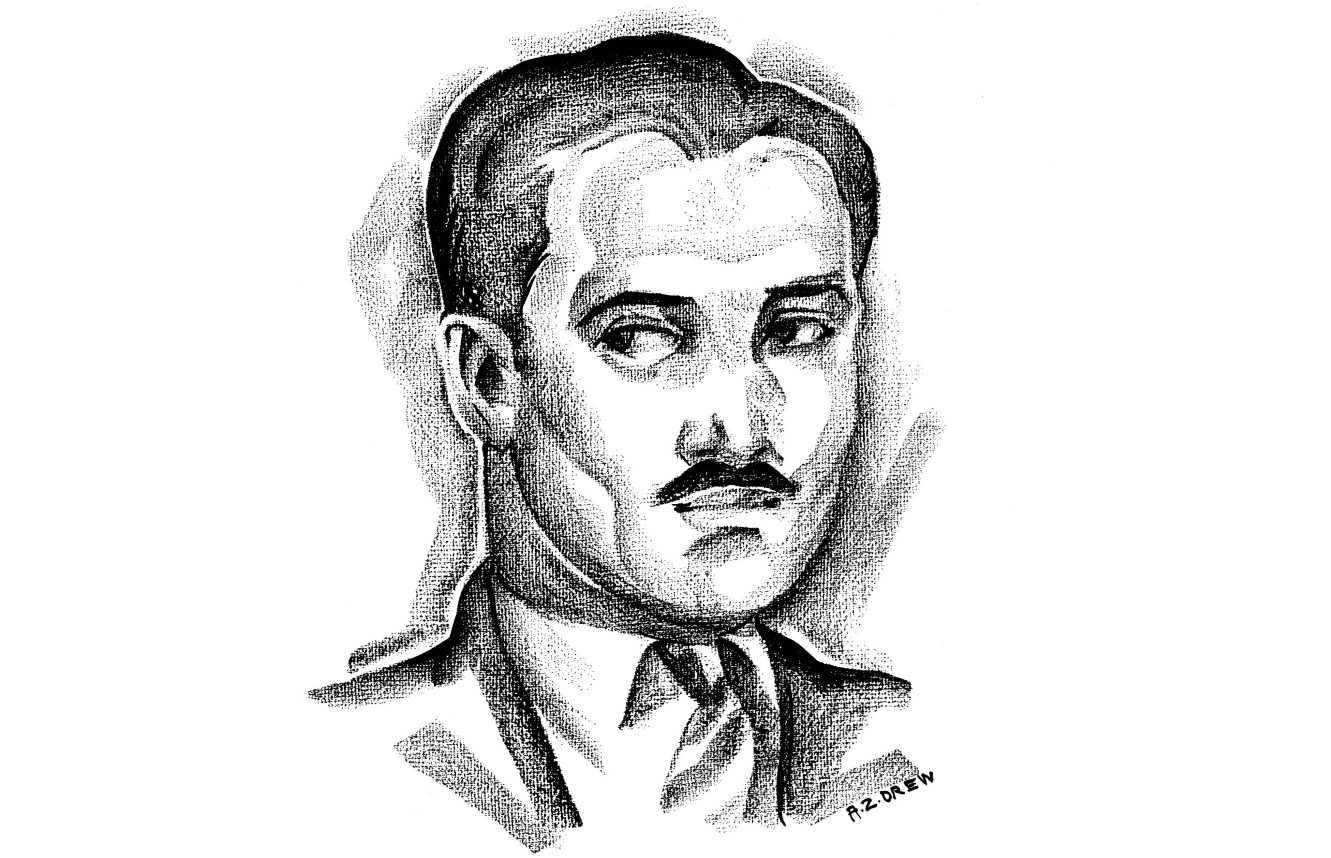
One of our history’s political prisoners that should be better known. Able to elude police for several years despite $25,000 on his head, Matthew Schmidt was arrested in September, 1914 for the Los Angeles Times bombing of 1910 for which the McNamara brothers were serving time. Sentenced to life for providing the explosives, ‘Schmidtie’ was released after a long campaign in August, 1939 after twenty-five years at San Quentin.
‘Twenty Years in Prison’ by Phil McCann from Labor Defender. Vol. 12 No. 11. December, 1936.
A pen-portrait of the second-oldest political prisoner in the world, by a man who knew him in jail.
Very little has been written about Matt Schmidt. Looking at him you immediately gather the impression of efficiency, competence, ability. Why? Well… Matt looks like the expert workmen you see pictured around large projects, like Boulder Dam, Empire State Building, Dnieprestroy, Magnivorsk and Turk Sib railroad. When I saw the picture of Bill Shatoff and Walter Duranty standing beside a finished portion of the Turk-Sib I thought, there’s one of Matt’s pals (Shatoff) who made good in a big way. And Matt is an expert workman in every sense of the word.
Matt has one “bum glim” (glass eye) but his sight is so keen that he can see small guide marks on material. He is a tall man, over six feet, and at present weighs about 200. He carries his weight well, and although inclined to look fat, Matt is exceptionally strong. I saw him lift heavy machine parts in the San Quentin jute mill that made many a convict nearby exchange looks of admiration. Matt was the trusted friend of such men as Ed “The Rear” Nockles, Anton Johannson, John McNamara, Alexander Berkman. With few exceptions all his friends were leaders in the labor movement, big tough, hardy fighters all; ready to get out on a picket line at any time, always spoiling for a fight, and trusted wherever union men gathered.
Jim McNamara and John Cornelison were comparing Matt with Harry Donlin. Harry came to San Quentin after the San Francisco General Strike. Jim said, “If Harry was taller, he would be just like Matt when Matt was young.”
Harry Donlin was a leader of one of the “star gang” of longshoremen. He is better built, and in as good condition as most middle-weight boxers. He can hit like a mule’s kick, has wide shoulders, a deep chest and can work in the hold of a ship thirty-six hours at a stretch. While boxers can punch bags, skip rope and trot on highways, few of them ever do longshore work.
Standing together one visions the old and the young in Matt and Harry. Matt is past fifty, Harry not yet thirty. We often argued how they would look together if both were the same age. Jim McNamara has great faith in Harry, he sees in him a future leader of waterfront workers. Matt likes him as well, and takes time to school him on strike tactics.
Matt’s ability would be recognized anywhere. He has been convict-foreman of many shops in the prison. He has served under many wardens, all of whom have called on him to aid in the installation of new machinery, the erection of buildings, and the safe-guarding of the prison from fire hazards. For many years he held a responsible position in the prison furniture factory. He kept his books in a small cubby-hole “office” in the factory, and often loaned them to convicts whom he found interesting. Most of his books have been sent to him by the authors. Robert Joyce Tasker, author of “Grimhaven,” got his first lessons in advanced literature from Matt and his books. Ernest Booth read many of Matt’s books, and from his reading and studies wrote such masterpieces as “Ladies of the Mob,” “Stealing Through Life” and “Ladies in Durance Vile.”
Matt and Big Bill Haywood were great friends. He told many stories of Bill, of his activities in the Western Federation of Miners, later in the Wobblies, and of his going to the Soviet Union, and his death there. Some day a biographer will get Matt into a corner and drag out all those stories and become famous when they are compiled. The chief difficulty is getting Matt to talk. I said “Hello” to him for six months, before I could get him to stop and talk a while. He was always busy. When I got to prison he was the “Chief” of the prison fire department, his immediate aide being Norman Shelby, known to the world as Kid McCoy, champion pugilist. As the fire department was outside the walls, Matt slept out there. He was allowed to roam about the prison at will, day or night. Guards on the ground and walls called to him as he walked about. His tall, erect figure commanded attention from everyone, even lowbrow guards.
Prisons change their methods, their procedure and their treatment of prisoners. When the “red herring” was dragged across the prison, the guards and officials became jittery. Since guards and officials usually have warped brains, it was no wonder they wrongly estimated the growing uneasiness that swept the prison during the time when the Sacramento defendants entered. They thought such an entry would be the spark that would touch off a prison rebellion led by the class-war prisoners of San Quentin. Nothing could have been more absurd. Had they judged the other way, their judgment might have been nearer the truth. For I personally know of many times when all of the class-war prisoners calmed down hot-headed sympathizers who wanted to “start something” over any of the various evils which infest any prison. Matt and Jim were particularly active in stopping such abortive movements. I’ve often heard Jim say, “This is no place to start trouble. Get on the outside and organize the workers, then you’ll have some backing. In here all you’ll get will be bullets and no results.”
Mainly Matt’s ability is around wood-working machines. At the time the Los Angeles “Times” case broke, Lincoln Steffens obtained the promise of the authorities that Kaplan and Matt Schmidt would not be prosecuted since the McNamara brothers pleaded guilty and that should settle the case. Matt was working selling wood-working machines during the period following the trial. As the Burns Agency had a reward posted for him, he had returned from abroad thinking he was safe in this country.
One day he was demonstrating an intricate machine to a prospect. The buyer was impressed by Matt’s clear understanding of wood-working machinery. He looked at Matt intently many times. With a $25,000 reward hanging on his head Matt became suspicious. of the buyer’s attentions. Finally he said, “There is only one other man who knows wood-working machinery as well as you. If I didn’t know you so well, I’d say you were him.”
Matt became calm, looked squarely at the buyer. He smiled and asked, “Who is this fellow and what company does he work for?”
“Oh, you don’t know him,” he replied, smiling. “his name is Schmidt. But he is out of this country now, and the police are looking for him because of some labor trouble that took place out on the Coast.”
Matt stood stock still. They were in an office with many people about. Escape would be impossible once the alarm was spread. Think of what $25,000 would buy. He decided to bluff his way through. He laughed, admitted he knew “Schmidt” and invited the buyer out for a drink. The pall of suspicion broken, he and the buyer became good friends. Later, when Matt’s picture was printed in the papers the buyer feared to tell of meeting the actual Matt Schmidt.
There are many traits to Matt that are well-known but little publicized. I know Matt won’t like it when he learns he is being written up in papers. I don’t think there is a large organization, wood-working or mechanical, who would hesitate to employ Matt despite his years in prison. He is able, well-versed and has kept pace, not only with technical and mechanical progress, but with economic and political changes.
We who have been in prison with Matt know his worth and we’d like to see him on the streets again where he rightfully belongs.
Isn’t twenty-one years sufficient to serve in prison for labor?
How much longer will American labor leave him there?
Will protests, resolutions, demands accomplish results?
Try it and see.
Have your labor or fraternal organization demand the release of Matt Schmidt and McNamara.
For twenty-one and twenty-five years they have been patient-waiting-knowing that the workers of America have not forgotten. Shall there be more prison years?
Get busy today while the campaign is on. UNCONDITIONAL RELEASE OF MATT SCHMIDT AND JIM MCNAMARA!
Labor Defender was published monthly from 1926 until 1937 by the International Labor Defense (ILD), a Workers Party of America, and later Communist Party-led, non-partisan defense organization founded by James Cannon and William Haywood while in Moscow, 1925 to support prisoners of the class war, victims of racism and imperialism, and the struggle against fascism. It included, poetry, letters from prisoners, and was heavily illustrated with photos, images, and cartoons. Labor Defender was the central organ of the Scottsboro and Sacco and Vanzetti defense campaigns. Editors included T. J. O’ Flaherty, Max Shactman, Karl Reeve, J. Louis Engdahl, William L. Patterson, Sasha Small, and Sender Garlin.
PDF of full issue: https://www.marxists.org/history/usa/pubs/labordefender/1936/v12-%5B10%5Dn11-dec-1936-orig-LD.pdf
 Revolution's Newsstand