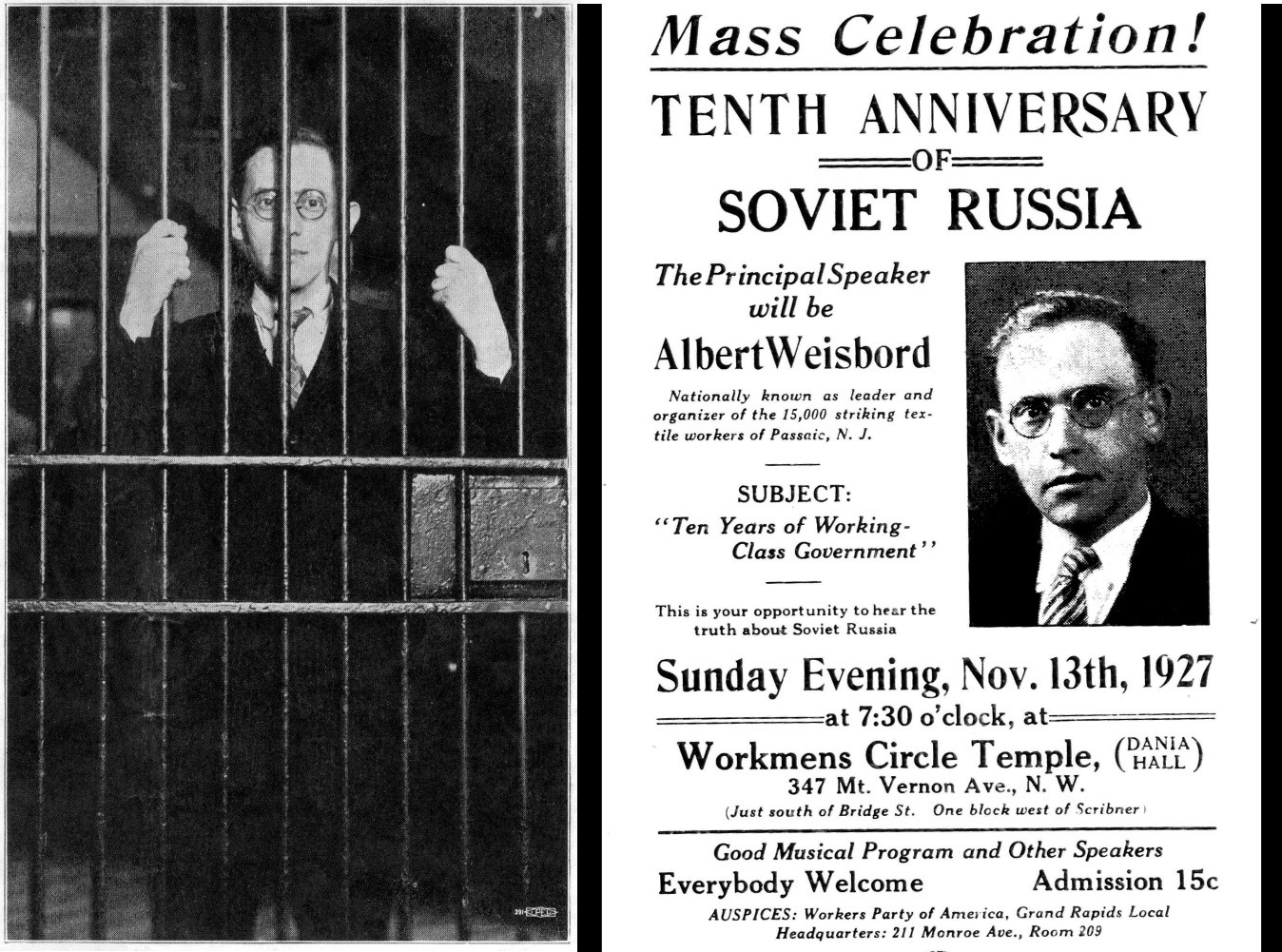
Expelled from the Communist Party in 1930 and formed in 1931, the militants of the Communist League of Struggle, led by Albert Weisbord and Vera Buch, considered themselves adherents of the International Left Opposition until breaking off relations in 1933. As part of an extended tour in 1932, which included visiting Trotsky in Prinkipo, Weisbord met many dissident European Communists and wrote this report on his return.
‘A Report on the European Sections of the International Left Opposition’ by Albert Weisbord from Class Struggle (C.L.S.). Vol. 2 No. 9. October, 1932.
In the course of my trip through Europe which took me through practically all of the principal countries from Turkey to Spain, I was able to visit many of the sections of the Left Opposition and to talk to many of the leading comrades. The following report, therefore is the result of various conversations with leading comrades who vouch for the accuracy of these reports. It will be seen that the Left Opposition has grown up. It has propaganda groups in many European countries. In Greece, in Spain, and to some extent in Germany, it has passed the stage of mere propaganda and especially in the first two countries has carried on independent action on the working class that has placed the groups in Greece and in Spain really ahead of the official Communist Parties themselves. In practically all cases the leadership is composed of men between 30 and 40 years of age with several older comrades and a good sprinkling of youth. Such a combination offers a guaranty that both a continuity of revolutionary experience will be absorbed and a constant adjustment to new events made.
I speak of the “International Left Opposition” but in one sense I may say that such an International Left Opposition does not yet really exist as a well organized force. This is the most serious defect of the Left Opposition, the correction of which becomes the main immediate task before us. Two principal things are lacking to the Left Opposition. They are first, a collectively worked out and comprehensive program and platform of action, and second, an authoritative collective center. In considering these we must, constantly keep in mind that although the Russian Left Opposition began its fight in 1923 the majority of the other sections were not formed till after Trotsky’s expulsion and deportation in 1928 or so. The many internal fights these groupings went through, their different levels of development, their different problems and conditions all naturally would compel sooner or later the calling of an international convention.
It is a fact that this convention has never been called. We have the many and brilliant articles and books by Comrade Trotsky setting forth our viewpoint and guiding, us in our problems. However, in spite of the general correctness and value of those writings, they cannot replace entirely the collective labor possible through a congress and through a capable political executive. The result of this state of affairs is very serious and has been one of the chief reasons hindering the more rapid growth of the Left Opposition. There exists a multitude of vital questions which can not be touched by Comrade Trotsky in his writings. This compels the various sections to do one of two things: Either to ignore these vital questions—as for example the Communist League of America (Cannon group) does with the Negro question—waiting for Trotsky to speak, or to take a positive action not knowing what action is being taken in other countries and risking a criticism from Trotsky. In either case the prestige of the leadership of the National groups suffers. If this is continued the Left Opposition will tend to become either a grouping of rubber-stamp yes-men who will lose all semblance of independent Marxist character and who will tend to become like the pitiful Stalin functionaries, or on the other hand while subscribing formally to abstract documents each grouping will take its own independent position on national questions. We have seen both these tendencies strongly marked in the United States.
The second defect, the lack of an authoritative political center is linked up with the first and greatly aggravates the whole situation. In 1930 a few comrades came together and “chose” a political bureau and a secretariat. The political bureau never, functioned. The secretariat in Paris headed by Hill took on political functions. But it was not a very strong secretariat. It had not been chosen on the basis of merit after examination by delegates at, a Congress. It was this secretariat that in a most bureaucratic way excluded the Communist League of Struggle, our organization, from the Left Opposition and it was against this type of irresponsibility against which the Communist League of Struggle had to fight.
This secretariat, engaged in constant bickering could not last long. (At first Roemer acted as secretary in fact. Then Suzo, Mill and P. Naville succeeded him, Naville soon reigning and being replaced by Frank. The whole secretariat lasted one year in Paris.) It was moved to Berlin with another personnel chosen in the same obscure manner. But this secretariat also does not function well. Because of the lack of a strong central discipline and adequate system of reports and minutes, there exists the possibility of groups carrying out a right wing policy while waving the banner of the Left Opposition, Here again we are reminded of the American League.
It is all the more remarkable then that in spite of all this the Left Opposition is growing. This speaks volumes both for the basic correctness of our principles and the tenacious work of the various groups.
The strongest group seems to be in Russia. According to Yaroslavskys figures given out 1929-1930, the last ones issued, over 7000 Left Oppositionists were either in prison or in exile in the U.S.S.R. Actually there are many more and to this must be reckoned the host of sympathizers and formal capitulators. Each year new batches are discovered and imprisoned, but the work goes on. In spite of everything a hand paper—the Bolshevik Fighter—is put out and from time to time other illegal papers appear. The deportees have their own conspiratorial paper. Besides this the Russian Bulletin put out in Berlin has a circulation of about 5000.
After Russia comes Greece. Here the Greek organization, the Archic-Marxists organized in 1922 and only by a long process found themselves in 1930 affiliated with the Left Opposition. Due to its capable and energetic work the Left Opposition group there now is really stronger than the official party. It has 1500 members and operates both legally and illegally. Its journal issued three times a week with over 7000 circulation is legal. It also controls unions which are legal and has over 20,000 members. It puts out a theoretical journal called Masses which has a circulation of about 4000 and also a Greek-Jewish paper. In Athens, Paraeus and Saloniki are to be found the principal centers of the Left. It has also developed a good Jewish movement and has established a strong Marxist training school.
In Bulgaria the Left Opposition also dates from 1930 when a small group joined. At first the social composition was not very good but it rapidly increased its membership until now it is a real force even though compelled to operate illegally. Its legal paper, Osvodbodjenie (“Liberation”) put out in Sofia at first a monthly now has become a weekly. As in Greece the Bulgarian movement offers much hope.
Roumania, Yugoslavia, Albania have no groups whatever. In Hungaria two years ago there was a big group of young comrades who had even a legal paper.
The situation in Czecho-Slovakia briefly can be recounted as follows. In 1927 a Zinovievist group was expelled by the Party which later formed a block with the right, split into two and then found its leaders, Mihaleo and Neurath capitulate to the Party. A part gravitated to Trotsky, a paper was issued the Iskra. Other little groups also existed and by mutual fusion (Frankel, Friedman tiny groups) at last a group of the Left Opposition was formed. It now has a few dozen members, putting out a paper Delnicka Politika from time to time. The group lives a meager sectarian existence. In Austria, when I visited it, there was no official section of the Left Opposition. There is the Mahnruf group putting out the paper with that name and having very few members in Wien and about 20 members in Gratz. This group is connected with Landau. Then there is the Arbeiter Stimme group led by Frey. According to Frey the history of this group is as follows. In 1922 the group began a fight against the right wing and by 1927 found themselves expelled from the Party. Several errors were committed however, one of them being that as a maneuver the group then passed a resolution against Trotsky. After this the group went down. It entered the Left Opposition only to leave it later because of an internal fight with Landau. Now the group wants to reenter the Left Opposition. It still has near 200 members with a semi- monthly paper, the Arbeiter Stimme, with a circulation of 1400…1800. It runs a school with 40-45 students and controls a club “Arbeiter Kultur Verband”, In my opinion the Arbeiter Stimme group should admit its error in leaving the Left Opposition because of internal struggle with Landau and on that basis should be readmitted into the Left Opposition.
In Poland a group only now is being organized and is putting out a paper. Up to now like Roumania and Yugoslavia, Poland had had nothing. This is also the situation, by the way, in all the countries of the Baltic with the exception of Russia and Germany.
In Germany the Left Opposition after many vicissitudes is again growing slowly but surely. The Left Opposition was expelled in 1927 and in 1928 Urbahns, Grylevich and Sholem organized a group called the Leninbund, This was split in 1929 over the question of the unconditional defense of the Soviet Union. While Urbahns got most of the 600 members to stay with him, 200 members went with Grylevich, Joko and Landau, who then were for Trotsky. Under the Landau leadership a new paper was issued, Der Kommunist and unity was effected with another group, the Wedding group. In 1931 a new split occurred, Landau being separated from the organization. Now the German Left is on the upgrade again. It founded a new paper—Die Permanente Revolution—first as a monthly and now as a weekly. The circulation is about 2600, with about 500 members in the organization well spread throughout Germany (except Bavaria) with strong centers in Berlin, Hamburg, Ruhr, Saxony, Middle Germany and Baden. The group is now carrying out independent action and participating in the life of the working class. In Oranienburg the Left Opposition was able to initiate and to lead a good united front movement against Fascism. In September a national conference will be held to take stock of the situation and to carry forward the work. The situation in Germany is overripe for a huge growth of the Left Opposition. Trotsky’s influence is enormous. What is needed is the end of picayune internal Squabbles and a bold independent policy of entering into all the battles of the working class.
The situation in France is a very good illustration of what the Left Opposition must make every effort to terminate. In all France in spite of the many sympathizers to the Communist League of France there were very few members. At one time there were five different groups claiming to be near Trotsky. To understand the situation it is necessary to give a bit of the history of the movement. In 1924 Souvarine was expelled from the party. He organized a group called the Communist Democratic Circle which now has about 20-30 members. A weekly paper was published called the Bulletin Communiste. Later the group became a study group, the paper changed to a monthly till 1930 when a new bimonthly review was issued “La Critique Sociale”.
At the same time in 1924 a few months after he had joined the Party Monatte, former syndicalist, was expelled. He too put out a paper, now semi-monthly, called La Revolution Proletarienne. In 1926 Treint, then Zinoviev leader, was expelled. In 1928 he organized a group called “Redressment Communist” with about 50 members and as a fraction of the Communist Party of France put out a paper “L’Unite Leniniste”.
In 1922, Paz organized a group for the Left Opposition and for a time was the official representative of the Left Opposition in France. Still there was no real organizing work done. Finally Claude Naville, one of the editors of Clarte, an organ close to the Party, and also a Party member, after a trip to Russia where he met Comrade Trotsky, organized another group and founded a monthly paper La Tutte de Classe with about 10 members. Thus there were five groups in 1928-1929 all negotiating with each other.
The deportation of Trotsky to Turkey rapidly changed this situation. After a visit by Roemer, Frank and R. Moliniere, Trotsky decided to break up these little groupings and organized around P. Naville a new official group. This marked the formation of the Communist League of France. Paz being dismissed as Left Opposition representative rapidly went to the right and soon joined the Socialist Party.
On the Trade Union field the Communist League quickly dissociated themselves from Monatte and built up a circulation of 1000 readers for La Verite and 800 for the Lutte de Classe, the theoretical organ. A Jewish paper was started, Klarkhieit, and had a circulation of 600-700, but it soon died.
In the course of the Trade Union work of the League differences arose with comrades Rosmar, Gourget and C. Naville who left the League (they were not expelled) and with 15 members have organized another group. They work with Landau and put out a mimeograph paper in 1931 called “Le Communiste”.
Then Treint came into the Communist League of France but soon left (May 1932) with 5 or 6 members and organized another group. He has put out a typewritten “Bulletin de la Fraction de Gauche” his main point being that the Communist Party is not a Communist Party but a vague, revolutionary party and the Communist League of France must be the Communist Party and so we must organize a party within the Communist Party. Thus he was opposed to the Rakovsky statement.
Within the Communist League of France other differences arose on the Trade Union question, first the League headed by Mill against P. Naville, and the Italian comrades and later Mill switching his position, the League against Mill. The issues were (1). Shall we demand unity with the reformist unions on condition they take the line of the class struggle or only on the condition they allow complete democracy within the unions? The latter position being that of the League. (2). Shall the Communist League be bound by Decisions made by a trade union bloc, “The Trade Union Unitary Opposition”. The League stressed the need of complete freedom of action for itself in all blocs. After being defeated Mill has practically left the organization, not taking any part in activity.
And now a new question arises regarding the Italian comrades, whether they are to enter into the French League to do work, except those needed for other work, or are they to remain an independent group.
From this report one can see clearly the weaknesses of the French Opposition. In spite of some very very propaganda the French opposition remains very poorly organized.
In Belgium the League organized in 1930 with Comrade Lesoel now has a considerable group of members with a good nucleus in Charleroi. It issues a semimonthly paper La Voix Communiste with a circulation of about 1000. It has a good basis for growth. In Holland and Portugal there are no groups. In Great Britain a few contacts exist. In Switzerland a group of 20 exists which puts out a monthly mimeographed bulletin. In France a new Italian Left Opposition has been organized in contradistinction to the “Left” Bordigiste. It consists of experienced members who under the leadership of Feroci puts out a mimeographed Bulletin.
It is the movement in Spain that offers the most encouraging results at the present moment. The group is really in existence a little over a year and in that time has accomplished considerable work. The first conference of the Spanish Left Opposition was held in Luxemburg in 1929 with La Croix and five other members present. In 1930 another conference was held this time in Madrid with about the same number of people (Nin, La croix, Andrade, Fersen) but it was only in the early part of 1931 that the Left Opposition really began to grow. The recent conference held in April 1932 with 25 delegates represented over 1100 members. Within a year it has put out a paper El Soviet now struggling to become a weekly, with 5000 circulation. It has issued a theoretical organ, Comunismo, with 1500 circulation and over 15 popular pamphlets have been printed with a large sale. A youth paper Young Spartacus recently appeared which it is claimed sells 2000 copies. In quality the Left Opposition is stronger than the Party (though not numerically: the Party having about 5000 members) and in many places the Left Opposition has groups where the Party does not (as in Salamanca). The last conference found the Left Opposition best developed in Biscay, Asturias, Castille, Andalusia, (Seville, Cadiz) Barcelona and Madrid. (However the group in Barcelona is numerically relatively small, considering the importance of the place).
The last conference of the Left Opposition accomplished a good deal and worked out elaborate theses on the situation in Spain, the position of the Left Opposition on the National and Agrarian questions, their relation to the Party and to the Syndicalists and on the Trade Union question. Within the Left Opposition differences are arising as to the correctness of the Spanish comrades but two things stand out clearly: 1. The great growth of the Spanish Left Opposition due to its bold independent working class activity. 2. The recognition it has received as the most dangerous revolutionary force in Spain. In Catalonia only the Left Opposition is illegal (the Communist Party is legal there) and the Chief of Police in a special brochure has declared that Spain must account it as a stroke of good fortune that the Communist Party has ejected the Left Opposition and that the Leaders of the Left opposition are not the head of the Party (see Maurice Karl: Communism in Spain pp, 91).
To recapitulate the press activity of the sections of the Left Opposition in Europe I bring forward the following table:
Russian———–Printed monthly, Russian Bulletin with 5000 circulation
Greece————Printed 3 times a week Pali Ton Taxeon 7000
Jewish Paper, Proletarian, semi-monthly
Theoretical review Masses 4000
Bulgaria———-Printed weekly, now, Osvodbojenie
Poland————new paper just printed.
Czecho-Slovakia—Printed irregularly, Delnicka Politika
Germany———–Printed now weekly, Permanente Revolution 3000
France————Printed La Verite, semiweekly now 1000
Theoretical organ, Lutte de Class 800
Belgium———–Printed semi-monthly, La Voix Communiste 1000
Switzerland——-Mimeographed Bulletin, monthly
French-Italian group——-Mimeographed Bulletin
Spain————-El Soviet, printed now put out as weekly 5000
Communismo, theoretical monthly 1500
Young Spartacus just out 2000
Besides this there is issued regularly a mass of mimeographed material. International Bulletins in four languages, internal bulletins, etc. Many of the sections have done valuable propaganda work in the form of pamphlets and books on various important questions.
In conclusion we may say that in Spain, Greece and Bulgaria the Left Opposition seems to be advancing rapidly, in Germany it is growing slowly but surely, while in other countries it is still in its first immature stages. The history of the Left Opposition can be divided into several phases. Up to 1928 there was no International Left Opposition but only a Russian section fighting for an internationalist position. After 1928, with the expulsion and deportation of Trotsky sections appear in various countries but it is only in 1930 that the really important groups became clarified (Greece, Bulgaria, Germany, France, Spain) and began activities as real sections of a Left Opposition. 1930 is also the year when the first attempt was made to organize an international secretariat and bureau. This marked the beginning of the third period of the Left Opposition, a period in which a number of the sections began to carry on independent activity and to grow.
Now we are ready to enter into a new phase of our development. This phase should be opened up with a real international congress and a collective political authority set up. The development of the left opposition since the first international conference (April 1930) has made it necessary and possible for the various sections to proceed as soon as possible from the state of a propaganda group solely to that of an organization which though a fraction of the Communist Party yet carries out independent action of the workers.
Wherever I stayed, as in Austria, Germany, France and Spain, I spoke to the Comrades on the American situation bringing home to them the position of the Communist League of Struggle. I am happy to say that everywhere I was treated in a most friendly fashion, the leaders assuring me that there was no principled reason why the Communist League of Struggle should not be part of the Left Opposition and why there could not be a unification of all Left Opposition forces in America. It is for our group to continue its loyal service as part of the Left Opposition until it is victorious.
Albert Weisbord—August 16, 1932.
The Communist League of Struggle was formed in March, 1931 by C.P. veterans Albert Weisbord, Vera Buch, Sam Fisher and co-thinkers after briefly being members of the Communist League of America led by James P. Cannon. In addition to leaflets and pamphlets, the C.L.S. had a mostly monthly magazine, Class Struggle, and issued a shipyard workers shop paper,The Red Dreadnaught. Always a small organization, the C.L.S. did not grow in the 1930s and disbanded in 1937.
 Revolution's Newsstand