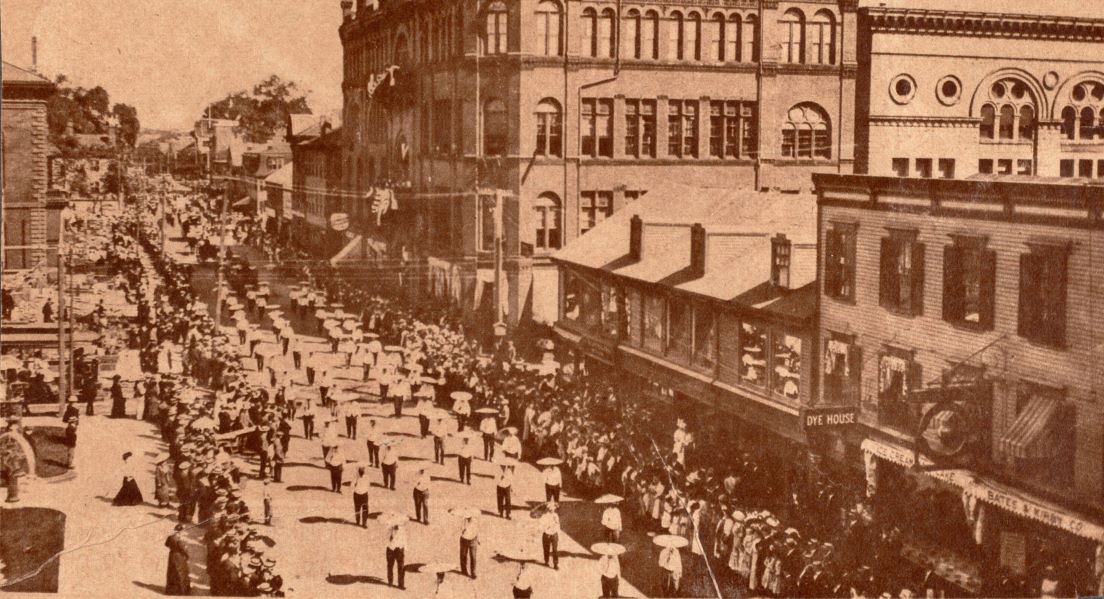
The Socialist Party’s leadership meets in Boston and participates in that city’s ‘biggest May Day parade’ in 1911.
‘Biggest May Day Parade in Boston’ from The New York Call. Vol. 4 No. 123. May 3, 1911.
Keynote of Demonstration Was Protest Against Capitalistic Injustice.
BOSTON, Mass., May 1. The greatest Socialist demonstration ever held in Boston and one of the most pronounced protests against capitalistic injustice ever registered by organized labor of New England was the May Day parade, with its series of meetings, held this evening, in which thousands of laboring men, Socialist and non-Socialist marched in a monster procession and listened to Congressman Victor L. Berger and the other members of the National Executive Committee of the Socialist party, who met here in annual session.
Although under the auspices of the Boston Socialist party, the demonstration was primarily the annual one of organized labor, insisting upon its demands for more human working conditions and protesting against the kidnapping of McNamara and the injustices of the courts.
Three thousand workers, nearly a third of them women, were in line in the parade, which took forty-five minutes in passing a given point. Prominent in the line were the shoe workers of Chelsea, Mass., who have been striking for nearly three months, and whose latest experience with plutocracy has been the basis for a spontaneous and intelligent organizing of a party branch in that city. Among the many other unions which marched were the cigar makers, the brewers, the bakers, the custom tailors, the cap makers and the bottle makers.
The response of the unions to the party’s invitation to participate in the May Day demonstration was given with a heartiness which was unprecedented, and the occasion, as a whole, showed that labor in the hub is waking up to the true situation. After a long line of march the unions assembled on the Common. Here they were addressed by Congressman Hunter, Berger, Robert George H. Goebel, and Lena Morrow Lewis. In addition to the out-of-town speakers, local propagandists addressed the crowds in many different languages, including Russian, Polish, Danish, Finnish and Jewish.
Crowd Overflowed Common.
The speaking was carried on from eight stands, and the crowd over flowed the Common. Estimates of political gatherings vary greatly, but the most conservative enumeration of the crowds on the Common placed the figures at from five to seven thousand.
The probabilities are that the numbers considerably exceeded this figure. Among the Socialists were the members of the Socialist locals from Lynn and Fitchburg. Mass., who came to Boston en masse to march in the parade.
The meeting in Ford Hall, which listened to the speeches of the National Committeemen literally exceeded the capacity of the auditorium, which seats 2.600 people. The great majority of the audience were non-Socialists.
The meeting was perhaps the most successful single achievement in propaganda ever effected in this city. Much of the audience was there to be shown, and it was an enthusiastic yet thoughtful crowd that cheered Berger to the echo as he stepped upon the platform.
James F. Carey, formerly Socialist Representative in the Legislature from Haverhill, presided. The other speakers were Robert Hunter, George H. Goebel, John Spargo. Lena Morrow Lewis, J. Mahlon Barnes, Morris Hillquit and Victor Berger. The indignation of the working class against the kidnapping of McNamara was never far in the background. Both in Ford Hall and on the Common resolutions were unanimously passed protesting against the illegal proceeding, and voicing the determination of labor to gain control of the legislative and economic centers of power which now keep the workers enslaved.
The Executive Committee meeting in Boston has been the center for a in series of propaganda meetings nearby cities. Comrades Berger and Lewis addressed large audiences at Lynn. Comrade Hillquit spoke with much effect at Brockton, and Comrade Spargo delivered a lecture to the newly organized and vigorous Boston chapter of the Intercollegiate Socialist Society. A number of other similar meetings are planned for this week.
The New York Call was the first English-language Socialist daily paper in New York City and the second in the US after the Chicago Daily Socialist. The paper was the center of the Socialist Party and under the influence of Morris Hillquit, Charles Ervin, Julius Gerber, and William Butscher. The paper was opposed to World War One, and, unsurprising given the era’s fluidity, ambivalent on the Russian Revolution even after the expulsion of the SP’s Left Wing. The paper is an invaluable resource for information on the city’s workers movement and history and one of the most important papers in the history of US socialism. The paper ran from 1908 until 1923.
PDF of full issue: https://www.marxists.org/history/usa/pubs/the-new-york-call/1911/110503-newyorkcall-v04n123.pdf
 Revolution's Newsstand