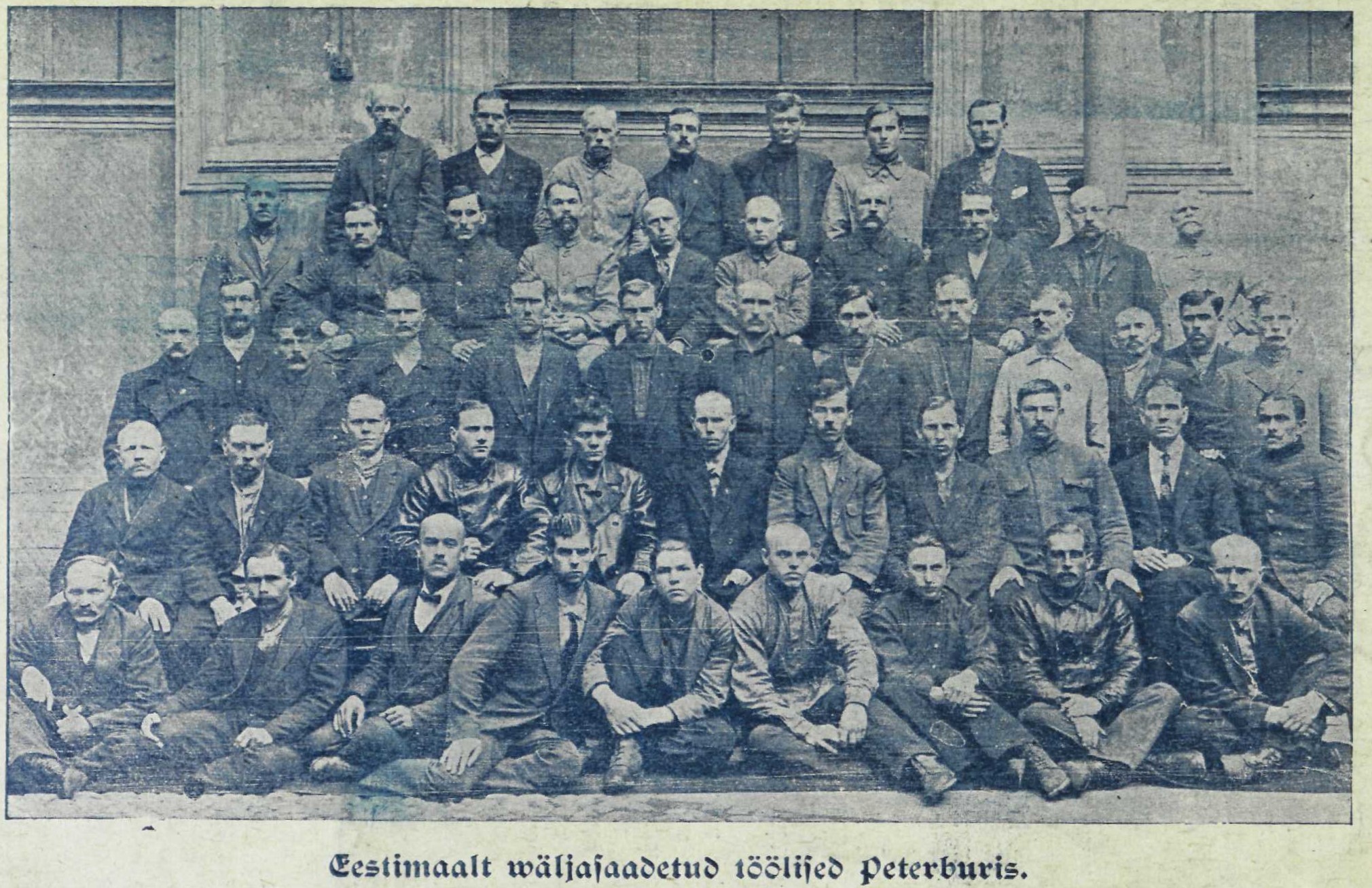
Formerly part of the Russian Empire, the Baltic states of Lithuania, Latvia, and Estonia, had strong, even briefly successful, revolutionary movements in 1917 and after, only to be decimated by foreign intervention and indigenous reaction in the early 1920s. The report of each Communist Party to the Sixth Comintern Congress.
‘Reports of Esthonia, Lithuania, and Latvia’ from The Communist International Between the Fifth and the Sixth Congresses, 1924-28. Published by the Communist International, 1928.
ESTHONIA
THE ECONOMIC SITUATION OF ESTHONIA.
During the first five years following the formation of the Esthonian State the Esthonian bourgeoisie were able to maintain their economic position with the aid of the gold which they received from the Soviet Union in accordance with the peace treaty, augmented by the yield from transit traffic and orders for locomotive repairs in 1981-22. But already in 1924 a severe crisis set in. This economic crisis, which severely shook Esthonia, was somewhat alleviated at the end of the year by the restriction of imports, by high protective tariffs, by the restriction of credit to industry and trade, by the reduction of the number of State employees and by wage cuts.
In 1925 there developed a partial stability, which, based mainly upon the development of agriculture, lasted until the end of 1927. Since then serious signs of crisis have made themselves evident in agriculture, but thanks to the loans granted by England an acute crisis has not yet broken out.
The large-scale industries, which were adapted to the requirements of old Russia, have been destroyed almost entirely in the metal industry and to some extent in the textile industry. There only remained the woodworking and paper industries, which mainly supply the U.S.S.R. The number of industrial workers is about 29-30,000.
The increase in textile production by about 70 per cent. between 1922 and 1926 is chiefly to be accounted for by the development of petty handicraft working almost exclusively for domestic consumption.
The rationalisation of industry on the one hand led to the closing down of less profitable enterprises, and on the other hand to a trustification of the larger plants. Thus, for example, the match industry is entirely in the hands of the Swedish Match Trust. At the present time negotiations are under way regarding the trustification of the tobacco industry with the aid of foreign capital.
AGRICULTURE.
After the crisis of 1924 the Esthonian bourgeoisie firmly set itself the task of the agrarianisation of the country. Certain positive results have been attained, especially in the export of the products of cattle farming. This is also responsible for the favourable trade balance of the last three years.
On the other hand, land cultivation has no particular future, as is clearly shown by the stagnation of this branch of agricultural production since 1923, the total value of whose products has remained practically unchanged since this time. The result is a rising land indebtedness.
THE POLITICAL SITUATION.
During the ten years of “independence” there has prevailed in the field of foreign policy a leaning toward Great Britain on the part of the Esthonian bourgeoisie. Among all the bourgeois parties, from the Fascist Peasant League to the Social Democrats, not a single group opposes this orientation towards Britain. For the last three years the Esthonian bourgeoisie, with the full support of the Social Democrats, is working for the establishment of an alliance of the Balkan States headed by Poland. The loan of one and a half million pounds sterling by England in 1928 still further strengthens British influence in Esthonia. In recent months the government has conducted negotiations with the Swedish bourgeoisie for a short term loan for railway building, mainly for military purposes. The Esthonian government sold to the Swedish Match Trust on extremely favourable terms the entire Esthonian match industry, and used the proceeds for the building of railways for military purposes.
The Esthonian bourgeoisie follows a hostile policy towards the Soviet Union. Negotiations for the conclusion of the trade treaty with the U.S.S.R. were dragged out by Esthonia.
As to domestic policy, the ruling circles have more than once considered the possibility of a coup d’etat. At present, however, there seems to be no immediate danger in this direction as the Fascist Parties hope to get the same results in a “legal” way, viz.: by the restriction of the suffrage and the introduction of a president. On the latter question, however, most of the bourgeois parties still consider it advisable for the time being to maintain the status quo, since, as the bourgeois Press writes, “there is no objective need for a change in the constitution.” As regards the suppression of the revolutionary movement there is full unanimity between all parties, including the Social Democracy.
The Social Democracy (“Esthonian Socialist Labour Party”) has succeeded in strengthening its position, thanks to the white terror which is directed against Communist workers. It has about 2,300 members. Inside this Party there is a so-called “Left” group which confines itself solely to Left phrases but which has little influence. At the present time a considerable section of the workers are under the influence of the Social Democrats.
The second Socialist Party—the “Esthonian Labour Party”—is a really Left party, but it is weak and its membership is small. Its leaders consist of radical intellectuals who have attached themselves to the revolutionary movement but who fail to understand the theory and practice of revolutionary struggle.
TRADE UNION MOVEMENT.
Already since the end of 1926 there has been a noticeable revival of the Labour movement. The tempo of development is slow, however, which is explained both by the economic situation and by the white terror.

The feeling of discontent among the industrial workers is again beginning to express itself, which can be observed in the efforts to organise class trade unions. In 1927, against the will of the Social Democrats, the trade unions organised two workers’ delegations to the U.S.S.R., which, upon their return, contributed considerably to the quickening of the labour movement (the Social Democrat Rukki was threatened with expulsion from the Party by the Social Democratic C.C. because of his objective statements in regard to the U.S.S.R.).
In 1926-27 a number of small strikes occurred owing to failure to pay wages on time. In April, 1928, a dispute in the book printing trade led to a complete strike throughout the trade, which has already lasted almost two months. The employers are trying to break the resistance of the strikers with the aid of strikebreakers. Another strike, the results of which are not yet known, has broken out in the clothing industry.
The situation in the Esthonian trade union movement is a peculiar one. The workers who were adherents of the revolutionary trade union movement were at first hostile to the trade unions as re-established by the Social Democracy. Furthermore, the leaders of the Esthonian Labour Party believed that it was correct to support such Left tendencies among the workers. The Social Democracy exploited this hostile attitude on the part of the workers and organised new trade unions, mainly among the land and forest workers, and secured the leadership for itself. The Social Democrats are able to carry out this organisational work, especially in the agricultural districts, as they are favoured by the authorities, whereas the Left are constantly persecuted and arrested or forbidden to hold meetings.
With the support of the police and with the aid of blatant forgeries the Social Democrats, in January, 1928, organised the third Trade Union Congress (the first regular congress after the smashing of the trade union movement in 1924). The subservient majority of the Congress decided in favour of affiliation of the Esthonian trade unions to the Amsterdam International.
The temporary victory of the Social Democrats was facilitated by the attitude of the leaders of the Labour Party, who, prior to the Congress and during its preparatory campaigns, followed a wrong policy by advocating the workers to boycott the reformist unions, while at the same time, through their clumsy maneuvering, fostering the work of splitting the unions. Against the “radicalism” of the Labour Party leaders and also against the distortion of the trade union policy, our Party waged a determined struggle, and was able to win important successes on this field. The “radical” moods of the masses of workers were gradually overcome. The great majority of the Reval trade unions is under revolutionary leadership, and is affiliated to the Reval Trade Union Council. The Party resolution on the tactics of trade union work which was confirmed by the Comintern is being carried out in all trade unions. The number of workers joining the unions is increasing, both as a result of a certain revival in the labour movement and in consequence of educational work based on Party decisions. The struggle for the leadership of the reformist trade unions is becoming more acute. In the struggle against our growing influence the reformists are resorting to the dissolution of such departments of the trade unions as are under the leadership of Left workers (e.g., in the land and forest workers’ unions).
DEVELOPMENT AND ACTIVITY OF THE COMMUNIST PARTY.
Until 1924 practically all labour organisations were under our influence. Also among the toiling rural population, among the poor peasants, our Party had considerable sympathy. On December 1, 1924, when the complete political and economic ruin of the country was obvious to all, our Party decided unanimously on an uprising to overthrow the bourgeois regime. The uprising ended in defeat. A ruthless white terror began. In the course of 1925 and the first half of 1926 about twenty trials took place in the military courts, in addition to the proceedings in field courts martial. About 300 people were shot and 800 imprisoned for various terms for participation in the uprising. The most prominent illegal functionaries of the Party were murdered either by the verdict of the field court martial (e.g., Comrade Reysmann in 1926) or whilst under arrest (e.g., Comrade Leiner in 1927). The terror continues up to the present time, only the methods of persecution of the revolutionary workers have changed somewhat : the secret police are making the greatest efforts to recruit spies in order to get a foothold in the legal organisations, so as to support the Social Democrats on the one hand, and on the other to get on the track of Communist workers. Prior to May 1 numerous arrests were made among the workers as well as among the leaders of the Labour Party. Nevertheless, the Communist Party of Esthonia has recovered, and its influence among the masses of workers has extended. The best proof of this is its influence in the trade unions, and the demonstrations on May 1, 1928.
In the period between the Fifth and Sixth World Congresses of the Communist International there were held two Party conferences and one conference of participants in the armed uprising. The conference which took place at the end of 1926 recognised that in Esthonia partial stabilisation had been attained, with the support of British imperialism, after the uprising, and that this required a corresponding tactic to be adopted by the Communist Party of Esthonia. In the Party itself there are no ideological differences of opinion. While the Trotskyist opposition did make an attempt to carry a factional struggle into the illegal organisations, it met with decided resistance and gained no ground among the Esthonian workers.
The work among the peasantry was expressed mainly in the agitation among the agricultural labourers and poor peasants, and in the utilisation of legal forms for the organisation of broad masses of peasantry. A series of campaigns was organised (against the war danger, for the organisation of trade unions, in connection with unemployment, for economic rapprochement between Esthonia and the U.S.S.R., for the sending of a workers’ delegation to the U.S.S.R., etc.).
PRESS.
The publication of Communist literature is forbidden. In Reval there is published a legal Labour weekly of a Left tendency, “Kiir’” (The Ray), with a circulation of 5,000, plus a bi-monthly periodical for the toiling youth, “Struggle,” with a circulation of 3,000, and a monthly of the Railwaymen’s Union, “The Railwayman.” From the publishing house of the “Labour Party” a series of pamphlets has appeared (report of the workers’ delegation to Russia, letters from prison, and some contributions in a more popular form).
From the publishing house of the Communist Party there appears illegally the newspaper “Communist” (once every two months, with a circulation of 1,000 to 1,500 copies), and an organ of the Young Communist League, “The Young Proletarian” (appearing monthly in an edition of 1,500 copies). Furthermore, during the period of this report about 65,000 copies of illegal manifestoes, leaflets, etc., were distributed.
The main shortcomings in the activity of the Communist Party of Esthonia are its small numerical strength and the weakness of the lower and leading cadres, in certain cases lack of timely reaction to questions of the day, weak propagandist work, insufficient training of Party functionaries (which is accounted for by the severe illegal conditions and by the lack of strength), and, finally, insufficient work in the countryside.
LATVIA
THE ECONOMIC AND POLITICAL SITUATION,
The Economic Situation of Latvia is determined by two conditions: firstly, its present development is cut off from its natural historic basis, i.e., the U.S.S.R.; secondly, it is between the imperialist states and the U.S.S.R.
The War and the separation of Latvia from Russia destroyed a big basic section of industry, and consequently caused an essential change in the class composition of the population of Latvia.
Agriculture is also experiencing certain difficulties. The sale of the agricultural products of Latvia constitutes a difficult problem, especially on the European markets. The demand of the home market has greatly decreased because of the industrial crisis. Latgalle, which constitutes about a third of the country, used to send great masses of workers to the industrial centres of what are now the North East provinces of the U.S.S.R., and now the industrial enterprises of Latvia are unable to absorb this reserve army.
In 1920 79.5 per cent. of the population was occupied in agriculture, in 1926, 63.3 per cent. Generally speaking, agriculture has reached the level of 1913, if we take into consideration. the change in population.

The shortage of production of recent years can be explained by the following: (1) bad harvest; (2) change from ccm growing to dairy farming. The export of butter has been continuously growing during the past six years and has increased more than tenfold. The position of agricultural products in relation to general exports improves from year to year (in 1923—41.8 per cent.; in 1926—55.7 per cent.)
Industry is far from obtaining the pre-war level: in 1910 there were about 115,000 industrial workers in Latvia and now there are only 59,000. The change in the size of the various industrial concerns is extremely marked; in 1910 no branch of industry employed less than an average of 100 workers (119 in heavy industry), whereas in 1927 the average has fallen to 17 workers.
There are only two ways out of this situation for Latvia: to become an agrarian vassal state under any of the existing imperialist countries, or to establish union with the U.S.S.R.
In 1927, under pressure from the workers, a trade agreement was concluded with the Soviet Union; the social democratic leaders sabotaged it for a long time and the present Right government is still sabotaging it in a more forcible and open manner. During the first months after the agreement came into operation it already exerted fruitful influence on the development of the economic life of Latvia. Even the Minister of Labour, Rublis, has to acknowledge that as a result of the first order received from Soviet Russia work was provided for 2,000 unemployed.
These contradictions between the economic and political demands of the ruling class are typical of the entire policy of the country. On the one hand we meet with the slow, but spontaneous trend of economic life towards the U.S.S.R., and on the other the open political attacks of the bourgeois leaders and the bourgeois press on the U.S.S.R., even going so far as to demand the termination of trade relations. Still the bourgeois would hardly contemplate a breach with the Soviet Union without great pressure being brought to bear by the imperialist powers.
The Position of Bourgeois Parties.—There is a strongly marked tendency to consolidate the class forces of the bourgeois around two fascist party groups: the peasant union (the agrarian bourgeoisie) and the nationalists. The petty bourgeois electors in the towns are leaving the democratic centre for the Social Democrats. In the countryside the peasant union is reaping the benefit of the decay of the petty bourgeois group. The leaders of the nationalist group are making tremendous efforts to establish a bourgeois united front.
The Social Democrats during their year in power showed themselves to be the true servants of the bourgeoisie (court-martial and the so-called progressive regime of punishment, ordering ‘incorrigible ’’ political offenders to be flogged, arresting Left workers and carrying on the most bitter persecution of the Left workers’ press, etc.).
The Social Democratic Party is clearly losing its influence amongst the workers. The local municipal elections in 1928 prove this; everywhere where the Left workers were able to put forward their own candidates the S.D. lost the majority of the workers’ votes: Holdingen, Mitau, Tukkum, etc.). Even in Riga, despite the support of the petty bourgeoisie and the intellectuals, the Social Democratic bloc (the S.D., Mensheviks and Bund) lost about 600 votes at the elections, whereas the Left Trade Unions polled 20,649 votes, in comparison with 13,434 at the previous elections.
This brought about a big crisis in the S.D. party. The first sign of this was the secession of the Latgalian district organisation from the S.D. in 1926; it became the independent S.D. Workers’ and Democrats’ party. This departure was followed by the formation of a S.D. group of leaders who openly supported a rapprochement and even union with the U.S.S.R. In the beginning this Left group, which did not go further than Austro-Marxism, succeeded in averting splits in the S.D. party, but when the Independent Socialist Party was formed in February this became more difficult and the real Left elements began to desert the S.D. individually or in groups, and at times in whole organisations. However, it would be rash to conclude that the S.D. is falling to pieces, for the S.D. still has influence over a large group of workers.
The swing to the left of the working masses is reflected in the mass organisations of the workers, especially in the Trade Unions. There is a split in the Latvian Trade Union movement, and so the process of Left development goes on in two ways: the strengthening of the Left Trade Unions and the growth of the Left opposition in the reformist Trade Unions.
The incessant persecution to which the Left unions are subjected prevents their organisational growth from corresponding with their influence, but all the same, during the past year some of the unions have almost doubled their membership, e.g., the metal workers, furriers, woodworkers, the Vindavsky union, etc. In the reformist section of the Trade Union movement the swing to the Left is most noticeable in the workers’ unions.
In the railway union, which has a membership of over 5,000 workers and clerks, the Left wing has developed to such an extent during the past eighteen months that at the last Congress in April it secured almost half the mandates. The Congress proved that this Left wing is not yet sufficiently strong, but it is interesting to note that it is composed of representatives from the most important points: Riga, Dvinsk Libau, etc. There were eighteen representatives from Riga at the Congress and of these eleven were Left wing.
The agricultural workers’ union has a membership of about 2,000, and at its last Congress in March there were 56 delegates, 24-26 of whom were Left-wingers. The Left opposition was able to secure the support of half the Congress for its proposal respecting democracy in the Trade Union movement. The reformists have now begun to have recourse to individual and mass expulsions and the disbandment of entire sections in their fight against the Left wing.
In the general workers’ union, composed of workers of various trades and formed by the Social Democrats as a kind of lever against the revolutionary unions the membership is 4,000, but the Left wing has not been able to strengthen its position, although its growth within the union is considerable. The reformists, in their struggle with the Left wing in this union, disband these sections, within one year seven locals were disbanded: (Rejitzky, Kreslavsky, Lutzinsky, Livansky, Sakkelnsky, Gazenpoysky and Valksky). In other reformist bodies, such as the tramway workers’ union and that of the post and telegraph workers’, there is also a Left wing movement.
The correlation of forces in the Latvian Trade Union movement at present is roughly as follows: membership of the Left Trade Unions is about 10,000, reformists about 20,000. The Left opposition in the reformist unions constitutes about one-fourth of the total membership.
The swing to the Left of the mass of the workers is fairly marked in the Health Insurance Societies. In the Riga Central Society with 15,000 workers, the Left wing polled 1o per cent. of the votes in 1925 and 23 per cent. in 1927; in the Riga General Society with 20,000 workers, the Left wing polled 16.5 per cent. of the votes in 1925 and 35 per cent. in 1927. In the Libau General Society, in 1927 the Left wing polled 37 per cent., in 1925, a very small percentage; in the Tukkum General Society, 70 per cent. in 1927 and considerably less in 1925.
Other mass organizations with a marked Left tendency include the reservists with a membership of over 6,000. Several of the local and central organisations af this body are completely under the influence of the Left wing. There is also a Left wing in the social democratic sport organisation, with a membership of over 4,000, but it has not had any great success so far.

There is no doubt that this body of Left workers seeks to find political expression. The first attempt to meet this tendency was the formation of the Latgalian Social Democratic Workers’ and Peasants’ Party under the leadership of the Sejm deputy, the adventurer Opintzan. This party developed quickly and secured a membership of 1,000 in Latgal. The organiser of the party, Opintzan, soon became afraid of the real Left elements within the party and resigned the leadership. Shortly after this a congress was held in the autumn of 1927, when a split took place; the Left were subjected to fierce persecution. The Left had the majority at the Congress and it was therefore declared illegal; a group of Opintzan’s followers, about fifteen in all, convened its Congress and elected its executive committee. This was the end of this party as a mass organisation of the workers and peasants.
The second attempt to organise a Left political party was the formation of the Independent Socialist Party in February, 1928. This party was founded by a group of radical intellectuals, the majority of whom were in close touch with the work of the Left Trade Union movement. Its actual political course has not yet been definitely put to the test, but the treacherous leaders of the S.D. Party are fighting it ruthlessly.
WORK OF THE COMMUNIST PARTY OF LATVIA.
The Communist Party of Latvia has been illegal and subjected to the severest persecution ever since the Fifth Congress. One-third of the Party membership is in prison. The bourgeois press has repeatedly declared that the C.P. has been finally disbanded, but of late the most reactionary have had to acknowledge that the Party has grown both in number and quality and that its influence on the masses has increased.
Campaigns. The main task of the Party in the period just elapsed has been the struggle against Fascism and intervention and on behalf of a rapprochement with the U.S.S.R. In addition to this there have been campaigns against the prison regime and against unemployment. The Left Trade Unions took the most active part in all these campaigns. In connection with the Fascist danger the Trade Unions held 53 meetings, some of which were attended by several thousands. The Left unions held twelve meetings against the war danger, which were also well attended.
Twenty-six meetings were held demanding a rapprochement with the U.S.S.R., and in connection with these there was a campaign for the despatch of a delegation to the U.S.S.R. Three fairly large delegations were sent to the October celebrations from the Health Societies, Trade Unions, and Co-operatives. Some Social Democrats also participated and were victimised by their treacherous leaders on their return.
One of the biggest campaigns was the campaign against the prison regime with which was combined a protest against the introduction by the Social Democratic government of the so called progressive system of punishment, which would create the most intolerable conditions for those imprisoned. The signal for this campaign was the declaration of a hunger strike by the political prisoners which lasted twelve days. The Left Trade Unions organised 41 meetings in aid of the hunger-strikers; in several instances the attendance at these meetings varied from 2,000 to 4,000. Demonstrations were held in Riga, Windau and Dvinsk. The masses were so stirred that in this campaign against the Social Democratic government many Social Democratic workers also participated; some county conferences also passed protest resolutions (Wolmar, Libau and others). The result of this extensive campaign was that the “progressive system of punishment” was suspended in respect of political prisoners, but now the government is again attempting to introduce it.
An important campaign was conducted in connection with unemployment; the Left Trade Unions held 21 meetings. Demonstrations of the unemployed took place in Windau and Dvinsk, inaugurated and led by the Left Trace Unions. It should be pointed out that demonstrations about current questions were never held hitherto in Latvia. The slogan for this year’s May Day demonstrations was ‘‘Down with Fascism,’’ but the price paid was an intolerable political concession to the Social Democrats not to criticise them during the demonstration. The demonstration was very imposing.
The Party still continues to take a very active part in the economic struggles of the workers, which of late have been fairly widespread. Big strikes continue to take place under the leadership of the Left Trade Unions. The most important strikes, led by the Left Trade Unions, were the dock workers’ strike in Riga and Libau involving about 2,000 workers; the wood workers’ strike in Riga and Mitau involving about 2,000, the shoemakers’ strike in Riga, Libau, and Holdingen and several other strikes in various institutions. With the exception of the dockers’ strike they all ended in a partial victory.
The shortcomings of the Party mainly arise from the difficulties in the way of influencing the Left Trade Unions in an adequate manner, which difficulties were increased by the errors and vacillations in the ranks of the Party. The manner of carrying out the united front policy gives a crass example of these shortcomings. It should be pointed out that the Party maintained an attitude of indifference to the mass movement in connection with the murder of Social Democratic sportsmen in 1925 by Fascists and the exodus of the Left Trade Unions from the reformist federations in Libau in 1928. The Party was also remiss and vacillating on the occasion of the formation of the Social Democratic government in 1926-27. When the new cabinet was being formed after the fall of the Social Democratic government the Party adopted a correct attitude, but did not succeed in having its policy carried out everywhere. The Party delayed too long in taking action against the Riga Left opposition group, though this was, of course, rendered difficult by the illegal position of the Party. This opposition has now been liquidated and the leaders expelled.
Party agitprop work is developing along two lines, printed and oral. Oral propaganda does not give any special results as the most active workers are continually being arrested. In the largest organisations propaganda groups are active, but there has been no decision made so far on the formation of a central propaganda collegiate. Theoretical circles are conducted in all Organisations in accordance with a specified programme. Printed propaganda work is developing quite successfully. During 1927 315,800 copies of 35 manifestoes were published. The following papers are published: “Tsindja,” which appears regularly once a month “Kommunist,” “Bolshevik” (in Russian), ‘”The Young Communist,” “The Flame,” “On the Barricades.” Three journals are published abroad: “Tsinjas Biedrs,” the leading theoretical journal in the Lett language; the mass journal in Russian, “Tovarisch,” and a similar journal, ‘”Latgalischy Tsaynja” in the Latgalian language. Pamphlets are published on important questions relating to the international or Latvian situation. During the first three months of this year ten such pamphlets, with an average of 80 pages, were published in the series entitled the “Propaganda Library.” The Party has neither legal papers nor journals. The Left Trade Unions publish three weekly papers in Lettish, one in Yiddish and one in Russian. The centre for the youth section of the Left Trade Unions publishes its own monthly organ and the Left educational workers also issue their own journal on educational questions.
Fraction work in the Trade Unions is confined to the Left organisations and is only carried on a local scale. In the reformist Trade Unions fractions are active only where there are no parallel Left unions. One of the sections of the Central Executive used to conduct fraction work, but recently a special Trade Union section has been formed. Steps are being taken to organise fractions throughout the country, to extend those that already exist and to form new ones in the reformist unions.
In the Co-operative movement the Party has little influence and the activity of the Left is undeveloped. The workers’ cooperative movement has not been able to recover since the destruction of the powerful co-operative organisation “Product” in 1922 (membership over 10,000). At present only a few provincial cooperatives are working well under the leadership of the Left.
Work amongst the peasantry. In this respect the Party has done little, it has not yet been able to determine the methods of approach to the peasantry. In the provincial Party organisations the percentage of peasants varies up to thirty.
Work amongst the National Minorities is most successful amongst the Jewish workers. It is less successful amongst the Lettish, Russian, and White Russian population, although the Latgalian peasantry shows a tendency to join the Party. The Party has issued the slogan of self-determination even to separation for Latgale.
Work amongst women is not carried on systematically. in the Riga branch there are about 4o per cent. women in the Party, in the provincial branches about 20 per cent. In Riga in the Left Trade Unions there are two women’s sections which carry on systematic work.
Work amongst the youth is under the control cf the Young Communist League. During the past two years the membership of the Y.C.L. has doubled and the League has had considerable success amongst the young peasantry.
The Party organisation has greatly improved during the past year and the Party has grown numerically by an average of 20 per cent., and in some organisations by as much as 100 per cent. Progress is very slow in respect of reorganisation on the basis of factory groups of which there are only a few. The Riga organisation is formed on a Trade Union basis, the others on a territorial basis.
LITHUANIA
1. BRIEF SURVEY ON THE ECONOMIC AND POLITICAL DEVELOPMENT OF THE COUNTRY.
THE economic and political situation of Lithuania was stabilised in 1925 as a result of the intensive exploitation
and oppression of the working class and the poor peasants. Towards the end of 1924 the productivity of agriculture had increased, and the production of cattle was on an average higher than before the war. Thus relative stabilisation had been established in Lithuania, although the situation in industry remained unfavourable Industry had not been restored to its pre-war level and was making little progress in that direction.
This situation gave rise to growing discontent in the country. The masses were becoming disillusioned with the Christian Democrats, who came into power in the beginning of 1925 (at first jointly with the Narodniki).
In the 1926 elections to the Sejm the Christian Democrats suffered defeat, and had to give way to the Narodniki and the Social Democrats.
The Social Democratic and Narodniki Government gave full freedom of action to the Fascists. The workers began to desert the Social Democrats, and the discontent of the peasants with the unsatisfactory policy of the Government grew, while the influence of the Communists also grew stronger and their activity more energetic.
Finally the Fascists, who championed the interests of the rich peasants, the landowners, and the urban bourgeoisie, became strong enough to bring about the coup d’état on December 17, 1926. In this they met with no resistance from the Narodniki Social Democratic government. After the Fascist coup d’état all the political and economic gains of the working class were nullified. In the course of one year over 800 workers were arrested and several of them shot (among them being two prominent members of the Central Committee of the Communist Party.)
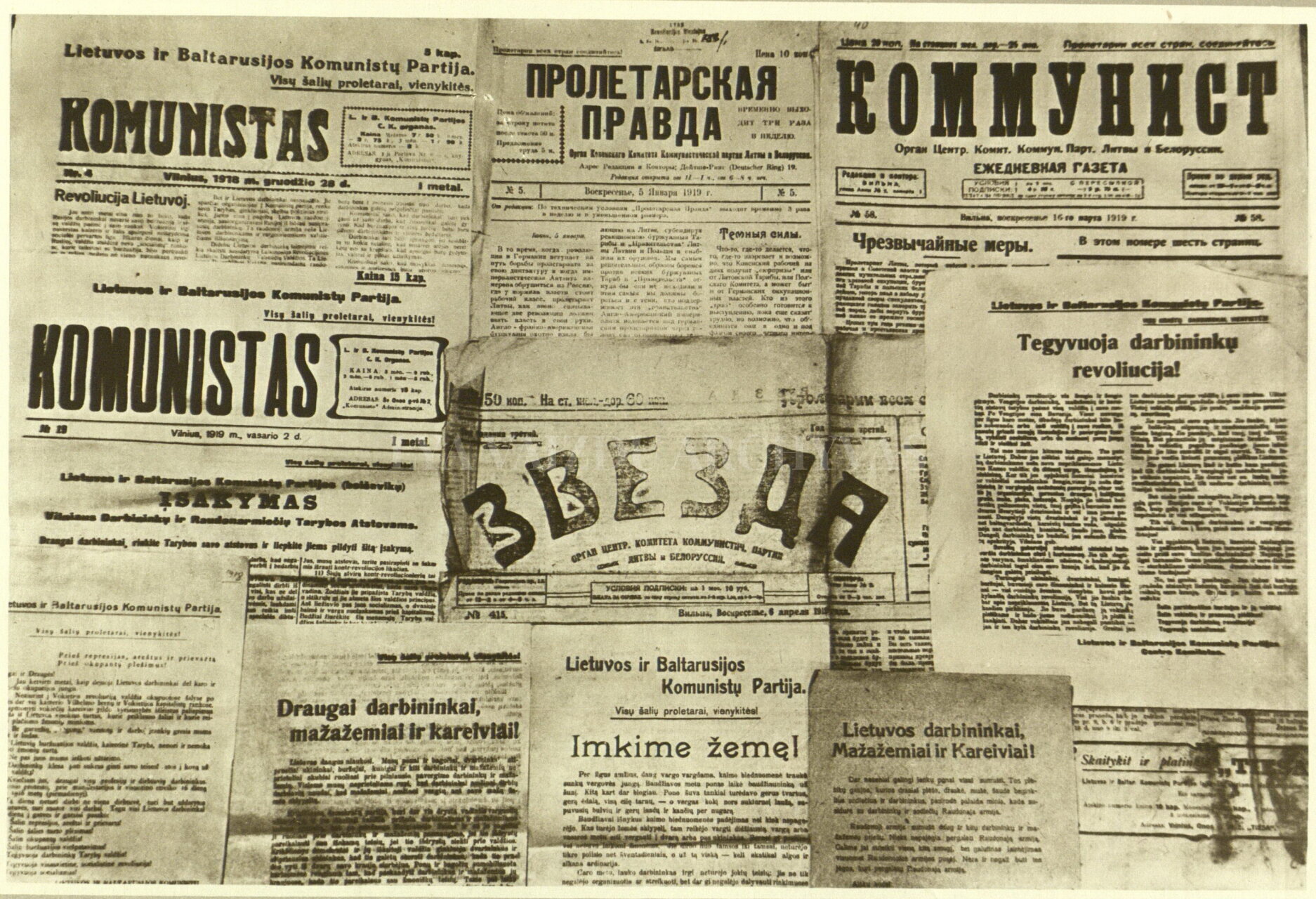
The Fascist dictatorship was at first a coalition of three Fascist parties—Nationalists, Christian Democrats, and landowners. Having secured a firm footing, the Nationalists dissolved the Sejm and threw the Christian Democrats and the land-owners out of the Government. The Nationalists, as the clearest expression of the interests of the rich peasants and land-owners, became the centre of gravity for Lithuanian Fascism.
In her foreign policy Lithuania was invariably hostile to the U.S.S.R., and was always hoping to effect an agreement with Poland. However, the Narodniki and Social Democratic Government concluded a non-aggression agreement with the U.S.S.R. in 1926 under pressure of the masses. At the present time the Fascist Government is subservient to Poland and is working for an agreement against the U.S.S.R.
The Situation in the Bourgeois Parties.
The bourgeois parties (Nationalists, Christian Democrats, and land-owners) are Fascist parties, although the Christian Democrats, being in opposition to the ruling Nationalist Party, pretend to stand for bourgeois democracy and for the Sejm, etc. The petty bourgeois parties (the Narodniki and the Social Democrats) vacillate between Fascism and bourgeois democracy, but they are becoming more and mere inclined towards Fascism. The most influential leaders of these Fascist Parties are prepared to make an alliance with Polish Fascism hoping thereby to achieve power. The Narodniki have the same political platform as the Fascist Christian Democrats, differing only on some minor questions. The rich peasants are gradually deserting the Narodniki, and are beginning openly to support the Nationalist Government. The leaders of the bourgeois and petty bourgeois parties are all seeking an alliance with Poland. The rank and file of these parties, however, especially of the petty bourgeois parties, are entirely against Poland. Among the rank and file Narodniki there are anti-Fascist tendencies to be observed.
The Situation in the Social Democratic Party.
Some of the Social Democratic leaders in Lithuania, headed by Plechkaitis, have concluded an open alliance with Polish Fascism. Some of them at first submitted to the Fascist regime in Lithuania, but now, together with the so-called “Lefts,” they have turned towards Polish Fascism, although not openly admitting it. Among the rank and file discontent with the leaders’ policy is increasing, and many are deserting the Party.
Radicalisation of the Working Class.
After the Fascist coup d’état the working class organisations were all destroyed by the White Terror and, as a result, a period of inactivity set in among the Lithuanian workers. This passivity has not yet been overcome. There are, however, some signs of a revival during the last six months, as witnessed by several small strikes, meetings of unemployed, the organisation of non-Party circles, the birth of underground trade unions.
II. THE WORK OF THE COMMUNIST PARTY.
(a) The Situation in the Party, Party Congresses, the Work of the Opposition.
The Communist Party and its Central Committee committed many blunders at the time of the Social Democratic and Narodniki Government. They held an incorrect view of the petty bourgeois Government, and they did not make sufficient preparations tor a struggle against the Fascist putsch; they pursued a wrong policy in connection with demonstrations and strikes; they employed wrong methods in their trade union activity; they neglected their work in the army and underground work in general, etc. The E.C.C.I. qualified this as a Right deviation. These blunders were largely responsible for the fact that, at the moment of the Fascist coup d’état, notwithstanding the hostile attitude of the workers, peasants and even soldiers towards Fascism, the Communist Party was unable to marshal the masses for a struggle against Fascism. However, notwithstanding all these and many other mistakes, the Party gained in strength in 1926, increased its influence among the masses, and established closer contact with them. This made the destruction of the Party impossible, norwithstanding the Fascist terror which then raged (people were sentenced to death merely for belonging to the Communist Party or the Y.C.L., or for distributing anti-Fascist proclamations), The Party recovered from the first Fascist blows fairly rapidly, and in many respects became more active than hitherto (it began to work in the army and to organise underground circles among non-Party workers).
During the period under review one Congress and two Conferences were held. The Fourth Conference summed up the achievements of 1926, carefully analysed the mistakes committed and mapped out the line to be followed in the future.
The Trotskyist opposition had until recently no followers in the Lithuanian Party, with the exception of a few individuals who withdrew from the Party on the ground of their Trotskyist convictions. In the second half of 1927 an opposition was formed in the Kovno prison, whose ideas approximated to those responsible for the mistakes of the Central Committee in 1926—an overestimation of the role of the Social Democrat and the Narodniki. At the Fourth Conference, the Party acknowledged its mistakes, but a small group of former leaders maintained that Lithuania was facing an immediate revolutionary situation which the Communist Party was not taking into account, and that the C.C. was hampering the overthrow of the Fascist dictatorship by the Social Democrats and the Narodniki. The opposition drew up its own platform and sought to gain followers outside of the prison walls. However, their efforts ended in failure (with two or three exceptions). They succeeded in gaining some followers in the Young Communist League, who joined the counter-revolutionary camp, actually supported the campaign against the U.S.S.R., and partly adopted the platform of the Trotskyist opposition and the Maslow-Ruth Fischer group. The Central Committees of the Party and the League took steps to liquidate this opposition.
(b) Work in the Trade Unions.
In 1926 the Party took advantage of the revival of the labour movement in general to review its work in the trade unions and to extend its influence among them.
The Fascist dictatorship at first liquidated nearly all the trade unions, prevented the organisation of new unions, and organised their own unions instead. The Party thereupon issued the slogan of organisation of illegal unions. But in view of the conditions imposed by the Fascist régime, work in the illegal! trade union groups made but slow progress. The Communists play a leading part at the illegal conferences of non-Party trade union leaders.
(c) Campaigns.
In 1926 our Party conducted the following campaigns: an election campaign, a 1st of May campaign, a campaign for trade union unity, a campaign in support of the British strike, an anti-Fascist campaign, a press campaign, a campaign against Pilsudski’s adventures, a campaign for a trade union congress, a campaign for a workers’ delegation to the U.S.S.R. In 1927 there were the May Day campaign, the Tenth Anniversary of the October Revolution, the campaign in commemoration of the four executed Communists, a campaign against Polish annexation of Lithuania, etc. The last campaign was carried on under the slogans; “Defend Lithuanian independence from Polish imperialism.” “Down with Fascist dictatorship in Lithuani,” and in favour of a “Workers’ and Peasants’ Government.”
(d) Agitprop. and Publicity Work.
The Agitprop. Department is not working satisfactorily owing to the lack of agitators. A number of political educational circles have been formed, and in 1926 courses were organised.
Publicity work is in a somewhat better condition, as is also the distribution of literature. The following underground organs are now being issued: “Truth,” in the Lithuanian language, a mass paper; ‘Soldiers’ Truth,” a mass paper appearing twice monthly; “The Communist,” a monthly journal, and one also in the Jewish language, which, however, does not appear regularly. Their circulation is about 1,000—1,500 copies. In addition, there is a bi-weekly, popular journal with a circulation of 2,000 copies. From two to five leaflets are issued monthly in the Lithuanian, Jewish, Russian, and Polish languages, to the extent of about 3,000 to 10,000 copies.
During the period dealt within this report sixteen volumes of Lenin’s collected works have been published with a circulation of 1,500 to 3,000 copies, and about thirty pamphlets. In 1926 a Radical legal labour press was established in the Lithuanian and Jewish languages. The Fascist dictatorship destroyed the legal press. Attempts were made in 1927 to start a legal Radical newspaper, which ended in failure.
(e) Rural Work.
Work among the peasantry cannot be regarded as satisfactory. Communist and Young Communist groups and non-Party circles have been organised by the Party and Y.C.L. organisations in the villages. During 1926 meetings were held and literature distributed. Work is being carried on in several rural co-operatives and peasant organisations hostile to Communism, but no mass work is being done, although the Party influence in some rural districts is quite considerable.
(f) Work in Mass Organisations.
In general work in the mass organisations is far from satisfactory; the best results are being achieved in the sport organisations. After the coup d’état, on the initiative of the Party, illegal anti-Fascist committees were organised as a united anti-Fascist front. These committees have an underground organ entitled “Down with Fascism,” in the Lithuanian language.
(g) Work Among the National Minorities.
This work is satisfactory only among the Jews. Practically no work is being done among the Poles, with the exception of the occasional distribution of leaflets. The work in the Memel district is also unsatisfactory. Prior to its occupation by Lithuania at the beginning of 1923, that district had a Social Democratic Government.
(h) Work Among Women.
The Party started its systematic work among women in 1926. In January, 1926, the first illegal conference on work among women was held. Commissions were set up in the C.C. and the local committees for work among women, and the Party papers devote special columns to the question, entitled “Working Woman and Women Peasants.” In 1926 delegate conferences were held and women’s commissions were organised in the trade unions. There are now illegal women circles in existence.
(i) The Composition of the Party. The Nuclei.
Most of the Party members are workers. They cannot be considered, however, as genuine industrial workers, most of them being handicraftsmen or agriculture labourers. The second largest group consists of peasants. There is a small percentage of employees and students.
The Party recognises the principle of factory nuclei, but in view of the absence of more or less large enterprises, and owing to the fact that the Party members are scattered in small workshops, most of the nuclei are organised on the residential basis, Here and there the local organisations are organising nuclei on the basis of nationality. The Central Committee combats this type of organisation. There have been some cases of the merging of Party with the Y.C.L. nuclei in view of the smallness of either the party or the Y.C.L. groups. The Party is, however, opposed to this.
(j) The Party Cadres.
The Party cadres have suffered greatly from the Fascist coup d’état. Some were shot, imprisoned, and others had to leave the country. Owing to the absence of industrial centres and a more or less wide labour movement, new Party cadres come forward very slowly, and there are not enough of them to cope with all the work and to consolidate the influence of the Party in organised forms.
The Communist International Between the Fifth and the Sixth Congresses, 1924-28. Published by the Communist International, 1928.
PDF of full book: https://archive.org/download/comintern_between_fifth_and_sixth_congress_ao2/comintern_between_fifth_and_sixth_congress_ao2.pdf
 Revolution's Newsstand