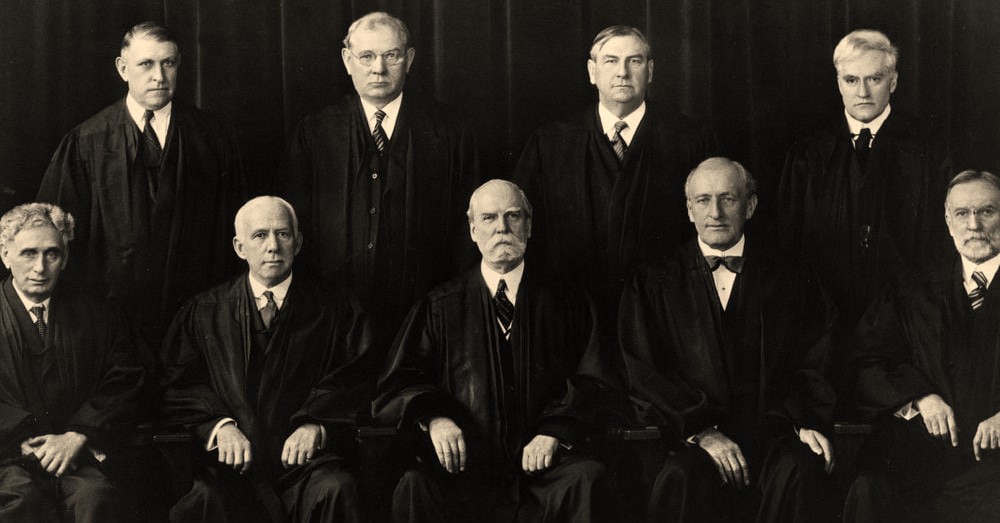
The Supreme Court’s consistent reactionary role was at the center of many legal fights of the New Deal-era. Here, leading Communist Harry Gannes with the Party’s take on the various moves, including constitutional amendments, to curb the power of the robed ghouls.
‘The United States Supreme Court and the Specter of Fascism’ by Harry Gannes from The Communist. Vol. 15 No. 3. March, 1936.
“The Court is an organ of power. The liberals sometimes forget this. It is a sin for a Marxist to forget it.” (Lenin.)
AS IN the turbulent days before the Civil War, the United States Supreme Court is now becoming a great center of political agitation. Far more than is generally realized, the effects of the Court’s decisions today intimately concern the lives of the people.
Again as in the period of the Dred Scott Case we are confronted with glaring examples of corrupt judicial manipulations which emphasize the fact that in the most critical periods of American history the United States Supreme Court is the accelerator of reaction.
Today all roads of reaction, no matter how devious, lead in the direction of fascism. The rushing business of the Court at present complies with the needs of the most reactionary section of American finance capital.
The Court is becoming more than a weapon for drastically curbing the limited expression of the people’s rights and the power of Congress which the economic crisis forces to echo the popular demand for social legislation. The Court’s avalanche of reactionary decisions is beginning to encourage the development of fascist trends.
The time is approaching when the class interests for which the Supreme Court acts as chief counsel and legislative censor will seek to conjure up the living mass instruments of reaction under the slogan of “defense of the Constitution” as interpreted and “protected” by the Supreme Judicial Despots.
As Marxists-Leninists we observe the present feverish activity of the highest Court as a prime factor in the class struggle in relation to the American capitalist state apparatus.
We utilize the bitter political battles evoked around this issue of the Court’s obvious tyranny to broaden the fight against the danger of fascism, for democratic rights, for social legislation, for the most elementary needs of the people. The building of a mass Farmer-Labor Party will be greatly speeded up if we harness the indignation and resentment aroused by the Court’s increased dictatorial action The need for such a party is more clearly demonstrated by the action of the court which at every turn blocks the people’s struggle for the improvement of their miserable lot, for every civil and legislative right, for relief, for social insurance, against taxation of the poor and middle class, and for placing the cost of the crisis on the fat pocketbooks of the rich.
The brazen deeds of the Court not only will help us to lead the toilers to strike harder blows at the most exposed links of the capitalist state chains, but will give us shining examples by which to teach the masses penetrating lessons about what the capitalist state power really means.
Many of the major questions of the next presidential election will be fought around the usurpation of power by the Supreme Court. Constitution and Court! will be the big cry.
In discussing the special features of the United States Supreme Court, a judicial body unique to this capitalist land, we must point out that its action affects not only the proletariat and poorest farmers, but also the petty bourgeoisie and small industrialists. For within the ranks of the property-owning classes there is manifested the struggle of the petty bourgeoisie and the small industrialists against finance capital and the giant trusts which are crushing the very life out of their smaller brethren and competitors.
In the long series of decisions which enhances the growth of monopoly capitalism, from the era of railroad construction to that of the rise of Standard Oil and the U.S. Steel Corp., as well as in the New Deal judgments, the conflict within the various strata of the propertied classes has deepened. Especially in the New Deal decisions do we observe the bitter struggle of the poor, tenant and middle farmer against the rich farmer and landowner, and the fight of all these against the bankers, industrialists, and food trusts.
During the profound general crisis of the capitalist system, this struggle assumes sharper political forms. For, as Marx tells us, when the capitalist class as a whole has to divide losses as well as profits, its contradictions increase. The extension of these conflicts within the ruling strata is one of the important factors in the development of a revolutionary crisis of capitalism.
Does, then, the exaggerated increase of usurped power of the judiciary at present play a significant part in advancing the crisis within the capitalist class and, thereby, the general crisis of capitalism itself? There is not the slightest doubt about this. It reflects itself in the contradictions within the capitalist state, showing the advance of the period of the inability of the capitalists to rule in the old way. In fighting for the most elementary demands against the usurpation of the Courts, and for amending the Constitution to curb the Court, we advance the popular struggle against capitalism and its state.
II.
In the 148 years of its existence, the United States Supreme Court nullified 67 Congressional acts. But in the past two years alone it has wiped out eight acts of Congress. Five of these concern the future of social legislation and the whole problem of who shall bear the burden of the crisis. In fact the major function of the Supreme Court is becoming more and more to void social legislation that has even the slightest hint of expense to the bourgeoisie and benefit to the masses.
The five decisions cover: (1) The railroad retirement act, where the Court knocked out a statute requiring a compulsory pension system; (2) the Frazier-Lemke act, also known as the farm mortgage act, voiding government aid to mortgage-ridden farmers; (3) voiding an order under the N.R.A. concerning “hot oil” as unconstitutional, thereby benefiting chiefly the oil trusts; (4) destroying the N.R.A., when it had served capitalism’s purpose; (5) A.A.A. decision declared unconstitutional, attacking the principle of levying taxes for farm relief purposes.
A series of similar decisions, carrying out the practices already laid down by the court, are expected.1 The court, thereby, is attaining an all-time rapid-fire record for voiding acts of Congress.
But we are confronted today not only with an augmentation of the legislative nullification power of the Supreme Court in the period of the present difficulties of capitalism. As is well recognized by members of the Court itself, the whole nature of judicial usurpation is changing in character. It is taking on a more brutally and cynically reactionary cloak.
III.
The first important assumption of legislative power by the Court was in 1803 in the famous case of Marbury vs. Madison, though the Court had nibbled at the idea earlier. Chief Justice Marshall’s decision in the Marbury case was expressive of the desire of the rising mercantile, trading bourgeoisie to centralize the newly established federal state power. As Engels and Lenin pointed out, the American capitalist state in its beginnings was extremely weak, loose, and decentralized. Marshall sought to help remedy this looseness and especially to grant the judiciary centralizing power as against the executive and legislative branches, which he, Hamilton, and other leading representatives of his class considered amenable to popular attack and to the “imprudence of democracy”. This was outlined in Marshall’s crafty decision giving the Court final word on all legislation on the ground of testing constitutionality.
But the power thus granted to the Court by itself did not have to be used or extended until a great crisis developed in the struggle for hegemony between the rising industrial bourgeoisie of the North and the slavocracy of the South in 1857. Then, this power, which the Liberty League so ardently praises, was used with a vengeance for the purpose of bolstering and expanding Negro slavery in the United States. This Supreme Court decision, reeking of the slave market, is the foundation stone of all future United States Supreme Court decisions usurping power to void legislation. By upholding slavery the United States Supreme Court for the first time used its self-granted authority to annul legislation by judicial decree.
The real issue in the Dred Scott decision of 1857 was the constitutionality of the Compromise Act, dealing with a compromise on the extension of slavery to new territories. The slaveholders directly intervened behind the scenes of the Court, making use of the Court as an instrument in their contest with the representatives of the Northern industrial bourgeoisie in Congress. The Supreme Court wiped out the compromise of the vacillating section of the industrial bourgeoisie and the slaveholders. By a vote of 7 to 2, the Court declared that a slave had no legal existence as a person, as he was property in the eyes of the law. Chief Justice Taney affirmed that a Negro had no rights which a white man was bound to respect, and that the Negro might justly and legally be reduced to slavery. The great Justice Marshall, protector of the Constitution and “American liberties”, had previously pronounced slavery “legitimate” and “lawful”. In the Antelope slave trader case, this theoretician of the right of usurpation said:
“Slavery, then, has its origin in force; but as the world has agreed that it is a legitimate result of force, the state of things which is thus produced by general consent, cannot be pronounced unlawful.”
Reminiscent of the joy among the Southern slave-holding circles over the Dred Scott decision is the enthusiasm of the Liberty Leaguers, the Chambers of Commerce, the Manufacturers Association, and other such forces, when the N.R.A. and A.A.A. Supreme Court decisions were handed down.
Thus, in its first and fundamental application of this usurped power, the Court advanced reaction and pro-slavery counter-revolution.
After the Civil War, when the industrial bourgeoisie held sway over all three branches of the state, the Supreme Court allowed its nullification powers to lie more or less dormant. In fact, they were not revived in full force until the early development of monopoly capital, when the big trusts required that the dictatorial powers of the Court be again asserted to safeguard the interests of the trusts.
“…The decade beginning in 1880 may be regarded as the dividing line between the earlier stage when judicial review of legislative enactments was of relatively minor significance and the latter stage in which this practice becomes one of the central and controlling features of the American system of government,”
writes an authority on the Constitution (Charles Groves Haines, Government of Laws or a Government of Men; Judicial or Legislative Supremacy).
The generation beginning with 1880 coincides with the development of the big trusts in railroad and oil, and the growth of the huge corporations in utilities and steel. It was the era of the rapid growth of the monopoly, parasitic, decadent phase of capitalism. The legislative review of decisions of the United States Supreme Court thus flowers to its most poisonous growth at that period described by Lenin as follows:
“Imperialism in particular—the era of banking capital, the era of gigantic capitalist monopolies, the era of the transformation of monopoly capitalism into state monopoly-capitalism—shows an unprecedented strengthening of the ‘state machinery’ and an unprecedented growth of its bureaucratic and military apparatus, side by side with the increase of repressive measures against the proletariat, alike in the monarchical and the freest republican countries.”
And this bureaucratic strengthening of the state machinery of imperialism is being advanced to a higher and more reactionary stage by the Supreme Court today.
The next great phase is 1935, when the growing pro-fascist elements in the United States again required the assistance of the United States Supreme Court’s dictatorial power. This time the Court acts against the aspirations of the masses, still bound down by parliamentary illusions, for relief and against the capitalists’ attempts to unload the burden of the crisis on the backs of the toilers.
Thus, we find that the United States Supreme Court developed and extended its usurped power of nullification mainly as follows: (1) For slavery, 1857; (2) For imperialism, 1880 and after; and (3) For further advance of reaction along incipient fascist lines, 1935.
In the intermediate periods, when they were not dealing directly with constitutionality of legislation, the Supreme Court Justices did not, however, waste their time. In the regular procedure of judicial review the great majority of them were worthy of their hire as former corporation lawyers, deciding individual cases to the advantage of their most favored corporations, helping the trusts get the best construction of the “constitutional” laws, beating back the civil rights won in 1776, and hampering the Thirteenth and Fourteenth Amendments against Negro slavery. The liberal judges who were concessions to democratic pretenses on the Supreme Bench were the exceptions who left a trail of indignant but impotent dissent.
IV.
Strenuous efforts are made to blur the significance of the Supreme Court power in voiding legislation. One popular means is to quote statistics. Look, say the defenders of the Supreme Court’s tyrannical powers, out of 24,016 Congressional acts passed since Congress first began business 150 years ago, only 67 have been declared unconstitutional. Laws, however, we answer, cannot be compared statistically like apples. One Dred Scott decision and one A.A.A. ruling affirm fundamental reactionary policy, to which thousands of other oppressive laws conform. An examination of the type of laws nullified gives us a good key to how, when, and why the Supreme Court uses its usurped power. We can group the chief decisions declaring the 67 acts unconstitutional as follows:
1. Establishment of the precedent of nullification of legislation by the Supreme Court (1803).
2. Affirming the legality of slavery and the right of its extension, Dred Scott decision, 1857; the first real use of the usurped power and the legal foundation for it to the present day.
3. A series of decisions beginning with 1870 encouraging rapid concentration of capital, voiding income taxes against the rich, and big corporations; attacking the civil rights of the masses; declaring laws cannot be passed to enforce equal treatment of Negroes (1883), thereby practically voiding the Thirteenth and Fourteenth Amendments to the Constitution. “The subject of Negro rights constitutes the most disgraceful chapter in the judicial history of this Government by Judiciary country; and this quite apart from the Dred Scott Case.” (, Louis B. Boudin, p. 126.)
4. Though upholding the Sherman Anti-Trust Act as constitutional, the Court remedied this defect at first by its record of assistance to the development of monopoly capitalism; by its construing individual cases in the interests of the trusts; and by using the Sherman Anti-Trust Act, not as a law against monopolies, but against labor organization. For example, Samuel Gompers, no enemy of the American capitalist state, a man. who died with the words on his lips: “God save our American institutions,” wrote in 1910 as follows on the United States Supreme Court’s use of the Sherman Anti-Trust Act against labor: “The event we have feared has come to pass. The [Sherman Anti-Trust] law has long been admitted to be of no value in restraining or really punishing trusts. Useless as an instrument of good, perverted from its original intent, it has now been made an instrument of positive mischief.”
5. Declaring social legislation “unconstitutional”, as in the Federal Liability Act, providing workmen’s compensation in accidents (1908); voiding the Child Labor Act (1918); and again, in 1922, under the form of voiding a tax act on child-labor produced products, declaring Congress cannot make it a criminal offense for an employer to engage in interstate commerce and dismiss an employee because he belongs to a labor union (1908); and voiding a law for minimum wage standards (1923).
6. Protecting the rich and big trusts from income tax, through voiding the income tax law (1895), saving the bosses thereby huge profits for a period of 20 years.
7. A continuation of all of these voiding decisions in sharper and more provocative form in reviewing New Deal legislation, especially in the A.A.A. ruling.
In the persistent fight to attain its judicial supremacy, the Supreme Court necessarily followed a contradictory course. This arose out of the conflicting nature of the needs of the most reactionary section of capitalism for centralized state power and the decentralizing nature of the Constitution.
The Court’s decisions on “unconstitutionality” are most frequently based on the theory of “protecting” the Constitution in its dual character, that is, as between the rights of the states and the rights of the federal government. Thus, by arguing that Congress did not have the power to arrogate to itself rights belonging exclusively to the various states and not delegated in the Constitution to the federal government, the Court has actually strengthened the centralized grip of the capitalist state power though it has insisted it has always been limiting the power of the federal government.
The decisions of the courts on the issues of the civil rights rank with the most reactionary of all its legal exhibitions, such as in the long battle on Negro rights, right down to the Herndon case, and the justification of fascist terror through upholding the Criminal Syndicalist and Criminal Anarchy Acts. At times the courts did threw a very meager bone to appellants on civil rights, but these are the rare exceptions that emphasize the reactionary rules.
In this respect a number of seemingly puzzling questions are often asked. They fall into two categories.
1. If the Communists fought against the N.R.A. and the A.A.A., or other such New Deal legislation as assisting chiefly finance capital, then why do they now so energetically fight against their nullification by the Supreme Court?
2. If we are against the right of the Supreme Court to declare laws unconstitutional, then why do we, in legal appeals to the Court, make use of the argument that certain laws (Sedition Act in Herndon case, the Criminal Syndicalist Acts) are unconstitutional?
To both questions at the outset the general answer must be made that in fighting against the usurped power of legislative nullification of the Supreme Court we fight against one of the strongest symptoms of developing reaction, benefiting equally the fight for social legislation and civil rights.
So far as the first question is concerned: The Communists correctly criticized and fought against the N.R.A. and A.A.A. because both these acts served as emergency measures to assist capitalism in the worst phase of the crisis. They greatly increased the profits of the big trusts. They helped their monopoly development at the expense of the smaller corporations. The rich farmers gained vastly more than the poor and tenant farmers from A.A.A. disbursements. These measures were garnished with only the most insignificant aid to the workers and farmers. When these acts had served their emergency purpose, the Court utilized its nullifying power, not only to wipe out these particular laws, but to lay the basis for legal justification of ruling out al subsequent real social legislation. With the Court’s nullifying decrees standing as precedents, even against bad or inadequate laws, it would be impossible to put through and to uphold those laws desired by the masses, without a fight to the finish to end the Court’s power of declaring any law unconstitutional. The very fight to curb the power of the Court would arouse and organize the forces to continue the struggle on a higher plane and for greater conquests.
The answer to the second question is: Though we fight against the principle of the Court to declare laws unconstitutional, as long as this procedure remains a part of American capitalist legal practice, we will utilize it in individual cases, along with all other legal arguments, buttressed by mass pressure, to get a most favorable decision for the working class defendants in each instance. This is not in the slightest a contradiction. Workers are forced to use capitalist laws and legal methods of which they do not approve in principle to get the maximum out of legal defense under capitalism.
In the case of the fight for civil rights, the Supreme Court, in order to conceal its utter reactionary character, as well as due to various contradictions of previous decisions and so-called liberal members of the Court, has been forced, but only in a few instances, to rule favorably for working class defendants.
In the overwhelming majority of cases, from the Civil Rights cases in the period after Reconstruction, the Court has overruled appeals on the ground of unconstitutionality of the Georgia “‘insurrection” law, but turned Herndon back to the Southern Courts. In the Scottsboro case, only the fear of rising Negro discontent, and united, growing mass pressure of Negro and white, forced lip-service recognition of a certain judicial right for the Negro in the South. Furthermore, in the Scottsboro case, the Supreme Court refused to declare the nine boys innocent on a court record clearly and beyond doubt proving them to be innocent.
By mass pressure and its own reluctance to expose its reactionary nature too openly, the Supreme Court was forced to grant some legal concessions on the technical rights of Negroes to sit in Southern juries. Despite the so-called favorable decision of the Supreme Court, the Scottsboro defendants are still in prison and are facing a living death for the rest of their lives or burning in the electric chair.
Workers, in their legal defense, utilize an established precedent of American capitalist law, that is, the usurped and condemned power of nullification by the Supreme Court. While doing so in individual cases, we do not for a moment fail to expose the real class nature of this Court to which we must appeal. We expose and castigate the injustices of the Court to the people in their fight for social legislation and civil rights.
V.
The most important single decision of the Supreme Court in extending its usurped power is that voiding the A.A.A, Dr. Howard Lee McBain, Ruggles Professor of Constitutional law at Columbia University, wrote on this issue:
“The Hoosac Mills case will live to torment the defenders of judicial supremacy long after the issue of farmer relief has become an historical episode. It may ultimately have a more profound effect upon American institutional development than all of the New Deal experiments rolled into one.” (“The Issue: The Court or Congress,’ New York Times Magazine, Jan. 19, 1936.)
Professor McBain, apparently of that school of juridical experts which believes that the Court has the right of constitutional review, expresses fear that the judges had too shamelessly undraped the ugly structure of the dictatorship of finance capital in the A.A.A. decision.
“It [the A.A.A. opinion],” he complains, “will not only be grist for the mill of the liberals and the radicals who have long opposed the institutions of judicial supremacy as such; it will weaken or shatter the faith of many who, though they sometimes greatly deplore specific results of the Court’s power to declare laws void, have, nevertheless, believed in the general beneficence and wisdom of judicial review as an institution.”
The issues involved were much deeper than the A.A.A. itself, though the Court saw to it that the $200,000,000 collected in processing taxes were immediately refunded to the capitalists who had paid them. Even Secretary of Agriculture Wallace was forced to exclaim that this $200,000,000 present to the food trusts was “the biggest steal in the history of the country”.
The principle presented to the Supreme Court, as the Communist Party pointed out, was the right of Congress to levy taxes for relief and to pass any other measure the people might demand.
“The Communist Party criticized the A.A.A.,” said a statement of the Central Committee of the Party, signed by William Z. Foster, Chairman, and Earl Browder, Secretary, “because it helped to raise the cost of living, because it did not substantially help the poor farmers of the country, because it helped mainly the rich.” The decision, it was pointed out, above all, “forbids Congress to help distressed sections of the population”.
It should be remarked, though it is not of major importance, that Justice Owen D. Roberts who read the majority A.A.A. opinion was proved in May 1933 by the Senate Banking and Currency Committee to be on the House of Morgan’s “favored” list for stocks certain to reap early profits.
Overruling the right of Congress to levy such taxes, or distribute such relief, the Court’s decision starts off with a defense of its power to nullify legislation. “It is sometimes said,” apprehensively assert the judges, “that the Court assumes a power to overrule and control action of the people’s representatives. This is a misconception. The Constitution is the supreme law of the land, ordained and established by the people. All legislation must conform to the principles it lays down.”
Was it not Chief Justice Hughes himself who declared, before he became chief justice: “We are under a Constitution, but the Constitution is what the judges say it is”? If the Constitution is a “limit” to what the people may do, it is also a guide to what the judges may not do. Nowhere does the Constitution give the nine judicial dictators the right to annul legislation. But capitalism in its bloody march to wealth and to domination never hesitated over the niceties of its own laws or Constitution. When the growing reactionary demands of the ruling aristocracy demanded the quashing of every semblance of social legislation that would either benefit the masses or establish a precedent for an increase of such legislation, the retired corporation lawyers begowned in the sacred garb of chief justice of finance capital were faithful to their judicial trusts and to the trusts. The juridical needs of capitalism flow directly from its economic and political exigencies. But the gap between the politico-economic needs and the juridical superstructure is being narrowed by the general crisis of capitalism, exposing both as reverse sides of the same decaying and corrupt organism.
The opinion of Justices Cardozo, Stone, and Brandeis, the three dissenters, from the first, takes issue with the majority of the Court, not on the A.A.A., but on the usurpation of power by the judiciary. Maintaining the right of the Court to judge the constitutionality of acts, it however says: “The courts are concerned only with the power to enact statutes, not with their wisdom.” Intimating that the Court was setting itself up as an instrument against the rights of the people, the dissenters assert: “For the removal of unwise laws from the statute books appeal lies not to the courts but to the ballot and the processes of democratic government.” Clearly, then, the A.A.A. decision, even in the words of three judges, is undemocratic, and therefore dictatorial and reactionary.
The Tory London Times was abashed at the dictatorial step of the United States Supreme Court in repealing the A.A.A. An editorial on Jan. 9 (quoted by the New York Times of Jan. 10) charged the American business leaders with forgetting that President Roosevelt “rescued them from disaster”, less than three years ago. This editorial, remarked the London correspondent of the New York Times, “is typical of others in the British newspapers, even the most conservative expressing amazement at the Supreme Court’s decision and sympathy for the president”.
The land of one king is amazed at the action of the country with Nine Judicial Monarchs.
VI.
There can be many motives and many aims in exposing the undeniable advancing reactionary trends of the United States Supreme Court. The motive of the minority of the Court itself is to preserve the prestige of the Court and its judicial dignity as an instrument for capitalism as a whole in view of the growing scepticism and distrust of the masses.
Liberals and other such want reforms for a more “equitable balance”, as they put it, between the three branches of government, in an effort to attain some semblance of democratic pretense in the judiciary, and for a gradual reform of capitalism.
Communists, by exposing and fighting against the reactionary role of the Supreme Court and its encouragement to incipient fascist forces in the United States, revealing the Court as the most dictatorial organ of the capitalist state power at this time, do not contrast thereby the “democratic” and “good” qualities of the other branches of the capitalist state.
But Communists are the most persistent in drawing the attention of the masses to the real nature of the entire state by the example of this most reactionary, exposed and attacked organ, rallying the masses for an assault against this hated enemy of the people. They utilize the rapidly rising anger and indignation against the Court as a fulcrum of revolutionary struggle to replace the whole, corrupt, bureaucratic, oppressive dictatorial capitalist state power by the power of the toilers.
In the fight to put through social legislation, to fight for democratic rights, to curb the power of the judges, arousing the resentment of the masses against the judicial monarchs, we strengthen the immediate struggle for the formation of a mass Farmer-Labor Party around the concrete issues of the most burning importance to the widest strata of the population. In the center of this fight now looms a battle against the Supreme Court.
VII.
Despite his evident disturbance over the N.R.A. decision, President Roosevelt was silent on the more important and fundamental judicial move in the case of the A.A.A. Roosevelt has discouraged a broad movement to curb the usurped power of the Supreme Court by constitutional amendment. He knows too well that such a movement would carry in its train class forces he does not wish stirred up.
Such a demand, fought for on a united front basis, should spur the creation of an independent people’s front.
But the struggle for an amendment to the Constitution to force through social legislation is gaining momentum, and, with the inevitable future developments, must gain even greater force. Here three main distinct programs have been presented:
1. The proposals of the A. F. of L. and U.M.W.A. last conventions in the form of a threat to struggle for a constitutional amendment, in the event the Supreme Court continues to void social legislation, particularly the Guffey Coal and the Wagner Labor acts. The purpose of such a fight for a constitutional amendment would be to protect the trade union and economic rights of the workers particularly, without risking, if at all possible, the hornet’s nest of an independent working-class struggle behind it.
2. The Socialist Party Old Guard proposal for an amendment to the Constitution. At first, the Hillquit amendment provided for no different policy than that of the U.M.W.A. or American Federation of Labor threats. It does not propose to curb the power of the Court, but takes from them the excuse of declaring social legislation unconstitutional. But this was later revised by Louis Waldman to appear as a proposal to achieve socialism in the United States through the utopia of constitutional amendment.
Neither the Hillquit, Waldman, A. F. of L. or U.M.W.A. amendments have provisions to help the farmers, or involve them in a struggle against the Supreme Court.
When the N.R.A. was voided, Louis Waldman, in an article in the New Leader (June 1, 1935), tried, as a Socialist legal expert, to show that the Supreme Court, especially because of its unanimous decision, was not really usurping power, but had “merely outlawed the technique[!!] set up by the Roosevelt administration”.
In the same issue of the New Leader, an editorial discussing the aspect of fascism in the light of the Supreme Court decision even looked favorably on the Court as a “protector” against fascism which might come by executive usurpation. Said the New Leader:
“We merely add this observation [to Waldman’s dissertation]. In denying the executive the power to govern by decree, it [the Court] has struck down a power which is exercised by every dictator in Europe.
“This power in the hands of a future president less scrupulous than Roosevelt would be a constant menace to the whole labor movement. Those who fear fascism should keep this in mind.”
While nobody will deny that the executive power vested in an American president can be utilized towards speeding fascism in the United States, no foe of fascism would look to the nine judicial monarchs of the Supreme Court as an obstacle to fascism. Especially is this so when the Supreme Court as a body has progressively become the more dictatorial expression of finance capital, as the pressure of the masses on Congress and on the president grows greater.
3. The fight for a constitutional amendment as advocated by the Communist Party. Spiking all illusions about “constitutional socialism” through amendment, or the value as a foe of fascism of any single branch of the American capitalist state, the Communists fight for a constitutional amendment to allow every measure of social legislation to become law without judicial veto, and to curb the power of the Court.
Such a battle for the most immediate demands of the workers, buttressed with the strengthening of the trade unions, and by extra-parliamentary actions, brings pressure on and against the capitalist legislatures and executive, and acts to curb the swollen judicial power. It becomes a fight, not only for amending the Constitution, but against the capitalist state itself.
It rallies behind it the rising streams of independent political action leading to the formation of a mass Farmer-Labor Party.
The Communist Party’s fight for constitutional amendment goes hand in hand with the struggle to preserve democratic rights; with the struggle for the immediate economic needs of the workers; with the fight for relief and social insurance for workers, farmers, and others; and with the formation of a mass Farmer-Labor Party. The Communist Party constantly directs all of these attacks against capitalism into swifter channels leading to the revolutionary goal of struggle for the ultimate overthrow of capitalism and the establishment of Soviet power as the only road to socialism.
The Central Committee of the Communist Party has already popularly outlined our main tasks around the issue of Supreme Court usurpation in its statement, “Sweep Away the Autocratic Power of the United States Supreme Court!” (Daily Worker, Jan. 11, 1936.) We here summarize these tasks:
1. It is necessary to develop the most popular and lively agitation against the Supreme Court. We must show the masses how it blocks social legislation at every avenue. It works against democratic rights, striving consciously in behalf of the most reactionary sections of capitalism to defeat the struggle of the masses for political independence, and advancing the incipient fascist forces in this country.
2. In the fight to curb the Supreme Court, we must put in the forefront the indispensable goal of the broadest united front against such reaction; which means the formation of a Farmer-Labor Party as the best instrument in the fight against the Court and reaction generally. In the fight against the usurped power of the Supreme Court, for amending the constitution, for changing the composition and power of the Court, the Farmer-Labor Party can thereby drive through more effectively and speedily the program for the immediate needs for social legislation and the protection of the democratic rights of the masses.
3. The fight to curb the power of the Supreme Court should center about the mass movement for amending the Constitution, for specifically ending the right of the Supreme Court to nullify legislation. We must at every stage of the fight bring greater mass pressure on Congress and the President to curb the tyrannical power of the Court by every possible means, taking the lead ourselves in the fight to clip the Court’s reactionary claws.
4. As Communists, we must utilize the mass resentment against the Supreme Court as a favorable opportunity for enlightening the workers and exposing the real nature of the capitalist dictatorship through its state power. By exposing the action of the Supreme Court, drawing lessons of the nature of the capitalist dictatorship, we have a concrete argument for the necessity of ultimately supplanting capitalist rule with a government of workers and farmers, in which all the instruments of power of the newly created state work for the advancement of socialism and the well-being of the toilers. We can contrast Soviet power in the U.S.S.R. and the advance of proletarian democracy there with the growth of reaction and the encouragement of fascism in the United States.
It is up to us to make the most of the growing mass sentiment against this organ of brazen reaction, the judicial oligarchy, in the fight against fascism and for democratic rights. ‘The historical conditions of the United States in the development of the Supreme Court and the fight against its tyranny give us the most favorable possibilities for revolutionary struggle against the whole capitalist state and for the advance of the workers’ cause.
NOTE
1. Since the above was written, the Supreme Court, on February 17, handed down its crafty decision on the T.V.A. (Tennessee Valley Authority). The Court’s refusal to deal with the “constitutionality” of the T.V.A. is, in a sense, a concession to the growing indignation of the masses against the Court’s tyranny, without at the same time granting the people anything real. The Roosevelt administration assisted the court in sidestepping the question of “constitutionality”. It joined issues on minor questions instead of on fundamental issues, giving the Court an egress, and permitting it to pose as a respecter of “judicial balance”. The real effect of the decision, however, is mainly to strengthen the government’s war preparation. It allows the sale of electric power as a by-product of nitrate and water-power development as a war measure. At the same time, the Court attempts beforehand to block legislation on questions of government ownership and especially on the question of control and opening of closed factories, a demand bound to grow with the continuance of unemployment and the cutting down of relief in all forms. Clearly, the decision is a compromise between the Liberty League majority of the Supreme Court and the Roosevelt legal spokesmen for the T.V.A. with the President’s connivance. The truce thus arrived at provides for a means of trying to screen the real significance of the Court’s avalanche of anti-social legislation decisions. It aims to take the Court out of popular agitation and attention and to dislodge it from the prime position it bids fair to occupy in the forthcoming election discussions.
There are a number of journals with this name in the history of the movement. This ‘Communist’ was the main theoretical journal of the Communist Party from 1927 until 1944. Its origins lie with the folding of The Liberator, Soviet Russia Pictorial, and Labor Herald together into Workers Monthly as the new unified Communist Party’s official cultural and discussion magazine in November, 1924. Workers Monthly became The Communist in March, 1927 and was also published monthly. The Communist contains the most thorough archive of the Communist Party’s positions and thinking during its run. The New Masses became the main cultural vehicle for the CP and the Communist, though it began with with more vibrancy and discussion, became increasingly an organ of Comintern and CP program. Over its run the tagline went from “A Theoretical Magazine for the Discussion of Revolutionary Problems” to “A Magazine of the Theory and Practice of Marxism-Leninism” to “A Marxist Magazine Devoted to Advancement of Democratic Thought and Action.” The aesthetic of the journal also changed dramatically over its years. Editors included Earl Browder, Alex Bittelman, Max Bedacht, and Bertram D. Wolfe.
PDF of full issue: https://www.marxists.org/history/usa/pubs/communist/v15n03-mar-1936-communist.pdf
 Revolution's Newsstand