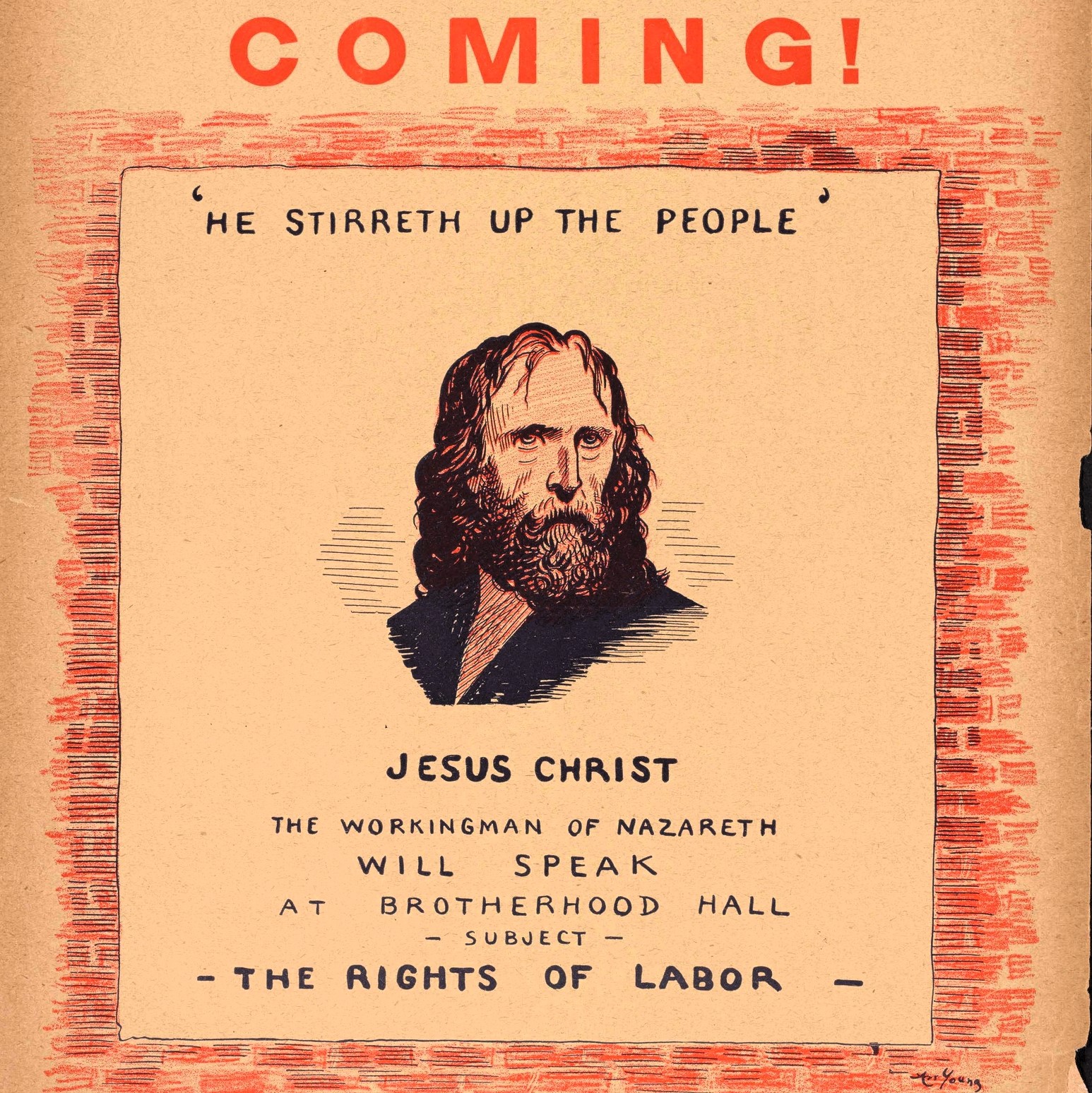
Comrade Wright takes the mickey out of the Socialist Party’s right wing. At the end of the 1912 Socialist Party convention, the constitution was revised, specifically the article (2) on membership in which section 6 declared that “any member of the party who opposes political action or advocates crime, sabotage or other methods of violence as a weapon of the working class to aid in its emancipation shall be expelled from membership in the party.” Wright looks at is potential applications.
‘Historic Sabotage’ by Alex E. Wight from the Commonwealth (Everett). No. 81. July 19, 1912.
In N.Y. Call. Editor of the Call:
Possibilities and probabilities under article 2, section 6, of the proposed socialist platform continue to come to hand-to wit, as follows:
1. Jesus, a prominent Jewish member of Local Jerusalem about A. D. 30, was alleged to have committed a breach of the peace in forcibly ejecting from the temple, without warrant of law, a number of leading business men, assaulting their persons in so doing. It was also alleged that, being hungry, he stole corn from a farmer, the offense being aggravated by the fact that this crime was committed on the Sabbath. Furthermore, it was alleged that by miraculously procuring large quantities of fish and bread he at one time deprived many fishermen and bakers of their just profits–manifestly a criminal offense. When tried by Local Jerusalem under section 6, Jesus admitted and attempted to justify these acts, and was therefore expelled from the socialist party for advocating crime and violence. Sabotage could not be proved against him, although there were rumors that as a carpenter he had been more given to dreaming dreams than planing boards, and that he lost his job in consequence. The members of Local Jerusalem considered themselves well rid of this irresponsible malcontent, and thereafter adopted “Safe and Sane Socialism” as their slogan.
2. In ante-bellum days one John Brown, of Harpers Ferry, was unanimously expelled from his local for the advocacy and commission of violence. The guilt of the accused was so clear that there were no arguments.
3. Some years later the illegal act of one Abraham Lincoln in signing the emancipation proclamation, which act, without process of law, deprived thousands of American citizens of property which was legally and morally theirs (as lawyers and clergy enthusiastically testified), resulted in said Lincoln’s expulsion from the socialist party because of crime against property. “Socialists stand for law and order,” explained the secretary of Lincoln’s local in an interview for the capitalistic press.
4. Emmeline Pankhurst and 50,000 suffragettes were ejected from their various locals in 1912 under section 6 for advocating crimes and violence. “We respect the rights of private property,” said a prominent British socialist in explaining this wholesale expulsion of women. “How about the rights of human beings?” asked a capitalist reporter. But the prominent British socialist suddenly became too busy to talk.
5. John Doe, in 1912, was arrested for violating the law by peaceful picketing during a strike. Defended his action. Expelled by his local under section 6 for advocating crime.
6. Richard Doe, in 1912, arrested for attempting to speak in the public streets in violation of city ordinance. Defended his action and at once expelled from his local.
7. Benjamin Doe, of Massachusetts, in endeavoring to carry out the recommendation of the socialist platform relating to propaganda among soldiers deliberately attempted to influence a boy against joining the militia. Arrested, tried to justify his action, convicted under the law, and at once expelled from the socialist party. “We harbor no lawbreakers,” said the Massachusetts socialist, with one eye upon the Puritan conscience and the other upon the November ballot box.
8. Frank Doe and others violated an injunction by remaining peaceably on strike. Arrested and convicted. Tried to justify their action, and therefore expelled from socialist party. “Law is law and crime is crime,” sententiously observed a defender of section 6.
9. Willie Doe, a member of the Young People’s Socialist society, stole a loaf of bread to keep from starving. Arrested in the act, and fainted from weakness while trying to justify himself. In harmony with the wisdom of section 6, Willie’s little comrades expelled him from their society for crime and violence, it having also been shown that before he fainted he had attempted to resist arrest.
10. Thomas Doe and 10,000 others working in Lawerence mills for $8 per week decided to do only $8 worth of work per week, and therefore “loafed on the job” about two-thirds of the time. Discharged, not only from their jobs, but also from the socialist party, under section 6, for sabotage. “It is the duty of every man to render his best service to his employer,” said a prominent defender of section 6, whereupon a lot of Boy Scouts and their trainers felt quite at home with the socialists.
11. Michaelvitz Doe, in Russia, killed a most excellent police official, who had always done his entire duty, as a large part of the Siberian population could testify. Michaelvitz was immediately expelled from the socialist party for crime and violence, and socialist detectives were put upon his trail to hand him over to justice. In conclusion, the writer wishes to remark that the socialist party never has advocated crime, violence or sabotage as party policies. If, however, it attempts to dictate to party members what their tactics shall be, outside of political action, in the innumerable exigencies of the class struggle, it will deliberately sow within itself the seeds of revolt. Section 6 is simply another form of the “free love” trap in which Avery and Goldstein once tried to catch the socialist party of Massachusetts. The Massachusetts socialists.
The Commonwealth was a Socialist Party-aligned paper based in Everett, Washington that began in February, 1911. First edited by O.L. Anderson, the weekly paper was quickly involved in the state’s very fractious inner Socialist Party life. Editors followed the changing political fortunes with Anna A. Maley directing The Commonwealth from September, 1911 until May, 1912, who also focused the paper nationally. Maley left the paper to run for governor in 1912, the first woman and first Socialist in the state to run for that office, winning a respectable 12% of the vote. Six more editors followed Maley, including Maynard Shipley. The paper’s orientation was left and supported the I.W.W. when many S.P. papers were denouncing them. The Commonwealth struggled, like nearly all left publications in history, with money financially and sold to the Socialist Party of Snohomish County in April, 1914 to be reborn as The Washington Socialist.
Access to PDF of original issue: https://chroniclingamerica.loc.gov/lccn/sn84025731/1912-07-19/ed-1/seq-1/
 Revolution's Newsstand