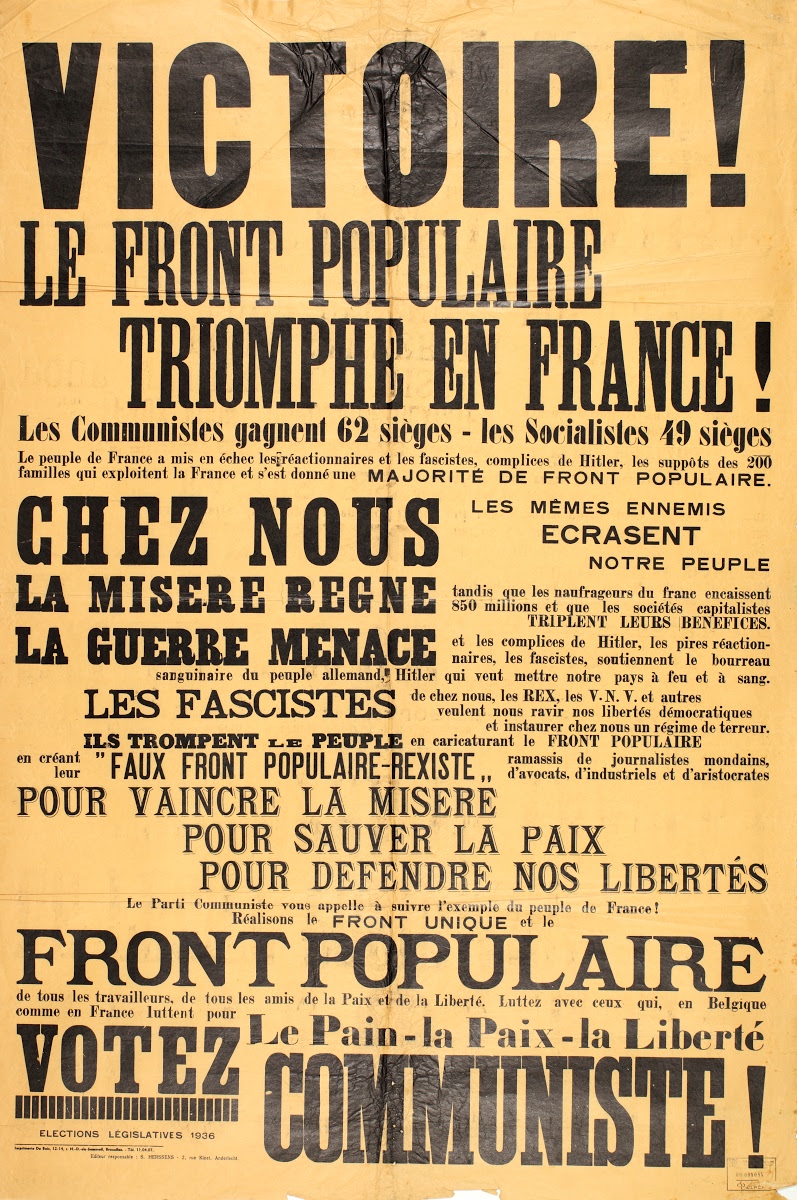
A rare translated article from Karl Volk, veteran of the German movement and leader of the ‘Conciliator’ faction of the Communist Party who would later be close to the International Communist Opposition (the so-called ‘Right Opposition’), here living in exile in Switzerland and commenting on the Popular Fronts just before the Spanish Civil War erupted. Published in the I.C.O.’s short-lived theoretical magazine.
‘The People’s Front Experiences in France and Spain’ by Ypsylon (Karl Volk) from International Class Struggle. Vol. 1 No. 1 Summer, 1936.
SPAIN
THE ILLUSORY successes scored by the Communist Party of Germany in the immediate pre-Hitler days, when it was the model Party of international ultra-leftism, were most instrumental in prolonging the ultra-left course. It is these surface successes which blinded the leaders of the Communist International and a considerable section of the membership and thus prevented them from realizing the actual situation. Prior to Hitler’s seizure of power, the C.P.G. grew organizationally and received huge votes at the polls. The Party, however, failed to realize that, as a result of its ultra-left tactics, it had lost almost all influence, practically all bases of organized support in the proletarian mass organizations, particularly in the trade unions. Therefore, it was unable to play a role of any consequence when the crises broke; first, in July 1932 when the Social-Democratic government of Prussia was dissolved and, later on, in January 1933 when Hitler became Chancellor.
The recent election victory based on the People’s Front in Spain brings with it a similar danger. The People’s Front of Spain has triumphed; it has won a parliamentary majority in the Cortes and has prevented a victory of the Right. Hence, so the C.I. reasons—the People’s Front policy has been brilliantly confirmed not only in Spain but internationally. Spain has thus become the most outstanding testing ground for the People’s Front tactics. In view of this attitude of the C.I., it becomes all the more necessary to subject the events in Spain to a thoro analysis and not to be content with the superficial appearance of things.
The working class of Spain has resumed activity and has regained its self-confidence in an amazingly short time after the October 1934 struggles in Catalonia, in Asturias and other parts of the country. The Left Republican bourgeoisie was very much discredited after the October uprising, particularly in Catalonia. This was due to its cowardly and treacherous role in these struggles. As a result of the People’s Front bloc (which includes the Left Republicans) they were enabled to regain some of their lost prestige and influence among the masses, and to secure artificially a too big representation m parliament at the expense of the workers’ parties. This they could never have secured by themselves.
Moreover, they forced on the People’s Front their election program which expressly rejects all basic and realistic revolutionary slogans as well as the most elementary reform demands of the working class. The program specifically rejects the revolutionary solution of the land question; the expropriation of the large estates and their transfer to farm laborers and peasants; the slogan of workers’ control of production; nationalization of the Hank of Spain, as well as national unemployment insurance at the expense of the employers.
Let us consider for a moment what would have happened had there been no alliance with the Left Republicans? Undoubtedly, there would have been a victory of the lefts—a victory which would have brought a parliamentary majority to the workers’ parties. This would have put the left bourgeoisie in the minority as it deserved, and would not have tied the working class parties to a People’s Front program which spurns the most fundamental and urgent demands of the working class for fear of offending the “left” bourgeoisie. We need only pose the question: would the workers’ parties have gotten less votes if, instead of propagandizing the miserable agrarian reforms of the bourgeois lefts they would have demanded a full agrarian revolution? Incidentally, this propaganda was responsible for the fact that the reactionaries again gained a foothold among the peasants, Would they have received less votes if they had agitated for state unemployment insurance at the expense of the employers, or workers’ control of production?
The events following the elections have shown (1) that the vigorous extra-parliamentary activity of the masses was the driving force; (2) that the Left Republicans agreed to support the amnesty, the restoration of “left” municipal councils, the re-opening of People’s Houses, the reinstatement of workers discharged because of their participation in the October uprising, new regulations in reference to agrarian reform, the dissolution of fascist leagues only under the pressure of the independent actions of the masses; (3) that the left bourgeoisie has only one end in view, namely, to paralyze the activities of the masses, to lure them away from “the streets” by using the workers’ parties of the People’s Front as a brake on the mass movement; (4) that the People’s Front program and the People’s Front itself has already become a brake on mass action and that there can be no progress as long as the People’s Front continues in its present form. The problem boils down to this: either the workers’ parties and organizations permit the Left Republicans to paralyze the actions of the masses (as happened when the peasants’ demonstrations of March 15th were called off at the insistence of Azana) or they break with the People’s Front.
The future development of the revolutionary situation must center around the following demands:
1. The realization of the agrarian revolution. The peasants have already begun to seize large estates altho Azana sent armed troops against them.
2. Breaking of the sabotage of the employers thru reinstating workers and reviving production in idle plants by having the workers take control of the factories thru their own organs. (Workers’ control of production).
3. The dissolution of the Civil Guard; the winning over of the army, the troops and the lower officers thru the agrarian revolution (the army consists mainly of peasants) by means of propaganda for and the formation of soldiers’ councils at the suitable moment, the replacement of officers by rank-and-file soldiers and the organized arming of workers (workers’ militia).
4. The transformation of the workers’ and peasants’ alliances into genuine, all-inclusive class organs of workers and peasants which will direct the revolutionary struggle toward a general uprising, and are to aim at gathering as much political power to themselves as possible—both locally and nationally, thus establishing a government dual to that of the Left Republicans. After a victorious struggle along these lines, these organs will develop into organs of proletarian state power.
5. A break with the Left Republicans; establishment of an alliance with the mass of farm laborers and toiling peasants and the urban petty bourgeoisie by means of workers’ and peasants’ alliances and later on by workers/ peasants’ and soldiers’ councils.
The “Partido Obrera de Unificacion Marxista” of Catalonia, of which Maurin is the leader, was the first to realize that the alliance with the Left Republicans had to be broken. They have already broken with it. The C.P., having learned from the masses, has begun to realize that the People’s Front program has outlived its ”usefulness.” In its letter to the S.P. it calls for a joint struggle more or less along the lines indicated above. But it continues to adhere firmly to the bloc with the Left Republicans. The dangers of continuing such a bloc have been illustrated by the events of March 15th when Azana succeeded in having the S.P and C.P. call off the mass demonstrations of the peasants.
If the Spanish revolution is to be continued beyond the bounds of the bourgeois revolution, it is imperative that the Communist Party break with the Left Republicans immediately so that it can direct, unify and lead the revolutionary mass movement. Only this would mean the guarantee of an actual and complete bourgeois revolution and the defense of the achievements won for the working class. The continuation of this bloc would mean disruption, division, paralysis, disillusionment and demoralization of the revolutionary mass movement. It would provide a breathing spell for all the counter-revolutionary forces of the big bourgeoisie, the big landowners, the clergy, the military. Such a breathing spell can only serve to organize and unify the counter-revolution and enable it achieve victory.
Merely to point out these phases will suffice to reveal the tremendous international significance of the Spanish events in general and the question of the continuation or abandonment of the People’s Front policy in Spain in particular.
FRANCE
The admirable initiative and energy of the working class of Spain has had little effect on near-by France. This is primarily due to the People’s Front which has been paralyzing the extra-parliamentary activities of the masses for some time. Likewise, the throttling of the strikes of Brest and Toulon against the emergency decrees has had very dangerous consequences.
The following events which have already transpired are indicative of the further development of the People’s Front in France:
1. Toleration of the Sarraut cabinet by the C.P. of France (abstention at formation of the government) altho several notorious enemies of labor belong to the cabinet—the assistant secretary of state, who is a member of the “Jeunesses Patriotes,” and minister of war, Maurin, a sympathizer of the Croix de Feu.
2. At the Party conference in Villeurbanne the C.P. approved the toleration of the Sarraut government and declared at the same time (a sort of a little turn to the left) that it was not ready to participate in a parliamentary People’s Front government. To counterpose an extra-parliamentary People’s Front government with the Radical Socialists as this convention did is, of course, sheer nonsense! The manifesto of the Party convention bristles with phrases like “national unity of France,” against the “200 families,” phrases which play into the hands of the reactionaries and chauvinists.
3. Immediately after the attack of the Royalists on Leon Blum, the People’s Front arranged a mass demonstration in which a great number of people participated. This meeting, however, had no concrete, political aim. It was a demonstration to the liking of Sarraut; that is, it provided a safety-valve for the wrath which was mounting in the ranks of the Parisian workers.
The “Action Francaise” has been declared illegal. But the Royalists continue undisturbed their activities in their organizations in different forms. Nothing has been done to dissolve the “Croix de Feu,” the strongest fascist organization. The result is that the dissolution of the “Action Francaise” has led only to a concentration of fascist forces.
The law for the dissolution of fascist leagues thus remains a dead letter. Nobody thinks of organizing broad political self-defense organizations which alone could really disarm and dissolve the fascist leagues. Such organizations would have been the correct answer to the attack on Blum.
4. The government, in conjunction with the representatives of the workers, avoided a strike in Marseilles. The most important demand of the longshoremen, insisted upon by their councils and presented to the employers, the right to strike, was dropped. The C.P. proclaimed this result a “victory” of the workers.
5. At the unity convention of the C.G.T. and the C.G.T.U. in Toulouse the Communist delegates failed to take the initiative either politically or as trade union leaders, they failed to urge a genuine struggle against the emergency decrees and other manifestations of the capitalist offensive. Even after the strengthening of the trade unions thru unification the C.P. members who were delegates failed to urge that the trade unions should participate in the direct struggle for the improvement of the standard of living of the working class. This failure is obviously a result of the People’s Front policy of avoiding conflict with the Radical Socialists who are bitterly opposed to any mass action on the part of the working class.
6. The Locarno Crisis: general helplessness, no mobilization of the masses whatsoever; instead of a clear working class position, the acceptance of Sarraut’s foreign policy, slogans such as, “National Unity”; instead of “Unity of Action” we find unity of non-action.
The net result of the People’s Front in France within the last few months is a big minus: independent mass action of the working class has been paralyzed for months. Moreover, everyone is becoming progressively accustomed to this state of affairs.
A short lived theoretical journal of the International Communist Opposition. Workers Age was the continuation of Revolutionary Age, begun in 1929 and published in New York City by the Communist Party U.S.A. Majority Group, lead by Jay Lovestone and Ben Gitlow and aligned with Bukharin in the Soviet Union and the International Communist (Right) Opposition in the Communist International. Workers Age was a weekly published between 1932 and 1941. Writers and or editors for Workers Age included Lovestone, Gitlow, Will Herberg, Lyman Fraser, Geogre F. Miles, Bertram D. Wolfe, Charles S. Zimmerman, Lewis Corey (Louis Fraina), Albert Bell, William Kruse, Jack Rubenstein, Harry Winitsky, Jack MacDonald, Bert Miller, and Ben Davidson. During the run of Workers Age, the ‘Lovestonites’ name changed from Communist Party (Majority Group) (November 1929-September 1932) to the Communist Party of the USA (Opposition) (September 1932-May 1937) to the Independent Communist Labor League (May 1937-July 1938) to the Independent Labor League of America (July 1938-January 1941), and often referred to simply as ‘CPO’ (Communist Party Opposition). While those interested in the history of Lovestone and the ‘Right Opposition’ will find the paper essential, students of the labor movement of the 1930s will find a wealth of information in its pages as well. Though small in size, the CPO plaid a leading role in a number of important unions, particularly in industry dominated by Jewish and Yiddish-speaking labor, particularly with the International Ladies’ Garment Workers’ Union Local 22, the International Fur & Leather Workers Union, the Doll and Toy Workers Union, and the United Shoe and Leather Workers Union, as well as having influence in the New York Teachers, United Autoworkers, and others.
For a PDF of the full issue
 Revolution's Newsstand