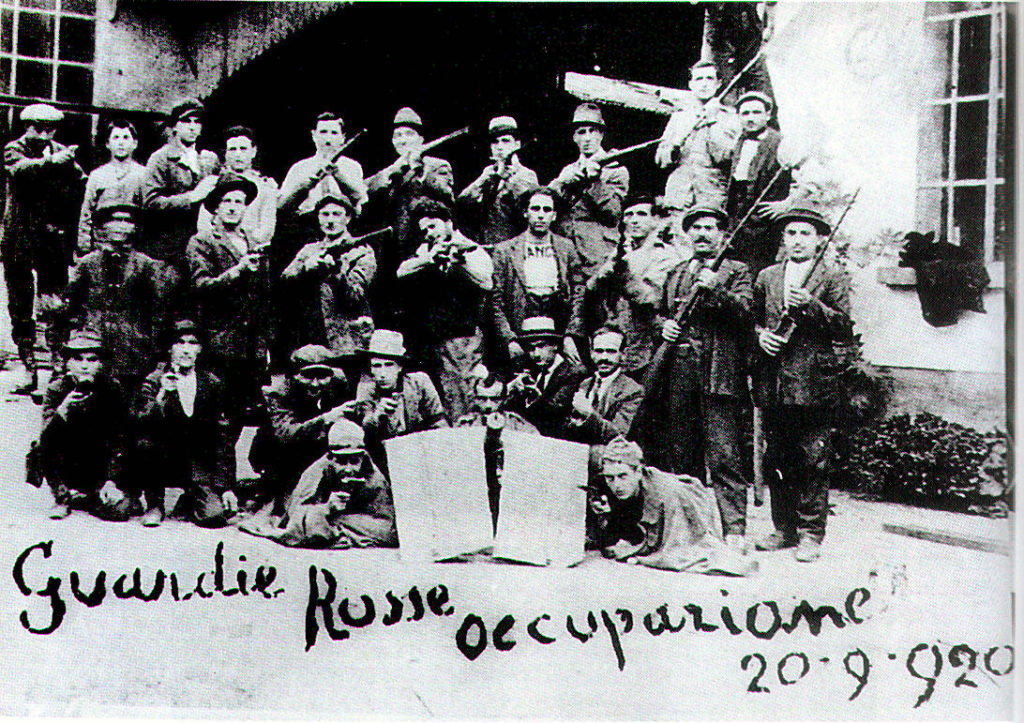
Get a sense of what Italy’s Biennio Rosso, ‘Two Red Years’, was like with this visit to the Tabanelli factory in Rome, under the authority of workers’ Factory Council and renamed the ‘Communist Factory of Rome.’
‘Communist Factories in Italy’ from The Liberator. Vol. 3 No. 11. November, 1920.
“VERY well, comrade, come in.” Accompanied by a member of the Central Committee I entered past the red guards through the gate of the Tabanelli factory. On a tree, high above me, waved the red flag. Over the door was a rude painting of the sickle and the hammer, and beside it a spirited drawing representing the “entrance” and “exit” of the factory. The worker was entering the one; the employer was departing through the other. The commissary of the factory soviet received me.
Was this in Soviet Russia? No, in Italy. The Tabanelli factory is only one of five hundred metal factories and other plants which have been seized in the past three weeks by their workers and operated under their own direction. In each of these factories the same conditions are repeated; red flags, soviets and commissars, and red guards. The seizure was merely the answer of the workers to the threat of a general lockout incident to a campaign of obstructionism. initiated in the effort for higher wages. It has already led to the granting of workers’ supervision of books (which is here called “control”). It is a possible step toward the actual transfer of industrial capital from the hands of the banking and commercial class to those of the workers themselves.
I went through the various departments of the factory, eager to see whether (the best authorities are convinced it cannot be done) production is possible without a capitalist to levy part of the product. Apparently it is possible. The wheels of this factory were turning. The furnaces were blazing. In one department the workmen were planing wood. In another they were putting the last coat of paint on newly completed tramcars. Yes, work was being done.
But how could ignorant workmen do this? “Meet the head of the department,” said the commissar. The head of the department was a middle-aged person, clean-shaven and clearly a man of education.
“Are you a union member?” I asked.
“No, I’m not organized,” he replied, “but I’m with the men in this fight.” In many of the Italian factories these higher bosses had similarly stayed with the men. In others they voted allegiance to the employers, but later submitted wage demands in language that said, though with their own phrasing, that they too were wage-slaves with grievances.
“Meet the clerks and accountants,” said the commissar. They came out of their office and greeted me.
“Why are you staying here?” I asked.
“Oh,” said one of them, “we are organized, too–in the clerks’ union. We want to make this experiment a success.” Throughout Italy the great majority of the non-manual workers have stayed in the factories with the others.
“But what,” I asked the commissar, “do you do if someone decides not to work?”

“He is brought before the factory soviet to be disciplined.” The discipline seems to be based mainly upon the moral reprobation of his fellows, but this is unquestionably effective. The commissar explained that to-morrow obstructionism was to cease, and an intensified schedule of work introduced. “We don’t object to work,” he added. “We are willing to work ten hours a day, or twelve, or fourteen, for the workers’ republic.”
A man in overalls approached us, carrying a dinner pail.
In it was a steaming stew of macaroni and vegetables. “From the railroad men,” he explained. Several such gifts were brought that noon, besides goodly quantities of bread from the railroad men’s own co-operative. It was not much, but it went to the general restaurant of the factory to feed the workers who had no families to bring them food, and it was a spontaneous gift from a rival and at times an enemy, organization. Bread and meat are supplied in large quantities by the co-operatives on credit, and improvised kitchens cook the meals.
We passed through the department in which the bunks have been fashioned out of blankets from home and any straw that could be found in the factory, and came to the machine shop. Here a good-sized rifle field-gun glared at me. “It isn’t quite finished,” explained the commissar. “The men got the impression it was going to be sent to Poland and so—it isn’t quite finished.”
I asked about the red guards. They were organized in squads, which relieved each other day and night. They were drilled each day with military methods by workers who had been officers in the war.
“And if the Guardia Regia comes, what will the red guards do?” I asked.
“They will resist,” he answered.
“But have you any arms?”
“Oh, no,” he assured me, and smiled an innocent smile.
In this factory, as in most of the others, life moved under a species of martial law. Very few of the workmen were allowed to leave the premises, except when permission was granted once in several days, to spend a few hours (but not the night) with their families. The women and children, who brought the lunch and dinner, were permitted to enter at meal hours and eat with their men-folk. But they stayed only until the meal hour was finished. Women workers were invariably sent home at the end of the working day.
The factory regulations posted at the Tabanelli factory are typical of those posted in factories throughout Italy:
“Every comrade who fails in his duty will be judged by a Disciplinary Council.
“Anyone who makes defeatist propaganda among the comrades or in the community will be judged as above.
“Whoever damages or neglects the machines, commits theft or wastes materials, or fails to take proper care of the tools confided to him, will be judged by the said Council.
“At the blowing of the whistle, whoever is not at his post, or whoever leaves work before the fixed hour, will lose the entire day.
“The Factory Council of the Communist Factory of Rome, formerly Roma Tabanelli.”
But the problem of internal discipline is the least of the difficulties. It is necessary to make the factories function, as far as possible, in a normal manner. This need forced the workers’ committees to build, in a rude way, the beginnings of a whole national economy within the existing Capitalist system. First came the need, explained years ago by Lenin, for “accounting and control.” The General Committee of Agitation appointed a “Technical Committee” composed of technical men appointed by the various factories, and of some of its own members. Here is its first order:
“The Central Technical Committee asks all the local branches of the Fiom (Metalworkers Union) to come to an understanding with the local branches of the technical and administrative employees and with the technical bosses as individuals where these are not organized, to form a technical and administrative commission to provide for the co-ordination of production and efforts, and for the solution of eventual differences which may arise between the directing element and the workers now in the factories.
“They are further asked to proceed immediately to a general inventory of all raw materials, machinery, tools and implements, etc., existing within each factory. For the machinery, tools and implements they need compile only one copy of the inventory, which is to remain with the internal commission of the factory in question, but for raw materials it will be necessary to prepare four copies of the inventory, of which one is to remain deposited with the internal commission, another is to be consigned to the local technical committee, another to the regional or provincial committee under whose jurisdiction the metalworkers’ branch is placed, and finally a last copy sent to the Central Technical Committee which has offices at the General Confederation of Labor in Milan.
“To the internal commissions is confided the execution of the above regulations, which must be conducted precisely and carefully as directed, in order that the Central Technical Committee may be informed of the available stocks of raw materials existing in Italy. It is especially directed that the inventory be conducted after working hours.
“To the inventory reports shall be appended specific indications concerning production in all the factories. The regional and provincial committees and all the branches are asked to communicate the information requested solely through their officers.”
Nothing could give a truer impression of the spirit in which this agitation is being conducted.
But where raw materials and fuel were lacking, what then? Then representatives of the internal commissions went to the places where they were to be found and demand- ed them. The following report gives the substance of dozens of others:
“The secretary of the Fiom had demanded of the firm of Binucci Brothers, wholesale dealers in metal, the consignment of a certain quantity of raw materials for the occupied factories, but the firm had refused. Thereupon the employees of the firm demanded the consignment of the mate- rials under the threat of occupying the factory. Under this pressure the firm consigned the goods to the factories which had demanded them.”
In other cases the metal workers needed fuel and sent down their request to the workers in the peat mines, who promptly seized the mines and shipped the fuel required.
Similarly, the railway men had a way of investigating into the contents of the cars they were hauling, and, finding goods which might be of use to the metal workers, shunting them off into the factory sidings. The railwaymen were not asked to give revolutionary assistance, but some of the minor-categories took what governments call “preventive action.” The employees of the Rome-Tivoli tram line one day raised red flags over their cars, seized the administrative offices, and put them under guard, and posted a notice which, after setting forth the desirability of operating public utilities for the benefit of the people and not for the profits of a few owners, continued:
“Having taken under observation the present general situation, the employees of the Rome-Tivoli line have decided to invite the representatives of the present managers to withdraw, and to be substituted in their property rights by the community, in whose name the employees now take into custody all rolling stock and fixed equipment for the regular continuation of the service to the benefit of the community.”
The movement spread to the apartment houses, where tenants threatened with expulsion or suffering under the neglect of their landlords, formed “internal commissions” and “red guards” of their own, raised the red flag, and summoned the landlords to come to terms. In every instance they came. The movement had an echo on the farms. For example, the wage-working peasants of Sicily, after clamoring for weeks for the right to work idle lands on the great estates, took possession of the estates of Baron Valdaura, Baroness Di Salvo, Marchioness Salandra, Prince Comporeale and many others. The Socialist Party, understanding from the Russian experience the importance of possessing at least the passive sympathy of part of the peasantry, issued an appeal pointing out that the aims of the two classes were parallel, and promising that in case of success the city workers would sell to the peasants the manufactured articles they need at better prices and on better terms than under capitalism. The appeal closed with the following paragraph:
“Peasants!
“Follow the struggle of the metal workers with sympathy, give them your aid. And if to-morrow the hour strikes for the decisive battle against all masters, against all exploiters, then make haste. Take possession of the villages, of the land; disarm the troops, form your battalions together with the city workers, march toward the large cities to aid the people battling against the mercenary police of the bourgeoisie. For perhaps the day of liberty and justice is near.”
I have not attempted to recount the course of the struggle, nor the strange political intrigues behind it; nor to explain the various factors which made the government helpless to combat the metal workers by force; nor to estimate the partial success of this almost impossible experiment in workers’ management while political and financial power were in the hands of their enemies; nor finally to estimate what substantial advantage may accrue from the rights of supervision granted to the workers’ internal commissions by the factory owners. Control or supervision, such as it is, is likely to prove a step not to an achievement, but to a new phase of revolutionary struggle. It is not likely to allay revolutionary feeling. The workers have now new weapons, but the only use for weapons is to use them against the enemy. Little of a definite nature ever comes of these agreements and accords.
What is definitive is the remarkable spirit and method of the agitation. They prove that the Italian workers have learned the lesson of the Russian revolution-that revolution means not shooting or shouting, nor slogans nor even ideals, but work, competence, administration, patience, discipline–in short, “accounting and control.” The whole emphasis of this struggle, not only among the leaders, but especially among the masses, has been on discipline, method, accuracy. The workers who accomplished the fundamental revolutionary act of seizing for themselves the social capital of production, did not believe that their act was symbolized in the red guards placed at the doors of the factories. They believed it was symbolized in inventories and records-in production. This is the victory of the occupied factories.
The Liberator was published monthly from 1918, first established by Max Eastman and his sister Crystal Eastman continuing The Masses, was shut down by the US Government during World War One. Like The Masses, The Liberator contained some of the best radical journalism of its, or any, day. It combined political coverage with the arts, culture, and a commitment to revolutionary politics. Increasingly, The Liberator oriented to the Communist movement and by late 1922 was a de facto publication of the Party. In 1924, The Liberator merged with Labor Herald and Soviet Russia Pictorial into Workers Monthly. An essential magazine of the US left.
PDF of full issue: https://www.marxists.org/history/usa/culture/pubs/liberator/1920/11/v3n11-w32-nov-1920-liberator-hr.pdf
 Revolution's Newsstand