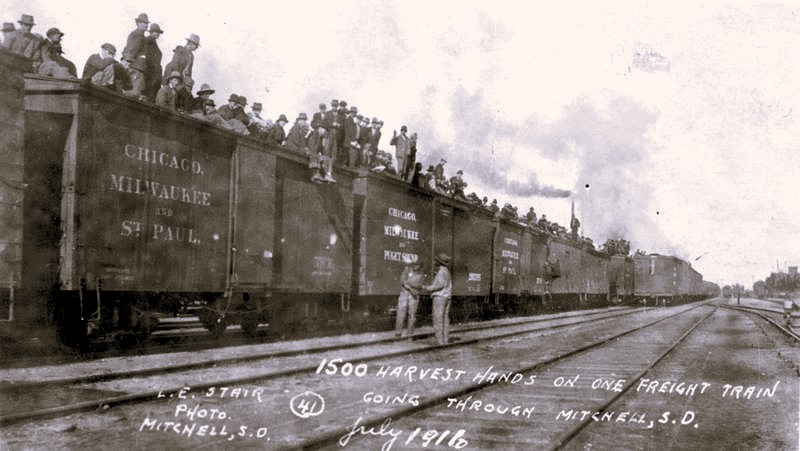
A country where lynch-law and the rule-of-law are often indistinguishable. Alongside better-known ‘battles’ of the I.W.W., mainly mob assaults on the I.W.W., like Bisbee and Everett, are hundreds if not thousands of harrowing events faced by wobbly organizers. Here, an escape from the noose for harvest agitators in South Dakota.
‘‘Battle’ of Mitchell, South Dakota’ by E.N. Osborne from Solidarity. Vol. 7 No. 345. August 19, 1916.
Organized Gunmen, Backed By City and County Officials, Make Murderous Assault on I.W.W. and Get The Worst of It–Four of Them Shot; Seven Turned Loose After Arrest, To Continue Their Unlawful Attacks.
Aberdeen, So. Dakota, Aug. 9. I was sent to Mitchell by the organization committee of the A.W.O. to act as stationary delegate there. I was there only a few days when I called before a committee of the fathers of the town, the police judge, chief of police, mayor and sheriff to find out just what the I.W.W. meant to do in that vicinity.
I told them that I was sent there for organization purposes only, and be no trouble there unless brought it on themselves.
For the first eight days there was no trouble (only a few minor cases of arrests, which were disposed of in our favor) until July 2, when a band of organized gunmen known “as yellow-card men” (who were put in the field by the commercial clubs of this state) arrived in Mitchell, after beating one of our fellow workers and destroyed his card. These gunmen, about 15 in number, in company, with about fifty unarmed followers, told all our members who were in town own that they (the I.W.W.) could not ride a train out unless they wanted to get shot. When the train whistled out of town, the I.W.W. members started towards it. They were met by a volley of shots and one of our fellow workers fell to the ground, shot through the back near the spine. After being shot he raised upon his elbow and emptied his gun into the crowd of gunmen. About 100 shots were fired in all. One fellow worker, seriously injured, Frank Wells. Two more were slightly injured, but did not require medical attention. Four of the gunmen were shot. Seven of them were captured by the police and deputies and were given their guns back and told to go and shoot a few more of “them damned I.W.W.”
A riot call was sent in and about 1,000 responded with arms of every description, from little bulldog revolvers to army-rifles. Every man who was not a home-guard was searched, placed under arrest, and kept under guard out in the open all night.
Fellow Worker McCoy and myself went to our room after things had quieted somewhat; but about the time we had fallen asleep a mob of armed citizens formed in front of our room and shouted threatening remarks at us. The Sheriff and a dozen deputies came up with a search warrant and tore everything to pieces in the rooms and then went across the street to my office and searched that. But whatever he was searching for he failed to find, for nothing was missing.
All the fellow workers in town were herded to the railroad yards at daylight in the morning and put on a north-bound freight. Then the chief of police and a few of his armed citizens came into my office and ordered me to leave town at once, which, of course, I refused to do. They then departed. I suppose for a conference among themselves. About 1:30 in the afternoon the sheriff, chief of police and a deputy came down to the office in their automobile and told me they wanted to talk to me at the courthouse. I consented, as arbitration would be best and asked them if I was under arrest they said “No.” Fellow Worker McCoy asked me if I was arrested and before I could answer him they threw him into the car with me and took us to the courthouse and into the sheriff’s office, where we had the honor of meeting Fellow Workers T.J. Thorne and Stricker, who had been arrested in the forenoon. We were then taken outside and each placed in a separate automobile with four armed guards to each man and deported out of the county; and warned under penalty of the noose if we returned.
When I asked the chief of police why we were not arrested and given a trial he replied that “no god-damned organizer would ever get a trial in Mitchell.” Three days before this the same officials had told me that we were not a law-abiding organization. Maybe we are not, but are they law-abiding?
The state senator from that county was one of these law-abiding citizens (?). He says we should all be given ten years apiece in the penitentiary for not being law-abiding. He says no organizer would be given a trial. Is he law-abiding? Yours for a speedy change of this rotten system.
The most widely read of I.W.W. newspapers, Solidarity was published by the Industrial Workers of the World from 1909 until 1917. First produced in New Castle, Pennsylvania, and born during the McKees Rocks strike, Solidarity later moved to Cleveland, Ohio until 1917 then spent its last months in Chicago. With a circulation of around 12,000 and a readership many times that, Solidarity was instrumental in defining the Wobbly world-view at the height of their influence in the working class. It was edited over its life by A.M. Stirton, H.A. Goff, Ben H. Williams, Ralph Chaplin who also provided much of the paper’s color, and others. Like nearly all the left press it fell victim to federal repression in 1917.
PDF of full issue: https://www.marxists.org/history/usa/pubs/solidarity-iww/1916/v7-w345-aug-19-1916-solidarity.pdf
 Revolution's Newsstand