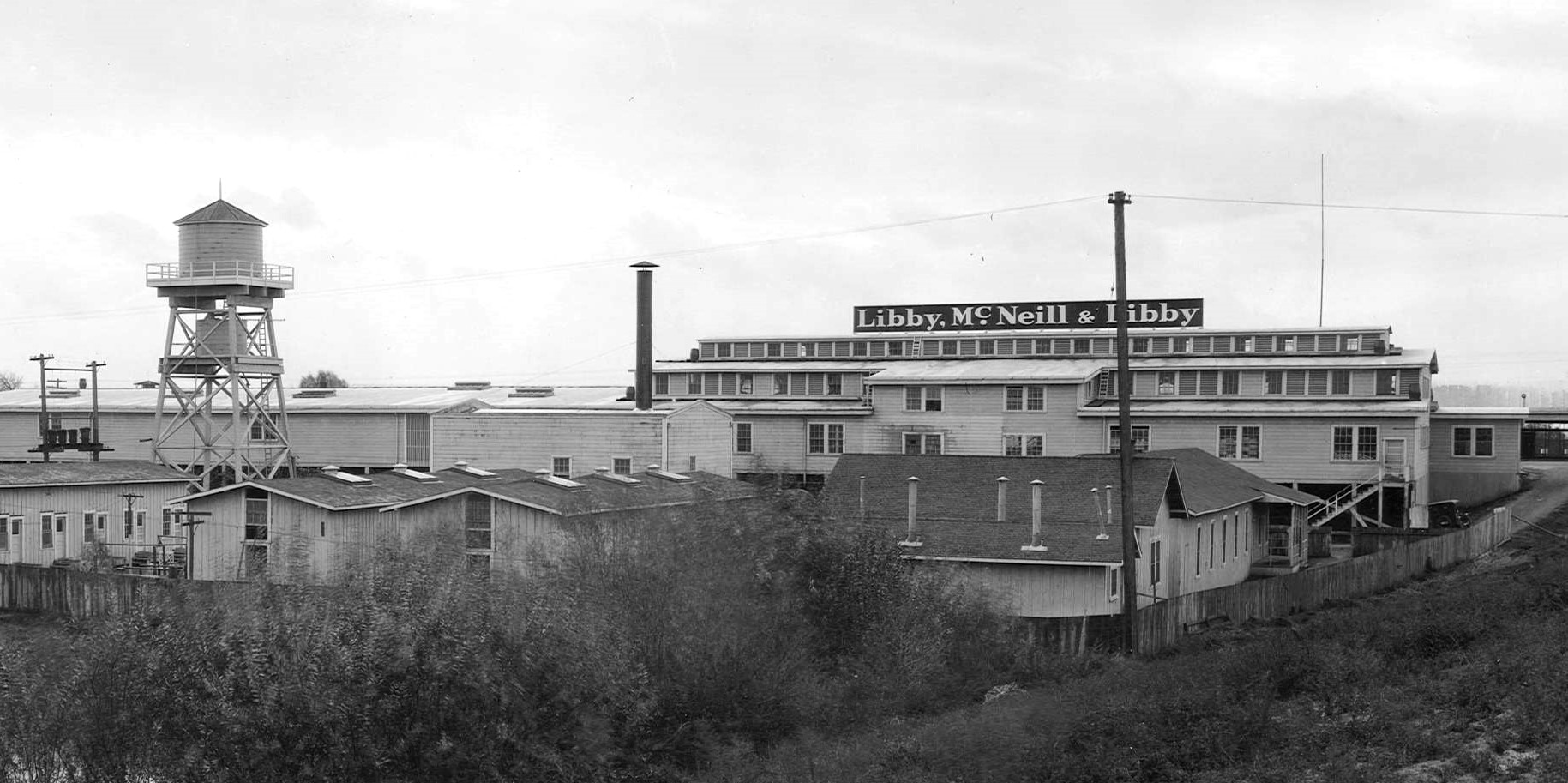
A look into a ‘typical slave pen of the worst kind, in which California canned goods are produced.’
‘Troubles of the Libby Cannery Slaves of Sacramento, California’ by A.C.L. from Solidarity. Vol. 6 No. 294. August 28, 1915.
The Libby cannery in Sacramento employs between 350 and 400 girls and about 100 men, and they are about the most ignorant bunch of slaves that the Lord ever sent on earth to be contended with.
The superintendent is known by the name of Van Eaton; he is a very picturesque product of capitalism, with his over-fleshy face and also the bump in front, which shows that his stomach has not touched his back-bone in some time.
As to wages, the women were paid 10 cents for cutting a box of apricots, with a lot of extra work on them this year which included eyeing all apricots except those for pie purposes.
The daily wages in apricots, working from 6:30 A.M. to 8:30 P.M., ranged from 50 cents to $2.
On plums they pay 2 cents for stemming a 50-pound box; they put girls between the ages of 12 and 18 years on this work; they had those girls on strawberries first, for which they pay 15 cents per crate. They let the girls work two days on plums, making from 20 to 50 cents per day, then put them on strawberries, at which they make from 75e to $1.05 per day. The women will not work on plums, so the boss forces the girls to scab on themselves by telling them that if they don’t work on plums they can go home and stay there, so, of course, they work for that small sum because they cannot help themselves.
The women are now working on peaches, for which they get 10 cents a box, and every peach must be cut just right; the floor ladies working for 17 ½ cents an hour are regular company suckers–if a piece of fruit is not cut to suit here she will sometimes run to one of the higher bosses, and he will come to the cutter and give her a half hour’s lecture on how to do it. Down in the cloak room they have an Italian woman “to look after;” if she catches a woman washing knives or rags in a washbasin, leaving washwater in a basin or leaving papers or anything on the floor, she will take your number and you are fined a dollar. She even had the nerve to ask some of the girls to wash upstairs.
The men are paid 20 cents an hour, but some of the boys under 18 are paid 17 ½ and some 12 ½ cents per hour.
Most of the employes of this cannery are Italians and Greeks, with a very few others. If you should happen to pass by the cannery you will see a bunch of slaves numbering from 10 to 75 standing outside, waiting for someone to quit or get fired so one of the number can take his place. These men are there from 6 in the morning until 7 at night; the most being there at 8 in the morning; then some begin to leave, and the crowd keeps dwindling away until noon, but at 1 o’clock the crowd is as big as ever.
They work overtime almost every night at these canneries, and the workers get one-half hour for supper some of the men in the can department only get 15 minutes for their meals, and if they are not “Johnny on the spot” they get their walking papers. As conditions are, a fellow gets tired once in a while and goes home to supper and forgets to come back, so one of the outside slaves gets a chance on the inside, and the one who would not work the night before generally finds his job gone the next morning. If he is a good slave he joins the waiting throng on the outside, and in about a week or so if the boss knows he is a good slave, he is put back to work and another tired slave gets a rest.
This partly explains conditions as they are in Libby, McNeil and Libby’s cannery in Sacramento, and if there are any Italian or Greek rebels in Sacramento, I would ask, Why don’t you get into this cannery and wake up the sleeping slaves
This same company also has canneries at Sunnyvale, Selma, and in almost every fruit-belt in this country. They have salmon canneries in Alaska and fruit canneries in the Hawaiian islands, so you can work for Libby, McNeill & Libby almost anywhere you happen to be; and all of them are slave pens of the worst kind. So get into these places; take your wooden shoes with you as they are the handiest shoes made these days.
In closing it may be well to add that Cunningham, office man of the Housing and Immigration Commission here tells me that he has it on good authority that two big fruit contracts have been cancelled by British fruit shippers, and it is not on account of the war, either.
A. C. L.
The most widely read of I.W.W. newspapers, Solidarity was published by the Industrial Workers of the World from 1909 until 1917. First produced in New Castle, Pennsylvania, and born during the McKees Rocks strike, Solidarity later moved to Cleveland, Ohio until 1917 then spent its last months in Chicago. With a circulation of around 12,000 and a readership many times that, Solidarity was instrumental in defining the Wobbly world-view at the height of their influence in the working class. It was edited over its life by A.M. Stirton, H.A. Goff, Ben H. Williams, Ralph Chaplin who also provided much of the paper’s color, and others. Like nearly all the left press it fell victim to federal repression in 1917.
PDF of full issue: https://www.marxists.org/history/usa/pubs/solidarity-iww/1915/v06-w294-aug-28-1915-solidarity.pdf
 Revolution's Newsstand