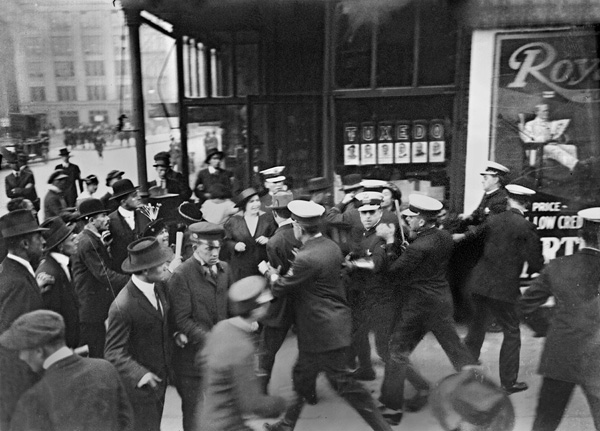
The founding strike of the Amalgamated Clothing Workers, formed by a rebellion in the conservative United Garment Workers, in Chicago during 1915 started with 5,000 workers. When they were fired and replaced, they were joined by 25,000 more; mass arrests and murderous violence failed to break the strike. By the end of the decade, the A.C.W.A. had organized nearly all of Chicago’s garment workers. At home in Chicago, Leslie H. Marcy reports.
‘Under the Stars and Stripes’ by Leslie H. Marcy from International Socialist Review. Vol. 16 No. 5. December, 1915.
OVER one thousand two hundred Chicago Garment Workers have been arrested and thrown in police stations since they went on strike for a living wage eight weeks ago.
Never, in the strike history of Chicago, has there been so many wage workers arrested. Over three-quarters of a million dollars has been furnished to bail out the men, women and girls, according to Comrade William A. Cunnea, who is fighting the battles of the strikers in the courts as attorney for the Amalgamated Clothing Workers.
The first day of winter finds fifteen thousand needle workers more solidly united than when they walked out eight weeks ago. Of these on strike, about one-fourth are Jews, the remaining being equally divided between Italians, Lithuanians and Poles. The strike has welded them together into a solid fighting phalanx.
Most of the workers have been in this country only a few years. The big point made by Grace Abbott of the Immigration Protective League is that these foreigners will get a queer idea of democracy and freedom under the American flag by the time the Chicago police have added a few more hundred arrests to the 1,246 so far charged with offences. These have ranged from disorderly conduct and unlawful assembly to “riot,” “inciting to riot,” assault and battery and malicious mischief. Many arrests have been made with no charges preferred.
Also, be it noted, these foreigners haven’t got the vote. They are not yet citizens. They cannot use their ballots to help get better conditions, even if it were a cinch that such use of the ballot would gain them their demands. They have been driven to find another way to find a shorter workday and a higher wage. So they are on the streets on strike, leaving their needle machines idle.
“Parliamentary action failed us and we are supporting now the only action that appears effective for gaining our ends,” was the remark of a club woman who lobbied for women’s laws in the last Illinois legislature and is now on the picket line of the striking garment workers.

“We asked for an eight-hour law for women. We pointed to women as mothers on whom it was unjust to impose the nine and ten-hour workday. Our demands were refused.”
“We asked for a minimum wage commission to investigate various industries and fix the lowest amount an employer would be permitted by law to pay his girls and women. We wanted the living wage arranged by law to safeguard the physical needs of food, clothing and shelter required by wage earners. Our demands were refused.”
“Sixty per cent of the garment strikers are women and girls. They are demanding the shorter workday and the minimum wage we asked of the state legislature. Our political demands having been refused, we are taking the only course possible for us. That is, we are getting out on the streets on the picket line, we are contributing money, and we are issuing public statements that our place is on the strike lines where our sisters are taking the most direct route to attain their industrial demands.”
On the other side are all the big bosses in the men’s clothing industry which has grown with gigantic strides in a few years until Chicago is the greatest men’s clothing center in the world, with an annual output of $140,000,000.00.
Backing up the bosses is the power of the press, the club of the cop and the Mayor of Chicago, as well as an army of special police and professional strike breakers.
In spite of the fact that the law grants the strikers the right to peacefully picket, the cold fact is that the special police are growing daily more bitter in their assaults on the picket lines. More arrests are made, more workers beaten up.
His honor, the Mayor, who not long ago was handed a halo for forcing arbitration during the street car strike, has steadfastly refused to use his power and pull to bring about arbitration. His advice to the strikers is that they should “Go home and keep the peace,” and, above all, not use violence.
The chief of police is also lined up with the bosses. The Day Book, the only Chicago paper which has stuck by the strikers through thick and thin, in its issue of November 17th, says: “Chief of Police Healey, seated by the Mayor, flourished a bundle of papers dealing with alleged attacks by strikers. But the Mayor said he had no reports of sluggings in which strikers had been the victims.”
The following paragraphs will give Review readers an idea of the majesty of the big stick as represented by the police force of Chicago:
James O’Dea Storren was a captain of police in Chicago a few months ago. He was a high and honored official. He was one of the regular attendants at the annual dinner of the Haymarket Veterans’ Association, he, Capt. Storren, having been one of the policemen who was on duty the night that the world-famous Chicago anarchists’ bomb was thrown.
And now Capt. Storren has had his captain’s badge taken from him and his buttons and his uniform. He is no longer a captain of police. He was convicted by a Cook county jury of the crime of extortion and conspiracy. He was sentenced to pay a fine of $1,000 and only his extreme age saved him from a term behind the bars of stated prison.
At trial, Capt. Storren’s lawyer shook his finger dramatically to the jury and then turned and pointed at the old man, saying: “This man is a veteran of the Haymarket riot. He is a defender of civilization. He risked his life to ward off the demon of anarchy from your hearths and firesides. ” It seems the jury wouldn’t fall for that stuff. The overwhelming testimony of witnesses showed that Capt. Storren, even though a Haymarket hero, had been a helper of a gang of thieves known as “the million-dollar burglar trust” operating on the west side of Chicago, chiefly near the Maxwell street station. These burglars used wagons. They ran their wagons up alleys, backed to the hind door of a store, and loaded up the whole stock of the store, whether dry goods, furniture, silk or what not. They hauled away a million dollars’ worth of this swag. They paid the police. And the police kept their eyes shut. And one Haymarket hero was caught with a sticky mitt.
“The detective bureau of Chicago is a den of thieves.” This remark is not from any Socialist or I.W.W. It is the cool statement of the state’s attorney of Cook county who knows the police of Chicago pretty well. Three detective sergeants and one police captain have been convicted in the last four months of extortion and conspiracy. One of the detectives sentenced to state’s prison is a nephew of the present captain of the detective bureau. Besides, the game isn’t over. A former captain of the detective bureau is now on trial and a lieutenant ‘will face prosecution after that. There are no charges of cruelty and cunning, facility in the “double cross,” made by labor men against policemen and detectives as a class, but are well backed up in the evidence brought out in these Chicago police cases.
Sidney Hillman advises the Review that over ninety thousand dollars have been given by the Amalgamated Clothing Workers in the shape of strike benefits, ‘ the big bulk of which has been paid out to strikers during the past five weeks. The strike fund is getting low and winter is here. We hope all Review readers who can afford to send in a dollar or more will do so at once. The clothing workers’ fight is our fight. It is the class struggle in action in Chicago in the clothing industry. Show these garment workers that you are with them by sending your remittance to The International Socialist Review.
The International Socialist Review (ISR) was published monthly in Chicago from 1900 until 1918 by Charles H. Kerr and critically loyal to the Socialist Party of America. It is one of the essential publications in U.S. left history. During the editorship of A.M. Simons it was largely theoretical and moderate. In 1908, Charles H. Kerr took over as editor with strong influence from Mary E Marcy. The magazine became the foremost proponent of the SP’s left wing growing to tens of thousands of subscribers. It remained revolutionary in outlook and anti-militarist during World War One. It liberally used photographs and images, with news, theory, arts and organizing in its pages. It articles, reports and essays are an invaluable record of the U.S. class struggle and the development of Marxism in the decades before the Soviet experience. It was closed down in government repression in 1918.
PDF of full issue: https://www.marxists.org/history/usa/pubs/isr/v16n06-dec-1915-ISR-riaz-ocr.pdf
 Revolution's Newsstand