
Bill Dunne at the armed funeral of striking mill worker, single-mother, and National Textile Workers organizer Ella May Wiggins, murdered when returning from a union meeting on September 14, 1929 in Gastonia, North Carolina. Wiggins came to life in the strike, by her own admission, writing songs for the workers and going to Washington to testify before Congress. She left five orphans.
‘Armed Workers Bear Ella May to Her Grave’ by William F. Dunne from The Daily Worker. Vol. 6 No. 166. September 18, 1929.
Requiem Sung Is Mill Mothers’ Song She Composed–Thugs Hunt Speakers–Grave Between Mill and Union Hall
CHARNOTTE, N.C., Sept. 17. Ella May is buried. Her body was borne to its resting place in the red clay soil of Gaston County while the gangs of the Manville-Jenckes gunmen ranged the road looking for National Textile Workers Union organizers who might be careless enough to travel alone.
Ella May pallbearers were armed mill workers. Her requiem was the mill mothers song she had composed, sung in the croning minor key of the Southern folk melodies.
Ella May’s song echoes through the rain-soaked laurel leaves as Ella May’s body went back to the red earth her blood had dyed a deeper crimson.
This was a stern funeral. Misery and death are commonplace in the mill villages of the South. Murder is nothing new, but even the machine cruelty of Southern industrialization has not yet made the murder of women a commonplace.
Gaunt, tight-lipped men and working women, red-eyed from weeping, witnessed the burial of Ella May, their fellow worker, who in one red moment became the sign manual of their revolt. Merciless as the Manville-Jenckes machines and just as efficient in their deadly purpose, gunmen of the mill owners sought and took the life of the woman worker whose example urged others on. Nine dollars was the sum slipped into Ella May’s pay envelope every week. The powder and lead of the volley that took her life cost more than this. These things her mourners knew.
They knew of the five children she tried to feed and clothe on nine dollars a week. They knew the song she sung. They sang it—they sang it with understanding and the cold and quiet determination that marks off the southern born mill worker from more demonstrative immigrant workers of the North.
As they sang there crept into the heart of every listener the feeling that Ella May will not go unavenged.
Such a simple song but so full of meaning the mill mothers song:
“We leave our home in the morning
We kiss our children goodbye,
While we slave for the bosses,
Our children scream and cry.
And when we draw our money,
Our grocery bills to pay,
Not a cent to spend for clothing,
Not a cent to lay away;
And on that very evening our little son will say,
‘I need some shoes, dear mother,
And so does sister May.’
How it grieves the heart of the mother,
You every one must know,
But we cannot buy for our children,
Our wages are too low.
Now listen to me workers,
Both you women and men,
Let us win for them the victory,
I am sure it will be no sin.”
Then Dewey Martin spoke, the local organizer of the N.T.W.U. Born of the mountain blood, slim and straight, marked for death by the Manville-Jenckes thugs. Then Cliff Saylor, kidnapped on the night of Sept. 9 by the black hundreds of Manville-Jenckes. Then Wes Williams, chairman of the Bessemer City local of the National Textile Workers Union, for whom the Loray Mill gunmen have been hunting for days. Hugo Oehler, Southern organizer of the N.T.W.U., was there, the workers greeted him like a man already dead. They wondered, and they said they wondered that he was still alive.
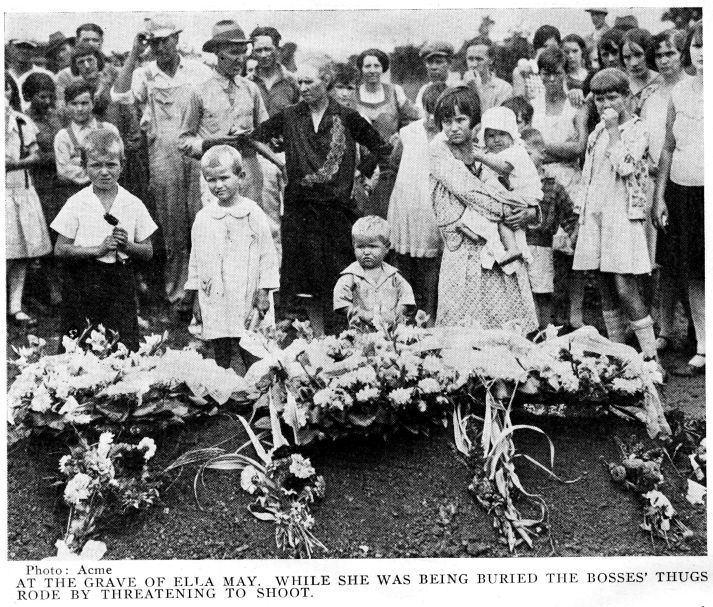
A cold gray rain swept down all morning Thru the damp fog, the gunmen’s cars surged and roared, and so her fellow workers buried Ella May. Not far from her grave is the shattered hall of the Bessemer City local of the N.T.W.U. In crude letters the name of the union stands out. All who pass on the highway’ must see it. In between this and the glittering Loray mills is the grave of Ella May.
The songstress of working class revolt in the South…
The Daily Worker began in 1924 and was published in New York City by the Communist Party US and its predecessor organizations. Among the most long-lasting and important left publications in US history, it had a circulation of 35,000 at its peak. The Daily Worker came from The Ohio Socialist, published by the Left Wing-dominated Socialist Party of Ohio in Cleveland from 1917 to November 1919, when it became became The Toiler, paper of the Communist Labor Party. In December 1921 the above-ground Workers Party of America merged the Toiler with the paper Workers Council to found The Worker, which became The Daily Worker beginning January 13, 1924.
PDF of full issue: https://www.marxists.org/history/usa/pubs/dailyworker/1929/1929-ny/v06-n166-NY-sep-18-1929-DW-LOC.pdf
 Revolution's Newsstand