
Technology, taste, mass production, and the market change the glass cutting industry.
‘The Cut Glass Industry’ by Richard James from Industrial Pioneer. Vol. 1 No 11. December, 1921.
SYSTEMATIC abrasions on glass ware technically known as cut glass, first gained prominence in the city of Prague through a German designer and cutter named Lehman. He taught the art to others, the most skilled of whom found favor with the Austrian Court.
Power was supplied by water-mills; the tools were crude, and the patterns only a vague promise of the aesthetic destiny of the trade. Europe is now behind this country in production of cut glass of merit. We shall speak of the trade here.
Glass factories make the shapes. Some of these plants have cutting shops, but most cut glass is produced by independent firms. Three lines of ware are cut, heavy and light table ware and shades for lighting purposes. Table ware includes such articles as jugs, tumblers, goblets, bowls, nappies, vases, etc.
Not much capital is necessary to start a cutting shop, hence the great number of small one-, two- and three-men shops. Glass manufacturers frequently threaten to boycott these shops but for both economic and artistic reasons they have thus far largely supplied the cutting shops outside. There are probably five thousand cutters in this country. It is understood we are not including those who bevel plate glass and mirrors, or who trim stained mosaics. The cutters were once on the road to organization in the American Flint Glass Workers’ Union, attaining 2,000 members. This has dwindled to about half. War industries offering greater remuneration took many from the trade.
When one spoke of cut glass twenty-five years ago heavy table ware was meant—“deep cut,” polished to brilliancy. Heavy ware has weight, fine material and beautiful finish. Formerly the “blanks” came to a cutting shop perfectly plain. Now the majority are pressed in process of moulding at the factories. In the case of the plain blank the design is marked on mainly with red lead. It is then “roughed.” Roughing is an abrasive operation accomplished by pressing the glass against a steel mill revolving perpendicularly and fed with a constant stream of watered sand, alundum or carborandum. The latter is best, and most used. The mills are fastened to a spindle, and this is held between wooden blocks. The entire working stand is called a “frame.” The mill-surface is shaped flat, cupped, convex or to a “mitre” by means of a file. The point of a sharp mill is its mitre.
When the rougher completes, say, a dozen bowls they are given to a smoother. This mechanic works on a frame, too, but uses stones instead of mills. The stones are very smooth and true, with water constantly running on their points and a sponge pressed against them to clear the residium. The stones are of two general natures, those quarried, and those manufactured. They are “turned” or “dressed” with solid carborandum bricks. When the smoother follows a rougher he removes the sand, alundum or carborandum by placing the glass against his stone, in the “groove.” The cut then becomes “white” and smooth. Smoothers also add finer details of design without other marks. When they smooth “figured” or pressed blanks the process is identical but mold instead of “sand” is cut out. Good smoothers detest working on pressed ware.
The smoothing finished, a polisher next takes the work. He uses a “wood” fed with wet pumice. The glass pressed against this wood and gritty pumice is made “soft,” free from surface imperfections impossible of removal through smoothing process.
The glass is then washed, dried, and inspected. It is then “waxed”—painted with hot wax on the inside. An acid-polisher now immerses it into a mixture of powerful acids. All parts exposed, not covered by wax, are affected. The result is a brilliancy that reflects in highlights all colors of the spectrum. Acid-polishers wear rubber gloves^ but are sometimes badly burned from splashes.
In the wash-room another immersion in hot water removes the wax almost intact. The glass is washed again, dried and given to a buffer, who works on a wheel of hard felt dressed with rotten stone, pumice and putty powder, all wet. This operation removes “acid-marks.” The glass is then washed for the third time and wrapped for shipment.
Light ware — articles of utilitarian and ornamental values in table ware—has been decorated in various ways, chief of which are etching, cutting and engraving. Some is also painted. The thinness of the glass necessitates more shallow cuttings. This makes for greater speed of output. Roughers and polishers are largely unnecessary. Very little of the cuts are polished. During the past few years this class of work has been gaining great popularity. While most of the designs little deserve to be called cut glass due to lack of beauty and skilled workmanship, it is also true that some manufacturers have seriously attempted to produce meritorious work. Some have succeeded with designs favorably reflecting the true aesthetic possibilities of cutting on light blanks. Patterns known as “grapes” and “stars” are an abomination. No one who really understands beauty in art would defend them, to say nothing of exhibiting such cheap stuff as worthy cut glass specimens.
But there is a line of junk in the cut glass trade that is even worse than grapes and stars. It is called “semi-cut.” This grade of work consists of heavier blanks of the pressed order and a “fire¬ polishing” method is used in the glass factories producing the stuff. This method is an imitation of acid-polishing. Cutters decorate the semi-cut ware just here and there putting on what is called “grey work,” cuts of floral designs, usually, that are left “grey” or “dull.”
Shades and domes are cut by stones just as the other branches. But the cutter of a shade follows certain main marks scratched or drawn on the outside surface, which is coated with wax. This leaves the cut shade ready for acid-polishing. Acids used for polishing cut glass are resisted by both wax, lead and rubber. The shade or dome itself, before waxing and cutting, has been sandblasted, converted from a transparent into a translucent state. This class of merchandise has been steadily losing ground on the market.
Engraved work is accomplished best on stones. Copper wheels wet with oil are also used. The wheels whether of stone or copper, are quite small, and are threaded on small spindles and run in small lathes. Good engravings constitute the purest artistic expression of the whole technique. They are as limitless as the dreams of an Angelo; as beauteous as the creations of Eodin. Flora and fauna are represented, and I have seen engraved human forms of exquisite perfection. The product is necessarily very expensive and relatively little engraving is done, but the tendency now is for better examples of the whole art.
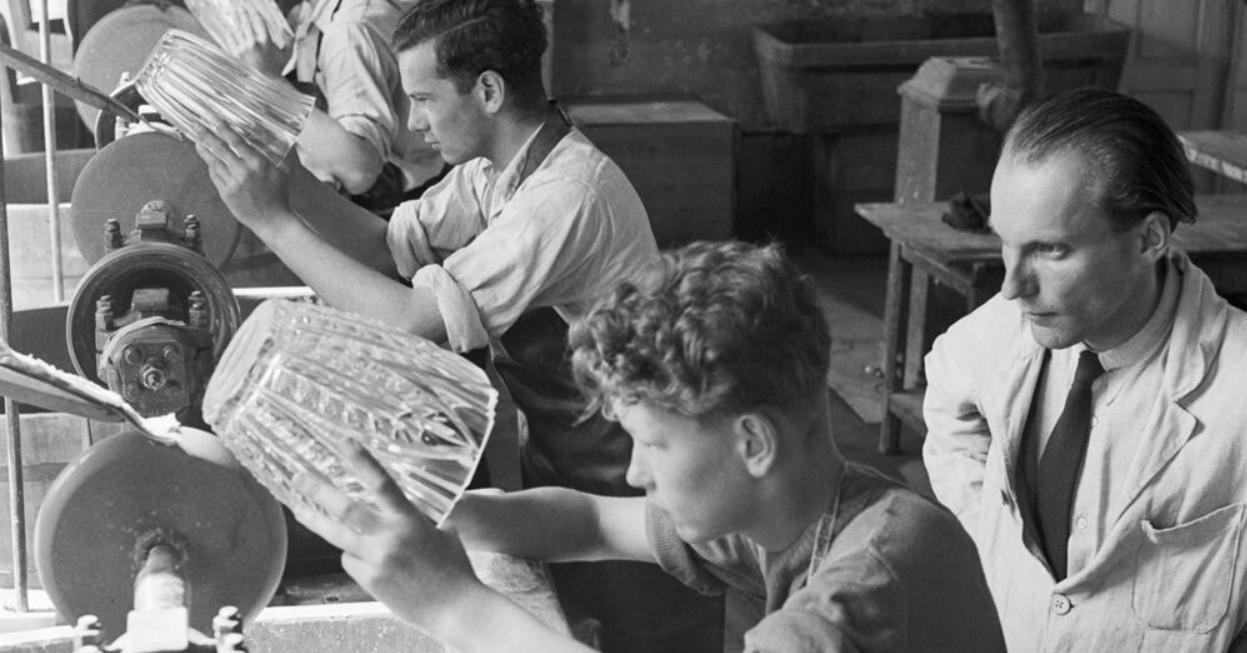
In union shops a four-year apprenticeship is required. Many shops have declined to train their own mechanics, preferring to recruit their industrial complement from the general journeyman mass. Other firms have made full use of the union rule permitting one boy to four journeymen, and even try to gain a larger proportion. Wages of apprentices are controlled exclusively by the employer, but hours must correspond to those governing the journeymen. When the latter are laid off a similar number of apprentices must be laid off. This rule was designed to frustrate attempts of employers to displace journeyman labor by intensive use of their apprentices.
Except during industrial conflicts these boys are not permitted attendance at union meetings, but at such times they are given seats, no votes and four dollars weekly for relief. The men receive seven when striking. Apprentice glass cutters are usually loyal to their class during strikes. Their employers super-exploit them by a general scheme of deductions ranging from ten to fifty per cent less than journeymen piece-work prices. It should be understood that most of the work throughout all the various branches is done on a piece-work basis.
In 1914 cutters received about $18.00 weekly for 55 hours. The schedule was then changed to fifty hours, and during the war wages rose to about a dollar an hour average. Cutters do not work after 12 on Saturday. At their recent conference with their masters they accepted a wage reduction approximating 20 per cent. They are conservative and quite individualistic. The nature of their work, where each one expresses his own creative ability in a pronounced manner, brings this about.
They have in one respect shown wisdom in the past, with regard to a well practiced ca canny. For a time limitation of production was abandoned by them, but the recent conference demonstrated conclusively their error, and I feel that they will revert to the one intelligent and militant practice that previously distinguished them from utter scissorbills.
The proposition is this: If glass cutters receive, say, a dozen bowls to cut for $12, and the job should pay fifteen in order to permit the mechanic to work as a human being should, it is obvious that the cutter must take fifteen hours, assuming that one dollar an hour is the prevalent rate. He must then contest the price himself or through his shop committee to get the three dollars needed. “Fast” men are always used to set prices on new jobs. Our friends of 120 would call them high grade Gypos. To prevent a sort of elimination contest among these speed-maniacs, who boast their high-power proclivities, the production limit is absolutely necessary under this system.
Since 1912 girls have rapidly been introduced into the trade. They are now admitted to Flint membership under the same rules as their brother slaves. The trade requires no great strength, but it is a tedium, uses up the eyes, and sometimes destroys the “grip” of the hands requisite to perform the work. There are all sorts and sizes of shops, and some few have good lighting and sanitation. Most of them, however, are not well ventilated, are cold in winter. Cutters frequently have been forced to work under really frigid conditions, and this obtains so long as they stand for it. When they march out in a body in defiance of contractual relations which do not cover such essentials as warmth, ventilation, etc., they get as far as the door when the dear boss promises heat, fresh air, and toilets fit for humans.
At this time slackness of work has them all discontented. When glass workers of the Flint Glass trade in hot metal departments organize industrially, the cutters will follow suit. Cutters have ever been under-dogs in the industry. The union has eight salaried officials; one is a cutter. He ostensibly strives to organize cutters. Actually he works to keep them separated.
The Flint treasury has about $500,000. There are 11,000 members, with headquarters at Ohio Building, Toledo, O. It publishes a reactionary monthly magazine. Even pink socialists are not tolerated.
The Industrial Pioneer was published monthly by Industrial Workers of the World’s General Executive Board in Chicago from 1921 to 1926 taking over from One Big Union Monthly when its editor, John Sandgren, was replaced for his anti-Communism, alienating the non-Communist majority of IWW. The Industrial Pioneer declined after the 1924 split in the IWW, in part over centralization and adherence to the Red International of Labour Unions (RILU) and ceased in 1926.
Link to PDF of full issue: https://www.marxists.org/history/usa/pubs/industrial-pioneer/Industrial%20Pioneer%20(December%201921).pdf
 Revolution's Newsstand