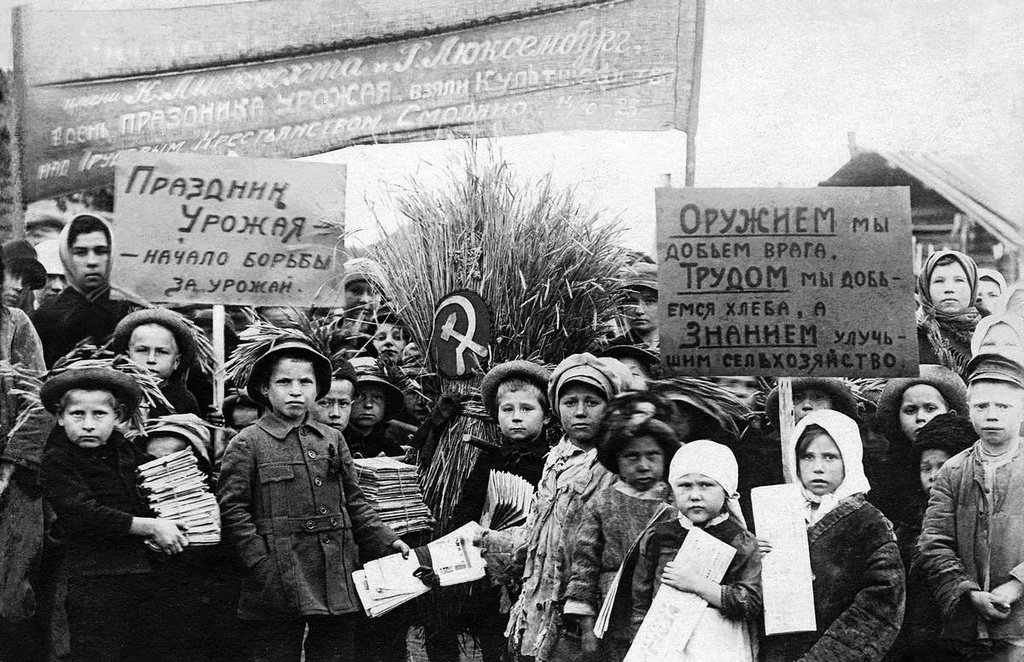
The strides made in education by early Soviet Russia, in the most difficult of conditions, were enormous and real. Its basis was the visionary October, 1918 remaking of the old school system led by Education Commissar Lunacharsky with the ‘Universal Labor School’ as its foundation. The core, universal schooling for every child from 8 to 17 in two ‘grades’; from ages 8-13 and 13-17. Below is its outline.
‘The Uniform Labor School’ from Soviet Russia (New York). Vol. 1 No. 30. December 27, 1919.
“It is necessary to combine school work with production, it will then have great educational significance. Only a close contact between education and socially productive labor can abolish the class character of the modern school.”
This principle, proclaimed by Karl Marx, became the basis of all the reforms introduced by the Soviet Government in the sphere of education. After the October Revolution, school reform, first of all, assumed the character of a struggle of the masses for knowledge, for education, and the Commissariat for Education, with the greatest speed possible, had to destroy the old school based upon class privileges.
In the pre-revolutionary period the school was greatly neglected. The “elementary,” “common” school was pushed to the background. The attitude towards it was not even indifference, but sheer ill-will. It was attempted to convert it into a medium through which the people’s mind could be poisoned and blind allegiance developed. The high school was not simply a school of higher standards, but a school where loyal overseers of the enslaved people were trained. This old school was destroyed after the October revolution, and in its place was created a new school. The new school of Soviet Russia is closely connected with the masses, it is near to its life and labor. The new school is free in all its grades, and it is not only accessible but obligatory for all. There will not be such an almost incredible percentage of illiterate people amongst the next generation as there was hitherto.
Further, the modern Russian school is a uniform and labor school. The former indicates that the whole system of normal schools, from the kindergarten up to the university represents a unit, a continuous set of ascending steps. All children join the same type of school and begin their education on equal terms. They all have equal rights to pass from standard to standard until they reach the highest. Moreover, the Russian school is “uniform,” because apart from giving purely scientific knowledge, it brings up the child to work and develops in it the habit of work. A child who has finished the uniform school is quite prepared to take an active part in social life.
The uniform school does not strive at a uniformity of type. The state requires specialists and youths who usually have different inclinations and are endowed with different gifts, therefore in the school attended by children at the age of about 14, all subjects are divided into several courses or groups; many fundamental subjects, however, remain the integral part of all courses. These groups are not interlocked until the pupils join a special high school.
The new school is a labor school. This is particularly indicated by its present organization, as Soviet Russia requires people who were brought up in the atmosphere of labor.
In Russia, the demand to introduce labor as an integral part of education is based upon two quite opposite principles, the result of which, however, is the same. The first principle is the proposition that real absorption of knowledge can only be achieved by active absorption. A child acquires knowledge very easily if it is introduced to him in the form of play or work (if the latter is skillfully arranged). From that point of view, this principle leads to an active mobile acquaintance with the external world. The next source stimulating the striving of the modern Russian school towards labor is the immediate desire to acquaint the pupils with what they will most need in life–particularly with agricultural and industrial labor in all its forms.
The uniform labor school based upon these principles is divided into two grades, according to the age of the pupils: the first grade is attended by pupils between the ages of 8 and 13, the second from 13 to 17. (The next step is special high schools or universities).
In the first grade school, tuition is based upon work which has more or less an artisan character, conformably to the strength of the children. In the second grade school, industrial and agricultural labor, in all its modern forms, is undertaken, and machinery becomes of paramount importance. But on the whole, the aim of the labor school is not to prepare skilled workers for this or that branch of industry (that must be the aim of trade schools), its aim is to give the children a comprehensive education which will give them a practical knowledge of the methods of the most important forms of production.
Thus, in Soviet Russia, the child, on the one hand, studies different subjects, making collections, drawings, lessons in photography, modelling, pasting, observing and cultivating plants and animals. Languages, mathematics, history, geography, physics, chemistry, botany and zoology are now taught in the new school according to a new active method. On the other hand the school acquaints the pupils with the principal methods of labor in the sphere of cabinet-making and carpentry, wood-engraving, moulding, forging, casting, alloying, welding of metals, hardening of metals, boring-work, working on leather, printing, with various branches of agricultural work (in the village), etc.
From the kindergarten the children pass directly into the first grade school. In the kindergarten, the aim of the studies is to acquaint the child with nature and society. The teacher, without applying the least constraint to the child, systematizes and directs its inquisitiveness and desire for movement so as to attain the best possible results. The idea is to go through a sort of children’s “encyclopedia.”
In the higher standards of the first grade uniform labor school, systematic work in a certain cycle of subjects becomes of paramount importance. The same “encyclopedia” which now acquires the character of a study of human culture in connection with nature, is preserved here as well. The study of this subject is divided into two cycles (for children from 8 to 13). In the first period the children’s attention is directed to a series of selected materials. The pupils are given a certain article of production or cultivation to study. This article is thoroughly examined from two points of view: as the product yielded by nature and as a result of production, and at the same time its physical and chemical nature and origin are also examined, etc. In connection with it, reference is made to the history of labor (the means of production in the past) and the process of work necessary for the production of that article in modern industry. In the study of encyclopedia the greatest importance is attached to experiment. The object of study is selected with the view of conducting the study of it, actual observations and independent performance of acts mentioned while the object was examined.

The second cycle includes almost the same subjects as the previous, but the latter are studied more in detail and in chronological order. In vivid sketches and always with the aid of their own work the children become acquainted with the history of labor and together with it with the history of human society. The evolution of culture in connection with the change of labor conditions is studied by the children not only from books or the teacher’s narrations, but partly by their own experiments.
The same subject of the “encyclopedia,” transformed into a course of sociology (on the basis of evolution of labor and change in economic forms as the result of it) becomes the subject of the “encyclopedia” of the second grade school. In the second grade school the study of sociology goes on parallel with the study of other subjects.
At the same time the pupils of both schools are encouraged to make personal researches, to write essays, to do modelling, collecting, etc., in their leisure time.
The higher the standard the pupil passes into, the more serious and profound becomes the study of his native language, history, biology, physics, chemistry, etc., which subjects are taught by specialists. The study of these subjects is also based upon the labor method. Great care is taken that the labor upon which tuition is based should be productive labor and real, and the pupils should actually participate in the economic life of the country.
Subjects of aesthetic value, such as modelling, singing and music, are of no less importance in the uniform labor school. Particularly great attention is paid to drawing-modelling. At the beginning, drawing is taught according to a method giving wide scope to the child’s creative powers; imaginative drawing, memory drawing and so on. Later on the pupils begin to draw didactically selected articles from nature, and at last drawing branches into drawing and painting. Theory is taught only in the final stage.
Obligatory music courses are introduced in the school. Aesthetic education in general is introduced on such a wide scale that one can expect that complete development of all the senses and of the creative powers of the young Russian generation, which is so necessary for their later development.
The labor principle in school assists the physical development of the children. For the same reason, rhythmical gymnastics, individual development of muscles under the supervision of a doctor, and games, have been introduced into the school. The academic year in the uniform labor school is divided into the winter, middle, and summer terms: during the latter term, work is conducted in the open air.
Only a part of the school day (4 hours in the first grade school, and 5-6 in the second) is devoted to studies according to the program. The rest is partly at the disposal of the pupils who, remaining in school, are allowed to take advantage of all school resources, and partly is devoted to recreation. The school time-table is so arranged as to avoid monotony.
The extremely important principle of the regenerated school is individual tuition. It is an analysis on the part of the teachers of the inclinations and particular traits of character of every pupil so as more completely to satisfy the requirements of each pupil. This is done so as not to hinder the development of particularly gifted pupils.
On the other hand, the important aim of a democratic school is to pay great attention to backward pupils. At every school special classes for all backward pupils with a special course of studies must be introduced.
Finally, the difference between the uniform labor school and the pre-reform school is that the former is a secular school (for the first time the Soviet Government has liberated the school from the influence of the church) and a mixed school for both sexes.
The relation between the pupils and the teachers is one of comradeship. The teacher is not an official, but an elder comrade of the pupil. Obligatory work is introduced into the school and the pupils, together with the teachers, perform various functions on the premises, in the kitchen where breakfasts and dinners are prepared, and so on.
The children take an active part in the life of the school. They are permitted to manage all school affairs and to exercise mutual aid. While preparing to become the citizens of the state, the children get accustomed to be the citizens of their school.
The school autonomy of the pupils can be divided into three parts: firstly, the participation of the pupils in the leading school councils (these councils consist of: (a) all school workers, (b) the representatives of workers residing in the school district (about 1/4 of the number of school workers), (c) pupils belonging to the groups composed of pupils from the age of 12, in the same proportion as above, (d) one representative of the department of the Commissariat of Education at the local Soviet of worker’s deputies. Secondly, the autonomy of purely pupils’ groups. A class or any other group of pupils is quite autonomous. In view of that a whole series (possible more) of posts duties are introduced. These posts are occupied by pupils temporary, from one day up to two weeks. The children are on duty in turn or according to lot. Thirdly, the pupils are given full scope as regards organization of various societies, permanent and temporary. They organize circles, edit various journals, open clubs, sporting societies, societies for arranging evenings, performances, orchestras and so on.
Huge sums of money are spent on the organization of the new school; during the year 1918 the organization and maintenance of the uniform labor school cost 10,000,000,000 roubles, a sum which was never before spent on education in Russia. The general disorganization inherited by the Soviet Government is keenly felt in the sphere of education owing to the lack of school books and appliances. In Moscow, Petrograd and the provinces, a series of committees have been set up in whose jurisdiction are all school appliances, and, owing to the strenuous efforts of these committees it was possible to get the necessary minimum of school appliances.
A series of pedagogic courses has been arranged, preparing the necessary workers for the new school, who are continually swelling the ranks of the school workers, bringing fresh energy and forces.
Two Supreme Pedagogic Academies exist, which develop various educational problems on a scientific basis, and prepare professors for the pedagogic courses.
Last year, the Commissariat of Education was faced with a task of colossal dimensions: to break the deeply rooted old school and to organize a new school. It was realized owing to very intensive work and now the strengthened uniform labor school is on the path of further progressive work.
PDF of full issue: https://archive.org/download/sovietrussiapic00buregoog/sovietrussiapic00buregoog.pdf
 Revolution's Newsstand