How did the United States ever control the Panama Canal to begin with? Even for imperialism, it’s a sordid story. In the week after the United States’ October, 1925 strike-breaking invasion of Panama Manuel Gomez (Charles Phillips, Secretary of the All-American Anti-Imperialist League) wrote this series detailing the history of the Canal and method of U.S. rule.
‘Panama’s ‘Freedom’ is a Myth’ by Manuel Gomez from The Daily Worker. Vol. 2 No. 235. October 16, 1925.
I. PANAMA’S FREEDOM A MYTH
Bayonets Rip Veil of “Independence” by the Sec’y, All-American Anti-Imperialist League
It there was ever an act of international politics that tore the Cover from a carefully nurtured fiction of international relationships, it is the incursion of American troops into the “Republic of Panama.” Panama is supposed to be a free country. Actually, its only freedom consists in that its minister plenipotentiary at Washington has the privilege of importing all the brandy, wine and beer that he wants. The real status of Panama, and of the other little “republics” of Central America and the Caribbean, has now been exposed so plainly that even the readers of capitalist newspapers can see it.
Coolie Conditions in Panama
The workers of Panama labor under condition which approach in wretchedness those of the oppressed colonial countries of Asia. Wages are pitifully low, while living costs have been mounting steadily. The great majority live in little one-room hovels, for which the landlords have been charging more and more extortionate rents.
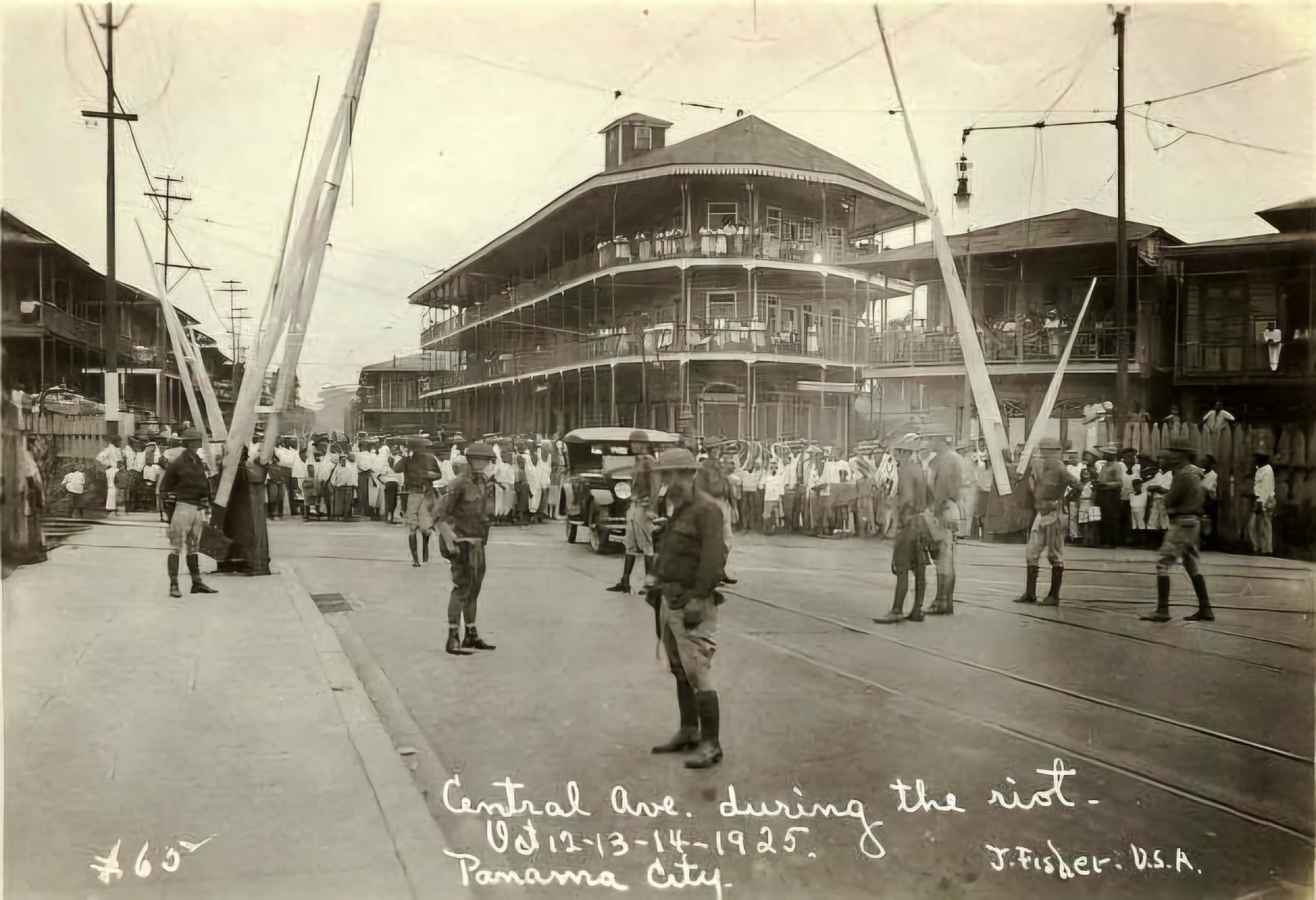
Rent profiteering became so flagrant that a month ago the worker-tenants in the city of Panama went on strike, refusing to pay rent until an agreement should be reached limiting the earnings of landlords to 12 per cent annually. The strike spread rapidly; it became a mass movement of aroused worker-tenants. Whereupon, General Lassiter, in command of the Canal Zone department of the United States army, sent three battalions of the 33rd infantry into the city “to put down the rioting.”
Appropriate Time Picked
The moment selected for the invasion was a fitting one. It was in the midst of a funeral procession which the strikers had arranged for two of their comrades who had been brutally murdered by the police. The American soldiers broke up the demonstration, occupied the strikers headquarters and proceeded to restore “law and order” for the Panaman landlords. It was a nice, quiet “domestic” affair. Senor Rodolfo Chiari, the dummy president of the republic, called for and obtained the service of U.S. government troops, just as a governor of the state of Pennsylvania or Kansas might request and receive federal troops tb put down a strike there. It is a recognized business of the U.K. army to break strikes. American trade unionists know this from bitter experience. Panaman workers know it too. This is not the first time that American soldiers have invaded their territory. It has happened time and again. The United States government has intervened in the affairs of every country in Central America, and never once on the side of the workers.
A Spanish Proverb
It was “como Pedro por su casa.” As the Spanish say, that the infantrymen of the 38rd regiment entered the city of Panama (“like Pedro going into his home”).
And this is the country that boasts itself the defender of the rights of small nations, and talks about “moral claims!”
Ah, but there is a treaty giving us the right to intervene! say the resourceful apologists of American imperialism. Article 7 of the treaty provides that the military forces of the United States may take over the police power in any portion of the republic of Panama whenever public order is endangered. But how did such a treaty come about? Out of the pure generosity of the Panaman people? Do nations make such treaties of their own free will? No. There is more than a treaty behind United States intervention in Panama.
Look at the supplementary volumes of the Encyclopedia Britannica issued in 1924 and you will find the following:
Panama, the youngest of the Latin-American republics. Is in reality a protectorate of the United States. Its constitution, which dates from February, 1904, states that in return for the guarantee of Panama’s sovereignty and independence the United States shall have power to intervene “to re-establish public peace and constitutional order.” A close fiscal supervision is at the present time being maintained, and more than once, when domestic disturbances began to threaten, the United States has landed marines, has supervised elections, and has assumed police power in the cities of Panama and Colon.
Thus, not only a special treaty, but the very constitution of the “Republic of Panama.” puts it directly under foreign imperialist rule. Panama is a protectorate of the United States, just as Egypt is a protectorate of Great Britain. But ninety-nine out of a hundred Americans are ignorant of this fact. They have been led to believe that Panama, Costa Rica and the other little nations to the south of us are free countries, living symbols, in fact, of American magnanimity and forbearance. They have been taught in school that the United States has no protectorates, that American capitalism is innocent and virtuous and quite different from its wicked cousins in Europe. The United States has not one protectorate but many of them. The example of Panama is illustrative of the whole method of American imperialism in Latin-American.
II. THE CONQUEST OF PANAMA BY MARINES
Now Section of “Our Empire”
“The name of ‘Panama,’ which is associated with the most notorious financial scandal of the nineteenth century, is associated also with one of the most formidable scandals of American diplomacy.”–Carlos Pereyra, in “El Mito de Monroe.”
How American troops happen to be so much at home in Panaman territory was explained in the first article of this series, printed in yesterday’s DAILY WORKER. I pointed out there that U.S. control is not limited to the Canal Zone, as popularly supposed and officially propagated, but includes a protectorate over the entire so-called republic of Panama, definitely established by the written constitution of the “republic.” Panama is thus an integral part of the American empire.
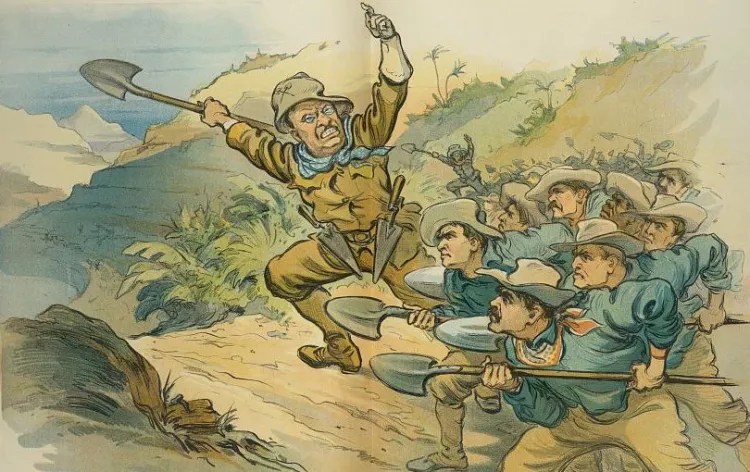
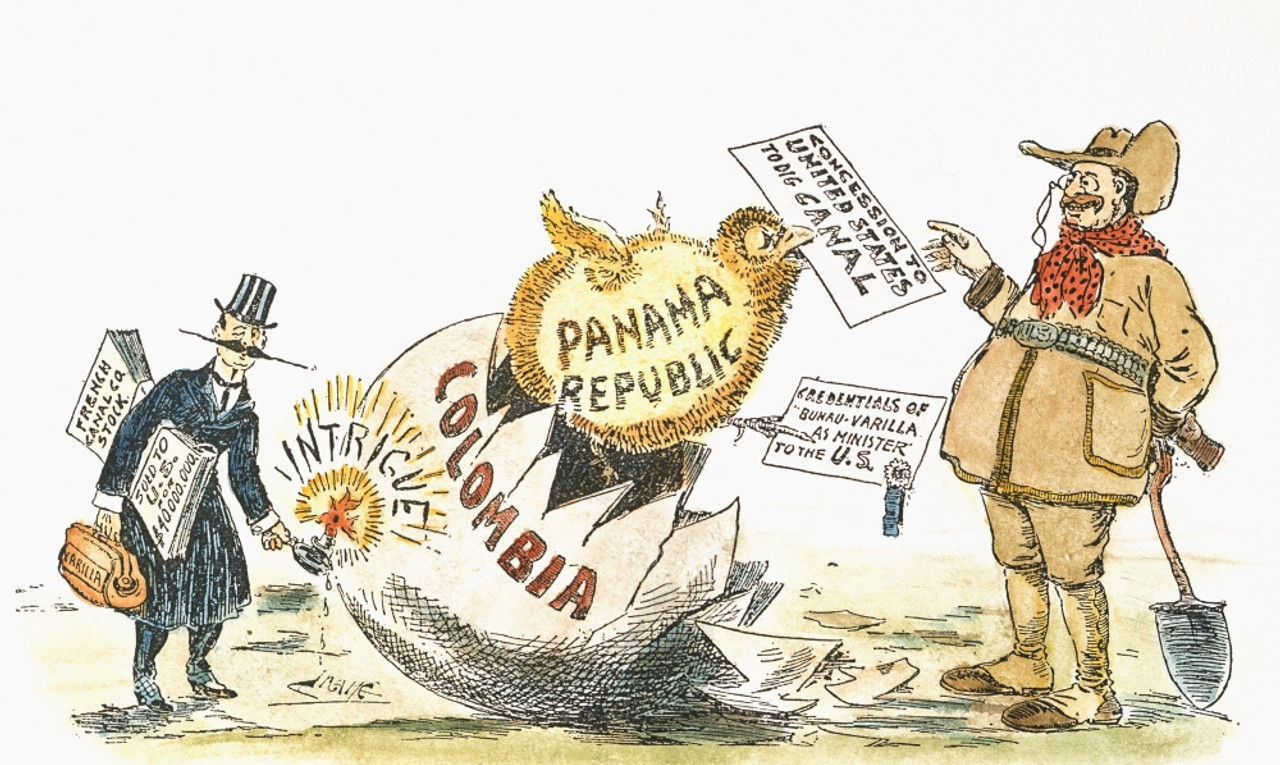
New light is now thrown on what Professor Pereyra, member of the Hague permanent court of arbitration, calls “the most formidable scandal of American diplomacy”—that is, the steal of Panama from Colombia, in 1903. Scandal has long been connected with the action of the United States government in this episode, but few have realized how great the scandal was. Rough-riding Teddy Roosevelt did more than simply foment a revolution in order to be able to lease a strip of land six miles wide across the Isthmus of Panama and construct a canal; he carried on a war of colonial aggression against the republic of Colombia, tore away 33,800 square miles of her territory, baptised it as the “republic of Panama” and then leased the Canal Zone from himself to cover up the nature of the proceeding.
Canal Central Factor
Of course the proposed canal was the central factor in the affair. Congress authorized the president to proceed to construct a canal at Panama, provided he could secure a clear title to the property of the French company which had previously obtained the franchise. The French company was able to give a satisfactory title; the company was virtually bankrupt and was eager to boost its stock by a deal with the United States. But Panama was a province of Colombia, and the Colombian senate unanimously rejected Roosevelt’s terms for the lease of the Canal Zone. Whereupon Roosevelt, after consultation with the French company, decided upon a revolution.
Proclaim Independent—Marines Land
On November 3, 1903, Panama “proclaimed its independence from Colombia,” and American marines were immediately landed on the isthmus with instructions from the president to prevent the landing of Colombian troops within 50 miles of Panama.
Four days later the republic of Panama was recognized, in marked contrast to the time-honored precedent, of U.S. governments of making haste slowly when it came to the recognition of revolutionary governments! Before the 15th of the month, Buneau Varilla, the resident manager of the French company in Panama, was received at Washington as envoy extra–and minister plenipotentiary of the republic of Panama.
Staging a Revolution
It is well known that on Nov. 3, Assistant Secretary of State Loomis had wired to the American consul in the city of Colon: “How is it that we hear nothing of the revolution?” (This was before any revolution had broken out).
“Have patience. The revolution has been delayed a little; but it will take place at 6 p.m.”
And it did!
A treaty was promptly signed with the new “republic” by which the United States secured the right of way for the canal oh the same terms that had been offered to Colombia.
The treaty also gave the U.S. government—by the way, as it were—complete supervision over the police powers of Panama. And when the “newcomer in the family of nations” adopted its constitution, in 1904, its position was found to be that of a plain protectorate of the United States.
Panaman People Betrayed
The Panaman people had nothing to say in the process by which they suddenly found themselves part of a colonial possession. The whole matter was cooked up with the aid of a handful of bootlicking politicians and renegade officers. No native administration in the country has ever been the true representative of the people of Panama. The presidents have all been miserable hand-picked lackeys of Wall Street, working in the shadow of U.S.-guns always at hand in the Canal Zone. Rodolfo Chiari, the traitor who co-operated with General Lassiter in bringing about the present strike-breaking invasion, is a typical example.
III. ROOSEVELT’S “BIG STICK” HITS PANAMA
Wall Street Grabs the Canal Zone
Theodore Roosevelt, who engineered the statesmanlike rape of Panama, in 1903, was a very remarkable man. He committed statesmanlike crimes against a number of other Latin-American countries, got a lot of publicity as the only man in the United States who could tell “good trusts” from “bad trusts,” sent federal troops to break a strike of anthracite coal miners, and won the Nobel peace prize. Accompanying his little Panaman adventure, Roosevelt issued a significant statement, which has been called “a new stage in the Monroe Doctrine.” It declared that If the United States was to continue “to protect Latin-American states,” it had the right to exercise an international police power over them.
Expressed Imperialist Era
This doctrine was a timely expression of the policy of imperialist expansion on which American capitalism had already entered. Panama was an outstanding instance. The fact that today, 22 years later, American soldiers are patrolling the familiar streets of the City of Panama, with fixed bayonets, proves that the doctrine was no mere chance phrase, but characterized a whole epoch of conscious aggression. It was the war with Spain, and the acquisition of the Philippines and Hawaii, bringing American capitalism face to face with new problems in the Pacific, that made the Atlantic-Pacific canal an “immediate necessity of American foreign policy.” And necessity knows no law—certainly no law of any dinky little Latin-American state!
U.S. Gets Canal Zone
Vigorous pushing of the negotiations for lease of the territory of the Canal Zone followed as a matter of course. Possession of the Canal Zone was necessary “to assure the safety of the canal,”—and no doubt the rest of Panama was made a United States protectorate to assure the Canal Zone. And subsequently, of course, the entire Caribbean area had to be brought under the American sphere of influence for the same reason. In much the same way, Great Britain has been gobbling up everything in sight in the eastern hemisphere for generations, “to assure the route to India.”
There is much truth in such claims. The economic and military problems of imperialism are interconnected. Once we grant the initial justification of imperialism we must expect to be led far afield, into brutal and bloody enterprises, for the sake of Wall Street.
Advance in Caribbean
The building of the Panama canal and the advance of the United States in the Caribbean went naturally hand in hand with the development of new political policies in what has been called the larger Canal Zone, that is, the West Indies, Mexico, Central America, Colombia and Venezuela. Some of these policies, which have been pretty definitely formulated, are the establishment of protectorates, the supervision of finances, the control of all possible canal routes, the acquisition of naval bases and coaling stations, and the policing of “disorderly countries.” Porto Rico had been acquired at the close of the war with Spain and Cuba had become a protectorate, the terms of which were defined by the Platt amendment. Panama was brought into the imperial system, and the Dominican republic later came under the financial supervision of the United States; President Taft landed and maintained a body of marines in Nicaragua, and proposed to place both that country and Honduras under financial supervision; President Wilson went further and assumed the administration of Haitian affairs, leased from Nicaragua for a term of 99 years a naval base on Fonseca Bay, and purchased the Danish West Indies (now the Virgin Islands).
Monroe Doctrine is “Gospel of Grab”
Today, American aggression is respected and feared thruout Latin-America. The Monroe doctrine has be-come the symbol of American imperialism in the western world. It is one of the three central watchwords of American foreign policy.
The fight to get the United States government permanently out of Panama is thus a fight against the whole policy of American imperialism. American workers, whose interests are diametrically opposed to those of the Wall Street clique that rules our government, must recognize imperialism for what it is. They cannot afford to believe the pretty fairy tales taught in school for the purpose of convincing future cannon fodder that the U.S. government is an angel of peace and has never been imperialistic. These stories are about as true as the statement that Panama is a free country. Class-conscious workers will make common cause, not with the profit-hungry Wall Street gang: but with the oppressed peoples of the countries under the Heel of American imperialism. In the concrete case of Panama, they must demand the instant withdrawal of all American troops, the abrogation of the vicious treaty of 1904, and the abandonment of all claim to a protectorate over the republic.
IV. U.S. BAYONETS STILL MENACE PANAMA CITY
Deportations for Talk Against U.S.
Newspaper reports that the Ameri can troops are leaving Panama are now proven to be false. Likewise the story that the Panama landlords have given in to the striking worker-tenants. And the regimental band is playing, “We won’t come back till its over over there!” Only a portion of the troops are leaving. The rest staying behind to complete the job of jailing workers, crushing Panaman nationalist (i.e. “anti-imperialist”) sentiment and rendering the strikers helpless before the landlords.
Even when the last American soldier packs up his tent and departs, if that time ever does come, it will be “au revoir but not goodbye.” In England during the height of the woman suffrage agitation, a peculiar police method was adopted, characterized by what was known as the “cat and mouse law.” Under this ingenious law suffrage agitators who became weak from hunger-striking, were let out of jail until they could get a little of their strength back, whereupon they were promptly rearrested and put behind bars again. The government played with the suffragists “as a cat plays with a mouse.” It is that way with the United States government and Panama. Whenever the nationalist movement and the anti-imperialist trade unions gather strength, the bayonets of American soldiers are called into play. The troops are always close at hand, massed threateningly just across the border in the Canal Zone.
Finance Capital Dominates.
The hand of American imperialism lays heavy on the so-called republic of Panama at all times. Even in “normal” times, there is an American financial “adviser” to look over Panama’s finances in the interest of Wall Street investors, an American customs’ “inspector” to take charge of Panaman customs’ receipts for debt payment, an American railroad commission to take charge of the rail roads and an American police inspector to see that Wall Street’s investments are not endangered by strikes or other undue disturbances to “law and order.” In addition, there is the American diplomatic staff —no mere polite handshakers, in a Latin-American country—forever browbeating and bullying.

Over all Central America and the Caribbean area the “Panama system” prevails in greater or less degree. It is the workers and peasants who suffer directly. While American imperialism rides rough-shod over the native capitalists whenever its interests demand, it tries to attach an entire section of them to its own golden chariot wheels; it does not hesitate to render prompt assistance to these petty bootlickers of imperialism whenever they are confronted with a militant and aroused working class American workers enjoy little enuf freedom of movement, but the under paid toilers of these semi-colonies have no freedom of movement at all
Wholesale Deportations.
Some weeks prior to the military descent upon Panama, American imperialism decided that there must be one of the regular periodical clean ups in the near Latin-American area.
The native labor movements were growing restive under the barbarous working conditions, under the leadership of Spanish, South American and other foreign workers who had won the confidence of the natives by their intelligent and resolute championship of labor’s interests. This was bad enuf, according to Wall Street. Some of the bolder elements, however, went so far as to commit the unpardonable sin.
They denounced American imperialism. Immediately, American diplomatic bulldozing machine got busy, and every single foreign worker “known to have spoken against the United States” in Cuba, Panama, and Central America, was arrested and deported. More than a score of workers were deported from Cuba during the raids. Men who had lived in Cuba for 18 years were torn away from their families and unceremoniously shipped out of the country Native Cubans fared little better; instead of being deported they wen thrown into jail, one of the first to be imprisoned being Julio Antonio Mella the Cuban section of the All-American Anti-Imperialist League.
A similar procedure was followed in the other countries. A labor leader by the name of Wendel was deported first from Costa Rica, and then from Panama. His instructions were to “Get out of Latin-America and stay out.” In a number of cases the news papers stated plainly that the men were being deported for speaking against the United States.
Part of American Empire.
Now it may seem a serious enuf violation of the supposed right of free speech to deport workers for speaking against American imperialism in the United States, but the uninitiated worker might be forgiven for believing that no such action could be taken under any circumstances for speaking against imperialism in the so-called independent countries of Latin-America…That is, for defending the liberties of those countries! Nothing of the kind! Any such assumption ignores the fact that the Central American and Caribbean countries are part of the American empire. To speak against the United States government in Cuba or Panama is “treason,” just is it is “treason” to speak against his majesty King George V. in India. That is the unpardonable sin, for which follows swift and sure reprisal.
The wholesale deportations from nearby Latin-American countries for the crime of denouncing American imperialism, proves conclusively that these countries are mere satrapies of Wall Street. Such complete domination as this reveals is made even more brutally manifest by the military occupation of the City of Panama. It will of course continue, whether or not the American troops remain there or finally go into temporary retirement across the border in the Canal Zone, American domination will continue in Latin-America as long as the oppressed peoples of those countries can be kept powerless. But the national liberation movement is everywhere taking on impetus. The growth of the sections of the All-America Anti-Imperialist League in Cuba, Mexico and Central America indicates clearly that American imperialism is falling in its endeavor to crush out the liberating impulse in the oppressed peoples. If the working class in the United States lends active support to the Latin-Americans in their struggle against the joint enemy, Wall Street, an irresistible force will be created which all the governmental might of American imperialism will be unable to resist. Such a combination can take the American soldiers out of Panama and keep them out, and at the same time usher in a new day of freedom for the wage-workers of the United States.
V. PANAMA LABOR NOT AIDED BY A.F.L. STAND
Fundamental Demands are Ignored
Hopeful Panaman workers, struggling desperately for decent living conditions in the face of the military strikebreaking occupation of the City of Panama by United States forces, must have experienced a momentary thrill at hearing that the American Federation of Labor convention in Atlantic City had adopted a resolution asking the U.S. government to explain why American soldiers are engaged in breaking the strike of worker-tenants in a friendly and supposedly independent country.
The Panamans have no confidence in the friendly purposes of Wall Street, nor of its ready instrument, the United States government; but they feel instinctively that the American working class is their ally.
They know that imperialism is as much the foe of the workers in this country as in Central America and the Caribbean area. This is especially true of the organized workers, who are pitted against the bosses in day-to-day struggles, and whose own interests must force them to fight the debauching of labor standards by American imperialism. It is but natural that the beleaguered Panamans should look to the convention of the A.F. of L. for help.
Resolution an Insult.
Actual reading of the resolution, however, must have brought disillusion. It was not a rank and file resolution. It was introduced by President Green with the approval of the other misleaders of the federation, and its purpose was plainly not to render support to the Panamans but to prevent such support. The bureaucrats knew that the rank and file members of the A.F. of L. would be waiting for some action by the convention in regard to the Panama situation, and the idea was evolved of lulling them to sleep by a resolution. Digging into the actual phrases of the resolution adopted, one sees that they are decidedly ambiguous, that they are in fact an insult to our striking brothers of Panama.
The resolution provides no real help for the Panamans, neither in their immediate struggle against bosses and landlords, nor in their long term struggle to get free of American imperialism.
It does not demand the unconditional withdrawal of American troops. It does not condemn their presence on Panama soil.
It does not even express sympathy with the Panaman strikers. It merely asks the United States government to investigate the use of the troops for “alleged” strikebreaking activities in Panama.
A.F. of L. Treachery.
After all, it was to be expected. The A.F. of L. bureaucrats—partners in insurance and banking schemes which draw their substance from imperialist exploitation have never shown any fellow-feeling for the lowly Panamans. In fact when Gompers was in Panama last year, he proposed to Secretary of War Weeks that no Panamans be given employment in the Canal Zone (which is technically Panaman territory) above the grade of laborers or messengers!
The resolution introduced by Green, besides being a sham and a betrayal, perfectly expresses the unity of Green, Woll and the other A.F. of L. bureaucrats with the United States government, and with American capitalism—- that is to say, with American imperialism.
Their purposes are neatly summed up in another resolution adopted at the Atlantic City convention, supporting the Monroe doctrine and going so far in service of American imperialism as to declare a “labor Monroe doctrine” against “European or revolutionary labor influence in Latin-America.”
Side by side with Wall Street’s “Pan-American Union,” the A.F. of L. misleaders have created the “Pan American Federation of Labor” which supports imperialism at every point. This is “pan-Americanism,” the slogan of J.P. Morgan, Calvin Coolidge and William Green, alike! But it is not the slogan of American labor.
The American workers demand solidarity and support of their Latin-American brothers. And “support” means action, not two-faced resolutions. The presence of American soldiers in Panama is a test for every self-respecting worker. What are we going to do about it?
The Daily Worker began in 1924 and was published in New York City by the Communist Party US and its predecessor organizations. Among the most long-lasting and important left publications in US history, it had a circulation of 35,000 at its peak. The Daily Worker came from The Ohio Socialist, published by the Left Wing-dominated Socialist Party of Ohio in Cleveland from 1917 to November 1919, when it became became The Toiler, paper of the Communist Labor Party. In December 1921 the above-ground Workers Party of America merged the Toiler with the paper Workers Council to found The Worker, which became The Daily Worker beginning January 13, 1924.
PDF of full issue: https://www.marxists.org/history/usa/pubs/dailyworker/1925/1925-ny/v02b-n236-NYE-oct-16-1925-DW-LOC.pdf
 Revolution's Newsstand