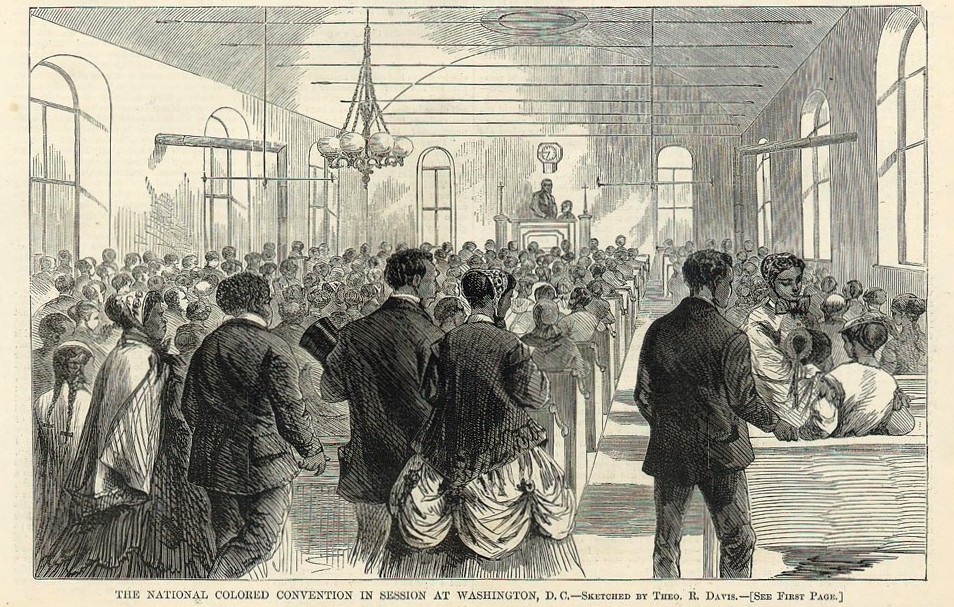
Continuing her history on the scale of the problem in the U.S. that ‘Workers of the World, Unite’ was meant to address. Amy Schechter reviews the the founding Colored National Labor Union meeting held in Washington, D.C. during December of 1869. The very first meeting of Black unionists passed a resolution against Chinese immigration.
‘The First Negro Labor Congress’ by Amy Schechter from the Daily Worker Supplement. Vol. 3 No. 10. January 23, 1926.
IN the preceding article it was shown that the advanced element in the post-civil war labor movement believed the future of the emancipated Negro workers of the south to be indissolubly bound up with the American labor movement as a whole. This view was, unfortunately, not shared by the great majority of the organized (white) workers. Governed by the deep-seated prejudices which arise wherever slave labor exists side by side with wage labor, and where the slave is identified in the popular mind with the system of which he is the victim, many trade unions discriminated against the Negro worker, rendering him antagonistic to the labor movement, and flinging him into the arms of the bourgeois politicians of both races.
William Sylvis and the other forward-looking leaders of the National Labor Union, who, after emancipation, had taken the initiative in declaring for the solidarity of white labor with Negro labor, were powerless to enforce the lifting of the ban against Negro membership in the unions. The National Labor Union, as has been said, was a loose federation of national unions and central labor bodies; and its committee had no control over the affiliated trade unions, acting rather in an advisory and organizational capacity.
At the Chicago congress of the National Labor Union a delegate stated that “although there were a number of colored mechanics in New Haven, we have so far been unable to induce the trade unions to admit them.” Some delegates inclined to the view that the question was similar to that of the foreign-born workers, the Germans, for instance, who voluntarily organized in national unions of their own. But William Sylvis, the leading figure in the labor movement of the time, and a keen analyst of contemporary conditions, held that the matter was extremely urgent, and said, “This question had already been introduced in the south, the whites striking against the blacks, and creating an antagonism which will kill oft the trade unions unless the two be consolidated.”
Trevellick, Sylvis’ most active aid in the organizing work of the National Labor Union, declared, in the course of the discussion, that, “The Negro…has already stood his ground nobly when a member of a trade union.”
A case which attracted general attention and took on the character of a test case was that of the Negro printer, Douglass, who was refused admission to a local Washington union in 1869. The constitution of the National Typographical Union in which this local was affiliated contained no clause regarding racial discrimination in reference to membership and Douglass appealed to the national convention, but his appeal I was turned down. The case aroused a good deal of bitterness, and was brought up as typical of union discrimination at the Negro Labor Congress held at the close of that year. This discrimination on the part of its affiliated unions naturally militated against the possibility of drawing the Negro workers into the National Labor Union as an integral part of the organization. Another factor of equal importance was the fact that very real divergencies existed between the immediate needs of Negro labor and white labor at this period.
In the first place the sense of a allegiance (quite inevitable at that time) of the Negro toiler to the republican party as the party of Lincoln and emancipation, brought him into opposition to the policy of independent working class political action, which was the foundation upon which the National Labor Union was built. Then, the question of money inflation was an issue of immediate importance to the white worker of the industrial north, whose wages were paid in greenbacks while the prices of commodities were fixed in gold (which caused a tremendous depreciation in real wages); but the newly emancipated Negro worker was not yet consciously interested in the problem.
Another, and the basic, divergency followed from the fact that the great mass of Negro labor was agricultural, and the workers represented in the National Labor Union, industrial. After generations of sowing that other men might reap, the Negro agricultural laborers naturally felt a deep longing to possess land of their own, and like the Russian peasantry, linked together “land and freedom.” Even the viewpoint of the industrial Negro worker was influenced by this great need of the mass of his race, and thus the demand for a liberal homestead policy became his central legislative demand. This question could not possess any such interest for the members of the National Labor Union, the great majority of whom were skilled industrial workers, though they did carry on a campaign against the wholesale grabbing of public lands, upon which so many of the vast fortunes of our “best families” were founded.
In July, 1869, the first state convention of Negro workers met in Baltimore. The convention report emphasized the discrimination against Negro labor, and recommended that a nation-wide organization campaign be carried on among the Negro workers. This convention issued the call for a national congress, to be held in Washington, D.C. on December 6th on the same year. The separate Negro National Labor Union was planned, the parent body assisting in its organization.
The convention-call, endorsed, among others, by the union of the (Negro) employees of the Chesapeake railroad stated among other things that the purpose of the congress was: “To consolidate the colored workingmen of the several states to act in cooperation with our white fellow-workingmen in every state and territory in the union who are opposed to distinction in the apprenticeship laws on account of color, and to act so co-operatively until the necessity for separate organization shall be deemed unnecessary.” The tone of the call, as well as the fact that the state convention publishing the call sent five delegates to the National Labor Union convention held in August at Philadelphia, shows the existence of a definite will toward cooperation with the general workers’ movement. And in the course of an organizing trip through the south in the spring of the same year, William Sylvis several times remarks the sympathetic attitude of the more advanced elements among the Negro workers toward the National Labor Union.
This tendency toward cooperation was opposed, however, by bourgeois politicians, intent upon using the workers of their race for their personal advancement and upon delivering their vote intact to the republican party. A pre-convention editorial appearing in the Workers’ Advocate’ issued an urgent warning to the Negro workers to steer clear of this type of counsellor:
“On the 6th of December, 1869, the first national labor convention of the colored laboring men of the United States under the auspices of the National Labor Union will be held in the city of Washington, D.C. We earnestly trust that it will frown down any attempt to transform it into a politico-partizan assemblage. The colored people have too much at stake at the present juncture to allow any of the political charlatans, who are so profuse with their sympathy and advice, and who are ever-ready to ride upon any hobby upon which a little capital may be made, to guide their councils. They must act and think for themselves–independent of party dictation if they expect the support of their white fellow-toilers. “The action of the National Labor Union is an earnest that its professions of sympathy are no lip service; that its members are prepared to aid by every means in their power the dissemination of those principles which have proved so advantageous to the white mechanics of the north. Let them therefore eschew all schemes of a chimerical character…and act upon the principle that their true friends alone can be found in the ranks of labor, and their safest counsellors in those whose interests are identified with their own…”
The fear that an attempt would be made to capture the convention for the republican party and to use race-hatred to stifle the dawning consciousness of common class interests with the white workers, proved to be only too well founded. Samuel P. Cummings, a member of the National Labor Union, who attended the sessions, gives an excellent account of the process.
“The convention of colored men at Washington last week was in some respects,” he writes, “the most remarkable one we ever attended. We had always had full faith in the capacity of the Negro for self-improvement, but were not prepared to see, fresh from slavery a body of two hundred men so thoroughly conversant with public affairs, so independent in spirit, and so anxious apparently to improve their social condition as the men who represented the south in that convention.
“The convention was called to order by Myers, of Baltimore, and Geo. T. Downing, of Rhode Island, was chosen temporary chairman; and upon assuming his position Mr. Downing made one of the best speeches on the labor question we ever heard. It was a gem in its way, and had his counsels been heard, some unpleasant things might have been avoided. But there were a few who evidently had some secret purpose to serve, who tried to make the convention the means of carrying it out. Prominent among these was Mr. J.M. Langston, the famous colored lawyer of Ohio, who evidently aspiring to the leadership of his race, and who we hear has been promised a high position in the government if he can control the colored vote of the south, in the interest of the republican party. Mr. Langston certainly possesses ability, but very little discretion, at least his course indicated it, for on the first evening of the convention he took occasion to insult the white delegates from Massachusetts, and warned the delegates to beware of us, intimating very strongly that we were the emissaries of the democratic party, which was certainly new to us, who have until this year acted with the republican party.” (They left the latter party to agitate for a national labor party. A.S.).
Upon Sella Martin taking the floor in answer to Langston’s attack, the latter’s supporters tried to prevent Martin from being heard, but he stood [his ground and spoke in strong condemnation of Langston’s tactics.
“He said forcibly and truthfully,” continued Cummings, “that the interests of the laboring class on this continent were identical, and that they should work harmoniously together for the furtherance of the cause of labor…we are happy to say the convention finally adopted his views. “Whether their course in forming an independent National Labor Union I was wise or not, time alone can tell… It is useless to attempt to cover up gulf between the two races in this country, and for a time at least they must seek each to work out a solution of this labor problem in their own way. At no very distant date they will become united, and work in harmony together, and we who have never felt the iron as they have must be slow condemn them because they do not see as we do on this labor movement. For ourselves, we should have felt better satisfied had they decided to join the great national movement now in progress. But fresh from slavery as they are, looking naturally as they do on the republican party as their deliverers from bondage, it is not strange that they hesitate about joining any other movement…”
A number of the resolutions adopted by the congress clearly show the hand of the bourgeois politician. There are resolutions recommending frequent conferences between employers and worker, ardently advocating loyalty to the government, unequivocally condemning strikes. The resolution on education is typical:
“Resolved that education is one of the strongest safeguards of the republican party, the bulwark of American citizens, and a defense against the invasion of the rights of man…We feel that it is our duty to educate them and impress them with the fact that all labor is honorable and sure road to wealth…that the habits of economy and temperance combined with education and independence are the great safeguard of free republican institutions, the elevator of the condition of man, the motive power to increased trade and commerce, and to make the whole of this land the wealthiest and happiest on the face of this globe.”
Then there is the following Hillmanesque resolution on the relations of capital and labor:
“Resolved: That we do not regard capital as the natural enemy of labor; that each is dependent on the other for existence; that the great conflict daily waged between them is for want of a better understanding between representatives of capital and labor; and we therefore recommend the study of political economy in all our labor organizations as a basis for the adjustment of the disputes that arise between employer and employe.” The most important definite recommendation of the congress, according to the accounts available, was contained in the memorial on agricultural labor in the south, with its proposal to remedy the evils existing in this connection by “making labor more scarce,” thru the medium of “making laborers landowners by means of homestead grants.” The New York Tribune (Dec. 11, 1869), gives the following account of this memorial:
“The chief matter of interest was a memorial…setting forth that the average wages of agricultural laborers in the south was but $60 per annum, that the planters were combined to keep labor down; that this combination was made more bitter from political motives, and its influence was so great that it was impossible, as matters stood, for the colored laborer to exercise civic privileges, except at the risk of his livelihood, poor as that was. To remedy this, labor must be made more scarce, and the best way to do that was to make the agricultural laborers landowners. Congress is to be asked, therefore, to subdivide public lands in the south into twenty-acre farms, to make one year’s residence entitle a settler to a patent, and also to place in the hands of a committee a sum of money, not to exceed two million dollars, to aid the settlement, and also to purchase lands in states where no public lands are found, the money to be loaned for five years, without interest.”
The congress platform omits most of the main planks of the parent National Labor Union, such as the taxation of the wealthy for war purposes, the establishment of a federal labor department, the incorporation of unions, greenbackism, the solidarity of men and women workers, the demand for the abolition of convict labor, etc. In addition to the resolutions mentioned above it adds resolutions on the equal rights of Negroes to jobs, endorsement of the Freedman’s bureau, endorsement of the republican party, etc. About the only definite point of agreement in the two platforms is the emphatic demand for the abolition of the importation of contract oriental labor.
In the period between the first congress and the second (and last) held two years later, the Negro organization fell more and more completely under republican domination, as will be shown in the succeeding article, finally severing all relations with the National Labor Union when the latter began to take definite steps for the organization of an independent national labor party.
The Saturday Supplement, later changed to a Sunday Supplement, of the Daily Worker was a place for longer articles with debate, international focus, literature, and documents presented. The Daily Worker began in 1924 and was published in New York City by the Communist Party US and its predecessor organizations. Among the most long-lasting and important left publications in US history, it had a circulation of 35,000 at its peak. The Daily Worker came from The Ohio Socialist, published by the Left Wing-dominated Socialist Party of Ohio in Cleveland from 1917 to November 1919, when it became became The Toiler, paper of the Communist Labor Party. In December 1921 the above-ground Workers Party of America merged the Toiler with the paper Workers Council to found The Worker, which became The Daily Worker beginning January 13, 1924.
PDF of full issue: https://www.marxists.org/history/usa/pubs/dailyworker/1926/1926-ny/v03-n010-supplement-jan-23-1926-DW-LOC.pdf
 Revolution's Newsstand