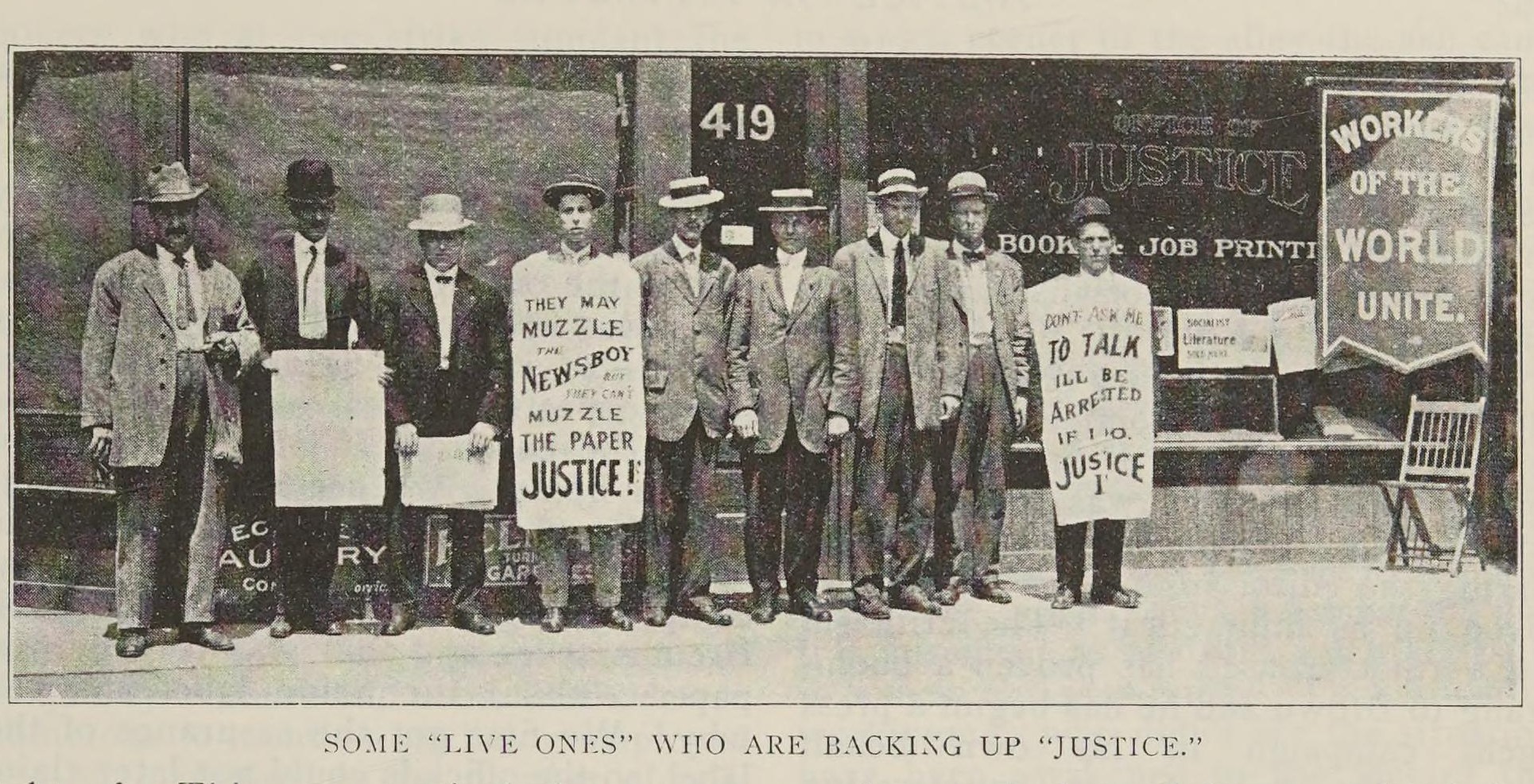
A fine piece from the editor of the revolutionary Socialist Pittsburgh newspaper ‘Justice’ on the seething class war in that city after the McKees Rocks strike and the associated class-based dispensation of legal ‘justice.’
‘’Justice’ in Pittsburgh’ by Frederick H. Merrick from International Socialist Review. Vol. 12 No. 3. September, 1911.
The Pittsburg district is destined to become the great industrial battleground of America. Literally it is already the melting-pot of the nations. Here motley hordes of various nationalities are learning the lesson of class solidarity before the fiery furnaces that melt iron into the steel necessary for the varied demands of civilization. In this industrial inferno is being evolved in a truly wonderful manner the keenest class war in the world today. The working class of every creed and all nations is forgetting its petty differences and is being amalgamated into a fighting phalanx, politically and industrially. The truth of Socialism is being demonstrated by cause and effect. Here is the greatest industrial center of the world. While New York is the financial center of capitalism, Pittsburg is the industrial hub, and as the capitalist class is entirely dependent upon the working class, so New York is more interested in knowing what the working people of Pittsburg are going to do than they are even to know what the working class of Gotham may propose. There is more than one good reason for this. The steel trade is the basic industry of this country. What Pittsburg does in the steel trade determines the character of that industry. However, the capitalists of Pittsburg are having troubles of their own. They are face to face with the most militant element of the working class, gathered in a larger group here than at any other spot on the earth.
Pittsburg a Volcano.
Pittsburg is an incipient class volcano. Here the working class have dominated the community since the first blacksmith welded iron by the aid of coal picked from a creek bank. The necessities of her very existence have made the working man of Pittsburg traditionally honored and respected for a hundred years as in no other community of capitalism. Many of the nice conventionalities which prevail in more parasitic towns are kicked into the gutter in Pittsburg. Underneath the glamor of a great metropolitan city there still persists in “Smokdom” many of the rough, brutal, direct virtues of the primitive mining camp and the blacksmith’s forge. Pittsburg’s smoke-scarred battlements, towering from the dirty banks of the Monongahela and the Allegheny, upon which the workers perch their houses, suggest nothing but work, and toil, and trouble. Pittsburg is the epitome of all the strength and revolt in wage slavery. Little of the weak or pitiful side of industrial serfdom is in evidence. Here come only those representatives of the working class fit to engage in the fiercest struggle for existence. The law of selection has segregated the choicest slaves for duty in this caldron. The daily danger and severity of the labor breeds a spirit of revolt and class hatred instead of one of servility and dependence as among so many other groups of workers.
Cossacks.
A man who experiences almost daily burns on his body from molten metal, without wincing, is not easily intimidated by a hickory stick in the hands of a policeman. This explains the necessity, as the capitalists see it, for the most brutal American police, christened years ago by the lone Socialist representative in the Pennsylvania legislature, James H. Maurer, as “Cossacks.”
Contempt for Compromise.
This mental reflex of the way the Pittsburg workers make their living has been intensified by the accumulated impetus of the traditions of past generations who have experienced the same toil and suffering. The great battle around the Pennsylvania railroad roundhouse in the strike of ’77, when the workers drove the armed militia over the hills and far away ; the historic fight at Homestead, when officers of the law begged workers on bended knees to desist in their struggle instead of arresting them; and the more recent struggle at McKees Rocks—are traditions that arouse a fiery twinkle in the eye of the average wage earner around Pittsburg while any reference to the tactics employed by the A. F. of L. in their so-called strikes usually produces a contemptuous sneer even from those who are nominally affiliated with craft unions related to the national fakirship.
Here more than anywhere else do craft unions demonstrate their absolute futility in the unequal struggle with international, trustified industry. There may be some reason why the workers, and even some Socialists, in other centers cherish the delusion that they will industrialize the American Federation of Labor. No such phantasy beclouds the vision of a Pittsburg wage earner, ignorant though he may be. If he is one of less than fifty thousand workers of a possible 350,000 who carries a craft union card he will explain to you that he carries it only for the time being to avoid any unpleasantness and that soon there will be no craft unions in this country to which he must pay dues.
The glorious defeat at Homestead sealed the fate of craft unionism, hereabouts, and from that moment they have suffered a steady decline. Had the workers realized why they were defeated at Homestead and learned a lesson which would have resulted in a class-conscious industrial and political movement able to cope with Frick’s aggressive policy, unionism and Socialism might have a different history at the present time. This signal defeat evidently convinced the workers, subconsciously, even though gradually, that there was something wrong with trades unions or they would not have been whipped at Homestead. As this idea became more and more prevalent, unionism, as an organization, wilted.
Class Courts.
Just as it was necessary for the capitalists to kill the effectiveness of the labor unions so it was important that the courts be unusually responsive to the dictates of the corporate bosses. It required judges of “courage” to render the desired decisions in a working class community and these demands were met by the selection of the ablest and most brazen judicial servants of plutocracy in America until at the present time the twelve Common Pleas judges of the Allegheny county courts comprise an oligarchy of judicial corruption, brazen effrontery and arbitrary tyranny not matched by any other judges in the United States.
Their term of office is ten years. Their salaries have now been raised to ten thousand dollars a year. And every petty shyster in the county is boosting the practices in the local courts in the hope that he will land one of the judicial plums that the Pennsylvania legislature creates at each session to more thoroughly subsidize the “profession” which lives by selling the pull its various members have with certain judges to the highest bidder.
Parole Delusion.
The parole system is in full bloom in Allegheny county and, aside from abolishing trial by jury, vests in the judges almost unlimited power and makes them particularly useful to the politicians who want to put some individual under obligations to them. Until recently it permitted a judge, “in his discretion,” to parole a convicted defendant. In this way the judge became the sole judge of a prisoner’s conduct. The victim must report at regular intervals and must report that he had obeyed all the instructions of the court. If he should fall into disfavor with the “court” the judge immediately sent him to jail for the latter offense, without the formality of jury trial, for the remainder of the unexpired sentence. This was to have been the plan employed against the editor of JUSTICE, but in was exposed too soon to be effective.
By a shrewdly concocted jury system the chance for a defendant is extremely poor. The foreigners who find their unfortunate way into the judicial maws of the Pittsburg courts might as well plead guilty and throw themselves on the “mercy” of the court.
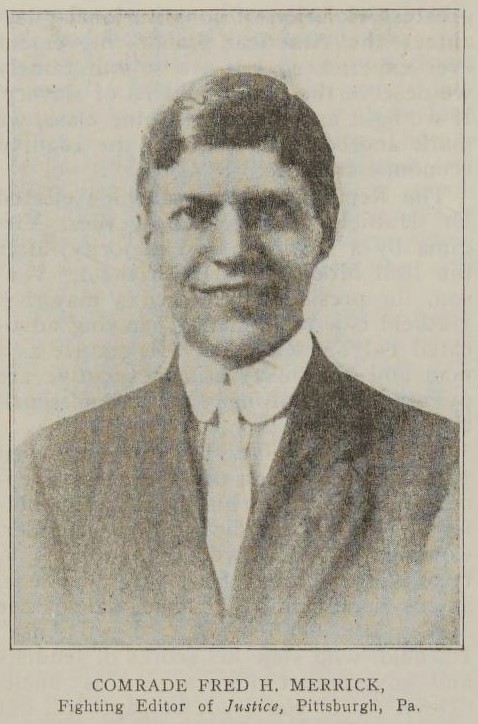
A typical case of this sort was the occasion for dragging the editor of JUSTICE into court on a charge of criminal libel. There is no question but the powers that be had been watching for a chance to use their courts for the purpose of suppressing JUSTICE.
A poor, but hard working Albanian with the views of that primitive people about taking human life, yet a man of undoubted courage, who had at least been of service to the community in which he toiled, was charged with having shot down his boarding-house mistress while intoxicated. When brought to court he wanted to enter a plea of guilty. Judge Marshall Brown, the cleanest and most humane judge of the twelve on the Common Pleas bench, presided in this case. As judges go he is above the average and he is the one used by the capitalists as an excuse for the rest. Brown would not allow this Albanian, Steve Rusic by name, to plead guilty and forced an appointed attorney upon him. Rusic resented it and seemed to instinctively recognize that it was a game of court baiting and that he had no chance.
The result was his conviction. On an appeal to a higher court the question of his sanity was raised by his attorney but not considered by the higher court. Now under the loose practice in the local courts there is no question but that Brown could have ordered an examination into the sanity of Rusic and thus saved his life. He did not do it, more because the atmosphere about him is-indifferent to such things than because Brown was viciously heartless.
A few months later Brooks Buffington, a notorious character about town and a chronic drunkard for forty years, brutally murdered a man in an argument in the bar of the St. Charles Hotel. Buffington had strong political influence and as it happened, Judge Brown also sat in this trial. At a certain juncture the defense was allowed to offer evidence tending to show that Buffington was insane and had been for years, although he was drawing a salary as superintendent of one of the largest office buildings in the city at the time of the commission of his crime. After the evidence had been offered Judge Brown issued a binding instruction to the jury commanding them to return a verdict of acquittal on the basis of Buffington’s insanity. This was done and then he was sent to the City Home for the insane.
The contrast in the two cases was too great for any independent news dramatist to overlook. Here was the ornament of the bench caught red-handed in unconsciously playing class rules. More than this, Brown is up for re-election this year. The educational value of making an issue of his conduct was too great to lose sight of. This was particularly true as Brown’s personal character and high reputation would preclude any possibility of the reader confusing the issue. It was clear and plain. It is not men we must remove, but it is institutions we must change. Judge Brown is all right if we are going to leave the courts as an institution where they stand.
JUSTICE met the issue squarely. Rusic had just been hung. His death was one of the most dramatic ever witnessed here. His crude but versatile genius found expression a few days before his death in a delightful and refreshing poem of love to his Albanian sweetheart in his homeland.
The morning of his execution he chanted the Albanian battle-song for three hours continually and up to the moment the black cap silenced his defiance to death and capitalist brutality. He marched to the death trap with a step and carriage that drew remarks of praise even from the hardened attaches of the human butcher shop.
To cap the climax the sheriff made a botch of the hanging.
This expert in murder, who had three months’ notice to prepare for the execution failed to hang Rusic and he strangled to death after thirteen minutes of such terrible agony that one witness to the horrible scene, a coroner’s juryman, fainted.
“Justice” Vindicated.
We therefore drew a comparison between the two cases and Judge Brown’s conduct and charged Brown with being influenced for political reasons. The editor of JUSTICE was indicted for criminal libel and given a farcical trial lasting less than four hours before Judge Evans. This man is the most despicable and heartless of the judges, noted for his discourtesy and brutality and had been repeatedly and severely criticised in JUSTICE. Any sense of decency would have caused him to retire in such a case. His rulings on the admission of evidence and allowing counsel sufficient time to prepare the case were intensely partisan.
An immense crowd thronged the corridors of the court house and, after being denied admission to the court room, were finally permitted to enter when Evans observed the hostile feeling that was being aroused. There was a noticeable change of attitude after stock had been taken of the interest displayed in the trial by the Socialists and workers. There were significant hints dropped that indicated that part of the object of the trial was to discover the extent to which the Socialists approved of the policy of JUSTICE. The authorities were promptly satisfied that they would be inviting political suicide to further persecute JUSTICE.
The attorney, Comrade Harold W. Houston, the state secretary of the party in West Virginia, had explicit instructions to employ none of the unfair technical defenses customary to attorneys, but simply put the case up fairly to the jury and abide by the decision. This he did under the most provoking insults from the court and his address to the jury suddenly forced upon him without a moment’s preparation was an able presentation of the position of the defendant as a class-conscious Socialist and not a supplicant for mercy.
In a short time the jury returned a verdict of guilty and recommended the defendant to the mercy of the court. Following this an effort was made to dispose of this unwelcome verdict by declaring the editor insane but was finally given up as impractical. The criticism the verdict aroused has proven a boomerang to Brown and he has begun a press agent campaign in his own behalf through the daily papers, enumerating his kind virtues for public consumption. Undoubtedly if they had it to do over again Evans would not try the case and a much fairer trial covering several days would result. Now the public with almost one accord admit that “railroaded” is the proper phrase to apply to the case.
Heretofore the thousands of cases that passed through the local courts were scarcely noticed by the working people. Now they are watching the judges with much more interest. Every act is being scrutinized and the result will be most beneficial.
The two great objects in launching JUSTICE were to expose to the naked eye of the dull public the class character of the courts and the control of the newspapers. The promoters of this sheet feel that if those two things can be but accomplished in a thorough manner the strong and militant organization of the party and its army of workers can make Socialist converts much more rapidly. This idea has therefore lately determined the policy of the paper. It has not been primarily a propaganda paper but a weekly newspaper dealing with current local events of a more or less sensational character, from a Socialist standpoint, which were suppressed by the other papers. Naturally our policy has been somewhat criticised in a friendly manner by some Socialists, but we feel justified in our course.
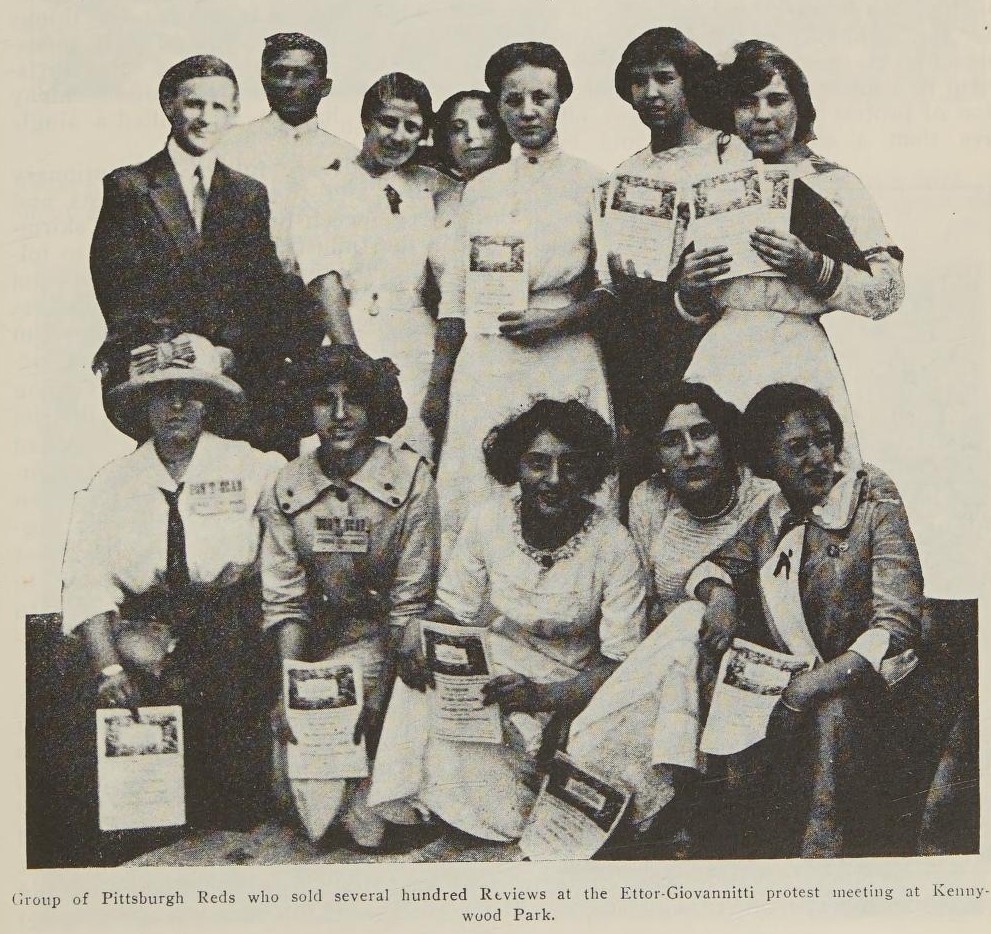
One of the first things decided upon was that “Justice” should advocate the principles of industrialism as strongly as we did political action. But following the rule of local news we deal with it only as current local events give rise for comment. As the local unions are extremely corrupt we felt that an explanation was due at the outset. The local typographical union had notoriously and repeatedly prostituted itself to union scabbing and if we expected to deal with this evil we would be cowardly to omit that organization because we needed their friendship to publish the paper. There was only one thing left for a militant and uncompromising sheet to do under such circumstances and that was to print the paper without the union label and tell why. We first got the assurance of the label, so the officials could not later claim we were disappointed soreheads, and then went after their treachery. The educational merit of a discussion on industrialism was greatly intensified by the omission of the label. Many good comrades who have for years been worshipping at the shrine of the label without investigating whether the label was a guarantee of its professions but who endorsed the principle of industrialism had their idol smashed much quicker because we did not carry the label. Of course there were politicians in the organization who said we were right, but that it would cost the party many votes by those who misunderstood and our reply was simply that we were out to educate first and get votes after the voters had become class-conscious, not before. JUSTICE was denounced as a union smasher, but has outlived the criticism in a remarkably short time. A sad commentary on craft unionism here is that the only protest received from those outside the party was one anonymous letter.
Disfranchisement.
Disfranchisement of working people in Allegheny county by special laws and court decisions has been carried on to an unusual degree here but, despite that, the Socialist vote of ten thousand in November, twice the democratic vote, so frightened the plutes that they began to disfranchise also from the top by making a number of formerly elective offices appointive. This is true of jury commissioners, and the fifteen school commissioners who at one strike supplant the ward school boards. In both cases the appointment is to be by the Common Pleas judges.
The government of Pittsburg has been changed to a commission with partisan ballot as a compromise, but the nine commissioners have already been appointed by the governor to serve until after the election. Needless to say they are all rabid business men with a good chance for election in November.
By a change of the primary election from June to September it was hoped to move up the last date of assessment so that propertyless workingmen would fail to qualify. These and other methods too numerous to mention are being employed and have resulted in the number of possible registrars in the city to which the Socialists were entitled being reduced from 245 to 2.
JUSTICE takes the position that the various strikes in this county, particularly Homestead and McKees Rocks, have proven that even industrial unionism cannot solve the problem without revolutionary political action, for the reason that the capitalist class are able to batter an industrial union to pieces by physical force as long as they hold control of the police powers through their undisputed domination of political government, and it is absolutely necessary that we wrest from them the control of the courts and the executive department to prevent interference with industrial organization and control of legislative department, not for the purpose of saying in which corner of the alley the ash cans are to be placed, but to prevent the impeachment and removal of fearless executives and judges.
To the direct actionist who urges the disfranchisement of the worker as evidence of the futility of the ballot we answer that the frantic efforts and laws to disfranchise are proof the capitalist realizes the imperative value of the ballot to the worker else he would ignore any political tendencies of the working class. JUSTICE is directing a vigorous campaign toward political action and is using the tricks and schemes of disfranchisement as the text and the result is extremely gratifying. Thousands of workingmen who didn’t see the situation have been awakened to the fact of the power of the ballot by learning of the efforts made to disfranchise them.
The day of revolutionary political and industrial action in the great Pittsburg district is at hand. The slogan of the party is becoming more clarion in its tone. If the political organization has not attracted the proper quota of people to its standard in the past it is not, as some fear, because they think we are anarchists; “but because they think we are following some kind of a utopian, Sunday school program. Let it become clear to the Pittsburg worker that the party wants political power to protect the worker while he organizes in a militant manner for the death grapple with his robbers and is not seeking to advance another group of politicians and, as Clyde Fitch reported to the Pittsburgh Survey, “the Socialists will not enjoy a landslide, it will be an avalanche.”
The International Socialist Review (ISR) was published monthly in Chicago from 1900 until 1918 by Charles H. Kerr and critically loyal to the Socialist Party of America. It is one of the essential publications in U.S. left history. During the editorship of A.M. Simons it was largely theoretical and moderate. In 1908, Charles H. Kerr took over as editor with strong influence from Mary E Marcy. The magazine became the foremost proponent of the SP’s left wing growing to tens of thousands of subscribers. It remained revolutionary in outlook and anti-militarist during World War One. It liberally used photographs and images, with news, theory, arts and organizing in its pages. It articles, reports and essays are an invaluable record of the U.S. class struggle and the development of Marxism in the decades before the Soviet experience. It was closed down in government repression in 1918.
PDF of full issue: https://www.marxists.org/history/usa/pubs/isr/v12n03-sep-1911-ISR-gog-Corn.pdf
 Revolution's Newsstand