
A fascinating, detailed look at British imperialism’s agricultural policies in its West African colonies by George Padmore.
‘The Agrarian Crisis in British West Africa’ by George Padmore from Communist International. Vol. 8 No. 13. July 15, 1931.
I.
DESPITE the intensive post-war penetration of finance capital in the exploitation of the mineral resources of British West Africa, which comprises the colonies of Gambia, Sierra Leone, Gold Coast and Nigeria, with a total area of 500,000 square miles, or five times the size of the United Kingdom, agriculture is still the basic industry of the 25,000,000 natives who inhabit these countries.
In order fully to understand the changes which have taken place in relation to the agrarian policy of British imperialism in this part of the continent, it is necessary to refer to three factors which, to a very considerable degree, prevented the establishment of plantations and otherwise influenced the early methods of exploitation.
Firstly, the earliest contact which the imperialists had with West Africa, was as slave dealers. After the decline of the slave trade during the sixties of the 19th Century, the merchant-capitalists, thanks to the Industrial Revolution, turned their attention to palm oil, for which there was a tremendous demand in England. Furthermore, as the palm tree regions are located along the coastal belt of West Africa, there was no necessity for the imperialists to open up the hinterland with its dense forest and unnavigable rivers. The merchants, therefore, established trading posts at various ports (Bathurst, Free Town, Gold Coast, Lagos, etc.), where their ships called from time to time and were supplied with kernels and oil by the natives, who collected these products from the palm groves.
Secondly, because of the general topographical features of West Africa, with its marshy lowlands and lagoons, which contributed very much to the prevalence of malaria and other tropical diseases in the nineties, the British Government did not encourage white colonisation, as has been its policy in East Africa, where the highlands of Kenya and Tanganyika enable Europeans to make permanent settlements.
The third factor was the lack of an adequate supply of labour for the plantation system due to the depletion of the native population caused by the slave trade. Therefore, in order to foster the development of the palm oil industry, the imperialists permitted the Negroes who occupied the coastal regions to remain on their lands. Later on, the system was extended in relation to the cultivation of other crops, and in this way the system of peasant proprietorship became the recognised economic form of agricultural production in West Africa. As a result, practically all of the cocoa has been produced by natives in the Gold Coast colony. The export trade, however, is largely in the hands of European firms. These companies maintain large shipping depots in the various coastal towns together with a system of small traders in the hinterland, where the crops cultivated by the natives are bought up at the end of every harvest season. The country or “bush” stores are generally in charge of native middle-men who receive a commission on their purchases from the European companies.
This system of indirect business relationship between the imperialists and the peasants of the interior has contributed to the creation of a class of West African petty-bourgeois traders, who have recently begun to organise co-operative market agencies, as well as a bank (the Industrial and Commercial Bank of West Africa) in order to compete with the foreign wholesale merchants who, they realise, are ruthlessly exploiting the peasantry through monopoly and pool purchasing. This represents the first open economic struggle on an organised scale, between the Native trading capitalists and the foreign imperialists.

Generally speaking, the policy of native peasant production has been pursued by the West African Governments up to the time of the last imperialist war. However, during post-war years the colonies have undergone tremendous sanitary changes, as a result of the scientific discoveries for the control and treatment of tropical diseases, as well as the opening up of the forest regions by means of railroad and motor transportation.
Thanks to these improvements, British capitalists are now attempting to develop large-scale plantations in various parts of West Africa. This is beginning to influence the former land policy pursued by the Governments, which are now actively co-operating with foreign companies in providing a broader base for the investment of finance capital. All this is being done by means of expropriating the lands from the Natives, and turning them into a landless class of wage earners, entirely dependent upon their white over-lords, as has already been successfully done in the British East African colonies of Kenya, Uganda and Tanganyika, as well as in South Africa, the Belgian Congo and French Equatorial Africa.
In order to secure labour for these plantations, the governments impose various forms of taxation, such as Poll, Head and Hut taxes upon the natives, and thereby force them to go and work for the Europeans in order to secure the money to pay the Government. In some territories even more direct methods of forced labour are applied.
For instance, the principal functions of the Chiefs in Nigeria, Sierra Leone and Protectorate and the Gold Coast, are those of labour recruiting agents and tax-gatherers. Whenever there is a shortage of labour, the foreign plantation owners, acting through the State officials, order the Chiefs to provide the required quota of labourers.
Thanks to the tribal institutions of the West African peoples, which generally confer all sovereign power of the tribe on the person of the Chiefs and, as such, make them the trustees of all tribal lands, these lackeys are still in a position to wield a great amount of influence over the broad masses. These renegades, therefore, exploit their prestige to the fullest extent, notably by issuing orders calling upon all able-bodied men to leave the villages and go to work for foreign companies during certain periods of the year.
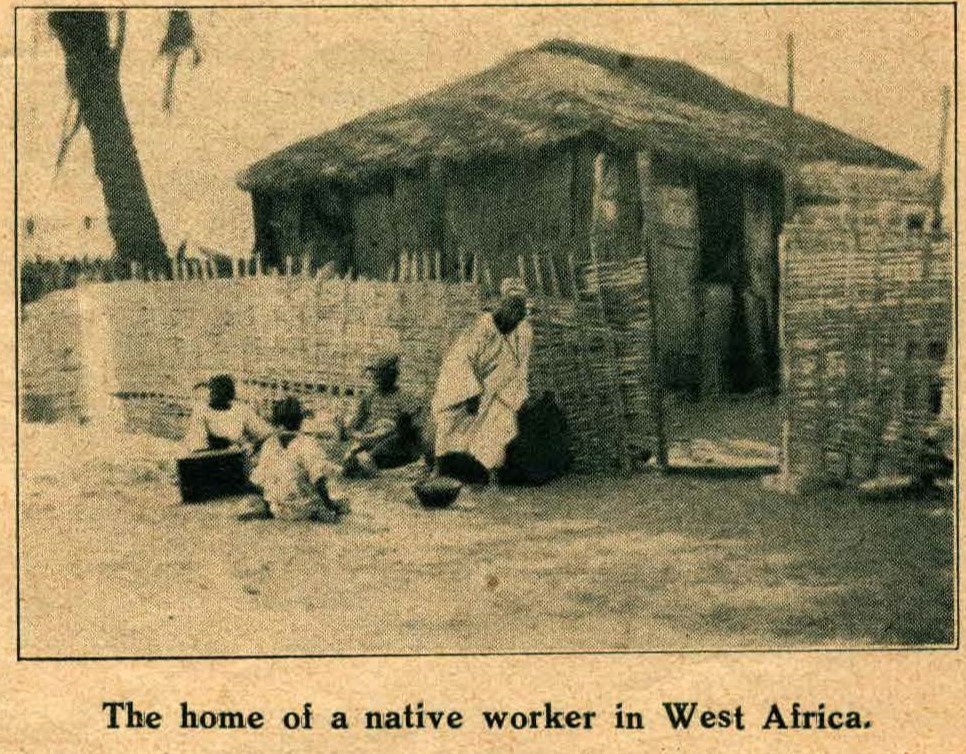
There are more than 20,000 agricultural labourers on the pre-war German plantations in the Cameroons, part of which is now under the administration of Great Britain, as a Mandated territory. The average wage is 5 cents per day for unskilled labour and 20 cents for native overseers and foremen. The working conditions of the agricultural labourers are far worse than those of workers engaged in other industries. The working hours depend entirely upon the overseers, who are permitted to ill-treat the workers in the most shameful manner. These capitalist tools are generally members of a different tribe from the great mass of field-hands. This is done in order to promote prejudices and ill-feelings among the tribes. The social and housing conditions of the agricultural workers are also worse than of any other section of the population. Most of them live in mud huts covered with straw or the skins of animals, while their sanitary arrangements are of the most primitive character.
Thousands of natives of natives are also employed by European timber concessionaires in the Benin River territory. These workers are most mercilessly exploited by the contractors, who force them to work for six months at a time before they are entitled to receive pay. During this period the workers are advanced food, which consists of rice and salted fish from the company stores, and at the end of six months the total of the advance made is deducted from their pay. As a result of this system the workers invariably find themselves indebted to the companies, which compel them to continue work another term under similar conditions. This system of peonage is most widespread throughout the timber regions of Southern Nigeria and the Cameroons.
In Nigeria, the Government of the Southern Province is openly working hand-in-hand with British agricultural companies towards this end.
The chiefs and the big native landlords are also giving active support to this scheme, because such a policy coincides with their own economic interests. In order to crush all opposition that might be raised against land expropriation, the Nigerian Government recently enacted a Bill known as the Appointment and Deposition of Chiefs’ Ordinance, which empowers the Governor to depose any chief who shows “disloyalty” to the Government, and appoint another in his place.
The policy of agricultural monopoly is nothing new, for it was officially endorsed and supported as early as 1917 by His Majesty’s Controller of Oil, Oil Seeds and Fats, who was also a member of the British Empire Resources Development Committee, which was created shortly after the war for the purpose of finding out ways and means to intensify the exploitation of the vegetable resources of the Empire. Speaking in the House of Commons, this imperialist Minister, parroting the words of Chamberlain, said:
“The West African Colony should be regarded from the point of view of estates of the Crown which should be developed for the benefit of the Empire. Furthermore, it should be remembered that the lands belong to the Crown and that the natives were an undeveloped national asset, who should be trained and developed to the fullest extent.” (Emphasis mine.-G.P.)
Another ardent advocate of the plantation system was the late Lord Leverhulme, the Governor of Lever Bros., Ltd., who, addressing a meeting of the British African Merchant Association in London some years ago, said that
“the African natives will be happier, produce the best and live under the largest condition of prosperity, when his labour is directed and organised by his white brother (the capitalist.-G.P.) who has had all these million years’ start of him.”
Since this time steps have been taken to prepare the way for a huge monopoly of agricultural products by the formation of a huge trust in 1929, known as Lever-Margerine, which is a combination of Maypole, Lever, United Africa Co., and Margerine Union, Ltd., with a capital of about 40 million pound sterling. Under this scheme the United African Co., which comprises the Eastern and African Trade Corporation, the Niger Company, as well as a number of smaller firms, with an issued capital of 13 million pounds, has already taken over the West African businesses of Margerine Union and N.V. Margerine Union, for the consideration of 1,534,000 pounds sterling. The chairman of this powerful combine is no less a person than Sir R. Waley Cohen, who is also a director of Royal Dutch Shell Oil Company.
This agricultural and trading monopoly, which in turn is dominated by the great banks of England, has already had a tremendous effect in worsening the conditions of the peasant masses; added to which, the world economic crisis of capitalism has intensified the general agrarian. situation. By controlling the bulk of the import trade which is chiefly made up of such commodities as canned foodstuffs, cotton cloth, earthenware, boots and other leather goods, etc., etc., the new combine is in the position to compel the toiling masses of negroes to pay whatever prices it feels inclined to quote, and at the same time regulate the current market rates for raw products. The result is, wholesale pauperisation is sweeping over the entire West African colonies, for the purchasing power of the natives has been considerably reduced. According to the Board of Trade Journal, 13/11/30, the purchasing power per head of the West African natives in 1929 was ten shillings and ninepence as compared with that of New Zealand, which was £14 11s. Id.
If we take the condition of the Gambian farmer to illustrate the point, we at once see the desperate economic position of these Africans. The average peasant cultivates 1 ½ tons of ground nuts per year, which fetches about £5 per ton on the local market, thus making a total income of £7 10s. ; while his living expenses amount to the following: Rice during planting season, £1 16s. ; ground nut seeds for planting, 1 4s.; hut tax, four shillings; poll tax, six shillings; cost of living for 365 days at one shilling per day, £18 5s., making a total of £21 5s. for living expenses as compared to an income of £7 10s. Thus the West African peasant’s expenses exceed his income by £14 5s. annually. So, in order to augment the family budget and help make ends meet, the entire household–mother, children, and in many cases aged folks–are all forced into the labour market, which is unable to absorb them at the present time of crisis and of great unemployment in the colony.
The present conditions of West African export trade in relation to the European market can be summarised as follows:
(a) Cocoa: The Gold Coast Colony produced about 232,000 tons or 43 per cent. of the world’s cocoa output in 1929, as compared with 219,000 tons in 1928. Similarly, the Nigerian cocoa output has increased. It was 55,246 tons in 1929, 49,209 tons in 1928 and 38,210 tons in 1927. The highest price fetched for this commodity in 1928 was £67 sterling per ton for the best grade, and £50 sterling per ton for ordinary quality, while the price in 1929 ranged from £46 to £52 per ton. The current price is £35 per ton.
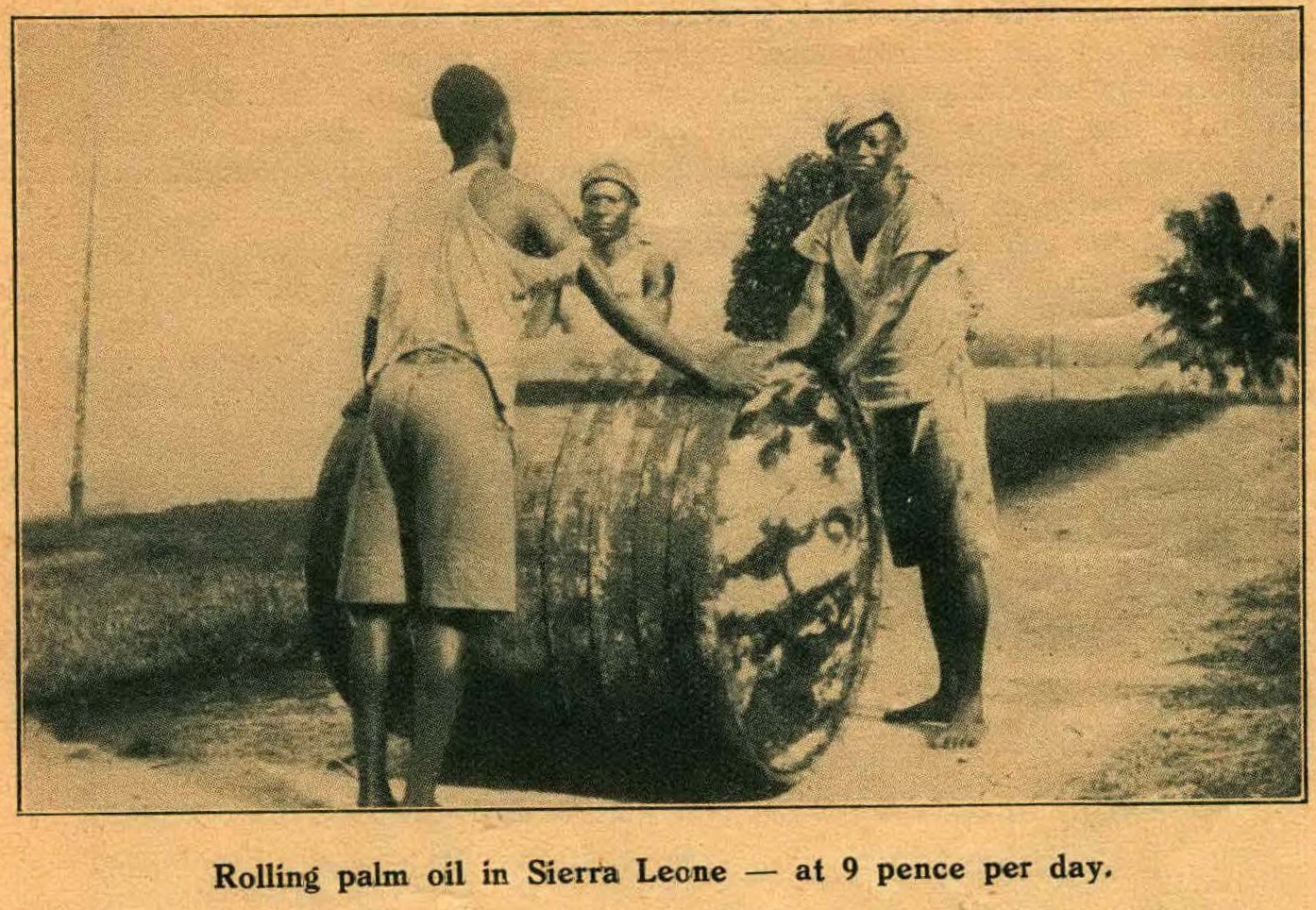
(b) Palm Oil: Nigeria made a record shipment of 132,000 tons of palm oil in 1929, as compared with 127,000 in 1928 and 130,250 tons in 1927. The price, however, has shown a decisive decline, from £38 in 1928 to £32 in 1929. To-day, the sum of £20 is being quoted per ton for palm oil on the Liverpool Exchange.
(c) Palm kernels: Nigeria and Sierra Leone continue to increase their exports of palm kernels. For example, over 250,000 tons were shipped from Nigeria, and 60,200 tons from Sierra Leone in 1929. But here again a drop in price can be observed from £22 in 1928 to £15 in 1929. To-day, kernels can hardly fetch more than £12 per ton in the European and American markets.
(d) Ground nuts continue to be the staple crop of Gambia. Large quantities are also being exported from Nigeria. Last year’s shipments from the latter place amounted to over 145,576 tons as compared with 103,162 tons in 1928 and 70,773 tons the year before. The 1929 export from Gambia amounted to 58,000 tons. In 1928, ground nuts fetched about £21 per ton; in 1929, £18, and to-day £14.
The current local market rates which directly affect the native farmer are as follow: ten pounds sterling per ton for palm oil, four pounds sterling per ton for kernels, four pounds sterling per ton for ground nuts, and eight pounds sterling for cocoa. When we compare the prices which these African peasants get locally with what the European merchants sell for in Liverpool and elsewhere, we see the tremendous rate of profits derived by the foreign capitalists.
The same situation applies to other products, such as rubber, cotton, Kola nuts, ginger, etc.,
An analysis of the foregoing export trade figures reveals two striking features: (1) a tremendous increase of production is to be noticed on the one hand, and (2) a constant decline in mass values on the other.
The agrarian problem has become so acute during the past six months that even the African World, one of the most reactionary journals of the South African bourgeoisie, commenting on the situation, has been forced to recognise the unenviable position in which British imperialism finds itself.
“Probably nothing causes West African farmers to think more furiously than fluctuation in the prices of their products, They have seen the returns for their labour steadily diminishing for several years till they have come near to the level of the cost of production, and the growers are beginning to ask themselves whether it is worth while to grow crops for sale to the white traders, who appear to fix prices at their own pleasure, but always to the disadvantage of the native. They are shrewd enough to know that the traders do not buy the products out of a philanthropic desire to serve Africans, but for profit, and if they get the impression that the game is too one-sided, that they are being exploited, they will cease to play. When they come to the conclusion that the game is not worth the candle, they will refuse to market their produce. The same is true only to slightly smaller degree in the other colonies.” (Emphasis mine.-G.P.)
Already, in the Gold Coast, the cocoa farmers have taken up the counter-offensive. Over 30,000 small growers have organised themselves into an association to control the production and marketing of their crops. In some districts of the Gold Coast and Ashanti the farmers are cutting down their trees and destroying their crops rather than sell to the European merchants at the terribly low prices quoted.
The agrarian crisis does not only reflect itself on the general trade depression, but of necessity has its repercussion on the finances of the colonies, which, to a considerable extent, are derived from customs duties on imports and exports.
For example, let us take the case of Nigeria. There we see a sharp drop in the revenue from £8,728,451 sterling in 1927-28 to £8,429,308 sterling in 1928-29, while the general expenditure of the colony rose from £9,147,530 sterling to £9,395,749 sterling during the same period. On the other hand the public debt of the colony has increased from £19,309,210 sterling to £23,559,209 sterling within a period of two years. Furthermore, if we were to examine the situation in the Gold Coast we will find a similar state of financial depression. The revenue of this colony in 1927-28 amounted to £5,217,638 sterling, while in 1928-29 it dropped to £4,703,967 sterling; the expenditure during a corresponding period was £4,714,947 and £5,419,732 respectively. The customs revenue also showed a considerable decline. For instance, it amounted to £3,000,799 in 1928 as against £2,301,739 in 1929. The value of imports for that year amounted to £10,082,381 sterling, which was £2,117,664 less than the year before. The exports for 1929 were valued at £12,677,716 sterling, being £1,147,159 less than in 1928.
Although complete statistics for 1930-31 are not yet available, there are indications that the situation is becoming worse and worse. Mr. Picton H. Jones, Chairman of the West African Trade Section of the Liverpool Chamber of Commerce, speaking at the annual meeting on April 9th, 1931, reviewing the economic situation in West Africa for 1930, said:
“I regret that I have nothing very cheerful to say. The year has been a most depressing one with scarcely a redeeming feature. The causes to which the experts attribute this state of affairs are many, and it is difficult to pick out any one. In any case I think those in the trade will agree that West Africa has experienced its full share of the effect of the slump in the prices, and of the difficulties in finding satisfactory markets.” Continuing, Mr. Jones said:
“Trading operations have been carried on under the most trying conditions, and everyone is looking for a silver lining.”
This decline in the value of exports from the Gold Coast can be traced directly to the present state of the world cocoa market. The dependence of this colony on this predominant staple crop makes the Gold Coast peculiarly sensitive to the present world crisis. This is strikingly illustrated by the fact that the export of raw cocoa amounted to 238,068 tons, valued at £9,704,493 sterling, but when compared with the export of the commodity in 1928 we discover an increase of 12,991 tons of cocoa but a decrease in the value to the amount of £1,525,019. Another factor which has contributed to the decline in revenue of the Gold Coast is the drop that has taken place in the importation of gin. importation of gin. This commodity represents one of the biggest items of import into the colony. The Government, by means of a special tax imposed upon the importation of gin, has always been able to derive a large percentage of revenue from this source. In 1927, 1,118,913 gallons of gin were imported into the Gold Coast, while in 1929 the amount dropped to 569,746 gallons. This caused the revenue derived on this commodity to fall nearly £670,000 sterling. This decline in the importation of gin can be attributed to the curtailment in consumption among the peasants, whose present purchasing power caused by the fall in value of produce, prevents them from indulging in as much of this liquor as in previous years, and not to any Temperance movement as has been claimed by the missionaries.
The same general state of financial stagnation prevails in Sierra Leone and Gambia. In the latter colony, the revenue dropped from £289,419 sterling in 1927 to £225,385 in 1929, and still continues to decline. In Sierra Leone, the finances of the colony are in such a threatening condition that the Government has instituted a wholesale programme of retrenchment in order to stave off an impending bankruptcy. The revenue was, during the first quarter of 1930, short by about £21,500.
Faced with this state of affairs, the West African Governments have embarked on a dual policy of: (a) increasing taxation on the already overtaxed and pauperised peasants and workers, and (b) reducing the salaries of the Africans employed in the Civil Service. employed in the Civil Service. This is being done in order to provide funds to maintain the functioning of the State apparatus which becomes more and more indispensable to imperialism at this time. when the revolutionary forces are shaping themselves and the masses are beginning to take up the counter-offensive.
As a result of increased taxation, the toiling masses are more and more driven into the hands of the native kulaks (chiefs and big landlords in the villages), and other usurious elements in the cities, in order to provide the money to pay the tax-gatherers.
Unemployment in West Africa is increasing in astonishing proportions. The rising tide of unemployment is getting so acute that the Sierra Leone Guardian, the organ of the native petty-bourgeois nationalists of Free Town, has been forced to comment on the situation as follows:
“In this little world of Sierra Leone, the tide of unemployment has been very rapid. Many of the young men have been thrown out of work by the mercantile world, owing to bad trade. The total crash of kernel and palm oil trade has caused the Railway Department to cancel the run of several trains weekly. Rumour is in the air of retrenchment to take place in this Railway Department, as well as in the Public Works Department. Since the beginning of the year, it has been declared that the Government was not going to undertake any new building work. Our mechanics who have been carrying on with such ordinary work in the Public Works Department have had to be put aside, and there is an army of carpenters and masons that have nothing to do to keep life a-going. Initial salaries have been reduced in the Gold Coast and we have no doubt that Sierra Leone will soon follow. The constant fall of revenue cannot but result in further unemployment. Already all future appointments have been suspended and a deadlock created.”
In order to place themselves at the head of the unemployed movement, the petty-bourgeois, especially the “Left” leaders of the West African National Congress, have established committees of the unemployed in the most important West African towns, such as Lagos, Free Town and Accra. In this way the thousands of unemployed workers and agricultural labourers are being brought under the influence of petty-bourgeoisie nationalism. Every move on the part of the petty-bourgeoisie to-day is made in order to subordinate the growing proletarian mass movement to their own class interests. The only way in which the unemployed will be able to get any assistance from the Government and the European capitalists is by organising their forces under the leadership of the trade unions and independent Committees of Action. The employed must unite with the unemployed, especially in view of the tremendous retrenchment and cutting of wages now taking place, and put forward demands in their own class interests and not permit themselves to become the pawns of the native petty-bourgeois nationalists.
II.
British Imperialism, faced with an ever-deepening crisis in the metropolis on the one hand, and with revolutionary uprisings in the East (China, India), displacement and loss of world markets, on the other, is turning its attention more and more to Africa, the last stronghold of world imperialism. In this way the British bourgeoisie hope to find a way out of their dilemma by unloading the full burden of the crisis on the backs of the black toiling masses of the continent, who are still largely unorganised.
However, the very conditions under which the negroes live, subjected as they are to the most intensive and ruthless forms of exploitation, make for their rapid revolutionary development.
Since the beginning of 1930, new events of tremendous significance for the revolutionary movement have taken place throughout West Africa. With the rapid proletarisation of large sections of the negro population, thanks to the exploitation of the mining resources of the colonies, class differences are beginning to manifest themselves more sharply. The proletariat is becoming more and more class-conscious, and as such, is starting to organise trade unions and at the same time rousing the semi-proletariat and agricultural toilers to action. Battles have already broken out between the toiling population and the imperialists in Nigeria. In the South-Eastern Province of Nigeria, the semi-proletariat and poor peasants are forced to leave their villages and work in industry and on the plantations in order to get money to pay their taxes. As a revolt against this imperialist policy they took up the offensive against the Nigerian Government last December. It has been estimated that over 30,000 women staged monster protest demonstrations against British imperialism in Apobo and Calabar districts. They carried on guerilla attacks on the British settlements for several days. It was only after the Social-imperialist Government of MacDonald had ordered troops to the scene, where 83 women were murdered by machine-gun fire of the soldiers, and 54 others wounded, that the rising was crushed.
The chief causes for the revolt were, first of all, the attempts of the Government to levy a special head tax on the women in order to force them into the labour market; and secondly, the tremendous fall in the prices for peasant produce, caused by the world crisis and aggravated by the monopoly policy of the British trading companies and the banks.
However, as was to be expected, the blame for the uprising was immediately attributed to the agents of Moscow. The Colonial Secretary of Nigeria, Sir Frank Baddeley, speaking at a dinner in connection with the Colonial Conference in London in June, 1930, said
“that the Government of Nigeria had discovered the circulation of the Negro Worker, a trade union bulletin published by the Profintern in Moscow, among the workers of Lagos, and that the Government was adopting precautionary measures to combat the spread of Bolshevism among the peasant masses and workers of Nigeria.”
This was not the first time that the peasants of Southern Nigeria had revolted against the attempts of the British Government to impose taxation upon them.
“Eleven years ago, Lugard made his first attempt to introduce this system of Capitation or Poll Tax into the Southern Province and the net result was to convulse the Southern Provinces, inasmuch as such a system was opposed to their traditional customs and usages; and more particularly because the Southern Provinces have been accustomed to the payments of tolls and excise duty upon trade rather than upon head or person.
“So violent was the opposition by the Southern Provinces to this nefarious capitation tax that it led to number of native risings with a corresponding number of so-called “expeditions,” and their attendant destruction of African lives and property, to put down those risings. Indeed, within a very short time following the introduction of this system of capitation tax in the Southern Provinces, the number of native risings-protests against the imposition of the tax-and the corresponding “expeditions’ to quell them was by far greater than those throughout the whole period comprised within the date of the Colony and Southern Provinces that first came under the British flag and the time of the introduction of these nefarious taxes. And to-day, though everything seems outwardly calm, yet the bitter truth of the whole situation has yet to be told; for the widespread misery which the imposition and collection of these taxes appear to have entailed is such that many persons in the provinces have practically abandoned their homes and sought evasion by migration. (Memorandum, National Democratic Party of Nigeria.)
The “Times” Correspondent of Nigeria, commenting on the findings of the Commission which investigated the December revolt, writes:
“The trouble was of a nature and extent unprecedented in Nigeria. In a country where the women throughout the centuries have remained in subjection to the men, this was essentially a women’s movement, organised, developed, and carried out by the women of the country, without either the help or permission of their menfolk, though probably with their tacit sympathy.” (Emphasis mine.-G.P.) Another peasant revolt broke out in the Protectorate of Sierra Leone in February, 1931. Hundreds of poor peasants, some of them armed with rifles, and others with agricultural implements, refused to pay the Government tax collectors and drove them away from their villages. The Government sent several battalions of soldiers. of the West African Frontier Force into Gambia district where the peasants had seized control and were confiscating the Government’s lands. After several days’ fighting the uprising was suppressed and the leaders, as well as a number of peasants and soldiers, were shot.
A number of strikes of a political character have also taken place in Gambia and Gold Coast. In the former colony, the Bathurst workers have been able to withstand the attacks of the foreign bourgeoisie and their imperialist Government, which attempted to destroy the trade union movement.
The struggle began when the transport workers refused to accept a wage cut and called a strike. The Government ordered out the troops, declared martial law, and raided the workers’ quarters. The natives, however, strengthened their ranks by extending the strike, which lasted for several days. The fighting spirit of the workers was marvelous. They forced the Government to withdraw the soldiers from the streets; and the British trading companies, United Africa Co., Ltd., Bathurst Trading Co., Ltd., Gambia Trading Co. and Palmine Ltd., represented by the Chamber of Commerce, were compelled to agree to the demands of the workers. This was one of the most brilliant victories for the young trade unions of West Africa. Throughout this section of the continent, the workers are beginning to organise and to fight against the ever-increasing measures of imperialist exploitation. carried out by the British trusts and banks with the aid of the State apparatus.
The basic force in the revolutionary liberation movement in West Africa lies in the agrarian masses, who form the overwhelming majority of the toiling population under the leadership of the proletariat; and because of this, the question of the organisation of the agricultural workers as well as the peasantry must be made one of the central tasks of the trade unions. Up till now we have not paid sufficient attention to the labour movement in West Africa. Therefore, it is absolutely necessary for us to begin to give more attention to this rising movement in the African colonies, especially in connection with those parts where there is a well-crystallised proletariat. Immediate steps should be taken to establish contacts with existing trade unions, peasants’ movements and national revolutionary organisations, in order to raise their ideological level and give them more conscious leadership. Facilities must also be created to train cadres directly from these colonies for leadership in the anti-imperialist movement.
In all of these respects a great responsibility is thrown upon the British and French Communist Parties as well as the Minority Movement and the C.G.T.U. The isolation which at present exists between the advanced proletariat of these imperialist countries and the African colonies must be immediately overcome. The revolutionary press of Europe and America must also give more publicity to the conditions under which the Negroes in Africa live, such as forced labour, Poll Tax, Pass Laws, as well as exposing the brutal policy of flogging women and children, all of which are resorted to in order to crush the militancy of the black workers and thereby keep them in a condition of virtual slavery.
Furthermore, with respect to our trade union work in West Africa, it is necessary for us always to keep clearly in mind the oppressive economic, political and social character of the situation in these colonies. Because of the special forms of exploitation of the toiling masses which British imperialism has adopted, every attempt on the part of the natives to organise, becomes a political issue; every economic strike immediately develops into a political struggle.
Why is this so? Let us take the case of Nigeria for example. The coalfields and railroads are owned and operated directly by the Government. In the event of the workers in these industries organising and putting forward even the most elementary economic demands, the Government will at once interpret this, not as an ordinary dispute between the workers and capitalists, but as an attempt to revolt against the State. And under the statutes of an anti-labour character embodied in the Criminal Code of Nigeria, pressure will be brought to bear on the unions and the workers through the intervention of armed police and the Royal West African Frontier Force which are specially stationed throughout the most important industrial centres of the country, to facilitate their quick mobilisation on occasions of emergency. The same applies to the tin industry. For although the tin mines are being exploited by private companies, the Nigerian Government is closely linked up with these capitalist concerns from whom it derives royalty on production. The finances obtained from this source form a large percentage of the revenue of the country, in consequence of which, the Government will always be ready to defend the interests of the tin producers against the miners.
We had a glaring illustration of the strike-breaking role of the colonial Governments during the last railroad strike in Sierra Leone.
In January, 1926, a general strike broke out among the railroad workers under the leadership of the S.L. Railway Workers’ Union.
“At the end of six weeks, the Government had succeeded in breaking the strike. It declined to take back into the service thirty-seven pensionable employees, some of whom had worked for twenty years. Others they took back only after a temporary reduction in pay, ranging from 30s. to £6. These measures led the Africans to declare that the Government was attempting to destroy the Railway Union and to deny the right of Africans to strike.
“The Government denied that it had any intention of breaking the union; its responsibility was to maintain the country’s system of communication; if the men chose to strike, the Government was entitled to employ men to take their places. (This was not an ordinary industrial dispute in which the Government was a neutral party). This was a revolt,’ according to the Governor, ‘against the Government by its own servants.’
“The Secretary of State for the Colonies telegraphed:
‘The strikers must realise that as Government servants who had left their work without leave, they are liable to the penalty of instant dismissal.‘ In the debate on the strike the Governor went so far as to imply that even if the employees were not Government servants, they would be liable to a fine under the Manual Labour Ordinance of the Colony which makes any labourer who refuses to perform his work without ‘just cause’ liable to a fine not exceeding £2 and, in default of payment, to imprisonment not exceeding one month. In other words, the Master and Servants’ Ordinance of Sierra Leone, mild as it is, compared with ordinances found in East and South Africa, operates to make strikes of any kind illegal.” (Emphasis mine-G.P.) (“Legislative Council Debates,” April 9, 1926, Bull. Vol. I. p. 859 “Native Problem in Africa.”).
The recent Gambia strike also exposed the repressive role of the Government in industrial disputes.
It is therefore necessary to point these facts out to our African comrades in order that they might be better prepared to organise their forces and to lead the masses in the coming class battles.
Only through active participation of the workers of the mother countries in the struggles of the African toilers against their imperialist oppressors, will we be able to establish a true spirit of internationalism, and at the same time help to develop and strengthen the fighting forces of the international working class against world imperialism.
The ECCI published the magazine ‘Communist International’ edited by Zinoviev and Karl Radek from 1919 until 1926 irregularly in German, French, Russian, and English. Restarting in 1927 until 1934. Unlike, Inprecorr, CI contained long-form articles by the leading figures of the International as well as proceedings, statements, and notices of the Comintern. No complete run of Communist International is available in English. Both were largely published outside of Soviet territory, with Communist International printed in London, to facilitate distribution and both were major contributors to the Communist press in the U.S. Communist International and Inprecorr are an invaluable English-language source on the history of the Communist International and its sections.
PDF of full issue: https://www.marxists.org/history/international/comintern/ci/vol-8/v08-n13-jul-15-1931-CI-riaz-orig.pdf
 Revolution's Newsstand