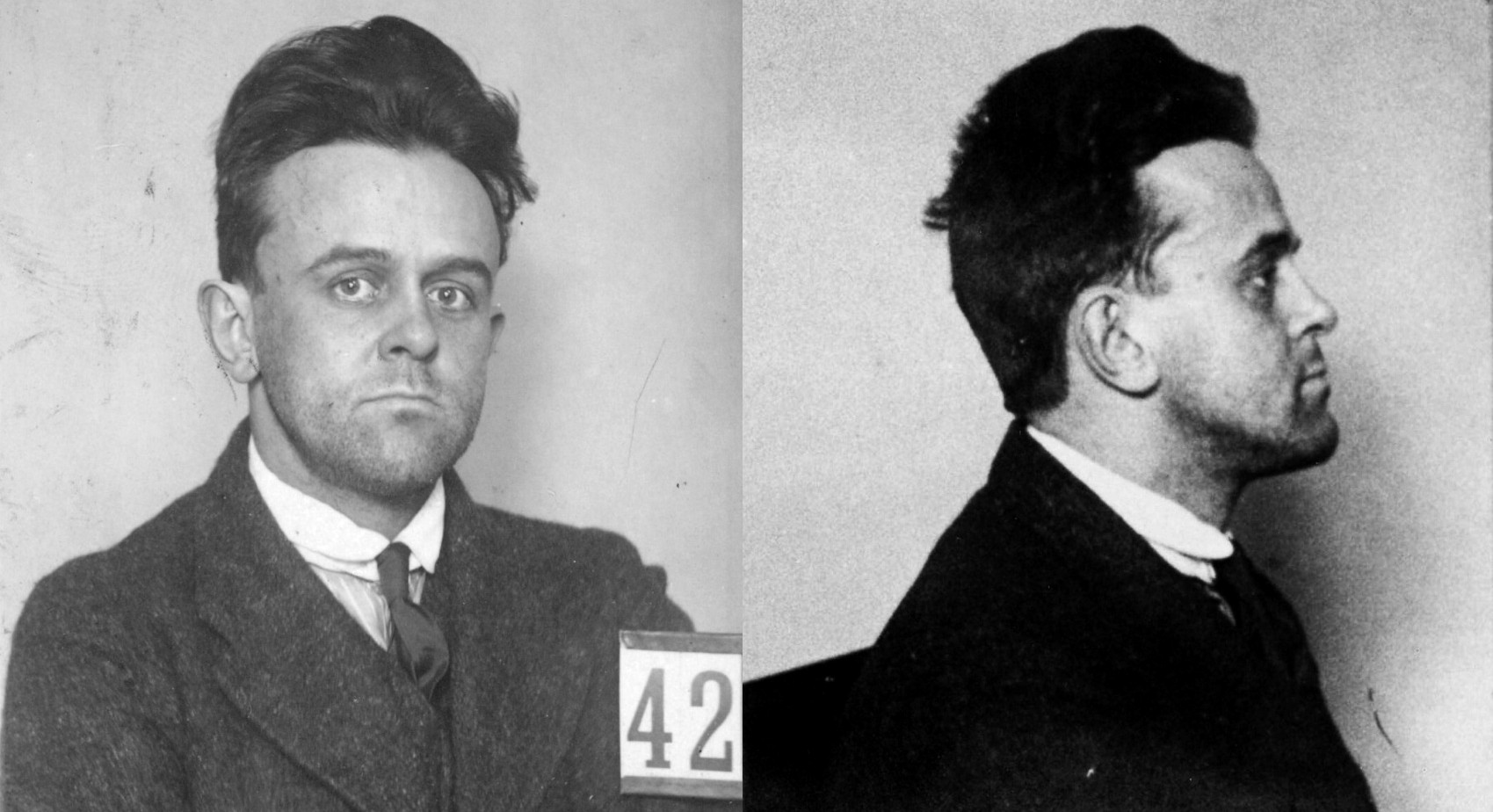
John Reed continues his needed revisionist history of the U.S. Socialist movement, calling out Party leaders Meyer London and Victor Berger in an article written to guarantee his expulsion from the Socialist Party. The final installment to follow.
‘Why Political Democracy Must Go, Parts VI-VII’ by John Reed from The New York Communist. Vol. 1 Nos. 8 & 9. June 7 & 14, 1919.
VI.
THE foundation of the Socialist Party of America proved that Socialism had become acclimatized. Born of Populism, Greenbackism, and Trade Unionism, it was grafted on to a Socialist tradition whose most important ancestor had been the teachings of Ferdinand Lasalle, imported into this country shortly after the Civil War. It was dominated by the prevailing American belief that the ballot controlled the State, and that the State could be conquered for the working class by the ballot. At the beginning it was still revolutionary that is to say, it aimed at the capture of political power. At hand it had a native economic organization of the workers the American Federation of Labor–already grown powerful. Instead of trying to create a rival labor organization, it realized that this was impossible, and set out to capture for Socialism the organization already existing.
In all respects, therefore, the Socialist Party was apparently equipped to enter the political struggle with the capitalist class for power. And this it proceeded to do at once, with results which justified its belief that at last the combination had been discovered by which Socialism could be made attractive to American workmen.
The first national campaign that of 1900 tabulated 87,814 votes for the Socialist Party. Debs, who was very popular with the workers because of his activities in the American Railway Union, made a series of spectacular campaigns for the Presidency, culminating in 1912 with the country-wide tour of the “Red Special,” when the Party rolled up almost a million votes. And this last campaign was carried on in the face of Roosevelt’s dramatic crusade for “social justice,” wherein the Progressive Party had incorporated many of the planks from the Socialist platform.
At the same time the Socialists in various parts of the country elected several members of State Legislatures, city aldermen and administrative officials. The most striking example of Socialist political success was in the City of Milwaukee, where Berger was elected Alderman-at-Large, and finally Emil Seidel was elected Mayor, with a large proportion of the City Council composed of Socialists. For a time, indeed, Milwaukee was looked up to by American Socialists as a shining example of what Socialist political action could do just as, before the war, Germany dominated the International because of its powerful party organization and its millions of votes.
The real emergence of Socialism upon the arena the political fight, however, did not occur until 1910, when Victor Berger was elected Member of the House of Representatives for the Fifth Wisconsin District, and for the first time a representative of the Party of the working-class took his seat in the Congress of the United States, the highest law. making body. He sat for two terms; and then, after a lapse of two years, Meyer London of New York succeeded him as Representative, to be followed again in 1918 by the re-election of Berger. It is not necessary here to go into the record of Victor Berger as first Congressional Representative of the working class Party. His first act was to cast his vote for a substitute to the direct election of Senators. His maiden speech contained not one single reference either to the Socialist International or to the interest of the working-class as such; it was a purely reformist criticism of the capitalist state. The most salient feature of his tenure of office was the introduction of mild social reform legislation, of which his Old Age Pension bill is characteristic. For example, the pension was to accrue only after the worker’s sixtieth year–and it is well-known fact that the average life of American industrial worker is forty years. It was to be denied to anyone convicted of a “felony”–even such a “felony” as that of which Victor Berger now stands convicted by the capitalist courts. It was to be denied to anyone, no matter how old, who had an income of six dollars per week. And finally, all “unnaturalized aliens”, which compose the vast majority of the most exploited section of the American working class, were barred.
Add to this Berger’s opposition to Woman Suffrage, on the ground that women were largely dominated by religion, and would therefore strengthen the reactionary political forces; and later, his advocacy of Intervention in Mexico; and we have a picture of a man in some respects less revolutionary than the bourgeois Jeffersonian Liberals.
In full consciousness of the desperate situation in which Victor Berger now finds himself, and in full respect to his courage, I do not wish to misquote Berger or misstate his position. I shall therefore quote extracts from his recent pamphlet, “Open Letter Addressed to His Colleagues in Congress”, in order that he may speak for himself:
“I am one of the founders of the Socialist Party of America…I have always prided myself on strict obedience to laws, even when I do not like them.
“The American Socialists were opposed to our entry into the war, but so were many Republicans and Democrats in and out of Congress…
“The American Socialists held to the wise counsel of George Washington, Thomas Jefferson, James Monroe and Abraham Lincoln–to keep out of European troubles.
“That is the reason why we demanded legislation depriving any citizen or corporation of all profits from the sale of war supplies for the American government. “Many Republicans and Democrats believed and said the same…
“Now Socialism is not Bolshevism.
“Socialism is the collective ownership of the means of social production and distribution while Bolshevism, as far as I understand it, is Communism combined with syndicalism…
“The Communists want to produce and consume in common. Socialism, however, wants to control only productive capital–not all property. A Socialist commonwealth will not do away with the individual ownership of property, but only with the individual ownership of socially necessary capital.
“Communism denies individual ownership of all property.
“The Bolshevists discourage parliamentary action. They prefer direct action and the dictatorship of the proletariat. “The Bolshevists want to break entirely with the past. and start anew. The Socialists do not believe that a complete break is either possible or desirable.
“If we are to remain a politically free people the inevitable outcome must be that the people must take possession collectively of the social means of production and distribution–and use them for the nation as a whole–and that is called Socialism.
“The measures that the Socialists will take must closely connect with the present system and evolve from it.
“The Socialists believe that everything that is necessary for the life of the nation–for the enjoyment of everybody within the nation–the nation is to own and manage…
“Everything that is necessary for the life and development of the state–the state is to own and manage…
“Everything that is necessary for the life and development of the city–the city is to own and manage…
“Everything that the individual can own and manage best–the individual is to own and manage. There will be plenty of enterprises left for the initiative of the individual.”
This is nothing but State Capitalism in its most complete form. Mr. Hearst win cheerfully endorse it. In it there is not a word to indicate that the proletariat must control the State, and that it must, as Marx points out, break down the capitalist State apparatus and rebuild anew the entire machinery of government and of production. There is very little difference between this ideal and the industrial organization of Imperial Germany before the war.
Meyer London’s career in Congress began little better. In a speech supporting the Jones bill giving citizenship to the Porto Ricans, London threatened that if Congress denied the ballot to these people it would be placing in their hands “the bomb of the revolutionist and the assassin’s knife.” Immediately the House was in an uproar; the members sternly threatened that they would discipline the Socialist Congressman unless he withdrew his remarks, so Socialist Congressman Meyer London apologized and ate his words.
From that time on, outside of a few speeches concerning the housing situation in the District of Columbia and other minor matters of that sort, Congressman London remained silent. On the resolution declaring war on Germany, he voted “nay”. On the military appropriation, however, he did not vote. Finally, the fearful pressure engendered by the Congress beat down his half-hearted resistance; so war, and the savage patriotic persecution in the that in 1918 he was the Congressman selected to deliver an address of eulogy commemorating the third anniversary of Italy’s entrance into the war!
Taken to task by his comrades in New York for his chauvinistic utterances, Comrade London declared that although born a foreigner, he had been made in America, and he would be true to his country; furthermore, he added that he was responsible to all his constituents and that these constituents were not only Socialists (working men) but all the people of his district. The disastrous records of Socialists elected to office are endless. Mayor Seidel of Milwaukee appointed many non Socialists to posts in the city administration, and when criticized, declared that he represented all the people not merely the Socialist Party. Mayor Lunn of Schenectady did the same thing; when taken to task for his un-Socialistic behavior, the Mayor proudly resigned from the Socialist Party–but remained Mayor, and afterward became one of the chief pro-War Democratic Congressmen. Mayor Van Lear of Minneapolis, after election to office of an anti-War program, joined Samuel Gompers’ Alliance for Labor and Democracy, which was formed by the reactionaries of the American Federation of Labor to support the War; and when the Non-Partisan League put up a candidate in a local election, Mayor Van Lear made a public speech in favor of this candidate, although a candidate of his own Party was running. His last act in office was to refuse to veto a Red Flag law passed by the City Council of Minneapolis against the Socialists.
But after all it is not these examples of the failure of Socialist officials in office which forms the most damning demonstration of the failure of old-style Socialist political action. The War intensified and brought out the real nature of political power and control. For example, in cases where the Socialists in office actually tried to follow Socialist principles, capitalist action was swift and merciless. In Minneapolis, for instance, Mayor Van Lear having manifested a mild hospitality toward free speech, the State government promptly took away police power and governed the city through the State Council of National Defense, which was composed of the representatives of big business. Mayor Hoan, Socialist Mayor of Milwaukee, was completely divested interests of Wisconsin acting through the Governor of his power as a city executive by the business interests and Council of National Defense. In Cleveland two Socialists were elected to the City Council; one was disbarred, because a woman reported that he did not believe in the Red Cross–and the other twelve months before he had been heard to say that Councilman was expelled because he belonged to the same political Party as his colleague. Victor Berger ran for United States Senate in Wisconsin in the Spring of 1918. In order to prevent him from taking his seat, the business interests of his State and of the country at large secured his indictment in the Federal Courts, on charges much less grave than those upon which many Socialists had already been acquitted. Berger then ran for the House of Representatives. This was the signal for still further indictments. He was elected by an overwhelming vote and another indictment was clapped upon him; and after the armistice had been signed, Berger was tried and convicted, and sentenced to twenty years in jail.
At the height of the Socialist Party’s career, in 1912, more than nine hundred votes were cast for the entire vote cast for its Presidential candidate–about one-fifteenth of ballots cast for the President, and one-sixth of the ballots cast for Woodrow Wilson, the winning candidate. Roughly, the Democratic and Republican electorate was represented in Congress proportionally to their Presidential vote; but the Progressives–the Party of the rebel small property owners–was not represented in proportion to its vote; and the Socialists, with one-fifteenth of all the ballots, got one Congressman, although on the face of it they were entitled to about thirty. True, many Congressional Districts had no elections in 1912, but this does not alter the essential truth of this statement. In Europe the development of such political strength by any party would have immediately showed in the legislative body; this is true even in Germany, in spite of restrictions to the franchise. But in America it can be readily seen that, although political democracy more or less accurately reflects the comparative strength of the bourgeois parties, it operates to block the adequate representation of all classes contending with the great capitalists for State control.
Why is this so? Why is it that in Europe the political Socialist movement was able to develop great strength in the legislative bodies, and exercise an important influence on the Governments? This results from the fact that nowhere in the world is the capitalist class so strongly organized and so firmly intrenched as in America. In America, from the first, the capitalist class controlled the State, and there was no other class in society except the working class. In Europe the capitalist class had to fight against the remnants of the feudal class. Almost up to the Great War, in some parts of Europe there was a dual revolution going on: the capitalists were striving with the dying feudal system to gain control of the State, and the rising proletariat was also beginning to battle for power. Both feudal class and capitalists used the working class against each other, and thus the Socialists became an important factor between the two contending class-factions. And thus, above all, the capitalists were compelled to fight in two directions at once, and in the meanwhile, to give concessions to the working class in return for its aid against the feudal system.
In America, however, there was no feudal class to divert the capitalists from their war against the working class. More than that, the ballot enabled the American capitalist class to blind the workers with illusions of “democracy” until they had perfected their hold upon the throat of the republic.
For the last decade the history of the American Socialist Party has shown a continuous tendency to draw away from the proletariat. The policy of “boring from within” in the American Federation of Labor resulted in the virtual capture of the Party, for a period, by the Federation–which by that time had become a definitely wage-conscious,
anti-Socialist, counter-revolutionary, reformistic body. The split with the I.W.W. in 1912, by the adoption of Article Two, Section Six, in the Party constitution, finally completely separated the Party from the revolutionary American proletariat, and forced out of the Party some of its best elements.
The Party platforms became so filled with reformist demands calculated to appeal to professionals and small property owners, that the Progressive Party adopted several of them in 1912. For the moment this did not effectually modify the Socialist vote; but when, four years later, under the threat of war, the Wilson Democrats adopted the same tactics, it proved fatal to the Party–the Presidential vote fell almost one-half.
The St. Louis War Resolution, forced upon the Party officialdom by the rank and file, gave promise of a new spirit in the Socialist movement, born of the shock of war. But how the Party officials and office-holders violated or apologized for the St. Louis Resolution, and what happened to the members of the rank and file who attempted to live up to it, reminds one of the leaders of the Second International, and the millions of trusting workers betrayed by them.
The War revealed the power of capitalist political control. Before it the political workingmen’s parties disappeared, were overwhelmed by the parliaments in which they participated, by the machinery of political democracy which they helped to maintain…
VII.
HAVING in former articles traced the failure of the small property holders, Labor and the Socialists to gain control of the Government in America, it is now necessary to indicate how the few great capitalists are able, in the most advanced political democracy of the world, to withstand the pressure of all other classes, either alone or combined–in other words, just how political democracy fails to assure a government by the majority.
When Karl Marx said that the modern capitalist state was “nothing less than a machine for the oppression of one class by another, and that not less so in a democratic republic than under a monarchy,” he made a profound observation, the more remarkable since at that time the origin of political democratic states was still surrounded with a romantic halo of libertarian phrases which still inspired the Forty-Eighters.
Fortunately, thanks to the work of Beard, McMaster, and others, the origins of the American Republic are today available to all; and they demonstrate with utter clearness that the Government of the United States was designed by its founders to protect the rich against the poor, property against the necessities of life and liberty, and the monopolistic minority against the majority.
Pre-Revolutionary society in America was divided into three very sharply-defined classes: the upper class consisting of the clergy, professional men, merchants, landed proprietors and the great slave-holding planters in the South; the middle class, of shop keepers and farmers; and the comparatively unimportant lower class, of slaves, poor whites in the South, mechanics, indentured servants and apprentices all of which had no votes. Except among the middle and lower classes, there was no discontent with the political institutions of the British Empire; on the other hand, there was a healthy contempt for Democracy, often expressed, among the well-to-do and educated.
Until the acts of the British Government began seriously to hamper trade--in other words, property–the upper class in the American colonies was not in any sense revolutionary; in fact, many of the framers of the Constitution had been against the Revolution. In any sense, the Revolution, for the Colonial upper class, was favored only insofar as it promised to protect their material interests. Like all Revolutions, however, it was precipitated and expressed by idealists, and carried through by the masses in this case, the middle class-who saw in it the opportunity to establish a government in their own interests. These interests were expressed in the formula, “Life, Liberty and the Pursuit of Happiness”–which did not refer to slaves and indentured servants at all, but to the vast majority of traders and farmers.
This was the element which wrote the Declaration of Independence, in the heat of the Revolutionary struggle, when, as in all Revolutions, the mass was dictating the slogans of the movement.
The eleven years of the confederation which followed, however, proved that human society was definitely embarked on the capitalist era, which was incompatible with those “natural rights”–that individualistic liberty so fondly embraced by the small property owners, as best suiting their free development in a land of unequalled opportunity.
The middle class whose services in the Revolutionary struggle had made them the dominant class in society, were jealous of their freedom and independence. Already the development of capitalism had begun to concentrate wealth in the hands of few. Great corporations had already tied up immense tracts of land, and the banking interests in the towns had a monopoly of capital; these conditions had made the petty bourgeoisie a debtor class. The middle class therefore was in favor, as at later periods, of cheap currency, and of the violability of contracts. A small group of capitalists had secured control of depreciated Congressional and State obligations issued to pay for the Revolution, and the middle class wished to wipe out this debt. And just as the great capitalists were in favor of a strongly centralized government, which would guarantee their speculative investments and mortgages, and protect this property with federal troops and police, so the middle class feared a centralized government, whose actions it might not be able to control as it controlled the separate state legislatures.
Attempts at oligarchy or dictatorship in each separate state might be opposed, if all other means failed, by a popular uprising. In fact, the eleven years of the Confederation saw many such insurrections. It is interesting to note here that these insurrections were directed against the capitalists, who had got control of the state governments, by the middle class debtors. The culminating insurrection was Shays’ Rebellion.
The situation is well described by Mr. Curtis, in his Constitutional History of the United States:
“A levelling, licentious spirit,” says this old reactionary, “a restless desire for change, and a disposition to throw down barriers of private rights, at length broke forth in conventions, which first voted themselves to be the people and then declared their proceedings to be constitutional. At that property ought to be common, because all had these assemblies the doctrine was publicly broached aided in saving it from confiscation by the power of England. Taxes were voted to be unnecessary burdens, the courts of justice to be intolerable revision of the state constitution was demanded, in grievances, and the legal profession a nuisance. A order to abolish the Senate, reform the representation of the people, and make all civil officers eligible by the people…”
It was these revolts which furnished the immediate incentive to the adoption of the Constitution. The work of preparing the country for the capitalist coup d’etat had been carried on carefully and tactfully for several years by Alexander Hamilton and James Madison–afterward President of the United States. In calling the Constitutional Convention of 1787, for instance, the leaders did not dare to suggest their real objects; the aim of the Convention, it was stated, was merely “to revise the Articles of Confederation.” It was also carefully arranged that the delegates should not be elected by the people, or even by directly representative bodies, as had been done in the case of the Congress which issued the Declaration of Independence; instead, they were either chosen by the legislatures, or, more often, appointed by the Governors of the states. And it should be remembered that property qualification for the franchise existed in all the states, so that in no case was the lower, or working class, represented in the Convention.
And when the Convention finally met, it did its Conference in Paris; and like the latter, in order to work in secret, behind closed doors, like the Peace. prevent the public from knowing what was going on, it even forced its members to promise not to talk to anyone outside. So that when the Constitution was finally completed, it was issued to the world in such a form that its real meaning, and the forces which produced it, were absolutely unknown to the colonists.
The majority of the signers of the Declaration of Independence were Revolutionary leaders, men representing the small property holders; while the majority of the framers of the Constitution were the bankers, speculators in the land and money, and the merchants. Many delegates to the Constituent Convention who had signed the Declaration of Independence refused to sign the Constitution, denouncing it as a “conspiracy”; among these was Benjamin Franklin.
James Madison, afterward President of the United States, who was chiefly responsible for the Constitution which he described as having “the form and spirit of popular government while preventing majority rule”–expressed in 1785 the theory of economic interpretation in politics. He wrote:
“The most common and durable source of factions. (parties, classes), has been the various and unequal distribution of property. Those who hold and those who are without property have ever formed distinct interests in society. Those who are creditors, and those who are debtors, fall under a like discrimination. A landed interest, a manufacturing interest, a mercantile interest, a moneyed interest, grow up of necessity in civilized nations and divide them into different classes, actuated by different sentiments and views. The regulation of these various and interfering interests forms the principal task of modern legislation, and involves the spirit of party and faction in the necessary and ordinary operations of the government.”
It will be seen by this that before the end of the eighteenth century the American capitalist class had discovered, and applied for its own advantage, what Karl Marx discovered more than sixty years later. Listen once more to Madison, speaking before the Constitutional Convention, advocating that the vote be given to the propertied classes alone:
“In future times a great majority of the people will not only be without landed, but any other sort of property. These will either combine under the influence of their common situation; in which case, the rights of property and the public liberty will not be secured in their hands, or, which is more probable, they will become the tools of opulence and ambition…”
Elbridge Gerry, declared that all the evils experience by the Confederation flowed “from the excess of democracy.” Edmund Randolph said, “that the general object was to provide a cure for the evils under which the United States labored; that, in tracing these evils to their origin, every man had found it in the turbulence and follies of democracy; that some check therefore was to be sought for against this tendency of our government… Alexander Hamilton, in urging a life-term for Senators, said that “all communities divide themselves into the few and the many. The first are the rich and well-born, and the other the mass of the people who seldom judge or act right.” Gouverneur Morris, of New York, wanted to check the precipitancy, changeableness and excess” of the representatives of the people, by the ability and virtue of “great and established property-aristocracy; men who from pride will support consistency and permanency…Such an aristocratic body will keep down the turbulence of democracy.” Gouverneur Morris showed the capitalist viewpoint of the Convention, when he boldly stated, “Life and liberty were generally stated to be of more value than property. An accurate view of the matter would, nevertheless, prove that property was the main object of society…If property, then, was the main object of government, certainly it ought to be one measure of the influence due to those who were to be affected by the government.” And finally, Mr. Madison again:
“An increase of population will of necessity under all the hardships of life and secretly sigh for a more equal distribution of its blessings. These may in time outnumber those who are placed above the feelings of indigence. (The poor may outnumber the rich.) According to the equal laws of suffrage, the power will slide into the hands of the former. No agrarian attempts have yet been made in this country, but symptoms of a levelling spirit, as we have understood, have sufficiently appeared, in a certain quarter (Shays’ Rebellion), to give notice of a future danger.”
Madison further advised the Convention that in framing a system which they wished to last for ages, they must not lose sight of the changes which the ages would produce in the forms and distribution of property.
The Convention did not. It finally framed a Constitution which, while appearing to preserve popular government, in reality secured the rights and property of the minority against “the superior force of an interested and overbearing majority.”
Liberals and “parliamentary” Socialists in this country are always pleading for the “minority rights” guaranteed by the Constitution. But the “minority” which the Constitution guarantees is not the one they are talking about; it is the permanent capitalist minority, and it is guaranteed against the will of the majority.
This is accomplished through the so-called “check and balance system”, by which the President is indirectly elected, the members of the House of Representatives are elected in one way, the Senate in another, and finally, the most powerful body of all, the Supreme Court, is not elected at all, but appointed. These various bodies check each other’s action, so that no popular majority can control the processes of legislation, except after a long and tedious process. Today even this possibility is removed, by the fact that the colossal financial interests absolutely own and control the government.
It is fascinating to study the history of these times–to discover, for instance, that most of the signers of the Constitution derived immediate personal wealth from its proclamation; that there was a conspiracy among the upper class of the colonies, in case the Convention failed, to organize an insurrection to overthrow “democracy” by force of arms; that out of the sixty-odd delegates elected, only thirty-nine signed the document, many withdrew from the Convention altogether, and an immense anger shook the middle class when it discovered, too late, what the Constitution meant; that the middle class had to threaten to refuse ratification. before the first ten amendments, which constitute the Bill of Rights, were added to the document; and that the different state legislatures were persuaded to ratify the Constitution through the most shameless corruption by the capitalist interests–even going to the extent of bribery.
The first act of the new Government established by the Constitution, as was to be expected, was the “funding” of the public debt that is to say, an arrangement to pay the badly depreciated state and Congressional obligations at their face value. This debt amounted to more than $76,000,000. The holders of the depreciated bonds and notes–most of which they had purchased for a song–were given in exchange bonds of the new Government of the United States, which then proceeded to levy taxes upon the middle and working classes to pay the interest and principal. Thus at the very beginning of our Government, the little clique of bankers and speculators who framed the Constitution were given a vast fortune, the payment of which reduced the American people to the position of debtors for half a century.
Another way by which the Constitution-framers profited. Although pledged to secrecy in the Convention, they used their knowledge of the proceedings to speculate in land and government securities and currency, before knowledge was made public. An analogy with the present situation regarding the Peace Treaty with Germany, which has got into the hands of the great financial interests before it has reached the people, will readily suggest itself.
The Constitution so devised has been the frame-work of the American Government, and has consistently thwarted the will of the majority of the people ever since it was adopted, except in cases of an overwhelming majority. Patrick Henry, upon reading the document, exclaimed, “It is, sir, a most fearful situation when the most contemptible minority can prevent the alteration of the most oppressive government; for it may, in many respects, prove to be such.”
Professor Burgess protests against the system for amending the Constitution, and in doing so, unwittingly criticizes the entire document:
“When in a democratic political society, the well-matured, long, and deliberately-formed will of the undoubted majority can be persistently and successfully thwarted, in the amendment of the organic law, by the will of the minority, there is just as much danger to the States from revolution and violence as there is from the caprice of the majority.”
So much for the foundations of the American republic; so much for “the most advanced political democracy in the world.” However, there have been times when the great capitalists in control of the Government, deliberately violated the Constitution, when it suited their interests; for example, just after the Civil War, when the Republicans in Congress forbade the Supreme Court to pass upon some of their reconstruction legislation, on pain of being dissolved. Toward the working-class, however the Supreme Court has become more and more the obstructive instrument of capitalist class-interest, and the Constitution an ever greater weapon against the workers; even to the point where it has upheld the conviction of Eugene V. Debs.
From time to time the Constitution has been amended, and its provisions interpreted, so as to widen and strengthen the political powers of the people in Government–in other words, our Government has become more “democratic.”
But this is only in proportion as the great capitalists strengthen the Invisible Government, and as the processes of “political democracy” became less and less able to overthrow their absolute hegemony–in other words, the center of Government has finally shifted completely from the Capitol and the White House to Wall street. This became clear during the Great War.
My next and last article of this series will point out some ways by which the American capitalist class preserves and strengthens its power.
The New York Communist began in April, 1919 as John Reed’s pioneering Communist paper published weekly by the city’s Left Wing Sections of the Socialist Party as different tendencies fought for position in the attempt to create a new, unified Communist Party. The paper began in a split in the Louis Fraina published Revolutionary Age. Edited by John Reed, with Eadmomn MacAlpine, Bertram Wolfe, Maximilian Cohen, until Reed resigned and left for Russia when Ben Gitlow took over. In June, 1921 it merged with Louis Fraina’s The Revolutionary Age after the expulsion of the Left Wing from the Socialist Party to form The Communist (one of many papers of the time with that name).
PDF of full issue: https://www.marxists.org/history/usa/pubs/thecommunist/thecommunist1/v1n08-jun-07-1919-NY-communist.pdf
PDF of issue 2: https://www.marxists.org/history/usa/pubs/thecommunist/thecommunist1/v1n09-jun-14-1919-NY-communist.pdf
 Revolution's Newsstand