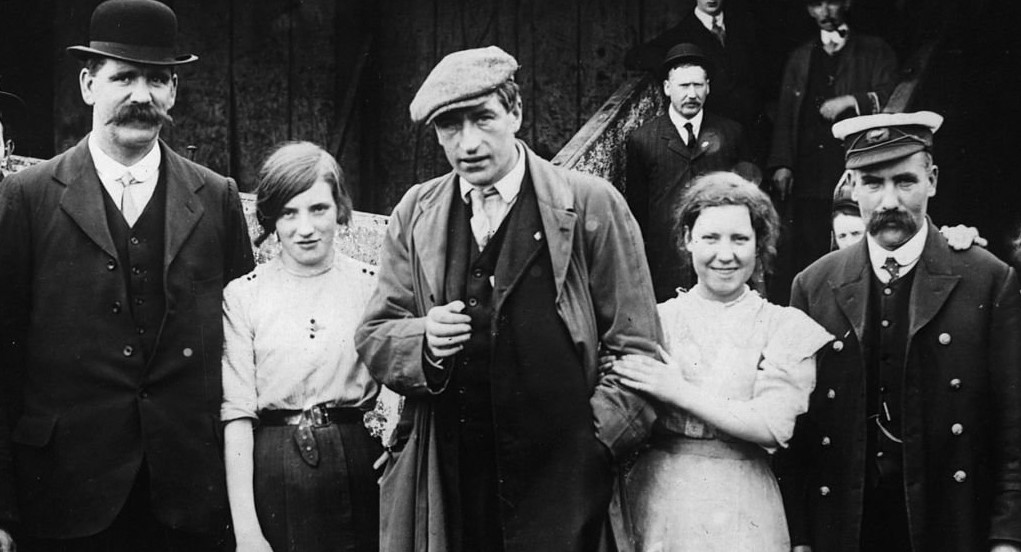
Among her many roles, Danish-born Caroline Nelson corresponded on the revolutionary European labor movement for the I.W.W. and left-Socialist press in the U.S. Here, she gives a sense of the electric charge that was Jim Larkin in 1913-14 for English-speaking radicals. When most of the Socialist movement was heading in one, opportunist, direction, Jim Larkin brilliantly emerged as a pole in another other, revolutionary, direction.
‘Fighting Jim Larkin Bucks England’s “Great Labor Leaders.”’ By Caroline Nelson from The Voice of the People. Vol. 3 No. 4. January 22, 1914.
Only those who have lived among the English working class can realize the peculiar conservatism that, underneath all its actions and declarations, keeps it, after all is said and done, where it is–the poorest working class in Europe, or at least one of the poorest. However, the Syndicalists have succeeded in driving a revolutionary wedge through this mass of conservatism, and it is this Syndicalist spirit that stirs the blood and cries out against the conservative leaders and shows up how they protect the capitalists, and stand in cahoots with them to keep peace.
A Trade Union Congress has recently been held in London where the general strike proposition was forced to the front on account of the Dublin strike and the Jim Larkin methods and tactics. Six hundred delegates were present, who represented three hundred organizations with two and a half million membership. These representatives were chiefly the leaders, and every one knew before hand the result of this gathering, viz, that the striking workers in Dublin should continue to be supported by money, but not by a general strike or sympathy strikes.
It is the workers’ pennies matched against the capitalists’ gold. We need not ask who will be victorious. The mass of organized workers are thereby forced to act as scabs to help break the Dublin strike, which they at the same time support with their money.
But it is a long road that has no turning, and this congress marked the turning point for England’s working class. There was a duel between the new and the old, in which the old won overwhelmingly, as it always does, at first.
The first motion before the congress was, that a new negotiation between the strikers and the bosses be sought, as the old one had stranded the day before without any result. Jones, secretary of the Gas Workers’ Union, added to this motion the following: That the Dublin capitalists should be informed that within a certain number of days all the organized transport workers on land and water would refuse to handle any goods going to or coming from the blockaded and lockout firms in Dublin, and that all other organized workers would give the Dublin strikers their moral and financial support; and, that the government should be requested to take away from the Dublin capitalists both military and police protection.” Jones explained that drastic measures were necessary to a quick ending of the strike.
Cotter, of Dockers’ Union; Williams, secretary of the Railway Union, and Shaw, representing the Textile Workers, fought Jones’ motion upon the ground that it would lead to a general strike, which would be a calamity! Davis, of the Chauffeur and Omnibus Union, thought that it was time that the leaders “left the easy life and began to do something by action.” Nayler, secretary of the Typographes, thought that the old leaders and their methods were fully twenty years behind the times. Smilie, secretary of the Miners’ Union, which is so large that the miners represented one-fourth of the congress, said that undoubtedly a national, general strike in England in the near future could not be avoided. But he held that the general strike question could not be decided in the congress, as it would have to be referred back to the membership by referendum vote.
The old leaders tore Larkin to pieces for his tactics and methods. He answered that he owed the old leaders nothing and that he was not responsible to them for his actions; that it was not they, but the rank and file, who had taken him out of prison. He jumped on Havelock Wilson of the Sailors’ Union because he had telegraphed to a crew of sailors, that intended to leave a boat in Dublin, “to remain and do their duty.” Larkin was informed that a motion was in the air to sweep him aside and to solve the strike problem without him. Larkin cried out “You may attempt it, but you will not so easily get rid of Larkin! We shall continue the strike in Dublin whether we get your money or not. We will not capitulate, either for the capitalists or for those who dare to explain that they will not overthrow this system.”‘ Larkin ended by crying out: “It is child’s play to win if you will only cease your organized, yellow strike breaking!”
It is a long time since, if ever, so courageous a voice was heard in England. Over two million votes cast against Jones motion, that only proposed to effectually and quickly bring the bosses to terms. Next we will hear is that the Dublin strikers have made terms with the bosses, and the grand opportunity for the workers to stand solidly together for a decided victory is passed for this time.
One could curse those leaders for their idiotic conservatism and grand stand play. But in reality they are only creatures of the workers social psychology in England as well as elsewhere. It is the outcome of slave philosophy, wherein and whereby the workers have placed the power in their hands, and thereby bound themselves hand and foot, even after they as workers on the economic field have learned that all the old tactics of fair play and consideration for the boss only lands them deeper in the mire of poverty and helplessness.
The Syndicalists are still boring from within in England, and are doing some good work evidently. But the time will undoubtedly come, as in other countries, when they will have to form an organization that is unhampered by such conservative folly as we now witness regarding the Dublin strike.
Larkin is not, a man that can easily be tamed. A man that in a convention can fling defiance in the teeth of the mighty is made of the right stuff. He is not defeated nor the cause that he represents. It will grow from now on by leaps and bounds, and the prophet that is out telling us that Syndicalism will never grow, don’t know what he is talking about, and nine times to one he has his weather eye to the old organization that for the time being it is to his interest to curry favor with. This prophet gets up all sorts of lies about Syndicalism. He tells us that the Syndicalist congress only had ten countries represented, while the old international labor congress had twenty-five countries represented. The truth is that at the international congress of Syndicalists there were fourteen countries, and at the old, reformists international there were seventeen. The most enthusiasm was manifested at the old when the delegates voted to hold their next congress in San Francisco in 1915 on account of the world’s fair. The greatest enthusiasm in the Syndicalist congress was made over the starting of a new and permanent International, that has for its object the overthrow of this damn system, that is the difference.
The Voice of the People continued The Lumberjack. The Lumberjack began in January 1913 as the weekly voice of the Brotherhood of Timber Workers strike in Merryville, Louisiana. Published by the Southern District of the National Industrial Union of Forest and Lumber Workers, affiliated with the Industrial Workers of the World, the weekly paper was edited by Covington Hall of the Socialist Party in New Orleans. In July, 1913 the name was changed to Voice of the People and the printing home briefly moved to Portland, Oregon. It ran until late 1914.
PDF of full issue: https://www.marxists.org/history/usa/pubs/lumberjack/140122-voiceofthepeople-v3n04w55.pdf
 Revolution's Newsstand