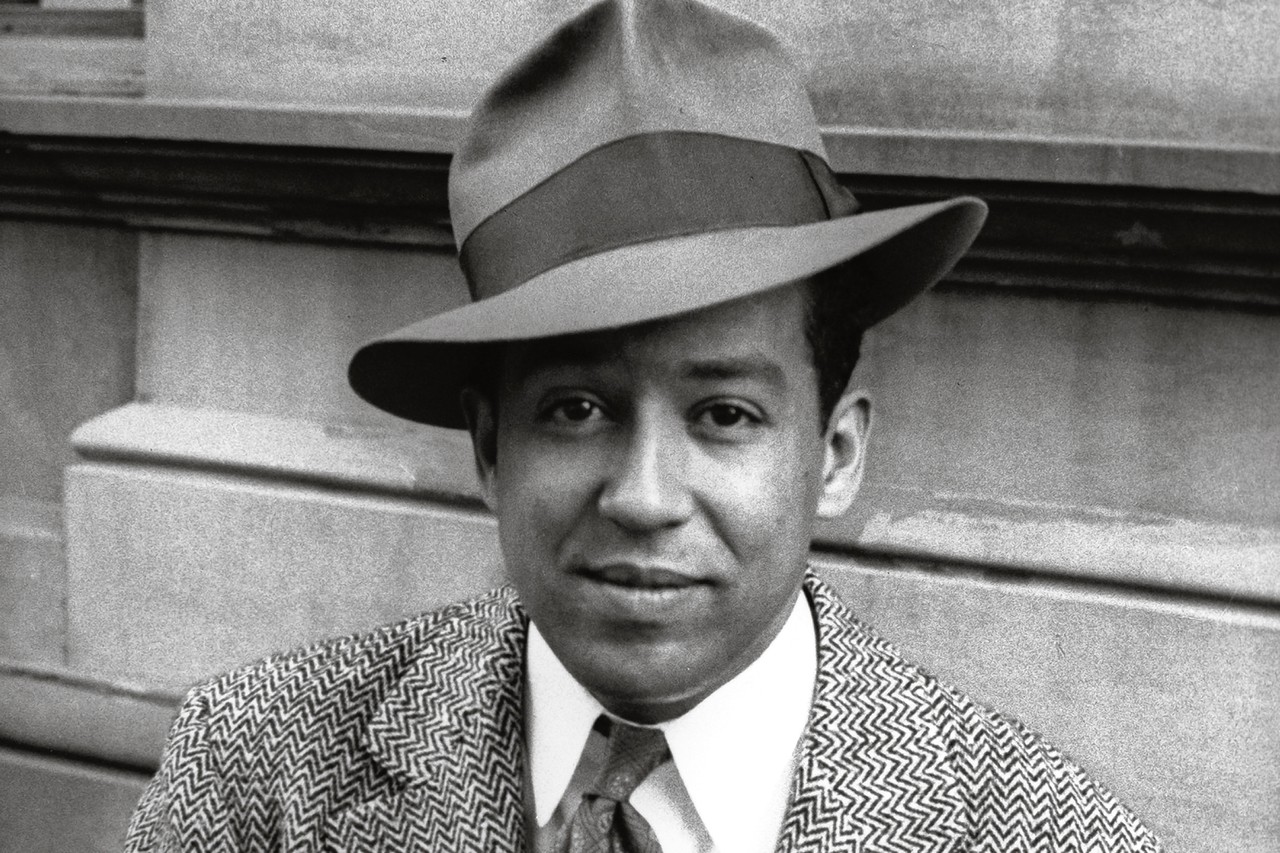
In 1923 a 21-year-old Langston Hughes got a job on the crew of the S.S. Malone traveling to West Africa and eventually to Europe in what would be a defining trip of his young life.
‘Ships, Sea, and Africa: Random Impressions of a Sailor on His First Trip Down the West Coast of the Motherland’ by Langston Hughes from The Crisis. Vol. 27 No. 2. December, 1923.
I. SENEGAL TO THE CONGO
THE East River…The Battery half veiled in fog..The Statue of Liberty dim to starboard as our ship glides past headed for the open sea…Sandy Hook…Grey green water…Darkness…In the lighted fo’c’sle sailors unpack sea-bags…We are off for five months to Africa.
—-
Long days of sea and sun…The last of June the mountains of the Azores float on the sky-line…High volcanic islands rise sharply from the water…We anchor in the harbor of Horta, a picture-book town…Houses painted like toy Noah’s arks, palm trees, nuns in flaring bonnets, oxen pulling wooden-wheeled carts, scores of brown-white children begging for cigarettes and pennies.
—-
We unload all night…The winches rattle, bags of wheat rise in the air, swing over and out, drop down into the harbor boats…At dawn we sail.
—-
The Canary Islands…Teneriffe…Las Palmas, a breath of Spain in a city of palms.
—-
Tomorrow,—Dakar…The Motherland.
—-
Dawn…The coast of Africa, long, low, bare and rocky, backed by a curtain of light and then a red sun that rises like a ball of fire.
—-
The port of Dakar, Senegal…The wharf crowded with black Muhammedans in billowing robes…The strange costumes seen…The thermometer at ninety…Women in scant clothes…Little naked children…The fierce sun.
—-
Portuguese Bissao, lost in a maze of islands…The old Negro pilot who guides our ship…The wild, fierce boatmen who take the mail-bag.
—-
Conakry from the sea…Groves aflame with vermilion flowers…White houses hidden in trees and foliage.
—-
Freetown…The hills of Sierra Leone…The fine young Negro policemen and harbor officials…Rain, all day rain.
—-
The Ivory Coast…The Gold Coast…Towns with strange names,—Grand Bassam, Assinie, Accra, Lome, Cotonou…No harbors, the ship anchors in the sea…A sand-white, perfectly straight coast-line…Towns hidden in deep cocoanut groves…The soft boom of the surf on the beach.
—-
The lagoon behind Grand Bassam…Streets shaded with palm and almond trees…French cafés…Clean, delightful natives.
—-
Secondee…The market flashing with colors, the piles of fruit, the dark girls in bright bandannas, gay strips of cloth twined about their bodies…The African princesses with gold coins in their hair.
—-
The roar of the surf at Assinie…Always the surf…The surf boats with their crew of eight black naked paddlers, their superbly muscled bodies, damp with seaspray, glistening in the sunshine.
—-
Lagos, a fascinating, half-oriental town…Indian bazaars…Muhammedan traders…Goats, dogs, pigs in the streets…Life, movement, crowds, dashing horses, rich Negroes driving expensive cars, a harbor full of ships…Seven days in port…Shore leave and money for the crew whose pounds, like Villon’s francs, go “tous aux tavernes et aux filles”.
II THE DELTA OF THE NIGER.
PORT HARCOURT up a jungle-walled river…Ostriches walking in the streets…The small, stark naked canebearer following his master…The datepalms…The boy with the bananas…The little black girls with henna-dyed nails and bare feet…The one with the Peruvian gold which she displays so proudly and guards so jealously…The monkeys…The young boy from the customs, brown with dreams in his eyes…“America, is it a wonderful place?”…The policeman whose salary is four pounds a month…Rain, swift, cool rain.
—-
Calabar among the hills…The descent of the Bonny River in the late afternoon, the steamer keeping near to the left bank.
—-
Impassable forests on either side…Swampland of snakes and monkeys…Yellow leaves like hidden stars…Smoldering crimson blossoms…The slender canoes of the wood-cutters…The palm-like bushes…Sunset…The river, broken by islands, dividing into vast alleyways of water…The little boats lost in twilight—a twilight of violet merging to purple dusk…The islands hidden in darkness…The impossibility of reaching the open sea…We drop anchor for the night.
—-
With pious homage to Father Neptune, we cross the Equator, the young sailors, according to ancient custom, being properly doused and shaved…At night we run through a sea aglow with phosphorescent fire…A million fallen stars foam in the wake of the ship and streaks of light move where fish swim near the surface.
—-
Banana, the point of land that stretches into the sea at the mouth of the Congo…Sailors’ chanteys on deck—
“They sailed us down the Congo River,
Blow, boy, boys! Blow!”
The ninety mile ascent to Boma and Matadi…Forests, but not so thick or tropical as those of the Niger…Then wide, arid plains, parched palms, dry yellow grass…Boma…The fiver narrows, runs swiftly between high hills, fantastic, bare…A strong and dangerous current…A sudden, broad, cafion-like curve and the white houses of Matadi rise before us…A town of hills…A busy wharf piled with drums of palm oil…Native villages scattered about, each on its own highland…Streets bordered by mango trees…The dirtiest, saddest lot of Negro workers seen in Africa…Black soldiers with bayoneted guns pacing the docks…Evening…The copper-gold of the Congo sunset…Bluegreen twilight…The hot, heavy African night studded with stars.
The Crisis A Record of the Darker Races was founded by W. E. B. Du Bois in 1910 as the magazine of the newly formed National Association for the Advancement of Colored People. By the end of the decade circulation had reached 100,000. The Crisis’s hosted writers such as William Stanley Braithwaite, Charles Chesnutt, Countee Cullen, Alice Dunbar-Nelson, Angelina W. Grimke, Langston Hughes, Georgia Douglas Johnson, James Weldon Johnson, Alain Locke, Arthur Schomburg, Jean Toomer, and Walter White.
PDF of full issue: https://archive.org/download/sim_crisis_1923-12_27_2/sim_crisis_1923-12_27_2.pdf
 Revolution's Newsstand