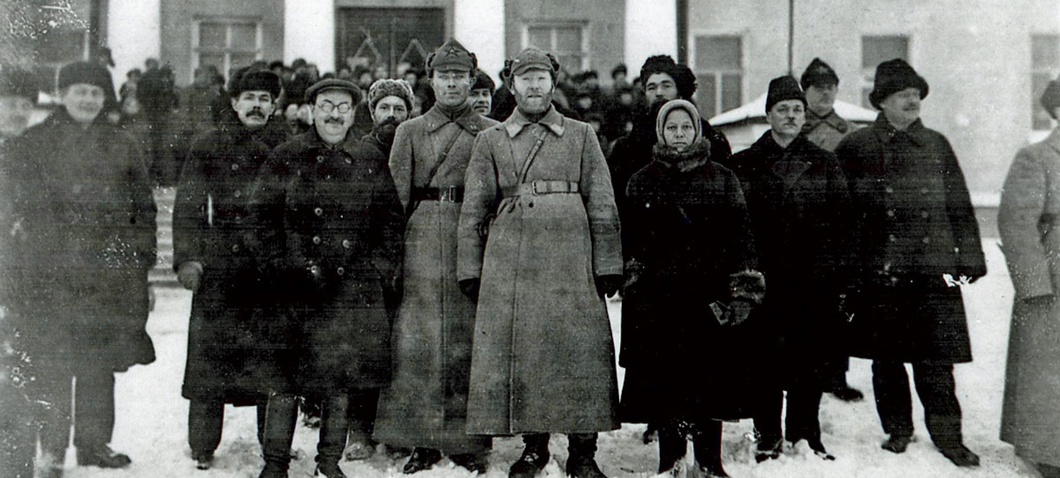
The sparsely populated, Finnish speaking Karelian Workers Commune established in 1920 (or 1918 depending), held its first Soviet congress in 1921 as reported below by a Norwegian friendly delegate. The Karelian Commune was almost entirely autonomous from Soviet Russia until 1923 when it became the Karelian Autonomous Soviet Socialist Republic of the U.S.S.R.
‘The New Soviet Republic’ by Haavard Langseth from Soviet Russia (New York). Vol. 4 No. 17. April 23, 1921.
(A report of the First Soviet Congress of the Karelian Workers’ Commune, held Feb. 10-18, 1921. Karelia lies to the east of Finland, and its population is ethnically and linguistically similar to that of Finland and Esthonia.)
New Organization of the Country
Very few people in Western Europe have paid any attention to the fact that present day Russia is a federated state, consisting of a number of united republics, each of which constitutes within its own boundaries a unified whole, both with regard to the nationality of its population and its specific economic situation. This is expressed in the name of the new federation, which is: Russian Socialist Federative Soviet Republic, usually abbreviated R.S.F.S.R., accompanied by the symbol of the hammer and the sickle. One of the social units belonging to this union of states is the little Karelian Workers’ Commune. Like every one of the Soviet Republics that have been thus joined together, it holds its Soviet Congress once every six months, in which representatives of all the Workers’, Peasants’ and Soldiers’ Soviets of all the districts meet for a discussion of all the more important political and economic questions, and for the election of an Executive Committee and Presidium of the latter. The Executive Committee supervises the political life in accordance with the principles adopted at the Congress, and is responsible to the next Congress. The Presidium of the Executive Committee is, so to speak, its working unit.
The Economic Council, with its own Presidium, similarly conducts the economic life of the country. The Karelian Workers’ Commune was founded in August last year; an event that has already been reported in SOVIET RUSSIA. Up to the present a revolutionary committee had been in control of the political life, which was understood to be altogether a temporary arrangement. At the head of this committee was, as is well known, the Finnish Comrade Edvard Gylling. The first Soviet Congress of the Workers’ Commune had invited representatives of the Scandinavian parties attached to the Third International. It was quite a large company that left Moscow and traveled by way of Petrograd and the Murman railway to Petrozavodsk, the capital of Karelia. Besides representatives of the Danish, Swedish, and Norwegian parties (the author represented the Norwegian party), there were also representatives of the Finnish emigrants in Petrograd and the People’s Commissariat for Nationalities, of the Russian Soviet Republic. The latter was represented by Comrade Klinger, who had been earlier associated with the Third International, and who is probably well-known to most of the Communists who visited Moscow. Kilbom represented the Swedish party. In the sharp winter cold, and in view of the difficult transportation situation in Russia at the time, the journey was anything but a pleasure trip, but our spirits were maintained nonetheless by the songs and cheerfulness of our Finnish comrades. Particularly Ussenius, and Rovio contributed splendidly to this end, not to mention our well-known Dano-Norwegian Robert Nilsen, from Bergen, who also gave evidence of his temperamental humor.
The Delegates to the Congress
The Congress was already in its second session when we arrived. The sessions were being held in the banquet hall of what was formerly the Governor’s Palace. The apartment was splendidly decorated for the occasion. Our attention was involuntarily directed to two gigantic urns either side of the platform, which were of a wonderfully tinted reddish-brown Karelian marble. It was an extremely interesting gathering that had come together here. It consisted of 145 deputies from all parts of Karelia. As the country is decidedly of peasant character, it was natural that the majority of the faces present were of the somewhat heavy, profoundly serious peasant type. Here were people from the sources of the Kemi and Kovda rivers, peasants in whose families Kalevala, the famous Finnish national epic, had been handed down for centuries by oral tradition from father to son, and thus saved from oblivion. Here were people who had been wont in the deep primeval forests to stand face to face with the bear. Here were Lapps from the great snowy wastes, and fishers from the White Sea coast, industrial workers from the saw-mills that once had belonged to English or Scandinavian capitalists, from the great cannon-foundries that had been in operation when the Tsar was in power; all now came hither as liberated men to discuss for themselves their common interests in their free homeland. It was a delight to see how immense was the faith in the Soviet system and in the present political leadership, shown by these simple peasants and workers. This faith put its mark upon the entire course of the proceedings. We also noticed clearly the unmixed joy in this gathering at the fact that the Scandinavian brother workers were showing their interest in the young Republic by sending representatives to this Congress, as well as their desire for an early understanding and cooperation.
From a purely political standpoint the composition of the gathering was as follows: of the 145 participants, 100 had the right to vote. Of these 100, there were 45 Communists and 55 Non-Partisans. The proceedings were conducted by a Presidium of five men, of which three were Communists and two Non-Partisans. Both the election of the Presidium, as well as the fact that practically all the propositions put forth by the Communist fraction were later adopted with slight alterations, bear witness to the great confidence of the people in the policies of the Communist party. And they will not be deceived this time, these plain forest and peasant people, who now after almost seven years of war and blockade hunger and privation, are setting forth toward a new peaceful and happy future under the leadership of this party.
Business Transacted at the Sessions
The order of the day of the Congress was very extensive, and included matters of the greatest importance. First the political situation was reported and discussed; then came a report from the deputies of Karelia to the Eighth All-Russian Soviet Congress. Then Gylling in an address lasting several hours outlined the fundamental principles in the establishment of the Karelian Workers’ Commune and sketched the guidinglines for its future tasks, as well as narrated the activity of the Revolutionary Committee. The representatives gave a report on the conditions in the districts. Later, as a sort of main issue, accompanied by many minor issues, came the report from the Economic Council concerning its past activities and future plans (also by Gylling); by the various sections of the economic council there were presented detailed reports, such as those of the section for popular instruction, the department of health, inspection by workers and peasants, etc. Finally came a report of the military situation, the election of a new Executive Committee to succeed the provisional revolutionary committee and a new economic council. In all, in the course of a little more than a week, 18 important items on the order of the day were discussed. Everyone had time to express his opinions fully. In connection with number of items there were very lively debates. It was particularly the Mensheviki who attracted attention to themselves. They always spoke as “Non-Partisans” and thought in this way to win over the real Non-Partisans. But in the able and thorough discussion of these matters they were always finally unable to answer. And the support they had gained was thus always lost. But the free and often very heated debate conducted on these matters was for us a new proof of how shameless a lie it was for the capitalist press in our country and in other countries to say that in Russia all expression of the opposition is forbidden.
Gylling’s election as chairman of the new Presidium of the Executive Committee aroused general satisfaction, and his able and self-sacrificing work on the Revolutionary Committee was rewarded with a well deserved vote of confidence.
Recreation and Instruction
Several celebrations were arranged for those who took part in the Congress. Thus the City Theatre presented a musical-dramatic evening, in which the Finnish Teachers’ Seminary had its students play among other things the well-known Norwegian operetta “Til Saeters,” while the Russian Teachers’ Seminary gave us an unforgettable festive evening with music and splendid tableaus executed by its pupils. We visited also the city Museum, with collections of historical, geographical, botanical, zoological and geological material. Particularly interesting was a great collection of old church utensils as well as another of minerals, including a specimen of every type of marble occurring in Karelia, at least 40 different colors and qualities. After having lived as guests in Karelia for a week, we again departed southward, taking with us the heartiest greetings of the Scandinavian brother workers and expressing on our departure the warmest wishes for the future of a Communist society of this newly liberated workers’ commune.
Soviet Russia began in the summer of 1919, published by the Bureau of Information of Soviet Russia and replaced The Weekly Bulletin of the Bureau of Information of Soviet Russia. In lieu of an Embassy the Russian Soviet Government Bureau was the official voice of the Soviets in the US. Soviet Russia was published as the official organ of the RSGB until February 1922 when Soviet Russia became to the official organ of The Friends of Soviet Russia, becoming Soviet Russia Pictorial in 1923. There is no better US-published source for information on the Soviet state at this time, and includes official statements, articles by prominent Bolsheviks, data on the Soviet economy, weekly reports on the wars for survival the Soviets were engaged in, as well as efforts to in the US to lift the blockade and begin trade with the emerging Soviet Union.
PDF of full issue: https://www.marxists.org/history/usa/pubs/srp/v4-5-soviet-russia%20Jan-Dec%201921.pdf
 Revolution's Newsstand