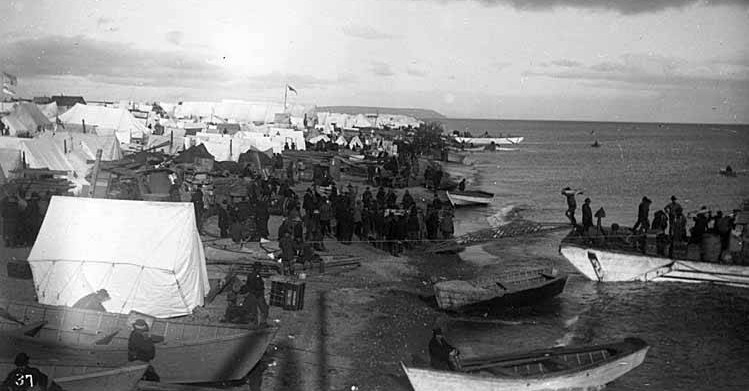
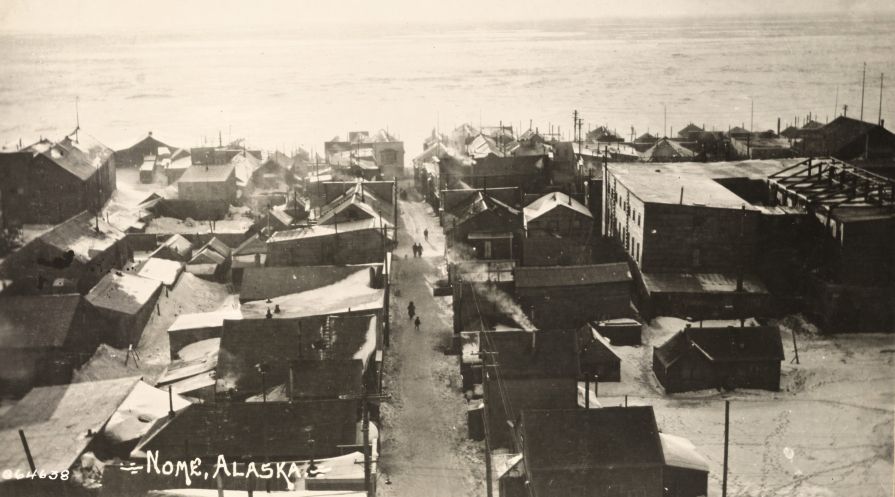
An early I.W.W. strike on shipping in far-north Nome, Alaska lead to two wobblies doing time at McNeil Island Federal Penitentiary.
‘An Alaskan Strike’ by Rex from Industrial Union Bulletin. Vol. 1 No. 9. April 27, 1907.
I.
In the spring of 1905, the Federal Labor Union of Nome, Alaska, became engaged in a strike. This strike was a good example to the working class of the solidarity of class-conscious union men. The above union, now a part of the Industrial Workers of the World, was composed principally of longshoremen. The shipping season at Nome, lasts only about four months. Owing to the fact that the Behring sea is very shallow along shore, the loading and unloading of vessels has to be done on lighters. The Lighterage company wanted two men only to work on a lighter, while the union demanded four. This was the only question at issue and was the cause of 900 men going on strike. The strike was an orderly and well-conducted one, from start to finish.
After the men had been out about two months, the Lighterage company realized that they were up against the real thing. They had tried with very little success to hire scabs. They got a few “boosters” and gamblers to go to work, but owing to their inexperience, they could move a very small amount of cargo. Some of the scows and freight capsized. The ordinary wages were $1 per hour, but the scabs were paid $5 per hour.
At this stage of the game the ship-owners saw that some desperate means had to be resorted to in order to get the men back to work. A so-called “riot” was the next move. A man called Harris Bell, alias “Baldy” Hart, who had done a long “stretch” in the Salem, Oregon state prison, claimed that two union men attacked him while he was out in a boat, hit him with oars and tried to drown him. That was the substance of his perjured evidence. The two men were tried, found guilty of the “crime” and sentenced to three years and three months at McNeill’s Island Federal prison. After serving seventeen months, they have just been released through the efforts of the Western Federation of Miners, and the Sailors’ Union of the Pacific.
The indictment was not signed by the grand jury, as it should have been but only by the prosecuting attorney. The San Francisco Circuit Court of Appeals decided that as they had been charged with a misdemeanor and had been sentenced for a crime, they should be set at liberty.
II.
The strike still continued, however, and not till late in the season, when the shipowners feared that the vessels would be frozen in, did they give in, and grant the conditions asked for. Twenty-seven vessels were practically tied up all summer. The strikers had no desertions from their ranks, although some of them were obliged to live on one meal per day.
The two men, found guilty, on the evidence of a man who had been caught in the act of robbing a loon and gambling joint in Portland, Oregon, were “railroaded” to the pen as related.
They were sent to the prison on the first available boat. While on the trip they were treated alright as they had many former shipmates aboard. Not till they reached the “pen” did their troubles commence. They were forced to work every day, Sundays and holidays included, except July 4th. One of the men was compelled to work while suffering intense physical pain. He wished to have medical treatment, which the doctor was willing to give, but the Warden would not allow. Finally he was operated on by two doctors by paying $25 for it.
A boy of 18 years of age was tied up for some infraction of the rules, with his feet barely touching the floor and was kept that way for six days. This was done on two occasions, while he only got one small slice of bread to eat daily.
Another prisoner, while out at work, was fired at by a guard and shot through the hand without any apparent reason. This man has since been transferred to Leavenworth prison, crippled for life. The guard was laid off a few days, and then reinstated.
The toilet is situated right next the dining table and is very insanitary. The food at present is fair, but at times it has been unfit to eat. On one occasion, when a prisoner complained about the food, producing a hamburg steak that was decaying, before the doctor, the official fired three or four cooks. The doctor at that time was a humane man, but he has been succeeded by one who is more severe.
Two molasses barrels do duty for bathtubs, and they are covered with grease and dirt on the insides.
Once a year, the United States Inspectors come around to make a tour of the prison yard, but they never see the inside of the institution. For weeks before they come the prisoners are busy. whitewashing, scraping and polishing. The official whitewash takes place later. Although the prisoners are supposed to get suspenders, toilet soap and postage stamps according to prison rules: they get none of these unless they “dig up” for them.
The cells are 6 by 6 feet in size. Into these cells are crowded two and sometimes three men. The prisoners work at farming, cleaning land and boat building. Like every other institution under capitalism, the prison system is run for graft and profit. The working class must be exploited, even if it be necessary to throw them into prison to do so.
The two I.W.W. men whose story is related here appear broken down in health from their brutal treatment, but like the men they are, they intend to return to Nome soon, knowing that they are innocent of any crime. It is to be hoped they will be more determined than ever to fight, if necessary, for the ushering in of the Co-operative Commonwealth.
Workingmen of all countries, unite: you have nothing to lose but your chains; you have a world to gain.
The Industrial Union Bulletin, and the Industrial Worker were newspapers published by the Industrial Workers of the World (IWW) from 1907 until 1913. First printed in Joliet, Illinois, IUB incorporated The Voice of Labor, the newspaper of the American Labor Union which had joined the IWW, and another IWW affiliate, International Metal Worker.The Trautmann-DeLeon faction issued its weekly from March 1907. Soon after, De Leon would be expelled and Trautmann would continue IUB until March 1909. It was edited by A. S. Edwards. 1909, production moved to Spokane, Washington and became The Industrial Worker, “the voice of revolutionary industrial unionism.”
PDF of full issue: https://www.marxists.org/history/usa/pubs/industrialworker/iub/v1n09-apr-27-1907-iub.pdf
 Revolution's Newsstand