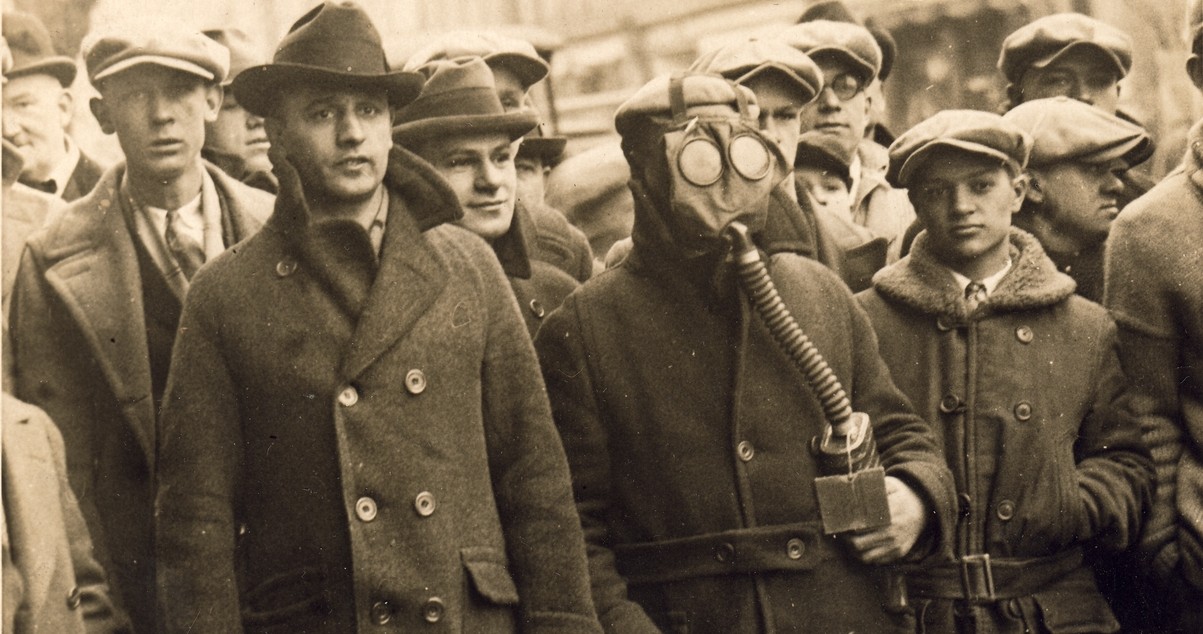
A look at the make-up and effects of tear gas, with advice on front-line first-aid.
‘Tear Gas for Pickets—What to do When Gassed’ from Health and Hygiene. Vol. 5 No. 1. January 1937.
Medical studies of the effects of this weapon against labor indicate that it can cause blindness, contrary to the claims of its manufacturers. Valuable advice to pickets on emergency treatment.
THE recent LaFollette Committee congressional investigation into the status of civil liberties in and around large industrial plants has shed additional light upon the already well-known attitudes of our larger industrialists towards the basic constitutional rights of their employees.
Document upon document has been presented to this committee, revealing that the steel, auto, and rubber industries are ridden with spies; that barbed wire is considered a part of the natural scenery surrounding the plants; that thugs are transported across state lines with regularity at the first sign of protest from workers; that intimidation, coercion, and violence are the rule of the day wherever attempts are made in the direction of unionization.
Not the least important of the findings of this congressional committee is the disclosure of a boom in the business of such companies as the Federal Laboratories of Pittsburgh. These companies specialize in supplying industrialists with the tear gas, with the vomit gas, and other similar poison gases which have become, in recent years, an indispensable part of the apparatus for breaking strikes.
We will not enter into a discussion of the illegal use of these poison gases against peaceful pickets exercising their constitutional rights. What concerns us here is the truth of the statements appearing in the advertising matter of the manufacturers of tear gas, as well as of the press comments of the industrialists who use it on their striking employees. Both stress the utter harmlessness of the gas.
Reading the descriptive folder which accompanies each tear gas shell makes one feel that this wonderful gas merely has the effect of soothing angry men, of turning them homeward, their passions dissolved in innocuous tears. It is enough to have heard the anguished cries of men and women reeling blindly under a barrage of tear gas, to know that this substance is not as harmless as these gentlemen would have us believe.
Tear gas, chemically known as chloracetophenone, was used extensively during the World War in the early days of gas warfare. When shells loaded with this substance landed in a trench, the occupants were immediately forced to evacuate. However, since the gas did not kill, it was found necessary to perfect deadlier gases and fumes such as phosgene and mustard gas. In the development of new and deadlier gases, tear gas was lost in the shuffle.
However, it was not to be discarded for long. Its use was soon revived by those ingenious industrialists who are ever on the lookout for instruments to aid in the “peaceful” settlement of industrial disputes.
AN analysis of the effects of tear gas on the human eye and skin was recently published by Dr. William D. McNally in the Journal of the American Medical Association (Vol. 98 p. 45, 1932). Dr. McNally’s cases of tear gas poisoning did not include any instance of burns acquired on the picket line. The patients whom he treated received their tear-gas ordeal in an unusual manner. During a wave of hold-ups in Chicago some years ago, it was decided to arm shopkeepers with small, specially constructed fountain pens filled with tear gas, as an aid in routing gangsters. Three curious young people, ignorant of the contents of the harmless looking fountain pens, suffered severe burns of the eyes and face when they discharged the contents of the pen into the air about them.
These patients presented themselves for treatment very soon after the accident, and it was only because of the early treatment that blindness and other serious complications were prevented. Working men on the picket line are not generally so fortunate in regard to prompt medical attention.
The patients complained of agonizing burning pain in the eyes, and on the cheeks and forehead. The skin irritation was intense, and marked by large blisters. The eyes could not be opened voluntarily and the lids were swollen and discolored. It was only with special instruments that the lids could be pried apart and the insides of the eyes examined. The eyeballs were blood-red in color, and a continuous and uncontrollable stream of tears were poured out. The delicate membranes covering the eyeballs and the insides of the lids were seared and had lost their glistening transparent quality. Of course, the patients were rendered temporarily blind. It was only with constant careful attention and treatment with special eyewashes and drops that permanent blindness was prevented. Blindness lasted for a week or more, and the eye condition did not return to normal for more than one month. The burned skin of the face and forehead required its own special treatment.
Since tear gas is being used with increasing frequency in industrial disputes, HEALTH AND HYGIENE feels that tear gas must be added to the list of industrial poisons, a list which is already far too long. An outline of the emergency treatment of tear-gas poisoning will perhaps serve to lessen the damage inflicted upon the eyes and skin of affected workers.
As the first step in emergency treatment, the gassed worker should get to the nearest source of tap water as soon as possible, avoiding, on the way, any rubbing of the eyes. The eyes and skin should be thoroughly bathed with the tap water, and this should be followed by instilling a solution of the following formula into the eyes with a dropper: 0.4 per cent sodium sulphite dissolved in glycerin 75 per cent and water 25 per cent. The bottle should be clearly marked: Eye solution for treatment of tear gas burns.
For the burns on the skin another solution should be applied. This consists of 4 per cent sodium sulphite dissolved in 50 per cent alcohol. This bottle should be clearly marked: Skin solution for treatment of skin burns by tear gas.
It would be advisable for picket captains to have these solutions on hand whenever tear gas has been or may be used against the pickets.
If these solutions are not on hand when needed, then repeated washings of the eyes and skin with plain water is of aid. It must be stressed, however, that this is merely emergency treatment. The care of the burns is a delicate matter, and treatment should be left to a physician, who should be consulted immediately. The solutions described above have no value in preventing tear-gas burns.
True prevention of tear-gas poisoning can come only when its barbaric use by employers and the National Guard against peaceful pickets has been outlawed. Strong, progressive unions, united in a Farmer-Labor Party, could send enough representatives to Congress to force legislation making the manufacture, distribution, or use of this poison gas a crime. Today, the worker not only needs his eyes, but needs to keep them wide open.
Health was the precursor to Health and Hygiene and the creation of Dr. Paul Luttinger. Only three issues were published before Health and Hygiene was published monthly under the direction of the Communist Party USA’s ‘Daily Worker Medical Advisory Board Panel’ in New York City between 1934 and 1939. An invaluable resource for those interested in the history history of medicine, occupational health and safety, advertising, socialized health, etc.
PDF of full issue: https://www.marxists.org/history/usa/pubs/health/v5n1-jan-1937-health-hygiene-n.pdf
 Revolution's Newsstand