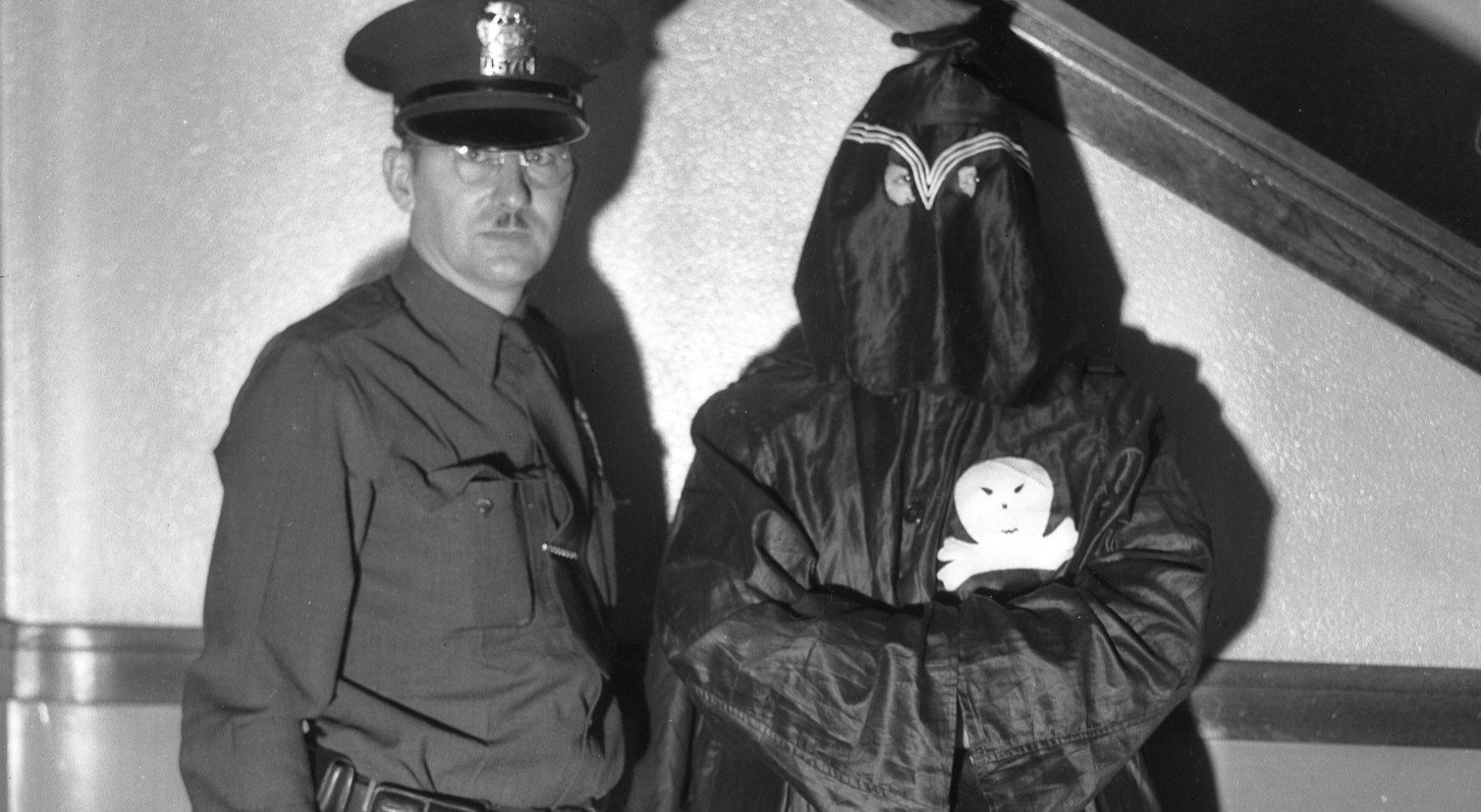
Part of John L. Spivak’s 1936 series on U.S. fascist organizations, this article looks behind the masks of the Black Legion, which terrorized Michigan in the mid-1930s, and finds–surprise–many of that state’s leading and most ‘respectable’ citizens.
‘Who Backs the Black Legion?’ by John L. Spivak from New Masses. Vol. 19 No. 11. June 19, 1936.
DETROIT. Not two weeks ago, but in August, 1935, the state of Michigan and industrial centers like Pontiac and Flint, learned of the existence of a secret terroristic organization known as the Black Legion. The matter was somehow promptly hushed up and forgotten. In Detroit, at about the same time, a prominent politician, in the course of an argument with Mayor Couzens, casually took a bullet from a vest pocket and flipped it in the air. It was the secret sign of the Bullet Club of Pontiac, more popularly known as the Black Legion. The politician was trying to find out if the Mayor was a member. The Mayor ignored it and the incident was forgotten.
On the night of May 12, 1936, some fifty members of the Wolverine Republican League met in Findlater Temple in Detroit, a favorite meeting hall of the Ku Klux Klan some five or six years ago. In the smoke-filled room the group, presided over by Harvey Davis, an employe of the Public Lighting Commission, decided to give Charles A. Poole, a young W.P.A. worker, “a neck-tie party” because he knew too much about the secret organization, and the morning of May 13 Poole’s body was found with five .45 caliber, slugs in it.
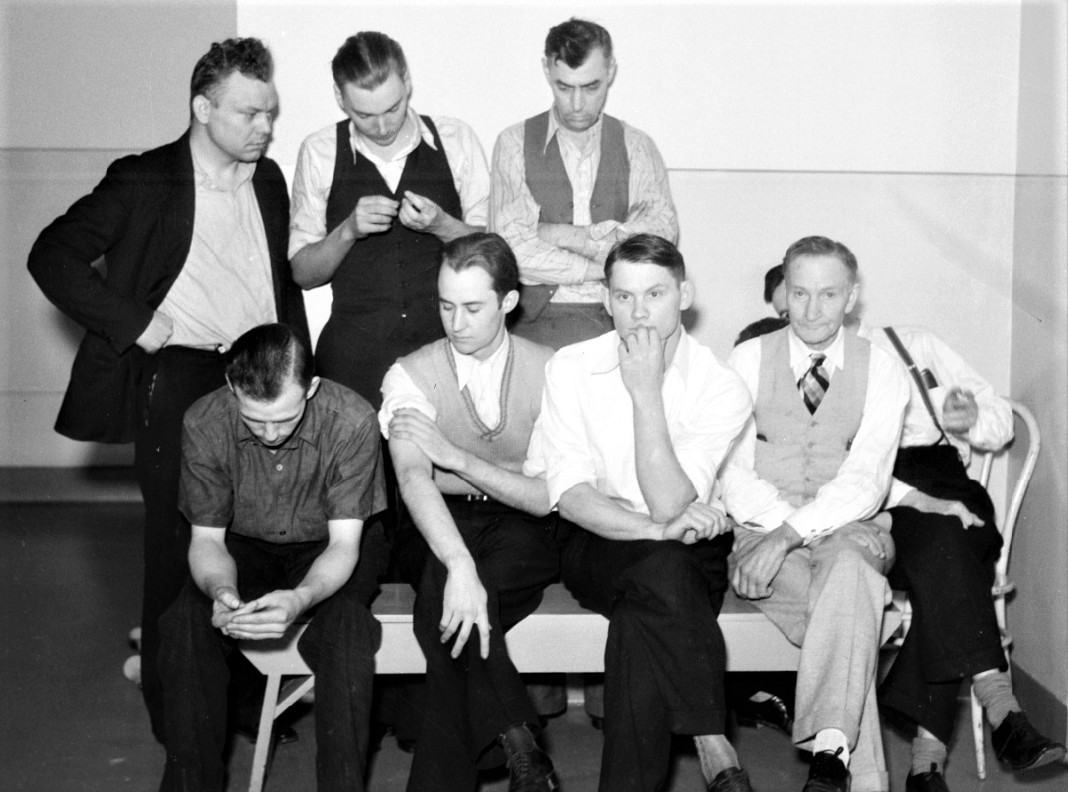
Within a few days after this murder fifteen men were under arrest in connection with it, warrants were out for ten more and the fourth largest city in the United States awoke to find it had a secret terroristic organization in its midst, an organization with members in high places and that Dayton Dean, an electrician also employed by the Public Lighting Commission and a member of the Wolverine Republican League, had cheerfully admitted pumping the lead into Poole when the “necktie party” tired of waiting for the rope which failed to arrive. A furious press and citizenry demanded the end of the organization, and politicians, nervous because they did not know who would be named next, rushed into print with statements denouncing the organization and insisting upon a probe to the very roots, and assuring the people that now the “back of the Black Legion has been broken.” Whether this is so or not remains to be seen. Most observers feel that the ramifications are only dimly being realized.
The story of the Black Legion, by now publicized the world over, is one of the most fantastic in American history. That the arrest of those already in jail has only scratched the surface of a complicated terroristic political organization, is now generally admitted by Michigan state officials, all of whom have the jitters as to who the real heads are and what its real motive is.
The outstanding facts so far brought out in the amazing disclosures show
1. Members of the Black Legion murdered Poole.
2. Fifteen men have been arrested in connection with it and warrants are out for ten others.
3. Other mysterious deaths, floggings, bombings and arson are attributed to the Black Legion.
4. Its members, despite all assurances that they will be protected, are in mortal terror of the Legion’s vengeance and are fearful of speaking.
5. The Black Legion sought members particularly in public office, especially among those who were armed like policemen and prison guards and if not armed, were instructed to buy arms.
6. Black Legion members have been found in high political office.
7. The terroristic organization was used as a political machine, controlling several cities.
8. The state of Michigan knew of the terroristic organization in the summer of 1935 and hushed it up.
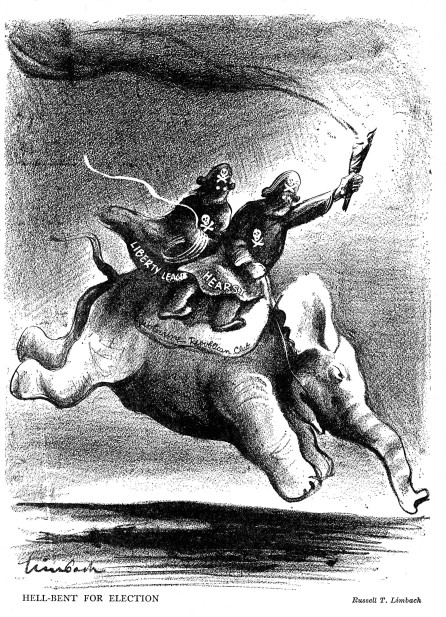
9. The leaders so far disclosed are members of the Wolverine Republican League.
10. The decision to kill Poole was made at a meeting of the secret terroristic group masquerading as the Wolverine Republican League.
The long, blood-curdling oath which every member took while kneeling at the feet of his sponsor (who held a loaded pistol to the supplicant’s heart), was for a peculiar 100-percent Americanism and swore, among other things:
“In the name of God and the devil, one to re- ward, the other to punish, and by the Powers of Light and Darkness, Good and Evil, here under the Black Arch of Heaven’s Avenging Symbol, I pledge and consecrate my heart, my brain, my body and my limbs, and swear by all the Powers of Heaven and Hell, to devote my life to the obedience of my superiors, and that no danger or peril shall deter me from executing their orders.
“That I will exert every possible means in my power for the extermination of the Anarchist, Communist, the Roman Hierarchy and their abettors.
“I will show no mercy, but strike with an avenging arm as long as breath remains.
“I further pledge my heart, my brain, my body and my limbs, never to betray a comrade; that I will submit to all the tortures mankind can inflict, and suffer the most horrible death, rather than reveal a single word of this my oath.”
In the midst of the furor aroused by confessions of men arrested and the disclosures that the Black Legion extended into official places, including the police, Duncan McCrea, Detroit’s prosecutor, announced that he intended to probe this mysterious organization until he got to its roots and prosecute to the utmost all those guilty in any way.
Just about the time everybody looked at McCrea hopefully as the savior, The Detroit Times, a Hearst paper which had been gunning for the prosecutor, published an application card to the Black Legion, signed by the prosecutor himself on Dec. 29, 1934. McCrea did not deny his signature, he merely said that he may have signed it because he was in the heat of a campaign and was joining anything. McCrea was not re- moved from his office as prosecutor as a result of this fresh disclosure, but Attorney General Crowley stepped in and suggested that both of them handle the case. In Lansing it is generally known that all state officials are jittery as to who is a member and who is not, and it is thought that the Attorney General’s presence would ease their minds.
Though McCrea denied knowing that he had joined the Black Legion, the sponsor is one Ira E. Albright of Detroit who used to be an investigator in McCrea’s office. McCrea fired him some time ago.
In McCrea’s office today is another investigator, former member of the Klan. named Charles Spare. On March 22, 1935, Spare sent out an anti-Catholic letter. This is known to McCrea who ignores it.
The Black Legion has state-wide ramifications with a membership difficult to estimate but variously placed at between 5,000 and 40,000. It seems to be chiefly centered in the industrial cities like Pontiac, where it tried to get control of the city government some fourteen months ago months ago by terroristic methods. Death was threatened to several candidates seeking office in November, 1934. One former member of the Black Legion who would not vote as instructed was kidnaped, tied to a tree and flogged.
The Black Legion was originally organized in Pontiac as “The Bullet Club,” so designated because members carried a bullet around which they flipped in the air play- fully when they wanted to identify them- selves to someone whom they were not certain was a member. The regalia was the same-black hoods with white skull and cross-bones.
Evidence of their terroristic activity was collected by Arthur P. Bogue, prosecutor. Bogue was turned out of office and David C. Pence became prosecutor. Pence refused to prosecute, saying the evidence was insufficient. Pence has since admitted being a member of the Black Legion.
V.H. Effinger of Lima, Ohio, is reputed to be the leader of the Black Legion for the “Western District” embracing Michigan, Ohio and Indiana. Evidence points that he receives 10 cents a month dues from the members and that he and his state subordinates sell $1.25 robes for $6.75. Nevertheless, Effinger and the other leaders of the Black Legion live in poor homes and are obviously not well-to-do. It is quite apparent that though the old Klan was a big money-maker for the leaders, the Black Legion is not. This gives rise to the belief that the Black Legion has some other motive behind it, greater even than the established fact that it mixes in practical politics and that one of the things a member is supposed to do is to help another Legionnaire get a job some place in the governmental machine.
Besides the various bombings, floggings and kidnappings attributed to the terroristic organization, the most serious charges concern other mysterious and unsolved deaths.
Paul Every, a Jackson prison guard, is re- corded as having died of “diabetes.” After the wholesale arrests of Black Legion members following the Poole murder, his widow named Ray Ernest, another guard at the prison, as having organized and carried through a flogging of Every for refusing to join the Black Legion, and that Every died as a result of the flogging. In Every’s home were found guns, Black Legion regalia, letters from Effinger and Art Lupp, Sr., appointing Ernest “Brigadier-General” of the Black Legion, and letters linking the Wolverine Republican League with the terroristic organization. Ernest and several other guards were placed under arrest, charged with kidnaping and assault.
Other correspondence seized in Ernest’s home established that he is in charge of the terrorists in thirteen counties, commanding “Brigade No. 3” which takes in Jackson, Allegan, Barry, Eaton, Ingham, Van Buren, Kalamazoo, Calhoun, Berrien, Cass, St. Joseph, Branch and Hillsdale counties.
There are five brigades in Michigan alone with a total possible membership of 135,000.
Rudolph J. Anderson of Detroit was found dead in his car on December 16 with a .30 caliber rifle bullet through his heart and an army rifle beside him. The death was recorded as “suicide.” Anderson was an employe of the Public Lighting Commission which also employed Harvey Davis, who con- fessed to presiding over the meeting at which it was decided to murder Poole and Dayton Dean, the “trigger man.’ Both Davis and Dean admit having known him but deny any connection with his death. Anderson’s body was found in the region where Poole was murdered.
John L. Bielak, of Detroit, Hudson Motor Car Company employe, was killed near Monroe in 1934. Bielak was shot to death by a party of men in two automobiles who took him to the death scene. In his pocket was found a membership card to the Wolverine Republican League. Bielak also had literature from two labor unions in the Hudson plant in his pockets at the time he was killed.
George Marchuk, a member of the Communist Party, treasurer of the Auto Workers Union, was killed on December 22, 1933, while on his way to a union meeting. Alfred Roughley of Detroit was found dead October 28, 1935, in a garage, death apparently due to carbon monoxide poisoning. It has since been established that Rough- ley was a Black Legion organizer.
Oliver Hurkett of Detroit was found dead in his car on April 25, 1935. Relatives say he was a member of a “secret organization.”
Garfield Wolfe of Jackson, Michigan, was found dead in 1932 with a ruptured liver. He died after a party at the farm of Arthur Silvius whose estranged wife says he belonged to “an anti-Catholic secret organization.”
The Wolverine Republican League, at one of whose secret meetings it was decided to kill Poole, plays a very important part in the whole set-up of the Black Legion, a part which is apparently being played down by the press and the officials. The club was formed last fall by a merger of two Republican groups: the Wayne County Republican Club and the Seventeenth Congressional District Republican Club. The Wolverine, however, is not listed with the regular Wayne County Republican Clubs. Its head- quarters is given on its letterhead as 2120 Union Guardian Building. This is the law office of Harry Z. Marx and Marion L. Leacock, prominent Detroit attorneys.
At the time the first arrests were being made in the Poole case, Marx and Leacock, personal attorneys to Detroit’s Chief of Po- lice Heinrich A. Pickert, were representing the chief of police in ouster proceedings launched by labor groups.
The President of the Wolverine Club is L.J. Black, Clerk for Common Pleas Judge Eugene Sharp.
Judge Sharp is one of the sponsors for the pistol permit given Arthur F. Lupp, Sr., “Brigadier-General” of the Black Legion, who, Dean confessed, sold him the pistol with which he killed Poole.
Harvey Davis, a “colonel” in the Black Legion, who confessed to having presided at the meeting at which it was decided to kill Poole, is on the entertainment committee of the Wolverine Republican League.
Roy Lorance, held in connection with the murder, is on the Wolverine’s membership committee.
Erwin D. Lee, held in connection with the murder, is on the membership committee.
J.H. Bannerman, held in connection with the murder, is a Wolverine Club director.
Jesse J. Pettijohn, Ecorse Township Clerk and until recently an Ecorse trustee, is listed as an official of the Wolverine League, but denied membership in the Black Legion. In his home were two automatic pistols and a shotgun.
Marion L. Leacock, attorney, is chairman. of the Wolverine’s resolution committee. Frank P. Darin, attorney and former state legislator from River Rouge, is on the Wolverine’s legislative committee.
Oren A. Johnson, former Assistant Prosecutor, is also on its legislative committee.
Harry Z. Marx, attorney, in whose offices. the club made its headquarters, is on the Wolverine Republican League’s delegate committee. Marx said he was a member of the Wolverine Club, but knew little of its activities. “Some time after the club was organized,” he said, “a fellow by the name of Dewey who was the secretary, asked me if they could use my office as a mailing address. I said they could and some mail came here, but I never had anything to do with it. They didn’t send any mail from here, just came and picked it up. I never heard of any such thing as the Black Legion.”.
Harry Z. Marx is a young and successful Detroit attorney, and has achieved considerable prominence in Detroit as one of the leading spirits in anti-Communist activities. Last year he was in charge of the Americanization Committee of the American Legion.
Though the headquarters of the Wolverine Republican League was in Marx’s office, he denied ever having heard of the Black Legion. The facts, however, show:
One George Woodward, arraigned before. Judge Arthur E. Gordon in Recorder’s Court on a charge of gross indecency, protested that he was being framed by the Black Legion. “I was invited to join the Black Legion and refused; now this comes along.”
“Who invited you?” asked the judge. “Attorney Harry Z. Marx,” said Woodward in open court.
On August 16, 1935, three men were arrested by state troopers near Fairfield in Lenawee County. They were Andrew Martin, Ellsworth Shinaberry and Ray Hepner, all of Detroit. State troopers found guns, the regalia of the Black Legion and Legion literature attacking Communists, Jews, Catholics and Negroes in the car. The troopers reported that they were organizers for the Black Legion.
On August 20 Virgil H. Effinger, L.J. Black, president of the Wolverine Republican League, and Harry Z. Marx personally called upon Lavon B. Kuney, Lenawee prosecutor, at Adrian, Mich., and asked for the release of the three men. Kuney refused. The men, however, were subsequently released on the charge that their car had been illegally searched.
Thomas R. Craig, Black Legion member held in the Poole murder, was recently tried in a legislative recount fraud case. His attorney was Harry Z. Marx.
Former Governor Wilbur M. Bruckner of Michigan addressed the Wolverine Republican League on April 16. He was introduced by Harry Z. Marx.
Harry Z. Marx’s real name is Harry B. Zirkalose (born Harmon Zirkaloser). After establishing a reputation as a lawyer under the name of Zirkalose, he suddenly had it changed last year to Marx, giving as his reason that Zirkalose was difficult to pronounce. In his application to be admitted to the bar in Michigan he stated that the nationality of his parents was American. His parents were German.
It is too early to draw conclusions as to the real powers behind the Black Legion. Those under arrest so far are merely dull- witted clods who were being used. So far presentation of the bald facts seems to be most important. By next week it may be possible to shed a little more light on the real forces behind the terroristic organization.
The New Masses was the continuation of Workers Monthly which began publishing in 1924 as a merger of the ‘Liberator’, the Trade Union Educational League magazine ‘Labor Herald’, and Friends of Soviet Russia’s monthly ‘Soviet Russia Pictorial’ as an explicitly Communist Party publication, but drawing in a wide range of contributors and sympathizers. In 1927 Workers Monthly ceased and The New Masses began. A major left cultural magazine of the late 1920s and early 1940s, the early editors of The New Masses included Hugo Gellert, John F. Sloan, Max Eastman, Mike Gold, and Joseph Freeman. Writers included William Carlos Williams, Theodore Dreiser, John Dos Passos, Upton Sinclair, Richard Wright, Ralph Ellison, Dorothy Parker, Dorothy Day, John Breecher, Langston Hughes, Eugene O’Neill, Rex Stout and Ernest Hemingway. Artists included Hugo Gellert, Stuart Davis, Boardman Robinson, Wanda Gag, William Gropper and Otto Soglow. Over time, the New Masses became narrower politically and the articles more commentary than comment. However, particularly in it first years, New Masses was the epitome of the era’s finest revolutionary cultural and artistic traditions.
PDF of full issue: https://www.marxists.org/history/usa/pubs/new-masses/1936/v19n11-jun-09-1936-NM.pdf
 Revolution's Newsstand