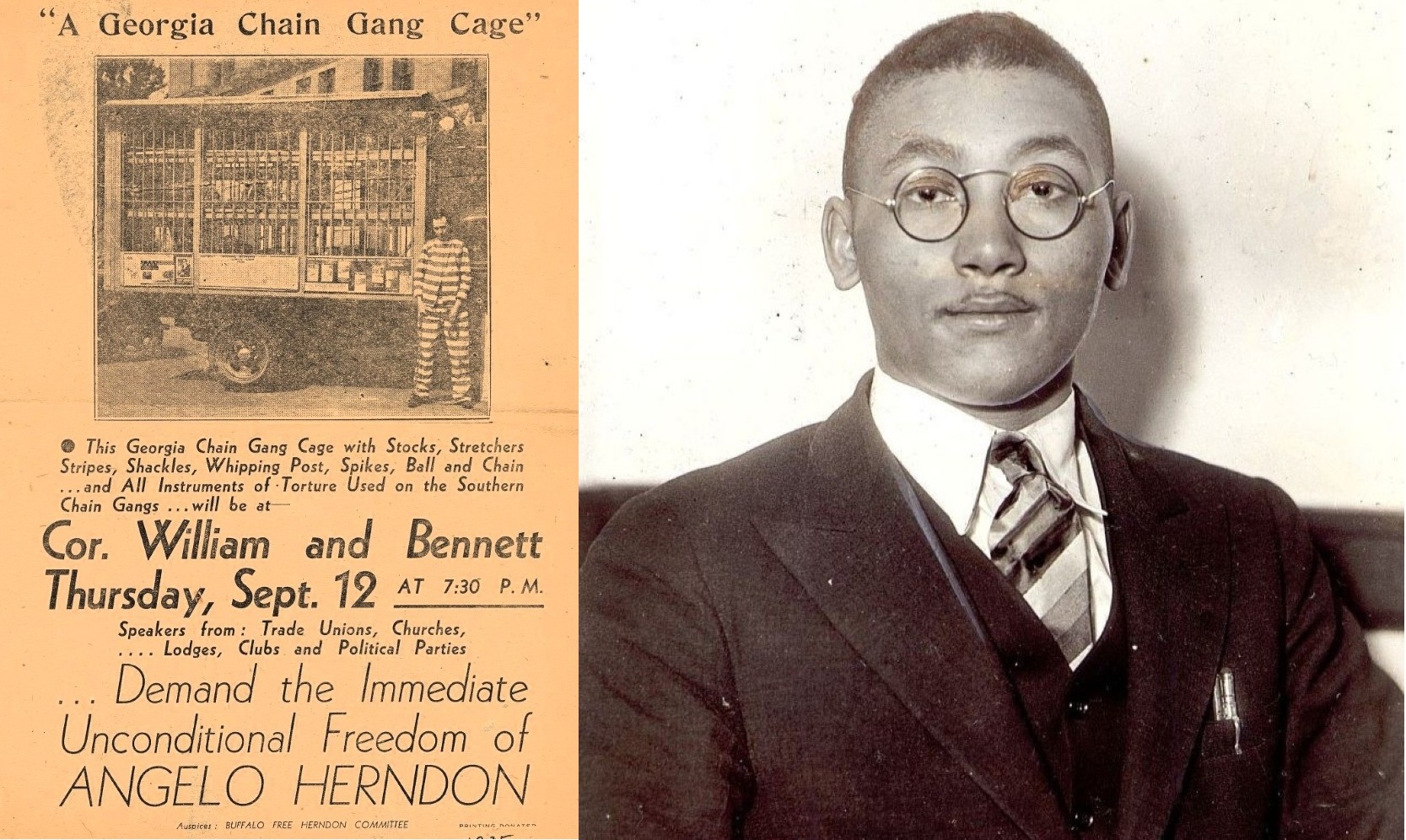
Herndon was a young coal miner who joined the Party in 1930 and quickly became a leading organizer. Arrested in July, 1932 by Atlanta police for “inciting insurrection”, he faced the death penalty, but was sentenced to 18-20 years hard labor; the chain-gang.
‘Chain Gang Judge Sentences Herndon’ by R.H. Hart from The Daily Worker. Vol. 10 No. 17. January 20, 1933.
SEND NEGRO ORGANIZER TO DEATH ON CHAIN GANG–GA. VERDICT STIRS DEEP MASS ANGER
I.L.D. Calls for Nation-Wide Protest Against Vicious Verdict–TO APPEAL SENTENCE–A. Herndon Denounces Capitalist Slavery
ATLANTA, Ga., Jan. 19—An all-white jury yesterday brought in a verdict of guilty against 19-year-old Angelo Herndon, Negro organizer, charged with attempting to “incite to insurrection” for his activities in organizing Negro and white workers for joint struggle against starvation, boss terror and lynching. Herndon was tried under an old statute dug up by the Georgia bosses to support their attempts to crush the rising struggles of the toiling masses. Six other organizers, two Negro men, two white men and two write women, are facing trial under the same musty statue, which provides for the death penalty.
Fearful of the growing thunder of protests of the aroused workers, Negro and white, the all-white jury recommended a sentence of 18 to 20 years on the Georgia chain gangs for Herndon. The sentence is practically a death sentence.
Aimed at Negro Liberation.
That this vicious sentence is clearly a class verdict aimed at the suppression of the struggles of the white and Negro masses against starvation and for Negro liberation is clearly shown in admissions even in the Atlanta boss press, which carries such headlines as “Death Penalty Asked for Red in Atlanta Sedition Trial–Man Accused of Agitating Jobless.” It is vividly shown also in the contention of the State Prosecutor, Assistant Solicitor John Hudson that Herndon’s possession of Communist literature regularly sent through the U.S. mails was “seditious” and an attempt to overthrow the government–the robber rule of the white capitalists and landlords. Hudson stressed the fact that this literature advocated unconditional equal rights for the oppressed Negro nationality and the right of self-determination for the Black Belt, where Negroes constitute the majority of the population.
“Stamp this thing out now with a conviction,” was the State’s closing plea to the all-white jury, which had been carefully hand-picked in advance to permit the exclusion not only of Negroes but of militant class conscious white workers.
Stressed Rights of Oppressed.
Joseph H. Greer and Benjamin Davis, Jr., prominent Negro attorneys engaged by the International Labor Defense, conducted a brilliant defense in the dramatic three-day battle. They boldly brought to the front the question of the Negro oppression and the right of workers, white and black, to organize in the workers’ political party, the Communist Party. They stressed the Communist position on the Negro question, full equality for the Negroes and the right of self-determination.
The defendant, Herndon, broke through the class rulings of Judge Lee Wyatt and used the courtroom as a tribunal to impeach capitalism and its murderous exploitation of the toilers, white and colored, and to defend the Communist Party and its leadership in the struggles against starvation, Negro national oppression and imperialist war. Herndon declared, in part:
“You may do what you will with Angelo Herndon. You may indict him. You may put him in jail. But there will come other thousands of Angelo Herndons. If you want to really do anything about the case you must go out and indict the social system. But this you will not do, for your role is to defend the system under which the toiling masses are robbed and oppressed.”
Packed to suffocation with Negro and white workers, the court audience hung on Herndon’s words as he described the pitiful conditions of the black and white working class mothers with their starving children, who had assembled at the all of the Unemployed Council to demonstrate for relief. So marked was the sympathy of white and Negro workers for the Negro organizer that the court had several times warned against any demonstration.
Chain Gang Judge.
Through a tense day, Judge Wyatt over-ruled with machine-like regularity motion after motion made by the defense attorneys. Over the repeated objections of the attorneys, he allowed the illegal placing in evidence of material seized from the person and room of Herndon, without a search warrant. This “evidence” consisted of copies of the Daily Worker, The Communist, the Party Organizer, the pamphlet entitled “The Communist Position on the Negro Question,” and the Liberator, organ of the League of Struggle for Negro Rights.
No charge of any specific act by Herndon was entered in the case. There was merely a general blanket statement that he was “inciting to riot.”
Insult Negro People.
Chauvinistic insults against the Negro people featured the State’s case throughout the trial. Watson, an Atlanta dick repeatedly referred to Herndon and other Negroes as “n***rs” or “darkies.” This brought sharp protests from the defense attorneys and the court was forced to rule against the use of such terms during the trial. Other chauvinistic acts included reference by the prosecutor and state witnesses to Negroes by their first names, instead of as Mr. and Mrs. terms consistently used in addressing the State’s white witnesses.
Will Appeal Case.
The defense attorneys have filed notice of appeal against the vicious class verdict. The International Labor Defense is urging all workers and sympathizers, north and south, to rush protests to Judge Wyatt and Gov. R.B. Russell at Atlanta, In Atlanta, many Negro liberals and intellectuals already have come forward with promises of support and a pledge to raise any amount of bail necessary to get Herndon out of jail pending the appeal.
The Daily Worker began in 1924 and was published in New York City by the Communist Party US and its predecessor organizations. Among the most long-lasting and important left publications in US history, it had a circulation of 35,000 at its peak. The Daily Worker came from The Ohio Socialist, published by the Left Wing-dominated Socialist Party of Ohio in Cleveland from 1917 to November 1919, when it became became The Toiler, paper of the Communist Labor Party. In December 1921 the above-ground Workers Party of America merged the Toiler with the paper Workers Council to found The Worker, which became The Daily Worker beginning January 13, 1924.
PDF of full issue: https://www.marxists.org/history/usa/pubs/dailyworker/1933/v010-n017-NY-jan-20-1933-DW-LOC.pdf
 Revolution's Newsstand