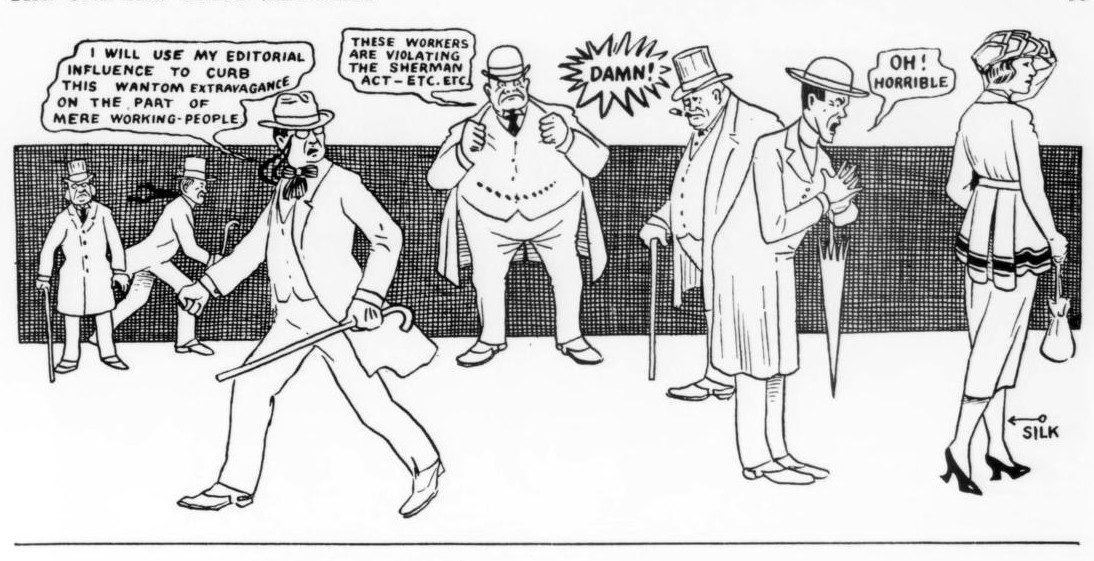
The capitalist class despises us, the working class. Mary E. Marcy on their enraged indignation when a worker has enough to buy a ‘luxury’; seeing it as proof workers are, unlike them, irresponsible with money or that wages are too high. This from habitual gamblers that don’t work and live encased by luxuries. Written after Marcy joined the I.W.W. in 1919 and in the midst of the post-war strike wave which brought out millions in steel, rail, and the the mines.
‘The Spendthrift Workers’ by Mary E. Marcy from One Big Union Monthly. Vol. 2 No. 8. August, 1920.
AMID all the ignorance, cupidity and chaos surrounding the capitalist system today, the characteristic that stands out most strongly is the growing hatred of capitalists for the working class. You hear it on all sides.
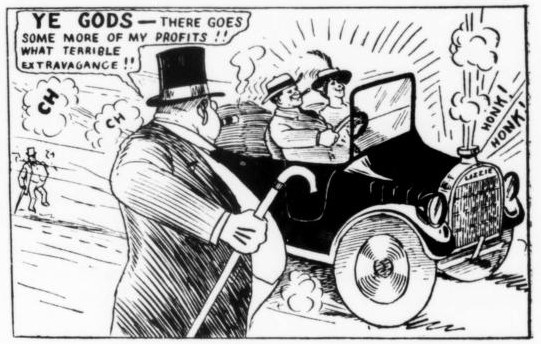
When an employer of labor, for example, sees a workingman who has slaved away in some machine shop or mill or factory for twenty years, riding around in a Ford automobile of his own, he just naturally foams at the mouth and shrieks that the only way to save society from utter barbarism is to lower wages right away.
When a magazine writer, who has done nothing in a long life of uselessness but dress up the ideas of the owners of industry in forms to fool the workers, sees a workingman buying a ticket for a vacation and riding in a PULLMAN, he ‘goes home and breaks out in a long article showing why the extravagances of the laboring classes is raising prices and driving the old ship of state straight for the rocks.
He exclaims with horror that the workmen today are demanding good and “expensive” clothing instead of shoddy, and to prove his statement he tells us how the second-hand clothing dealer has gone out of business and how a bang-up haberdasher is doing a land-office business at the old stand.
Working girls are known, during these unprecedented times, to go about wearing silk stockings, occasionally, and the clergy are shocked and grieved to learn that plumbers and steam fitters and electricians are to be seen now and then wearing SILK shirts.
And during all these outrages the employers of labor have been forced to sit back helpless and grind their teeth and endure these sights and plot to bring back the good old days when the workers who produced everything had to be satisfied if they had any sort of clothes to their backs and to eat the tougher portions of beef, when they had any.
The workers have had the employers in a corner owing to the great demand for American goods the past year and the shortage of labor, but the old politicians and the capitalist class are preparing to give us a great jolt in the near future.
Now that the bank deposits amount to about twenty-two times the currency in this country, the banks are up against the proposition of obeying the banking laws and holding the legal reserve in bank to (partially) protect their depositors, or of starting the printing presses going again and loading us all up with more paper notes and thereby lifting prices another thirty or forty per cent.
And so the banks are going to curtail credit. They are going to refuse credit to “legitimate business enterprises.” We know it because they have all said so. And, knowing the banking fraternity as we do, we may rest assured that each and every banker is going to preserve a noble exterior and tell the world he yields to social needs and social welfare, while he will secretly extend credit to favored clients—for special considerations. And so the banking situation is going to be acute before long.
There simply will not be enough credit to go around, so that some industries are going to find their loans called and the capitalists in these fields will probably have to dispose of their stocks at a reduction to meet the bank calls; some will be put out of business.
And while the press and the politicians, and, above all, the capitalists, are crying for “increased production” out of one side of their mouths, they will be forced to refuse credit where it is necessary and will thus cause DECREASED production in certain industries.
Now some capitalists are up against this curtailment of credit. The banks have called their loans; they know they are up against a stiff condition; the banks require additional security fer any loans. But the employers of labor, the exploiters of labor, are so obsessed with their growing FEAR and hatred of the workers that in spite of their own economic danger they often welcome a situation that will throw labor out of employment. They imagine unemployment will take out the new backbone the workers have developed during the past two years and make them servile wage slaves once more.
The capitalists regard it as perfectly right, justifiable and natural for the financiers, bankers or other groups of capitalists to prey upon any social group, to hold them up when they can do so, to squander, and loot and lie and steal. They admire and envy the capitalist who toils not and who is known as a conspicuous waster, but their bile rises when they read about a teamster eating porterhouse steak or a mere producer owning his Ford, or wearing a silk shirt.
A silk shirt on a workingman unites the entire capitalist and parasitical classes against the productive workers in society as nothing else on earth can. It draws attention so patently to the difference between the new and the old conditions, and it strikes the fear of the giant home into the hearts of those who prey upon society.
The workers in America today are in no mood for curbings, and the capitalists are in danger of losing all the power they have misused so long. Consequently, they are organizing to put up the fight of their very lives against the working class.
We shall see the waging of a giant battle during the coming months, in which it is not unlikely that the old craft unions may be torn and rent asunder never to be united again. For the pure and simple craft union will prove utterly unable to stand up before the onslaughts of united capitalism, and great numbers of men in the old unions will refuse to suffer disaster for the sake of an outgrown and dying institution.
These months ought to be the great harvest days for the I.W.W. It would be an extremely wise man who would be able to foresee what the next year will bring forth. But of one thing, I think, we may feel rather certain. It will bring us the greatest opportunity for the organization work of real class unionism that we have ever seen.
One Big Union Monthly was a magazine published in Chicago by the General Executive Board of the Industrial Workers of the World from 1919 until 1938, with a break from February, 1921 until September, 1926 when Industrial Pioneer was produced. OBU was a large format, magazine publication with heavy use of images, cartoons and photos. OBU carried news, analysis, poetry, and art as well as I.W.W. local and national reports. OBU was also Mary E. Marcy’s writing platform after the suppression of International Socialist Review., she had joined the I.W.W. in 1918.
PDF of full issue: https://archive.org/download/sim_one-big-union-monthly_1920-08_2_8/sim_one-big-union-monthly_1920-08_2_8.pdf
 Revolution's Newsstand