
How did revolutionaries build immigrant defense during the early 1930s deportation wave? F. Brown writes for the Communist Party Central Committee on the history of the work, some of its failings, and subsequent directions for work.
‘Fighting the New Offensive Against the Foreign-Born’ by F. Brown from The Daily Worker. Vol. 8 Nos. 311, 312, & 313. December 28, 29, & 30, 1931.
(The following are the directives of the Central Committee on the Foreign-Born Campaign)
PART I.
THE campaign for the protection of the foreign-born in this country is not a new event in the history of the revolutionary movement in the United States. In 1923-24 a mass movement was created around the slogans (for the protection of the foreign-born in the U.S.) against the proposed restrictions in the immigration quotas, against the reactionary measures proposed at that time by the Federal Government and the different states against the foreign-born workers the most advanced part of whom were in the forefront in the strikes of this period–in the forefront of the class battles.
Again at the end of 1929 the campaign for the protection of the foreign born was revived. In this period (starting of the new economic crisis, the wave of renewed struggle by the workers against capitalist rationalization and its effects, wage cuts, etc., with the first unemployed battles, with the direct attack against the foreign-born started by the Labor Department under the leadership of Davis)–further attack was developed by the Fish Committee. The Fish Committee one and a half years ago pointed out very clearly that one of the attempts to solve the unemployed situation was to deport the masses of non-naturalized foreigners in this country–especially the most class conscious of the foreign-born workers, many of whom were in the leadership of the revolutionary movement in the United States, in the leadership of our Party. This was a blow directed specifically against our Party and the Revolutionary Unions.
It was made clear, two years ago, that the aim of the capitalist class and of the U.S. Government was to check the growing unity of the working class and continue the division of the American working class, to terrorize at the same time the foreign born workers and the Negro workers in this country and on this basis make a free road for lowering the living standard of the working class as a whole.
At present under the pressure of the development of daily struggles, of the development of the struggle for unemployed insurance (with the perspective of still lowering the standard of living) the capitalist class in the United States and the Federal Government, inside the frame of widening the reaction against the American working class as a whole, are launching a new wave of terror against the foreign-born workers. This can be seen by the Labor Secretary’s report and especially in the Hoover message, and simultaneously from the new wave of terror against the Negroes in the South, as expressed in the lynchings that took place in the last few weeks.
How was the campaign for the Protection of the Foreign-Born conducted in the last two years? At the time of the first offensive launched by the Fish Committee, a real movement was built that culminated in the successful Washington demonstration which succeeded in drawing the attention of large masses of foreign born to the campaign for their protection. But our weakness at that time consisted in the fact that we were unable to use the influence our movement had created, and transform this influence in organizational form, namely into a real mass movement of the millions of foreign-born workers in this country, also using this influence for deepening our roots in the basic industries which still employ 60% foreign born workers.
Mr. Doak, Secretary of the Labor Department in his last statement, remarked that this year 18,000 foreign born workers were deported. But we must not forget that in his statement of last year, he announced that 16,631 were deported. Through El Paso and other cities on the border, 40,000 Mexicans passed on their way back to Mexico.
Inside the frame of the general deportations we find that the line of the Federal Government is to hit the most class conscious of the foreign-born workers. These methods are used especially in the case of strikes, as may be seen in Western Pennsylvania, Paterson and Lawrence, in order to terrorize the masses of foreign-born workers. During the last two years dozens of Party members, leaders in our language mass organizations and the revolutionary unions were deported, and others are still in jail waiting for deportation. Thru the development of a real struggle by the I.L.D., by the Council for the Protection of the Foreign Born, we succeeded in saving these comrades who were to be turned over to the hangmen of their original countries. Deportations to China, to countries of Latin-America and to the fascist countries of Europe were prevented.
Under the pressure of our mass struggle, Secretary Doak of the Labor Department seeing that some of the Courts were finding the deportations unconstitutional months ago, advanced the proposal that if the different organizations would discontinue their cases in court, the Labor Department was in favor of granting free departure of the undesirable elements. Under the pressure of our movement, the Wickersham Commission was forced to give to its report a bourgeois, liberal tinge.
Nevertheless, our movement (Protection of the Foreign-Born) is organizationally very weak. Only in Michigan have we succeeded in building a real movement around the struggle against the Alien Registration Bill. An organized movement exists in New York where some hundreds of organizations with thousands of members are affiliated to the Council, also to some extent in Philadelphia and Boston. But in other districts as in Chicago, Cleveland, Pittsburgh, etc., in spite of the instructions, in spite of the fact that organizers were sent to the spot, the movement does not exist at all, or only now beginning. Besides, the movement is still composed of purely language mass organizations, while our unions and locals of the A.F. of L. are still not involved. Also in those places where the movement is organized we succeeded only in a small measure to penetrate into organizations outside of our influence. Still the Party does not realize that beside the fact that a mass movement of the foreign born will strengthen the Party’s influence and organizations, this campaign is at the same time a struggle for the defense of the Party itself.
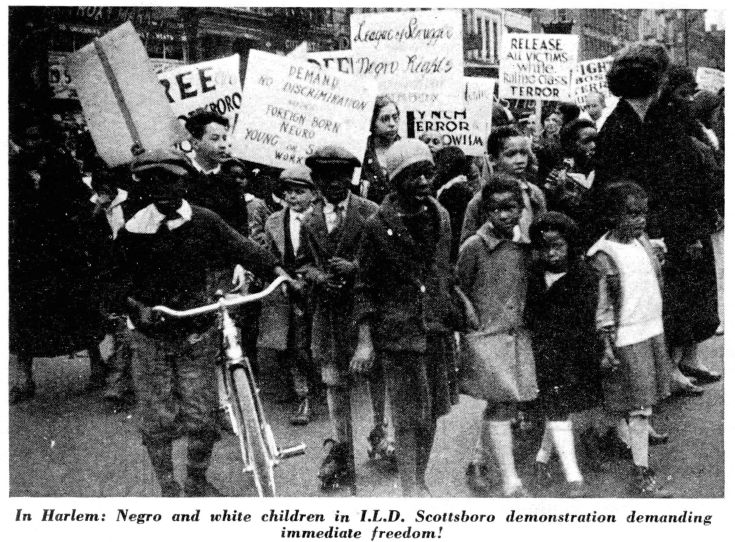
In the last two years we can say that the campaign for Protection of the Foreign-Born involved from 200 to 300 thousand foreign born workers. The workers to a great extent besides participating in the campaign for the protection of the foreign born, participated also in the campaigns of the I.L.D., in the Scottsboro campaign, and in the other campaigns led by the Party.
The possibility of creating a tremendous movement is before us. But this possibility will be realized only if the Party, as a whole, will really understand that the problem of the foreign-born in this country is one of the major problems facing the Party. Until now the campaign was conducted in a poor manner. The agitation was increased–conferences and mass meetings were called, and organizational measures taken only in such cases as the Michigan Alien Registration Bill or before new deportation cases; but not conducted in a persistent and systematic manner.
The National Committee elected at the time of the Washington Convention, because of its poor composition disappeared very soon. Since then the National Committee was reorganized twice.
The last event–the Hoover message, which came at the same time that the Alien Registration Bill in Michigan was declared unconstitutional, also the report of Secretary Doak of the Labor Department, shows very clearly how at the same time that the Michigan court was forced to repeal the reactionary bill, under pressure of the masses in Michigan, the Federal Government is making this Bill its own.
The reason given by the Michigan Court for declaring the Bill unconstitutional is that such Bill can only be passed by the Federal Government. Both declarations–Hoover’s and Doak’s, to which has to be added the latest decision of the Supreme Court which declares all non-naturalized aliens subject to deportation no matter how long they are in this country–reversing all previous laws, show us very clearly that we are confronting a new wave of terror against the foreign born in this country and that our duty is to develop a real mass movement for the protection of these workers.
Can we conduct this campaign on the basis of concrete issues? Yes. We have the proof that the foreign born workers, not only are deported en masse, but those who remain in the United States are discriminated against on every side–discrimination on public works as construction of new buildings, roads, etc., discrimination in the assignment of jobs, in the unions of the A.F. of L., discrimination in relief distributed by the charities, distribution in schools, etc., etc. For example, in New York City, in the elementary schools, 60 per cent of the children are of foreign-born parentage, but in the high schools the children of the foreign-born represent only 10 per cent, which shows that a large percentage of the child labor army in industry is composed of children of foreign born workers.
Finally, we must not overlook that all the reactionary measures against the foreign born and against the Negro masses are in line with the war preparations. It is the old policy of all capitalist countries to try to crush the revolutionary movement as one prerequisite for war preparations. For this reason we are compelled to pay more attention to the problems of the foreign born in this country.
PART II.
WHAT are the reasons for the organizational weaknesses of the movement for the protection of the foreign born?
1. Because our agitation and organization work is not systematic and concrete.
2. Because the movement was reduced mainly to a movement of language mass organizations. The revolutionary unions and rank and file of the A.F. of L. were not involved in the struggle.
3. Because of the wrong tactic in applying the united front we did not succeed in penetrating the hundreds of workers’ organizations led by the reactionaries. Either these organizations were approached from the top, or where our forces succeeded in bringing the campaign before the masses of the organizations that we approached for the first time, it was done in too general a manner, or directly on the basis of the Party program and not on the main issue on which the united front should have been established, namely, the struggle for the protection of the foreign-born–on the basis of concrete issues. especially local cases; deportations, discriminations, etc. Thus right and left opportunist deviations weakened mass mobilization.
4. Because our propaganda took a too general character: For example, we said that the reaction against the foreign-born workers and the Negro masses is intended to divide the working class and in this line create the basis for the lowering of the standard of living, which is the absolute correct assertion and clear to us–but we did not explain how this maneuver of the capitalist class works out in practice. We did not explain its dialectical development so that the workers could see and grasp the correctness of this analysis.
5. Because outside of the struggle conducted the International Leber Defense against case of deportation and the agitation conducted by the Party and the Council for Protection of the Foreign Born in Michigan against the Alien Registration Bill, by the Council for the Protection of the Foreign-Born in general, against deportations, discrimination, etc., no real struggle was conducted on concrete local issues by the revolutionary unions, by the unemployed councils (as in cases of discrimination in mines, mills, shops, discrimination of relief, assignment of jobs, etc.) in spite of hundreds of such concrete cases.
6. Our Party press (with few exceptions) did not follow up the campaign systematically. We had cases where not one of the protest resolutions voted at hundreds of meetings held all over the country, where not one of the protest telegrams sent by the Council for the Protection of the Foreign Born, by mass organizations with many thousands of members, to Secretary of Labor Doak, found space in our Party organs. How can the attention of the working class be aroused when the campaign remains only within the walls of the meeting halls?
7. Because the districts did not realize (with few exceptions) the tremendous importance of this movement, did not realize that through the development of this movement it is possible to tie up strongly the Party and this section of the American working class, to draw this section of the American working class into the daily struggle, to penetrate into the mines, into the steel mills, etc., where the foreign-born workers constitute 60 per cent of the employes!
Did the Party correctly estimate the importance of the campaign for protection of the foreign born at the beginning, and take measures on how to conduct it? I believe it did. It is not in the evaluation of this problem–it is in the problem of drawing the masses of foreign-born workers into this campaign, and, in general, into the daily struggle, that we are failing. We are failing in the concrete carrying on of the campaign–in making the District Committees, the revolutionary unions, the left-wing locals in the A.F. of L. and other mass organizations, conscious of the necessity to participate in the campaign. This is the major reason that explains why the whole movement as it now is, is to great extent purely a language movement bull on the efforts of a few comrades, active in the language organizations close to the Party.
PART III.
How to Correct Our Shortcomings.
Is it possible to correct the shortcomings and develop the campaign to a tremendous movement that will defeat the Hoover-Doak offensive and at the same time rally round the Party large masses of foreign-born workers who through this campaign can and must be drawn into the daily struggle of the American working class? Nobody can doubt that. It is the problem of involving the Party as a whole in this struggle, as one of the major struggles, that we are facing.

The proposals of how to overcome the shortcomings, how to conduct the campaign, etc., are already embodied in the positive side of the seven major reasons registered, which explain the weakness of the campaign, and which are contained in many Party documents, in the instructions of the National Committee for the Protection of the Foreign Born worked out especially after the last Party Plenum.
Nevertheless, I am enumerating those which are the most important. In order to revive and develop the campaign for the Protection of the Foreign Born, it is necessary:
1. Development of the campaign against the new offensive of the Federal government. This must be connected and dramatized through local struggles against the discrimination by which the foreign-born workers are affected–on city and neighborhood scale, and at places of work (for example, refusal to hire foreign-born workers on public, works, discharging foreign-born workers in the construction of public works, road constructions, etc., if they are not citizens; deportations in connection with strikes or militant participation in the revolutionary movement; discrimination in the distribution of relief, assignment of jobs, revocation of citizen papers, etc.).
The campaign has to be connected with the struggle against wage-cuts, with the campaign against the terrorization of the Negro masses, and, in general, with the struggle in the shops and the struggle of the workers as a whole against the capitalist offensive on the standard of living of the American workers.
2. A vigorous, wide, agitational campaign must be developed in our press against the new wave of terror launched by the Hoover government.
3. To strengthen the National Committee for the Protection of the Foreign-Born, drawing in more representatives of the mass organizations, of the revolutionary unions, locals of the A.F. of L. and other organizations which we are drawing into the campaign.
4. To strengthen the Districts and City Committees for the Protection of the Foreign Born through conferences in all those districts where the committees disappeared–conferences called in line with the revival of the campaign against the new offensive launched by the federal government.
5. The language mass organizations must be awakened to the realization that this is their major campaign at the present moment, through the activizing and enlightenment of our Party fractions within the mass organizations.
6. The I.L.D. shall work hand in hand with the Council for the Protection of the Foreign-Born. The tasks of the two organizations have already been laid down. While the major task of the Council for the Protection of the Foreign-Born is to conduct a wide, continuous, agitational campaign to lead the struggle for the protection of the foreign born in general, in giving legal advice, etc., the I.L.D. is to participate in the campaigns and to take care of the legal defense of the individual cases. Certainly the development of the campaign will enable the Council for the Protection of the Foreign Born in supporting the I.L.D. in its campaign for funds concerning the defense of desperate cases.
7. Building of Legal Advice Departments as already established in New York and Michigan. These have shown good results in the developments of the campaign, in making known the organization to large masses and dramatizing the campaign through the investigation of deportation cases, through giving legal advice to alien workers on different problems (citizen papers, legal stand in this country, etc.).
8. Organizationally, the Council for the Protection of the Foreign-Born must not become a rigid organization but continue to base itself on affiliation. The efforts of the District and City Committees, especially now during the renewal of the campaign, must concentrate on reaching the masses of new organizations. Certainly, if the campaign is properly conducted these masses will achieve the affiliation of the organizations to the Council for the Protection of the Foreign-Born, will create the basis for the development of the struggle of the masses against the fascist and social-fascist leadership in many mass organizations.
In the organizational measures elaborated by the Council for the Protection of the Foreign-Born, it is already established that the District and City Committees are to appoint special small committees whose task it is to visit and bring the campaign into the hundreds of mass organizations that were never reached before.
9. The District and City Councils for the Protection of the Foreign Born from now on, under guidance of the Party fractions, must react quicker in cases of deportations, discriminations, etc.–in calling of mass meetings and demonstrations before the immigration authorities, before the places of work where cases of discrimination occur.
Most attention in these cases must be given to drawing into protests American workers, Negro and white, and especially the youth–the new generation of the foreign-born workers which must be drawn into the struggle for the protection of their parents, in this manner giving to the demonstration a real character of united front against the offensive of the capitalist class.
The Campaign Must Be Discussed!
The entire Party must be made conscious of the importance of the campaign through discussion; functionaries’ meetings on district scale and discussion in the units must be arranged, at which not only the importance of the campaign is to be taken up, but also the organizational measures must be brought into the forefront–how the struggle is to be conducted and developed, also the problem of the millions of foreign-born workers (employed in all kinds of industries) who have to be drawn over to our cause. The fact that the federal government, the states and cities are dealing with these problems, the fact that a new offensive against the foreign-born workers is on its way, show as that this problem does exist and that it is one of the most important problems that the Party must face. In drawing large masses of foreign-born workers into this campaign, we must contrast the situation in the United States with that in the Soviet Union. Here, in the most powerful imperialist country, in the country of “prosperity and democracy,” the workers suffer mass unemployment, starvation, terror against the foreign born and against the Negroes, discrimination on all sides and a constant lowering of the living standards.
In the Soviet Union, not only has unemployment been abolished and the standard of living continuously raised, but all forms of discrimination have been abolished. The workers and farmers rule the country–they are building a new society from which exploiters are disappearing completely.
Not only must we bring before the workers the immediate war danger, the feverish preparation by the imperialists to attack the Soviet Union; but we must show them that it is in this imperialist country, the country of bourgeois democracy which means liberty only for the capitalists to oppress the working class and squeeze out higher profits, that the working class, foreign born and Negro and American, will be free from capitalist oppression only by following the example of their Russian brothers in establishing a workers’ and farmers’ government, a real democracy, real freedom for the majority from the exploitation of the few. Only in this way can the unemployment, discrimination, lynchings, deportations, etc., be abolished forever and a new society–a Socialist society–be established.
The Daily Worker began in 1924 and was published in New York City by the Communist Party US and its predecessor organizations. Among the most long-lasting and important left publications in US history, it had a circulation of 35,000 at its peak. The Daily Worker came from The Ohio Socialist, published by the Left Wing-dominated Socialist Party of Ohio in Cleveland from 1917 to November 1919, when it became became The Toiler, paper of the Communist Labor Party. In December 1921 the above-ground Workers Party of America merged the Toiler with the paper Workers Council to found The Worker, which became The Daily Worker beginning January 13, 1924.
PDF of full issue: https://www.marxists.org/history/usa/pubs/dailyworker/1931/v08-n311-NY-dec-28-1931-DW-LOC.pdf
PDF of issue 2: https://www.marxists.org/history/usa/pubs/dailyworker/1931/v08-n312-NY-dec-29-1931-DW-LOC.pdf
PDF of issue 3: https://www.marxists.org/history/usa/pubs/dailyworker/1931/v08-n313-NY-dec-30-1931-DW-LOC.pdf
 Revolution's Newsstand