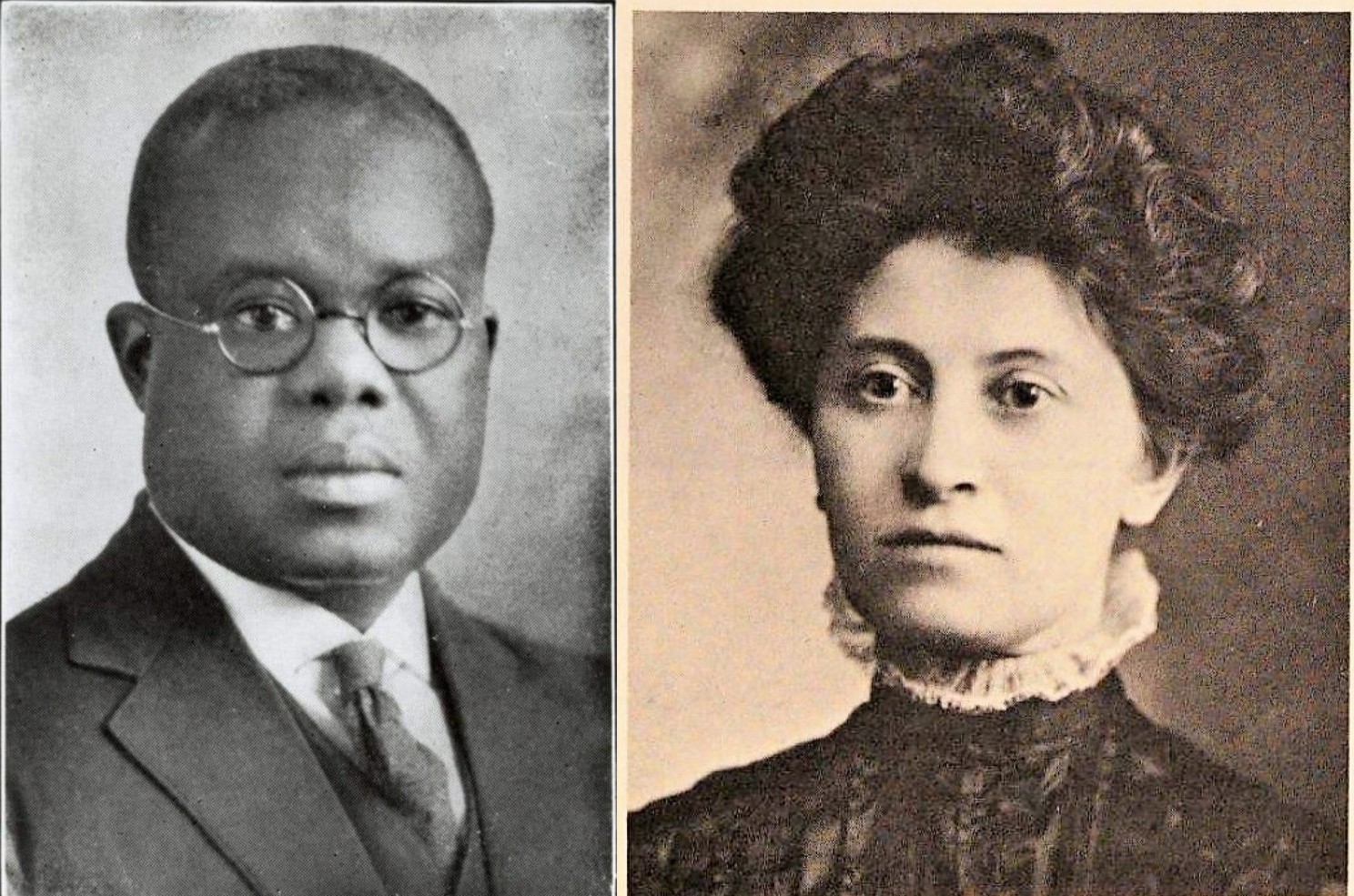
A remarkable letter to the editor from Hubert H. Harrison. After a disgusted Theresa Malkiel wrote of the experience during her 1911 speaking tour of the South with ‘”Socialists” Despise Negros in the South’ for the party’s ‘Call’ newspaper, a number of responses through the letters appeared, though no editorial from the Call. Here, Harrison writes in a month later on the ‘race problem’ in the Socialist Party and points to two letters, written by ‘William Morris’ and ‘Harry Smith’ as being the proper Socialist attitude. Below is Harrison’s letter, Malkiel’s article, and the two letters referred to by Harrison, making for one of the more serious exchanges on the topic in the Party’s press at the time.
‘The Negro and His Problem’ by Nils Uhl (Hubert H. Harrison) from The New York Call. Vol. 4 No. 275. October 2, 1911.
Editor of The Call:
Dear Sir: The Comrade from Washington, D.C., who signs himself William Morris, regrets that The Call had no editorial on Comrade Malkiel’s letter on race prejudice and Southern Socialism, but after reading his letter and that of Comrade Smith, of Brooklyn, which appeared on the same page of your issue of the 12th, one wonders whether any editorial is necessary. Those two letters summed up the orthodox Socialist view of race prejudice and they ought to be preserved as classics. There can be no doubt that “William Morris” has taken some pains to learn the negro’s side of the “problem”–and that, of course, is not to be got from the newspapers. And I know whereof I speak, because I belong to that race myself. Many Socialists are unaware of the way in which the newspapers of America deliberately manufacture sentiment against negroes. Take the case of Professor Du Bois, for instance. The newspapers over here stated that American members of the Lyceum Club, by threatening to leave the club, forced withdrawals of the invitation to him. But listen to the actual facts. I quote from a letter of Professor Du Bois, which I have before me as write, He says:
“With regard to the London incident, let me say that the Lyceum Club invited me for March 27. I could not get off and they again invited me for June 26, when I shall be present. The reports in the papers were, of course, pure fiction. “Very sincerely yours,
“W. E. B. DU BOIS.”
One would ask, why should the American newspapers accuse Americans in London of such superlative snobbishness when there was no truth in the charge. Well, in the first place, it was not intended as an accusation, but as a boast. The editors who faked up the story desired to make Americans here feel proud of the fact that even in London white Americans could keep negroes “in their place.” In the next place, by showing that such things were en regle in the centers of civilized society, it was meant to show good Americans what was considered stylish abroad so that their conduct might be fashioned accordingly. That is only one sample of the devilish ingenuity of American race prejudice. Here is another. In the case of all other race groups the name by which they are known is capitalized, but if any one writes to an American newspaper about negroes, no matter how often he may capitalize the name, it will be printed with a lower case n. And this for the same reason that prevents the Southern gentleman from referring to a colored school teacher as Miss. That, which is common courtesy to others would immediately make the negro forget that God has ordained Professor Du Bois and Captain Young, U.S.A., to be the everlasting inferiors of “Monk” Eastman and Detective Burns.
Then, again, it is good policy to damn all negroes, anyway. Thus, when on last Thanksgiving Day the body of a little girl was found with evidences of “the unmentionable crime” and Thomas Williams, of Asbury Park, was arrested on no ground save that of being a negro, all the sensational sheets from the Journal to the Times carried great glaring headlines of what “the negro brute” had done. By the force of the public sentiment thus created he was “judged” and given the third degree and quite a few other degrees. According to his sworn statement, “They did everything to me but electrocute me.” Bear in mind, that there was no evidence upon which to hold him. Yet if it had not been for the National Association for the Advancement of Colored People he might never have lived to tell the story. When the real murderer, a young German, was found and confessed, were there any flaming headlines about the “white beast” or “German-brute”? Not on your life! They hid it away inside in less than a quarter-column. But the damage to the race’s reputation was already done–which was the main intention: Three times in four weeks this horrible farce was enacted for the delectation of a people supposedly civilized, that kind of thing is perpetrated on the negro right along. Take the so-called “usual crime”: Of the 2,875 lynchings between 1885 and 1904, 564 were for “alleged and attempted criminal assault:” 2,127 were for complicity, murder, theft, arson, race prejudice (sic!), simple assault, insulting whites and making threats. The remainder was divided among twenty-five other causes, including “refusing to give evidence,” “testifying against whites” and violation of contract. The figures speak for themselves. Yet people who take their information from the daily newspapers will lift their hands in impetuous deprecation and ask, “But why don’t negroes stick to their own women!”
The great source of all this is in the South, and account of the complacency of the commercial conscience which shapes Northern sentiment into accord with Southern requirements it is spreading rapidly elsewhere. Someone a call a halt and Socialism by its very nature is better able to do this than anything else. For Socialism is the one gospel that cannot afford to indorse Southernism. As soon as Socialist trims and temporise it dies as Socialism, whatever else it may be transmogrified into. So there’s your issue presented: Socialism or Southernism, which?
Every democratic movement in America has found its ultimate touchstone in the negro problem. Political democracy, trades unionism, education, the civil service, have shivered at the touch of thin Ithuriel’s spear, which pricks the hollow bubble of conceit and glittering phrases, and caused it to collapse. Will it be this way with Socialism? When I lectured to the Yorkville Branch and to Branch 4 on this subject last winter Comrades expressed surprise that I should interpret the negro’s attitude toward Socialism as one of suspicion. I was told that whenever and wherever Socialism was accepted race prejudice vanished. Then came the letter from “A Southern Socialist.” Now we have Comrade Malkiel’s letter. What does it all mean? Simply this: That there are people who, like the old Athenians, think that there is such a thing as an aristocratic democracy. So in the South workingmen still dream of the adulterous union of Socialism and caste Let us wake them up.
Yours for the cause,
NILS UHL [Hubert H. Harrison]
Branch 5, Local New York. New York, N.Y.
‘”Socialists” Despise Negros in the South’ by Theresa Malkiel from The New York Call Vol. 4. No. 233. August 21, 1911.
‘Comrade’ Refuse to Allow Colored Men in Meeting Halls or Party
MEMPHIS, Tenn., August 7. At Bald Knob Ark., I had four meetings in the afternoon I spoke at the picnic grounds to a thousand farmers, and their wives and children. In the evening I spoke in a church. It was extremely hot, but they insisted on a meeting. I spoke for two hours and was tired out when I got through. They want their money’s worth even if they kill the speaker.
The next day I again spoke at Bald Knob, and had an unpleasant experience that sent my blood boiling. There was a picnic of Colored people in town, over a thousand assembled, and they sent a deputation to asking me to speak. I consented, but when our comrades heard of it, they would not allow it, as they claimed it would break up their organization. Lord preserve us from this kind of Socialists.
We must not preach Socialism to the negroes because the white workers are foolish enough to allow the masters to arouse their prejudices against their fellow workers to keep them divided so as to play one of the other. The result is that when the white men strike the darkies (sic) scab and vice versa. And even our Socialist comrades do not be able to see it.
Oh! For the tongue of fire and the lash of a scorpion! Maybe I did not give it to them. But they would not let me speak to the darkies. I was so mad that I cam near telling them to go to ___ and leaving the town.
Much Socialist Sentiment
I sold all the books I had and could have sold more. There is plenty of Socialist sentiment by the Socialists will have to learn more on the solidarity of the workingmen. The next day I spoke twice. In afternoon the park on the topic of ‘Women and Socialism,’ and in the evening on ‘Child Labor and Party Organization.’ The day before I spoke on ‘Socialism in Practice.’ My meetings in this town created a furor. They were large and the whole town talked of nothing else.
At one meeting I was shown two Democratic politicians in the crowd.
I challenged to tell me why they were Democrats and I offered to say why I was a Socialist. They kept mum. This gave me the opportunity to point out to the crowd who they were sending to the legislature. The people began to hoot them, so one of them came forward and said he was a Democrat because he believed in their principles. I wanted to know what those principles were and finally he blurted out: “Equals rights for all, and special privileges for none.” The I wanted to know where and when his party had carried them into effect. I finally got him into a tight place that he withdrew to the laughter of the audience.
In the evening, when I spoke in the church, I spoke on the white slave traffic, and got the sympathy of all the church people. Enthusiasm was at high pitch and all the comrades were elated. They feel sure they will double their membership.
Abominable Treatment of Negroes
Arrived at Earl an hour and a half late, which is quite the thing here. The trains are never on time. It was pouring. I was met at the train by a dozen comrades, and at least a couple of hundred negroes who came to hear a Socialist speaker. The poor, poor darkies are running to the Socialist Party as their only hope. And to the everlasting shame of our southern comrades, they treat them like dogs.
It was raining hard and it was sheer folly to speak in the open air, but they surrounded me pleading hard that it was their only chance to hear me, as the white people will not allow them to enter the hall where I was to speak in the evening. I had not the heart to refuse them, and spoke from the platform under shelter, while they stood out in the rain listening to the message of socialism so different than that the people around them were practicing.
There were about 600 hundred darkies (sic) around me before I was through. They are hungry for the truth and all we need to do is speak to them and point the way. Intelligence shown from their face and the words I spoke went straight home. Most of them are tenant farmers who work hard the year round, have to give half of their earnings to the white man who own the land, and are despised in the bargain by the men that live on their labor.
How like the capitalists of the north, only there they exploit men of their own color. I am so sick of it I would like to take wings and fly from these brutal regions.
Exclude Colored Men
Earl never had a Socialist local before, and we organized one with ten white members; they did not attempt to organize the colored people though they could have won any number of them. The meeting was held in a schoolhouse, and old a step I had to ride, for the mud was knee deep.
And again, I was aroused to indignation. A few of the colored people followed us to the meeting in the hope that the Socialists would be more humane than the others and let them in. But our comrades, who strike for the brotherhood of man, and the unity of the workers of the world, turned a deaf ear and a blind eye to the pleadings of their brothers. To my pleading that they could sit in the adjoining room so that they could listen to our work of organization, they would not listen.
We went upstairs and started the work. One colored man tiptoed in with a haunted look and sat in the furthest corner of the room when one of the white men rose and ordered him out. I remonstrated, but they maintained that the least move on my part to allow he darkie to remain would precipitate a riot and kill the movement.
I felt like a coward, but the crowd was waiting for me to begin. There was so much bitterness and scorn in what I told them that night.
I left early the next morning for Memphis and hope to meet some of the comrades at the station, as I had notified them of my coming. Nobody was there and after searching all over the city for several hour, I discovered a bunch of Socialists in the office of a little paper they were publishing. They seemed uneasy at my coming. I soon discovered that they had made no arrangements for my meetings, and instead of greeting me, starting to abuse each other and the National Office in turn for sending me without there constant.
I told them I did not want their meeting, and would go on to Louisville the next train. The finally roused themselves and organized a meeting in the open air, which was a rousing success no thanks the local socialists, It was entirely due to the great socialist sentiment among the people. The next day I left for Louisville, stopping over in Nashville for the night. The heat was unbearable but when I left Memphis by as we moved north it became much cooler and Nashville was very pleasant. The ride from Nashville to Louisville was wonderful. Kentucky is certainly a picturesque place.
As I spend along the hills and mountains covered with centenarian trees and I watched the wonderful blue sky I for once understood how good Ole Abe Lincoln was inspired to think and dream in spite of his humble surroundings, I wonder that Kentucky did not produce more Lincolns, perhaps because of our horrible system of society.’
‘The Negro and the Socialist Movement’ by William Morris from The New York Call. Vol. 4 No. 255. September 2, 1911.
Editor of The Call:
Not long ago Comrade Theresa Malkiel in a letter to The Call from the South told of the attitude of some of the so-called Socialists in that section to the negroes. That letter called forth just two letters from Call readers, and not a line from the editor, although the Volkszeitung had an excellent editorial on the subject. Last spring there was a series of letters on the same subject, which stopped after a short while. And so we stand. Nothing definite has resulted, and the question is still as open as it ever was.
Lincoln said about this same question, that nothing is ever settled until it is settled right. The terrible Civil war did not settle it right, and now it is up to us, the Socialist movement, to settle it right and forever. Of course the Socialist movement, like capitalism, is universal. The literature of our movement is worldwide. But just as capitalism takes different form in different countries, so must the form of the Socialist movement vary in the different countries of the earth. Each country has the one great question to solve, but in each there are differing institutions, all the fruit of the capitalist system, to be dealt with. In the monarchical countries of Europe there are the momentous questions of democracy to solve, the suffrage to gain, feudalism to overthrow, and in each country the Socialist party, the only party that is sincere and that has a real historical mission, is the one that will solve the problem.
In America we have the blessings of a certain amount of political freedom. But there are two great questions that are pre-eminently American problems, the legitimate fruit of capitalism in America, and they are the question of immigration and the negro question. We do not believe that the proper person to settle the former question is the big manufacturer, who wants all the cheap pauper labor that he can get, nor will the narrow, dogmatic, job-conscious craft unionist settle it. It can only be settled by the Socialist party, whose vision is just broad enough to see all the working class, and nothing else.
And so, the only people who can settle the negro question are the people of the Socialist party. No one else has seriously attempted to settle it: the common sneer that Northerners get is that it is none of our business, and that the people who are best fitted to solve the problem are those who know the negro best: that is themselves.
As Eugene Wood says, “It is pretty bad when people know so much about a question that they cannot learn anything about it from anybody else.” But let that go. Let us only look at the way that they have managed the question for the last half century. Let us see how they are treating the negroes. They brag that only they know the proper treatment. They like the n***r who knows his place. They love their old black mammies who nussed them when they were little. They adore the black men who are so devoted to the interests of the old families. But they “must keep their place.”
When they are called “black dogs” and they say, “Yes, sah,” then they know their place; but let us see the way that some who do not know their place are treated. In the City of Washington, there are three medical colleges. They are the Georgetown University, the George Washington. and the Negro Howard University. Dr. William A. White, the head of the Government Hospital for the Insane, lectured on psychiatry to a combined class of the two former colleges. Last spring he got an inspiration. He invited the negro students of Howard to listen to his excellent lectures: then the storm broke. The combined classes of the two former colleges walked out in a body, indignant that they should be subjected to such a damned outrage, suh, of having to sit in the same room and breathe the same air as n***rs. If they were waiters, if they were kitchen maids, then it would be all right. They would be in their place. But they had the sublime nerve to want to sit in the same room as the white men as equals. They forgot their place.
Those were college boys, you say, and not men. When a certain club in London honored itself by inviting that splendid scholar, Professor DuBois, to speak for them, the invitation was withdrawn because some of the rich American members said that they would leave the club if that insult to American republican principles was allowed. Those were snobs. Last week the American Bar Association honored itself by electing to membership a distinguished negro lawyer. The Southern members threatened to resign, and refused to attend the annual banquet because they did not want to eat with a n***r. They don’t mind waiters handling their food, or maids their clothes, but to break bread with one–never!
If a negro is so rash that he looks at a white lady–one of those holy, those celestion objects that the Southerners get so religiously fervent over, while denying them the right to practice law or to do anything that is not in accordance with the standards of 1624–well, we know the result. We have so often read of the brutal, the awful, the fiendish lynchings upon the doubtful evidence of interested parties that some white she-saint was violated. That is all right. But when we see the attitude of the South toward the negro women, we see that their wild, apoplectic excitement over the holiness of womankind is a lie, a fraud, and an outrage, Southern gentlemen boast that colored girls like to consort with white men–and they ought to know, Southern men boast that there is not a single colored girl above the age of 15 who is pure. That may be so, and it may not. If it is so, we know whose fault it is. But the boast itself is sufficient to inform us what is the esteem in which the negro is held.
A negro is not a man. He has no rights that a white man is bound to respect. His treatment is the one great blot on the reputation of the nation that tolerates it. The only thing in modern times that can fittingly be compared with it is the persecution of the Jews in Russia.
What does the Socialist party do in similar cases? There was a time when a workingman who thought for himself was a rarity, sneered, scoffed, hooted, hated. There was a time when a workingman who tried to overcome the bounds of class and caste had as hard a time as the negro has now. And the result is that the greatest modern phenomenon is the magnificent Socialist movement, uniting all those of the world who toil in the grandest movement the world has ever seen. And we glory in it. We are happy in being workers. We stand up, erect, and defy the world, and proudly boast that we are men–and the Socialist movement did it.
There was a time when the sister of mankind, our Comrade Woman was denied all. She was revered, and told to keep her place, which was the kitchen. She has gradually conquered all. And now, she stands erect, and proud, and defies all mankind. But when the days were dark, and when a woman who, wanted to vote was hooted and her name was a hissing and a byword, even in those dark days did the Socialist movement proudly stand by her, and now we share the victory that we helped her win.
Where there was oppression, there our great movement stepped in and proudly and gladly championed the cause of the disinherited, the doomed and the damned. But we bided our time, serene in the consciousness of right. We cared not for temporary victory, but with the authors of the Communist Manifesto, said, “Now and then the workers were victorious but only for a time. The real fruit of the battle lies not in the immediate result but in the ever-expanding union of the workers.”
When the movement is true to that great ideal, so long will it win. But as soon as it trims, and sacrifices ultimate principle to temporary advantage, that moment must it yield up to a truer movement that will not turn. And to be true to that great ideal that was set by these great internationalists. Marx and Engels and Liebknecht, and all the early heroes of the movement, then must we champion the cause of the oppressed workers of all colors and conditions. Regardless of what effect it will have on our immediate political future. If we trim, we are cowards. The people who refused to let the poor negro listen to Mrs. Malkiel are job-conscious, union-conscious, race-conscious, but not yet class-conscious, for our class, the working class knows no race, knows no land, no boundaries, no color, no religion, but only the splendid bond of a common brotherhood of toil. So we must not allow such half-Socialists in the movement. We must let it be understood that we want nobody who believes in such poisonous doctrines. We must be the ones who will lead the negro to the full realization of his splendid manhood, his brotherhood with all those who toil, and his common share in the great industrial republic that we are together going to win for ourselves. Not in a feeling of empty rhetoric, but in sober reality did Marx and Engels cry “Workers of all countries unite. You have nothing to lose, but your chains. You have a world to gain.”
WILLIAM MORRIS,
Washington. D.C.
‘Southern Socialists and the Negro’ by Harry D. Smith from The New York Call. Vol. 4 No. 255. September 2, 1911.
Editor of The Call:
Jack Ricova, of Richmond, Va., thinks he has solved the so-called “Negro Question” by throwing slurs on some of our Northern Comrades, in today’s issue of The Call. I would respectfully, in that southern chivalrous manner, advise “Comrade” Ricova, who signs his letter “Yours for the revolution,” that Socialism is the same wherever we travel; and if the prejudice of a certain section of “our” country is against Socialist principles, then we must face the issue and fight for Socialism.
The people of the Southern States have a thorough distaste of what they call “n***rs.” That unsocialistic, aristocratic feeling of these sample “Americans” is very much like that of the Spartans of ancient Greece. They cannot get over that feeling of superiority which dominates owners of slaves. This position is also assumed by descendants of so-called “White Trash.” We can easily tell what position these people had in the social world when even the slave negroes called them in disdain and disgust “low down white trash.” But be these Southern whites whom they may, we all know by this time the position of the South toward the colored race. We know that Intelligence does not count in the South and that the “Jim Crow law” applies toward all colored people traveling in that section of this country. We know of the lynchings of the blacks when even a suspicion is cast against them. These white aristocrats assume that all black men are anxious of getting, by hook or crook, a white wife. To say that this is ridiculous would be putting it mildly. The writer knows that many of the members of the black race, especially those who live further South, have a feeling of repulsion and of revenge against the whites; and can we rightly blame them?
This unjust feeling has entered the field of the Socialists of the South “as a matter of local policy.” This is very opportunistic, to say the least. What is the use, I ask our Southern Socialists, of delaying a settlement of the issue, which must be fought out sometime in the future? We all know that the race feeling is very strong in the South, but this is an obstacle which the Socialists of the South will have to overcome. The working class, regardless of race, religion or color, must get together to take control of the industries of the nation. To do the gigantic work, the workers must have a united front. To win, we must convert the colored people to Socialism. You cannot do it by shunning or ignoring them.
HARRY D. SMITH,
Brooklyn, N.Y.
The New York Call was the first English-language Socialist daily paper in New York City and the second in the US after the Chicago Daily Socialist. The paper was the center-right of the Socialist Party and under the influence of Morris Hillquit. The paper is an invaluable resource for information on the city’s workers movement and history, it is one of the most important socialist papers in US history. The Call ran from 1908 until 1923, when the Socialist Party’s membership was in deep decline and the Communist movement became predominate.
PDF of issue: https://www.marxists.org/history/usa/pubs/the-new-york-call/1911/110821-newyorkcall-v04n233.pdf
PDF of issue 2: https://www.marxists.org/history/usa/pubs/the-new-york-call/1911/110912-newyorkcall-v04n255.pdf
PDF of issue 3: https://www.marxists.org/history/usa/pubs/the-new-york-call/1911/111002-newyorkcall-v04n275.pdf
 Revolution's Newsstand