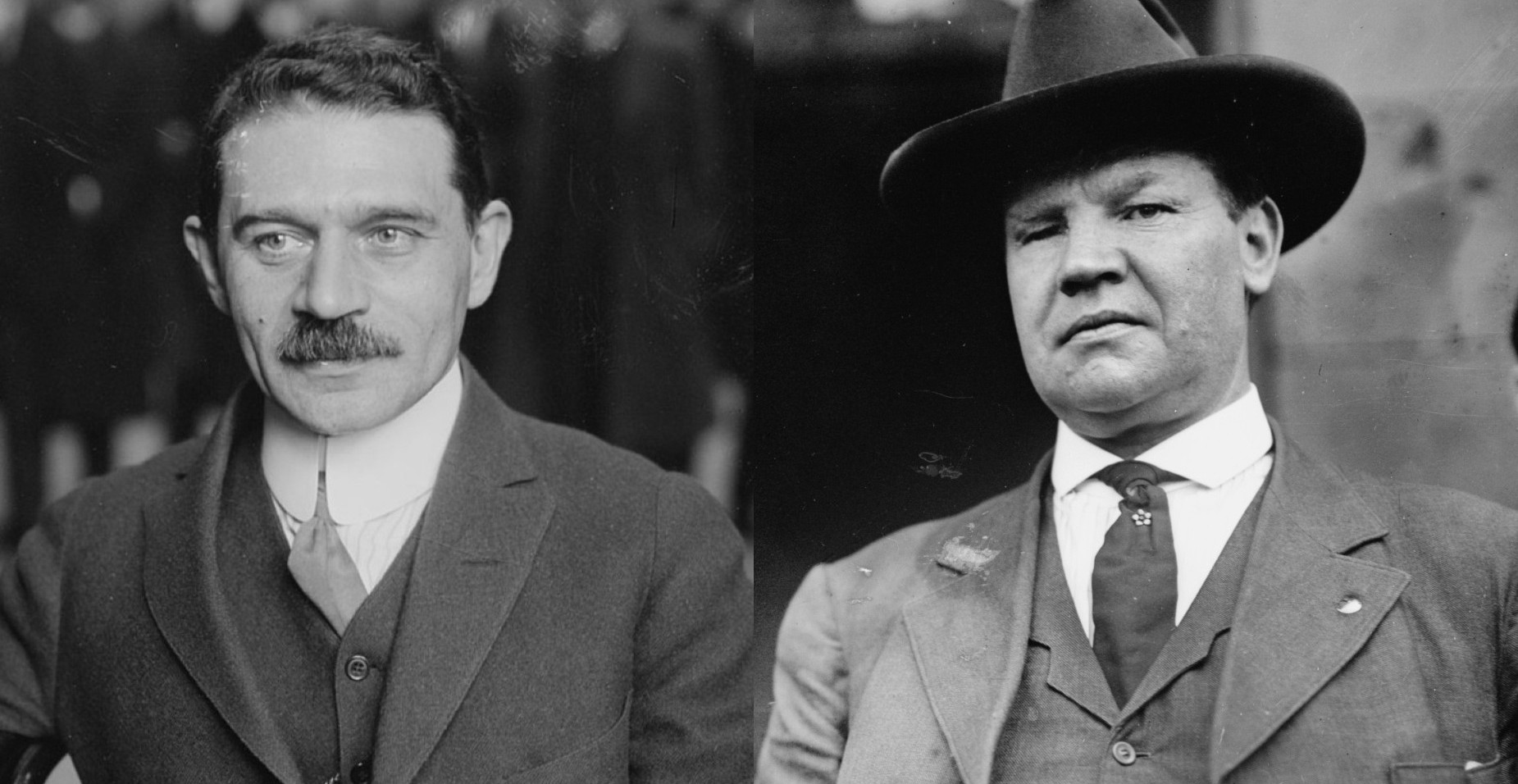
For years the two main antagonists in New York’s Socialist Party were Morris Hillquit, representing the opportunist majority, and Louis B. Boudin, the Marxist anti-revisionists. It is fair to say that there was no love lost between the two. Here Boudin defends Haywood and Bohn’s ‘Industrial Socialism’ from Hillquit’s violence baiting.
‘Law and Order’ by Louis B. Boudin from the New York Call.Vol. 4 No. 341. December 7, 1911.
Editor of The Call:
I have read Comrade Hillquit’s letter in The Call on “Socialism and Law” with the proverbial “mixed feelings.”
Although we have known it all along, it is yet a distinct satisfaction to have it recorded black on white that it is all a question of whose ox is gored. When opportunism is rampant and unchecked, it is “narrow-minded bigotry,” “hair splitting,” and, last but not least, “mischief making” to criticize “views” of any kind. Then we must all be doing “constructive work.” But when opportunism is in danger of losing its hold on the party, then “views” suddenly become of paramount importance, and our greatest “constructivists” take to writing criticisms of those “views” which they do not like, or which they consider as endangering their continued domination of the party.
Now as to the criticism itself.
Comrade Hillquit quotes the following passage from Bohn and Haywood’s “Industrial Socialism”:
“When the worker, either through experience or a study of Socialism, comes to know this truth (the economic foundation of modern ethics and jurisprudence), he acts accordingly. He retains absolutely no respect for the property ‘right’ of the profit makers. He knows that the present laws of property are made by and for the capitalists. Therefore She does not hesitate to break them. He knows that whatever action advances the interests of the working class is right, because it will save the workers from destruction and death. A knowledge of economic determinism places the worker squarely on his intellectual feet and makes him bold and independent of mind.”
And then he adds:
“This is good anarchistic doctrine, but is diametrically opposed to the accepted policies of Socialism and is not even a remote cousin to the theory of economic determinism.”
And again:
“To preach to the workers law-breaking and violence is ethically unjustifiable and tactically suicidal.”
All of these statements, with the exception of the very last one, which is too indefinite to admit of controversial treatment, are so wild and extravagant that had Comrade Hillquit’s name not been appended thereto I would never have believed that any Socialist of standing, and particularly one who pretends to be a Marxist, could have them. Comrade Hillquit has, of course, the right to his own views on the subject of law and order as well as any other subject. But it is quite different when it comes to declaring his own views as the “excepted policies of Socialism” and the reading of those who disagree with him out of the party as “anarchistic.” Also, people are supposed to learn something about such matters as “economic determinism” before rushing into print with a statement of their relationships.
I have spent a good number of years in fighting anarchism, studying the “accepted policies of Socialism” and the philosophy of Socialism, called by some “economic determinism,” and I am ready to subscribe to the passage quoted from “Industrial Socialism” as good Socialist doctrine, and very near kin to “economic determinism.” Although I personally do not like that name, and would probably have phrased the passage a little different, if I had the phrasing of it. But these are matters of detail. The substance of that passage is correct, and shows a pretty good understanding of the philosophy of Socialism, which I prefer to call “the materialistic conception of history.” Comrade Hillquit’s idea that “law-breaking” as applied to the laws of property is “ethically unjustifiable” is a monstrosity from a Socialist point of view, and I challenge him to name a single Socialist of standing who has ever advocated it. His invocation of the names of Marx and Engels and his references to the history of the Socialist movement can be the result only of insufficient knowledge, as I hate to suspect him of deliberate misuse of his knowledge. It is true that we do not “preach” lawbreaking as a policy.
But that is simply because we do not believe in the success of such a policy, just as we do not “preach” pure-and-simpledon for the same reason. Sometimes we “preach” very strongly against both, when there is danger that they may become the predominant policies of the working class. But we believe in unionism and that it has its own useful sphere. And we believe in the use of any weapon, political or economic, which may be genuinely useful to the ultimate interests of the working class, although some of them may involve lawbreaking. We have no more respect for law than we have for brute force. We submit to both as a matter of expediency, and only as long as we find it expedient. We may find it expedient for a long time to come yet. But when we shall find it expedient, we shall use “violence,” unless we shall be prevented from using it by such bourgeois prejudices as Comrade Hillquit’s “ethically unjustifiable.” Comrades Bohn and Haywood have therefore rendered a distinct service to the movement in writing that passage, calculated as it is to emancipate us from that bourgeois prejudice which “leaders” of Comrade Hillqult’a type are fostering in our movement.
The attempt to stigmatize that passage as “anarchism” or mix it up with “sabotage,” “propaganda of the deed,” etc., is very much akin to the attempts of our enemies to call every Socialist an “anarchist.” It has nothing to do with them. No, not even with syndicalism. I am opposed to all of these. But I am just as much opposed to the “Law and Order” poison, which threatens to convert us into a party very much akin to “His Majesty’s Loyal Opposition.” Comrade Hillquit’s love for law and order is best shown by the example which he chose to illustrate a situation when “violence” would be “justifiable.” Such occasion would be, he says, the “stealing” of an election or the attempt to prevent our elected representatives from taking office. “Stealing an election” is, of course, against the law, and we may therefore use “violence” to uphold the law. But suppose that the capitalists will simply disfranchise the working class “according to law”? Will we then be “justified” to use “violence” or must we then resort only to “legal channels”?
Comrade Hillquit’s appeal to “democracy” is entirely out of place. So far law has very seldom been the result of “democracy.” When it will be so genuinely there will be no occasion for a resort to violence.
L.B. BOUDIN. New York, Nov. 30, 1911.
The New York Call was the first English-language Socialist daily paper in New York City and the second in the US after the Chicago Daily Socialist. The paper was the center-right of the Socialist Party and under the influence of Morris Hillquit. The paper is an invaluable resource for information on the city’s workers movement and history, it is one of the most important socialist papers in US history. The Call ran from 1908 until 1923, when the Socialist Party’s membership was in deep decline and the Communist movement became predominate.
PDF of issue: https://www.marxists.org/history/usa/pubs/the-new-york-call/1911/111207-newyorkcall-v04n341.pdf
 Revolution's Newsstand