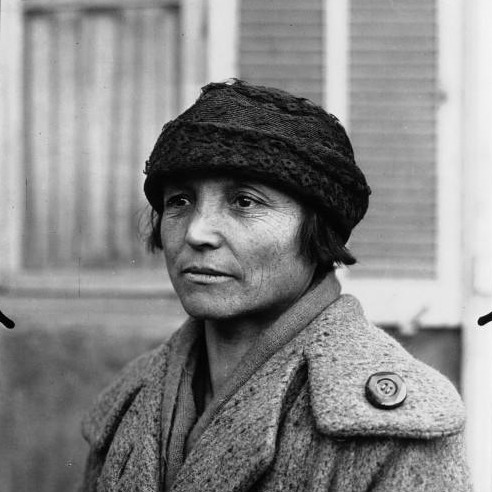
The third session is Kollontai’s report on ‘Forms and Methods of Work Among Women,’ followed by discussion with interventions from Zetkin, Roland-Holst, Lucie Colliard, Krupskaya, Ella Reeve Bloor, and others.
‘Report of the Third & Fourth Sessions of the Second International Conference of Communist Women’ from Moscow. No. 18 & 19. June 15 & 16, 1921.
The Session of June 12th opened at 11 a.m. with comrade Zetkin in the chair. The delegate of the Polish Communist Party to the Third Congress of the Comintern, conveyed greetings to the Conference, in the course of which he said that although there was no women representatives from Poland at that conference, it did not mean that the women of Poland do not participate in the communist movement. “We have no separate women’s organisation. We approach to working woman in the same way as we do the man. Furthermore the illegal conditions of our party do not permit the organisation of a special women’s section. Perhaps, when conditions will change, we will have to build a special technical apparatus. My burning desire is to see the women drawn into the fight for the dictatorship the proletariat. For without their active participation this great aim cannot be accomplished.”
Comrade Kollontai then reported on the forms and methods of work among woman. She said: “The moment experienced at present in Soviet Russia and in the Western European countries is characterised by its immediate objective conditions. There, as well as here, the pressing problem is economic reconstruction, and development of the industrial forces. The difference is only in that, that Russia can directly proceed to change her economic forms, while in the capitalist countries the proletariat must yet liquidate the dictatorship of the bourgeoisie. Formerly the problem of the socialist parties was to gather around concrete demands, which were a possibility within the frames of work of a bourgeois society. But now, the problem is quite different: it is the education of the masses in the spirit of their active awakening and expression of their will power impulses. Woman’s chief enemy is her passivity, which she must overcome. But for this we must find the necessary methods. We have to construct our apparatus in such a way that it will sever the basic aims at our party. Our immediate question is to take such a decision, that would oblige all communist parties to pay the most serious attention to this work. Then we have to strengthen the respective forms of this apparatus.
Illustrating the experience of the Russian communists, comrade Kollontai, reduced the aggregate of that experience to three fundamental tasks of the Women’s Section: to draw the broad masses into the Communist Party, to inspire initiative into the proletarian and semi-proletarian women, and questions of the emancipation of women, with regard to family, domestic and other relations. The various forms of organising work, as they appeared in Russia. consists in 1) the initial organisational basis the nuclei within the factories etc., 2) delegate meetings, and 3) Wide non-party conferences. Parallel with this, of vast importance in the business of attracting the broad masses of the women workers, is the political and economic campaigns (‘Subotniki”, special “Weeks”, special “Days”, etc.).
The reporter likewise drew attention to the great usefulness of the work of the Literary Collegiates in the Women’s Sections, the holding of discussions and debates in the form of mock trials, and work in the party schools.
Speaking of the application of all the above enumerated methods abroad, the reporter pointed out that uniform methods cannot be equally applied to the highly developed bourgeois countries and to the Countries of the East. For a large capitalist country the task of the Women’s Sections would be to inspire, and develop self-activity of the mass of working women with the aim of winning them over politically. The working women should take advantage of their participation in parliament and in the municipalities in so far as it is possible to accentuate the class contradictions, by means of the actual need of the proletariat, as well as sharply to expose the inability of the social-patriots to carry on a determined struggle. In the East, on the other hand, where the women live under specific conditions, under the age-long yoke of tradition, it is imperative to display the utmost flexibility, to apply unhesitatingly what would perhaps seem the most paltry measures in order to rouse the women of the East and draw them within the circle of communist ideas. The first thing to be done is to organise the women economically. Simultaneous with this cultural and educational work should be developed to the highest degree.
In summarising her report, comrade Kollontai, remarked that the centre of work should be the trade unions, the task of winning over which represents the fundamental problem of the Communist Party.
The discussion on Kollontai’s report was adjourned to the next session which will be held on the 13th inst.
II
The Conference opened at 1:30 p.m. with Comrade Clara Zetkin in the chair. Greetings were conveyed by the delegate from the Persian C.P. and a delegate from the Russian Young Communists.
Greetings were conveyed by a delegate from Finland in the name of the Finnish Women Communists, who vividly described the horrors of the White Terror in Finland.
After that followed the discussion on the report of Comrade Kollontai read on June 12th on the form and methods of work amongst women.
Comrade Smedovitch illustrated the work amongst women in Russia, by pointing to the arrangements of delegate meetings and Communist groups in the factories. The delegates, as experience has proved, presents a powerful means of drawing the broad masses of women workers into the Communist Party and Soviet work. The circumstance that the delegates meetings are called periodically in Moscow every 3-4 months imbues every delegate with the thought of the responsibility of her work. At the delegate meetings, all practical women workers are called to the various Departments of the Soviet, which in its turn imbues the mass of women electors with confidence in the Soviet institutions, which in this manner comes under their control. The delegate meetings must become actual schools for Communism: during the 3-4 months the delegate unconsciously goes through the whole course of the program of the Communist Party. With regard to the immediate work in localities; in enterprises, and factories such work has only commenced recently, and with this aim, the chief tasks are placed on the Communist Groups organisers conjointly with the delegates to penetrate into the very midst of the women workers.
The delegate from the Dutch Communist Party spoke next. She said that the question of where and how to influence the women and to capture them for Communism, is one of the most important questions which we have to decide. The Communist Party of Holland has already commenced its communist propaganda amongst women.
A commission has now been formed at Amsterdam for Communist propaganda amongst women. A large number of women-housekeepers, and factory workers are quite consciously attracted into our Party. The speaker emphasized the fact that the centre of gravity of the whole work, must be transferred to the Communist Groups in the factories and workshops. At all other enterprises we must utilise the forces of the Women Communists, for work among women.
Comrade Clara Zetkin followed next: “We have to thank comrade Kollontai”; she said, “for the fundamental idea of her report. It is understood that our most important work, is the educational work amongst women. The weakness of the women proletariat is not due to lack of organisation, but in the weakness of Revolutionary Will power, in the lack of confidence in their own powers. However, I do not agree with comrade Kollontai on another point. She outlined the plan of our work too mechanically. Of course no one can deny that our chief task is the work amongst the women industrial proletariat. We will even have to bring pressure on the Congress of the Red Trade Unions, in order that they should put forward a special resolution dealing with the organisation of women workers. We must not forget the fact, for instance, that in Germany, only a fifth part of all the women are occupied in independent productive labour. The great majority of women–even proletarian women are housekeepers. This applies not only to Germany but also to France, Italy, Switzerland and to all countries of Western Europe. Therefore it is absolutely necessary, that we draw into the struggle these proletarian women who are engaged in housekeeping. We must not regard this as of second-rate importance. These are two aspects of the same task. How stands the matter with the peasant women? Our agitation in the villages must apply to men and women. A great part of the peasant women, are already proletarianised they present a favourable ground for Communist agitation. The conduct of the peasants farm largely depends on the peasant woman. In the event of her illness or death, the thing goes to pieces. The peasant woman lives under as great a yoke of capitalism, as the proletarian woman, it is only Communism that can give freedom. Comrade Zetkin also thought it very necessary to pay great attention to the work amongst the educated women, working in Government Departments. They are connected with the political apparatus of the State. They are serving that apparatus which crushes and oppresses the proletariat. At the same time their position is a very difficult one. In times of crises or bankruptcy, women are the first to be thrown on the streets. The work of capturing this class cannot be left till the time when the apparatus of the bourgeois State will be wrecked. It is understood that the whole of this work must go on without a shadow of abatement because of bourgeois opinion. Apart from that, it is quite clear that this work must not take one atom of our forces from the work amongst the women of the industrial proletariat”.
The representative of Germany followed comrade Zetkin. She reported on how the work amongst women is organised in Germany. The work is conducted by an agitational committee, composed of five people. Every member of the committee has a special duty to perform: one takes charge of the agitational literature, another, the agitation of the domestic workers, the third, work in various enterprises etc. Separate groups affiliated to district groups, the districts into counties. Every district group has a secretary. The essence of that organisation is that it is headed by a member of the Party Committee, and all the work is conducted under immediate leadership of that comrade. The work amongst the domestic workers is extremely difficult: usually it is done by comrades, who have streets specially assigned to them. In conclusion the comrade pointed out the necessity of conduction agitational work in all enterprises, and Trade Unions, in the direction of exposing the compromising policy of the Social Patriots, who have taken root there.
Comrade Bloor (America) spoke next. She expressed pleasure at the fact that the Third International will define the form and methods of work amongst the mass of the working women. Our Communist Party, she continued, is working underground, consequently it is extremely difficult to crystalise special forms of the women’s movement. Our chief work is conducted in the Trade Unions. Comrade Bluer who is here as a representative of a Trade Union reported in detail by what methods the Communists get into the very midst of the American Women workers.
In conclusion Comrade Bloor again emphasized the need for working especially in the trade union movement.
Comrade Nikolaeva (Petrograd), analysing all the methods of working amongst women practised in Russia, especially the work of the “sections” and delegate meetings expressed conviction that delegate meetings play a tremendous part in instilling a communist spirit amongst the large masses of women workers which they attract. By means of these delegate meetings we create bands of agitators who reach right down into the heart of the masses; and from amongst whom, from time to time, many gifted and practical workers are drafted into the Soviet institutions. She illustrated by figures the growth of the women’s Communist movement, which thanks to the activities of the Petrograd Women’s Department, quickly attracted women into Soviet work. Thus, formerly there were 45 women members in the Petrograd Soviet, then 200, then 340 and now over 500.
Further comrade Nikolaeva pointed out the part which women take in public education and food departments. Dealing with the work amongst the peasant women Comrade Nikolaeva described the deep interest which is shown by peasant women in large non-party conferences. These conferences are now part of the scheme of work amongst women, and considerable attention is to be devoted to them, in view of the fact that the change in internal conditions–the transition to peaceful economic reconstruction–confronts the Women’s Departments with new and more important questions–the attraction of foreign women workers and peasants and the fact that conditions abroad are almost the same as those which existed here under Kerenski in 1917. She spoke of the need of agitation for taking an active part in the proletariat’s struggle for capturing political power. As delegate conferences abroad cannot yet be carried out it is therefore necessary to build special organisations to suit the special conditions of each country.
Comrade Krupskaya expressed her opinion that there seemed to be no difference in the points of view of comrade’s Zetkin and Kollontai. She pointed out that the theses spoke of specific Russian conditions and emphasized the close relations between the women workers and women peasants,
The Swiss delegate then said a few words and observed that the report of comrade Kollontai gave the delegates a clear conception of the ways and means of working under Russian conditions, whereas they required a plan of action to suit the conditions of the countries West where capitalism still existed.
European countries could be divided into two categories as regards the work being done amongst women. In the first group are those countries where hardly any agitation has been carried on amongst women. In the second group are such countries as Germany and some other states where attempts have already been made to found an organisation accepting the resolutions of the First International Women’s Conference. The report of the comrade who dealt with the work in Germany seems to be exemplary. The organisation of a Central Secretariat and district secretaries seems to be almost ideal for us. I believe that these theses should be accepted. But first of all we must devote all our energies to put into action the theses and resolutions adopted at the former conference. Besides these. we must strive at making the Comintern Congress seriously consider the question of beginning work amongst the women proletariat.
The next speaker was the Austrian delegate. She emphasized the necessity of adopting different tactics for Russia and for the capitalist countries. The workers in Russia have already passed those stages in which the Western proletariat still finds itself. The Russian men and women are now issuing their slogans of construction, we have as yet to make our slogans of destruction. If we were issuing our slogans of construction, we would have fallen into opportunism and have deserted our post of working in common with the Russian Proletariat. The speaker proposed that the work amongst women should be divided into the following three groups. 1) Housewives 2) Women workers who are at the same time housewives and factory workers and 3) Factory workers. It is natural that the first group should be the most backward. They must be approached in a special manner. One must talk to them of their children, of their daily economic life, of their domestic difficulties etc. The factory women feels herself a real part of the proletariat and as a class she is conscious and revolutionary. She can be directly approached on the revolution. But a careful approach is necessary for the intelligent working woman. We may not make an active communist of her, but we can undoubtedly arouse her sympathy towards us. The Russian worker must not forget the special circumstances under which the worker of the West lives, and the fight with petty-bourgeoisism and routine which hinders his revolutionary work.
Lucy Colliard from France then addressed the Conference. She pointed out that the syndicates offered a wide field for work among women. She emphasised the need for obtaining complete control of the syndicates by the party and believes that in the most reactionary syndicates strong attempts at communist work were being made. She emphasized the need for caution in propaganda amongst women and showed the necessity of putting party energy into working amongst women. The party up to the present has not devoted much energy to this work, but we lay strong hopes on the teachers who are being fortunately driven into it by the government. These modest workers, living side by side with the peasant masses will be the most active elements for instilling revolutionary consciousness into the masses of the peasant women, and will help to win them over to communism, The high cost of living, the struggle with profiteering, extremely prevalent in France and other countries, will show the manner of approaching this part of the population.
The representative of Germany said that in the sphere of work amongst housewives special attention must be paid to the consumers cooperatives, and clubs for mothers and housewives which we must penetrate with our communist propaganda. Special attention must be paid to the trade unions In Germany we have 9,000,000 organised trade unionists, of whom about 2,000,000 are women. It is essential that the party in every country makes each of its members join a trade union. Our work is of such a nature that we have our groups in every institution at whose conferences we must arouse sympathy and which must discuss all questions before they are touched by the trade union conferences, As for example, the Executive of the Engineering Union, where we have a communist majority. We have had two special organising conferences of the workers in the clothing industry. She proposed that the International Congress of Trade Unions have a special report of the question of work amongst women.
The conference then adjourned till 7 p.m.
Moscow was the English-language newspapers of the Communist International’s Third Congress held in Moscow during 1921. Edited by T. L. Axelrod, the paper began on May 25, a month before the Congress, to July 12.
PDF of full issue: https://www.marxists.org/history/international/comintern/3rd-congress/moscow/Moscow%20issue%2018.pdf
PDF of issue 2: https://www.marxists.org/history/international/comintern/3rd-congress/moscow/Moscow%20issue%2019.pdf
 Revolution's Newsstand