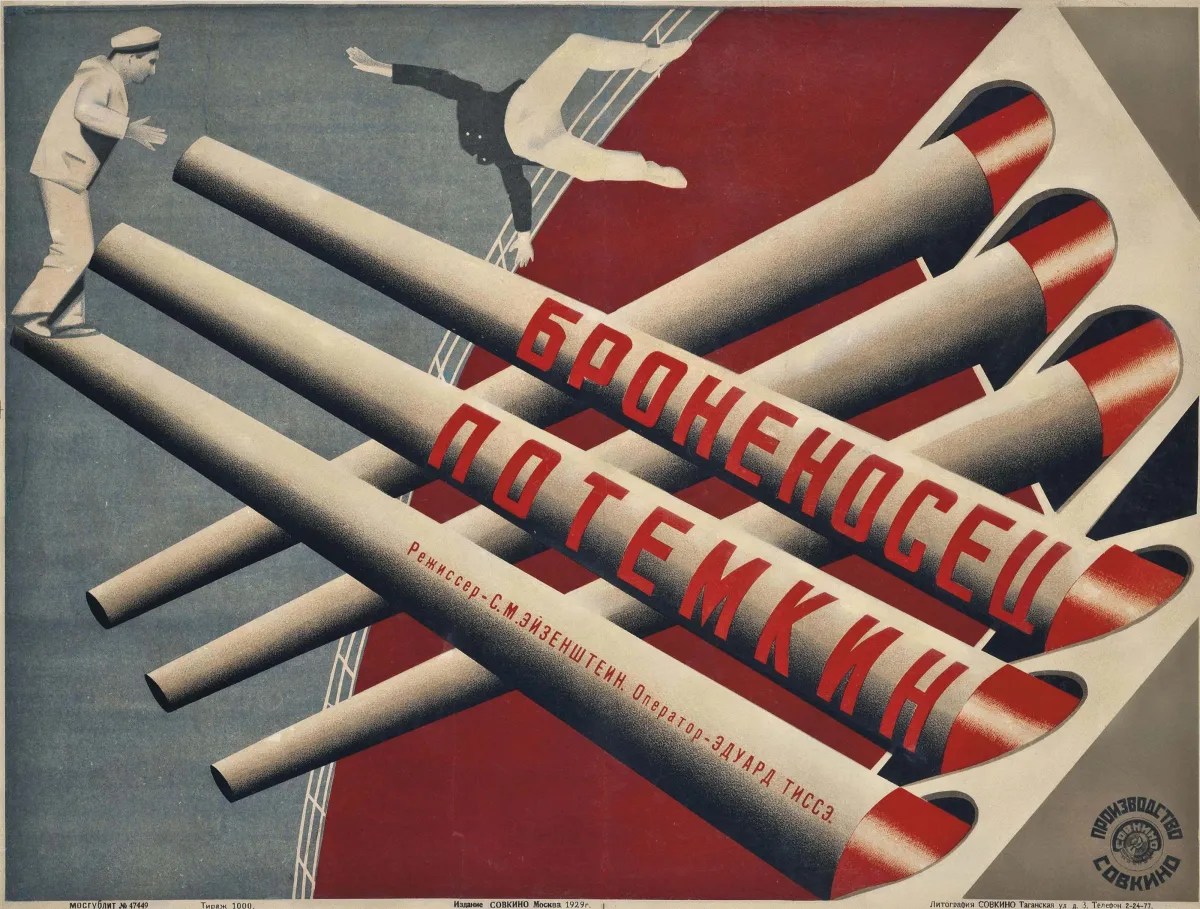
Edwin Seaver has an early view of Eisenstein’s Potemkin before its official U.S. premiere on December 6, 1926 and is blown away.
‘Potemkin’ by Edwin Seaver from New Masses. Vol. 2 No. 1. November, 1926.
Potemkin, by the almost unanimous consent of those who have had the privilege of seeing it, has been nominated the peak achievement in the art of the motion picture.
America invented a new vehicle of expression; Germany gave it cunning; Soviet Russia has given it a soul and a mission in life. America invented a new machine and put it to work earning money; Germany endeavored to make it conscious of its possibilities; Russia accepts it entirely as the perfect means of expressing her new life, the life of our mechanical age and of masses of men.
Potemkin is a complete break from anything hitherto known in the art of the motion picture. (Experimental films like Murphy’s Ballet Mecanique and Beaumont’s Of What Are the Young Films Dreaming, while splendid in themselves, may here be put aside as serving the craftsman and quickening the artist’s imagination to new possibilities rather than deepening the layman’s vision.) Potemkin is a break from the silent drama, from situations. It might be called rather, silent narrative. But we should have to drop the adjective, for if anything can be more eloquent than the marching legs and levelled rifles of the cossacks, or than the excited machinery of the battleship steaming in full flight before the Czar’s fleet, I have yet to hear it. Potemkin is a straight line narrative, expressed in pictures of action as simply as in the words of a folk story, its dramatic value lying not in situations but in the natural ebb and flow of its emotional intensity.
If subject alone were the foundation of Potemkin it would have its parallel in any number of cheap American thrillers. Substitute for the sailors the hero, and for the crowds on shore, the good people of the town; for the officers the villain, and for the cossacks the villain’s accomplices, or associated hijackers, thugs and pimps, or a forest fire. Have the hero racing from what appears to be the villain’s accomplices, only to find out in the nick of time that it is not they at all but really his friends. And there you have a good western thriller, American brand.
No, it is more than subject that makes Potemkin so pulsate with excitement, so throb with horror and awakened sympathy, with hatred for injustice and understanding of the insulted and injured. It is the comprehension, the social vision that makes the subject; it is these things expressed with emotional power; it is the perfect understanding of form in the art of the motion picture. It is the formal arrangement of subject that piles thrill upon horror and release upon thrill, that makes even machinery emotional and endows human brutality with the stupidity and fearsomeness of machinery. Action, suspense, crisis, release, quickening tempo, resolution of conflicting elements all these are the formal stuff of Potemkin. After the revolt of the sailors is the calm of ships resting quietly in the harbor of Odessa. After the sunlight and joy of the crew freed of their oppressors, after the awe and visioning of the crowds on shore at the humble resting-place of their martyr, comes the uneasy sleep of the sailors, the mounting shadow of further oppression on the part of the Czar’s fleet, the fearful race for life working up to a frenzy of excitement, and the sudden release in the knowledge that escape is assured. Poetic justice. Curtain.
All this may be “life itself,” but it is life arranged by an artist to give a unity of approach and understanding. The fact that the director of Potemkin has used masses of men rather than individuals to express his mass drama (the masses are never mobs but streams of individuals made one in suffering and one in joy and one in resolve) is also a formal element. It is an element native to the art of the motion picture.
The New Masses was the continuation of Workers Monthly which began publishing in 1924 as a merger of the ‘Liberator’, the Trade Union Educational League magazine ‘Labor Herald’, and Friends of Soviet Russia’s monthly ‘Soviet Russia Pictorial’ as an explicitly Communist Party publication, but drawing in a wide range of contributors and sympathizers. In 1927 Workers Monthly ceased and The New Masses began. A major left cultural magazine of the late 1920s and early 1940s, the early editors of The New Masses included Hugo Gellert, John F. Sloan, Max Eastman, Mike Gold, and Joseph Freeman. Writers included William Carlos Williams, Theodore Dreiser, John Dos Passos, Upton Sinclair, Richard Wright, Ralph Ellison, Dorothy Parker, Dorothy Day, John Breecher, Langston Hughes, Eugene O’Neill, Rex Stout and Ernest Hemingway. Artists included Hugo Gellert, Stuart Davis, Boardman Robinson, Wanda Gag, William Gropper and Otto Soglow. Over time, the New Masses became narrower politically and the articles more commentary than comment. However, particularly in it first years, New Masses was the epitome of the era’s finest revolutionary cultural and artistic traditions.
PDF of full issue: https://www.marxists.org/history/usa/pubs/new-masses/1926/v02n01-nov-1926-New-Masses.pdf
 Revolution's Newsstand