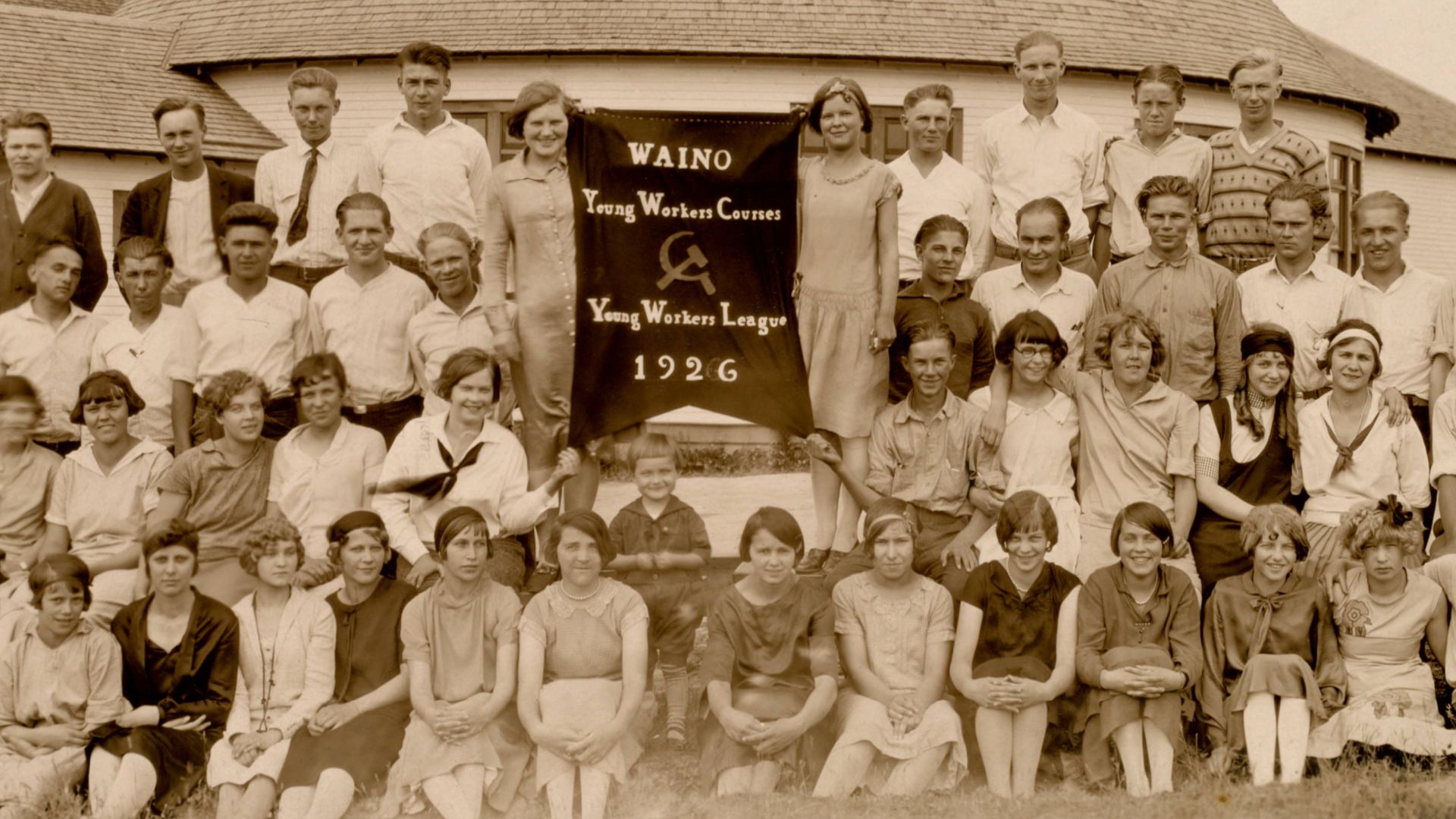
A report to 1928’s Fifth Congress of Young Communist International on the organization and work of the approximately 2400 (with a high turnover) Y.W.L. members over the previous four years.
‘Report of the United States’ from The Young Communist International Between the Fourth and Fifth Congresses, 1924-1928.
GENERAL STATUS OF WORKING YOUTH.
During the past period there has been a gradual increase in the participation of the working youth in industry, till today they number over eleven million, i.e., one-fourth of the total working population. These are distributed amongst all of the important industries. The general economic conditions of the working youth are very poor, being far below the average conditions of the adult workers, and their wages even being much lower than is the accredited minimum living wage of the government and bourgeois statisticians.
Politically, large numbers of the working youth are directly under the influence of the bourgeois youth organisations. Despite this fact, there is an increasing response on their part due to the pressure of social changes, and they are beginning to be an important factor in the life of the country. The principal revolutionising factors are: restriction of immigration which makes the youth one of the main sources of unskilled labour; the continued farm crisis, which drives large numbers into the city labour market; the increased rationalisation since 1922 of American industry, which has increased the proportion of young workers in industry, and even created a whole series of youth industries; the acute crisis in specific industries, such as coal mining and textile, where the youth are being driven to the forefront as the militant section of these workers; and, lastly, the present unemployment, resulting also from rationalisation, which affects a section of the working youth.
CHARACTERISATION OF THE LAST FOUR-YEAR PERIOD.
At the time of the fourth Congress of the Y.C.I. the League had already adopted a general programme of Communist activity, which was receiving its initial introduction, into practice. From this period up to the present time there have been four main characteristics of League work and life:
(a) Concretisation of the decisions on mass work through increased participation of the League in the actual struggles of the young workers.
(b) Organisational consolidation of the League through the establishment of a better working apparatus, the liquidation of the obsolete language units and the development of some new leading forces.
(c) Increased politicalisation of our work by trying to react to and give a practical lead on all current political events.
(d) The periodic factionalism and resulting internal crisis, based primarily on a reflection of the unhealthy Party situation, has been a great obstacle in the path of greater progress on the part of the League.
ORGANISATIONAL STATUS.
In the past period the organisational apparatus has been improved and strengthened through the liquidation of the obsolete language units, and the creation of district apparatus coordinated nationally. The League as yet is still a small group separated from the masses of the American young workers, although some progress has been made towards increasing the membership. In contrast with approximately 1,700 members at the Fourth Congress, today the League numbers 2,400 members. There has been considerable fluctuation caused primarily by the internal situation and the great turnover annually in membership. The social composition of the League has fluctuated. Up to 1927, the tendency was towards an increase in the worker elements in the League. In 1927, all elements exclusive of students numbered 77 percent, while today the total of all elements exclusive of students is 64 percent, showing a decided increase in the student element in the League, which is not good. At the same time the League is still insufficiently rooted in the basic industries. A decided improvement is reflected in the national composition of the League, by having today 66 percent native born in contrast to approximately 20-25 percent in 1924.
The experiences of the League in reorganisation have been many and varied, but have resulted in few practical achievements, exclusive of the aforementioned liquidation of language units and the experience and knowledge gained. The League still has the primary task of organising shop groups as the prerequisite for a later complete reorganisation.
TRADE UNION AND GENERAL ACTIVITIES.
In the field of mass work, the League has made the greatest achievements in economic trade union work. It participated in all of the important strikes and in some, such as Passaic and mining, the League has been a very important factor. In these strikes the League, through its slogans, demands and activity, has gained the confidence of many times the leadership of the young workers involved. Some of the weaknesses have been the tendency to issue general instead of concrete demands, to hide the official face of the League, and to gain insufficient organisational results from the influence achieved.
The outstanding activity of the League has been its concentration on the mining industry for a period of four years. While at first this tended to be abstract and journalistic, gradually with the continued crisis in the coal industry culminating in the present strike lasting already one year and resulting in the betrayal by the bureaucracy and the actual disintegration of the union, the League has become a vital factor in the present campaign to win the strike and to rebuild the Miners’ Union with the labour fakirs outside. This activity has expressed itself during the union election and convention period, the strike period with its resulting battles with the coal operators, labour fakirs and armed forces of the State, as well as in the present campaign for saving the union and rebuilding it, simultaneously conducting an organisation drive in the unorganised fields. In every district and nationally League members are to be found in the leadership of the Left wing forces of the miners’ struggle. In connection with this the League organised successful United Front Miners’ Relief Conferences of youth organisations.
Linked up closely with our strike activity has been one of the basic campaigns of the League, namely, unionisation of the youth. This is especially important because of the actual lack of effort on the part of the existing unions to organise the young workers. In some places the League has been responsible for the organising of new unions in industries where the youth are predominant. Experience has been gained in the calling of youth conferences, four of which have been held to date three in the mining industry and one general conference.
While factory activity is conducted and a number of factory papers issued, this work as yet shows many weaknesses, especially an underestimation of the importance of individual activity on the part of every League member.
To the present unemployment crisis the League has reacted quickly, many times taking the leadership over the Party, despite some serious errors, which have been made in the form of the demands.
The League has conducted a campaign, both internally and externally, against the C.M.T.C. This has resulted in popularising the League as a champion against capitalist war.
In the United Front activities many mistakes, primarily of a pacifist character, were committed in 1926-27. The mistake of making united fronts only with petty bourgeois, liberal groups have been recognised and corrected to a large extent.
While previously much of the activity was limited to general propaganda, recently steps have been taken towards more concrete work, such as demonstrations and the distribution of literature among marines and soldiers who were being sent to Nicaragua and China.
Access to full book: https://hdl.handle.net/2027/uc1.$b812215
 Revolution's Newsstand