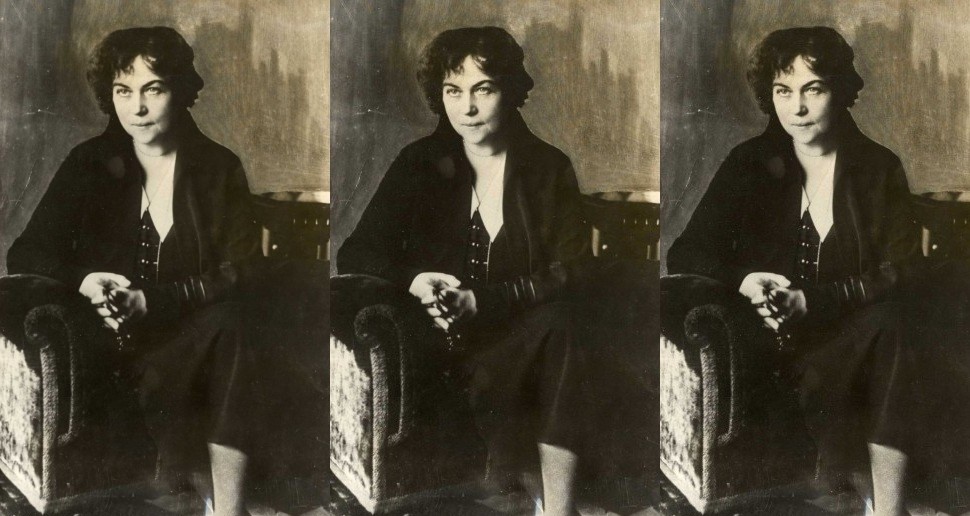
Evening of June 13, 1921 continuing the discussion of Kollontai’s report on the ‘Method and Forms of Work Among Women’ with interventions by delegates from Bulgaria, Czechoslovakia, Armenia, Hungary, Austria, Korea, and Britain, with Kollontai’s response.
‘Report of the Fifth Session of the Second International Conference of Communist Women’ from Moscow. No. 20. June 17, 1921.
The delegate from Bulgaria continued the discussion: she said that the question of methods and forms of the Woman’s movement are not new to us. The theses worked out by the conference last year were accepted and carried out by us. Our small country with its small agrarian population of 4 million can present to this conference actual results of our work. Capitalism commenced to develop in our country 10-15 years ago and at the very start the women were drawn into industry. Out of 300,000 workers 40% are women. This is why the large masses of women joined the growing revolutionary movement. It reached, however, a special stage of development in 1914. In that year auxiliary apparatus within the parts were formed for agitational work among women. The Central Committee formed a special Women’s Central Commission and Women’s Committee with the local committees, which numbered 162 all over the country. Great work is being done in the formation of circles among the peasantry. Every 6 months we have a Woman’s Red Week. During the railway strike of 1919, the women participated most actively in the movement and served as a living connection between the comrades who were in prison and the Central Committee which was leading this great strike.
The speaker concluded her speech by expressing the wishes that the women’s movement next year will have grown to such a stage as will demand the working out of a thesis for Soviet re-construction the world over.
The representative from Tchecko- Slovakia said; “All our work is being conducted on the principle established by the Third International Congress. At this conference we must correct the mistakes of last year. The women must get the right to vote, and this, not for feminist reasons, but because of the great educational value of such a right. Only when the woman will be involved in political work, shall we make a revolutionary fighter of her.
“We will be glad”, concluded the speaker, “if next year we will not need a special woman’s congress, but will have a general interparty communist congress”.
The Armenian representative said: “The task of the Communist International is to mobilize the proletarian masses for a struggle for the dictatorship of the proletariat. But side by side with the proletariat there are other great masses of people, who suffer not less than the proletariat under the yoke of capitalism. These are the peoples of the East. They are also ripe for the revolution. They rising already for the storming of the capitalist stronghold. The whole nation participates in this struggle. This is a war for liberation of nations. The work of the women of the East must make it its object to draw in great masses of women into this war. Naturally work of such a character demands special methods. We must remember that without successful work done in the East, we will not be able to establish the social revolution in the West. The women of the East must go hand in hand with the women of the West”. The speaker proposed to all the representatives of Eastern countries at the conference to gather at a special conference to discuss methods and forms of work amongst the women of the East.
The delegate from Hungary said: “Before we discuss the theses and methods among women, permit me to describe the women’s movement in Hungary. Hungary, at present has not any women’s movement in the real sense of the word. The reign of White Terror for the last two years has rendered it impossible to create such a movement. However a certain interest in the movement is noticeable. Within the communist parties, which are illegal, there are special apparatus for work among women. These organisations are also illegal. It is necessary at this conference to work out for them a form of organisation. Of course it is impossible to build one international form of organisation for these illegal apparatus. The speaker therefore asked delegates of countries which have underground women organisations, assemble in order to work out methods for their work.
“Before the war, she continued, “the movement was insignificant. During the communist revolution in Hungary women were not given responsible political work. Now things have changed, for the bloody reaction equally affects the working women as it does the working men. Now the woman of Hungary is ripe for revolution”
Comrade Kudell, dwelt on methods for the rousing activity among woman workers. There is one sure way to this vie closely to observe the woman masses and know how to draw out their abilities. For this purpose special circles, literary, agitational and others, must be organised where the most able display her abilities. Such a method of work has a great educational value. The speaker replied to comrade Colliar who stated that in France the work among women is done by teachers The working women must rely upon themselves and not upon the intelligenzia. The intelligenzia is revolutionary only as long as it is oppressed, but it will desert the proletariat on the day when the proletariat will take power. It is necessary to create a purely proletarian intelligenzia Comrade Kudell speaks of the formation of special organisational courses for the training of instructors for agitation in the country and in the provinces. The speaker concludes her speech by an exclamation: “Long live the communistic intelligenzia which came from the ranks of the proletariat”.
Comrade Smythe then spoke and said: “One cannot approach a British worker with a mere dry theory. The English worker is more class conscious and better trained for the understanding of his position and his problems, than we think. Although he lacks knowledge and theory and fundamentals of communism he learns by actual practice. All that takes place in Russia is understandable by the healthy mind of the English worker. Nothing is so rapidly approaching the social revolution in England as the labour movement at the present time. The English workers are conducting a firm policy in the spirit of the Third International.
In the field of woman’s work, very little has been done. The International Secretariat is partly to blame for this. We have not yet received the instructions which were worked out at the First Women’s Conference last year.
In England we have not any special apparatus for woman’s work but the English delegation considers it necessary to have such apparatus.
In England the working women are mature for Communism. The work among them, however, should be carried not on the basis of theory, but by training on concrete activity. We should infuse in them the principles of self-activity. In England the Party is weak, if judged by its membership. But if judged by its influence over the masses, it should be considered very strong. Thanks to the Communist Party the workers refused to load arms for the s White Polish Army during the war with Soviet Russia. Much credit for this should be given to the women communists, who carried on a lively agitation at the dock for the purpose. The hour of the social revolution in England is undoubtedly approaching, and precisely because of this it is necessary to exert all efforts to ensure that the women do not become an impediment to that revolution. Attention should be paid to the growing generation. Care should be taken that the working mothers bring up their children conform able with, and attach them to the necessary Communist institutions. In England it is important to pay attention to the housewives, who are more susceptible to communist propaganda than the women in the trade unions. The speaker further objected to the thesis on parliamentarism, considering that the germ of parliamentarism would only undermine the revolutionary feeling of the masses and hinder them from undertaking direct methods of struggle. The speaker concluded by pointing out the importance of intensified work in the cooperative societies.
The delegate from Korea said: “On Kollontai’s theses and in the discussion of them I heard nothing about the methods of work among the women of the Far Fast. Western Europe and to some extent, the Near East has been made the centre of activity, particularly of the women’s movement. It does not need repeating that the basis of every social movement, including that of the women, is economic conditions. Economic conditions have forced the women of the Far East to leave the harems and go to work in the factory or on the plantation. I am in possession of Japanese statistics from Korea. In 1920, where there was a population of 20 millions, there were 3,255,000 women workers working at the plantations, 128,000 working in the factories, 68,000 on transport there are altogether four and a half million women wage workers. These figures speak convincingly of what Japanese Imperialism has accomplished. The same thing although in a milder form, is obtained in China. Further, women have only merely broken with the harem, they have become revolutionized to no less degree than the men. At the beginning the women’s movement bore a feminist character like the movement in America, whence it was borrowed. But the economic conditions have done their work. The famine in 1919 deprived a huge part of the small proprietors of their plots of land, and consequently still more the army of the women proletarians. In Japan, moreover, there is at present an acute over production, as a result of which unemployment among women has grown enormously. Traffic In women has developed to an incredible extent. Societies have even been formed to engage in that traffic. As a result of all this, the women in Korea have become active revolutionaries; the more progressive part of them, even armed themselves and went into the ranks of the insurgent forces. In Korea, there are quite a number of revolutionary women’s organisations, (Society of Patriotic Women, Society of the Red Cross, League of the Red Death and others) which are of a terrorist nature, and whose leaders have now been in jail for two or three years, 597 members of these detachments are now incarcerated in the jails of Korea. All these organisations bear the character of a movement for national liberation, directed against Japanese Imperialism, and this is what we have to reckon with in drawing up the methods of work among the women of the Far East. Swayed precisely by these considerations the Delegation of the Far East proposes two supplements to the theses.
1) In relation to the movement for national liberation, and;
2) in relation to the revolutionary intelligenzia.
Kollontai then spoke, she said: “The Austrian delegate was perfectly right when she pointed out that we have combined under one principle, diverse conditions of all work such as exist in Soviet Russia and in capitalist countries. This diversity of methods is necessitated by the diversity of political conditions. While here, in Soviet Russia, our chief care is construction, in capitalist countries it is destruction, which according alters the methods of work. The capitalist countries are now living through, not a preparatory period of the dictatorship of the proletariat generally, but are on the threshold of the social revolution. This should be taken for a guiding factor in the appreciation of every practical demand. Comrade Zetkin, and many others too have spoken here about the work among the intellectual women. I generally have no objection to this work, particularly on consideration of the role which the intellectual women occupy in the bourgeois economic machine, and which renders them extremely valuable for the proletariat at the moment of the transfer of power into the latter’s hands. It is necessary, however, to introduce full clarity on the point as to who is to serve as the fundamental nucleus, the foundation of all our activity. Neither the peasant woman, nor the intellectual women, nor the housewives are that. The foundation of all our work should be and can only be the women worker, the wage labourer. It is necessary to have a well crystallised communist nucleus, organically strong and welded by an iron party discipline concentrating withing itself the will of the revolutionary Proletariat. Only if we possess such a nucleus shall we be able, at the necessary and decisive moment, to secure the backing of the broad masses, only on that condition shall we be guaranteed against fatal vacillation and irresolution at the critical moment.
Our Oriental comrades called attention to the fact that the intrinsic value of our conference is not at all in that it has advanced or established any new methods of work they have remained as before–but precisely in the fact that this Conference was the first in History to set up in all its magnitude the question of the working women in the East. Our Eastern comrades would like to see in our resolutions exhaustive instructions for carrying on the work among the women of the East, whereas we are at present only able to mark out here the main road, and leave to the Eastern comrades themselves to suggest the details for our methods. Our methods, established last year have proved correct. This is attested to by our Conference and our debates which have revealed that many countries, not knowing of the resolutions adopted, have independently approached them and employed them during all their work. Our Conference has merely broadened, vitalised and complemented them, as is proved by the number of amendments made by comrades of various countries. It speaks most strikingly of the fact that however modest the work of our Conference has been, it signifies a step forward on the road to establishing the Soviet Government in all the countries of the world.
End of the Evening Session.
Moscow was the English-language newspapers of the Communist International’s Third Congress held in Moscow during 1921. Edited by T. L. Axelrod, the paper began on May 25, a month before the Congress, to July 12.
PDF of full issue: https://www.marxists.org/history/international/comintern/3rd-congress/moscow/Moscow%20issue%2020.pdf
 Revolution's Newsstand