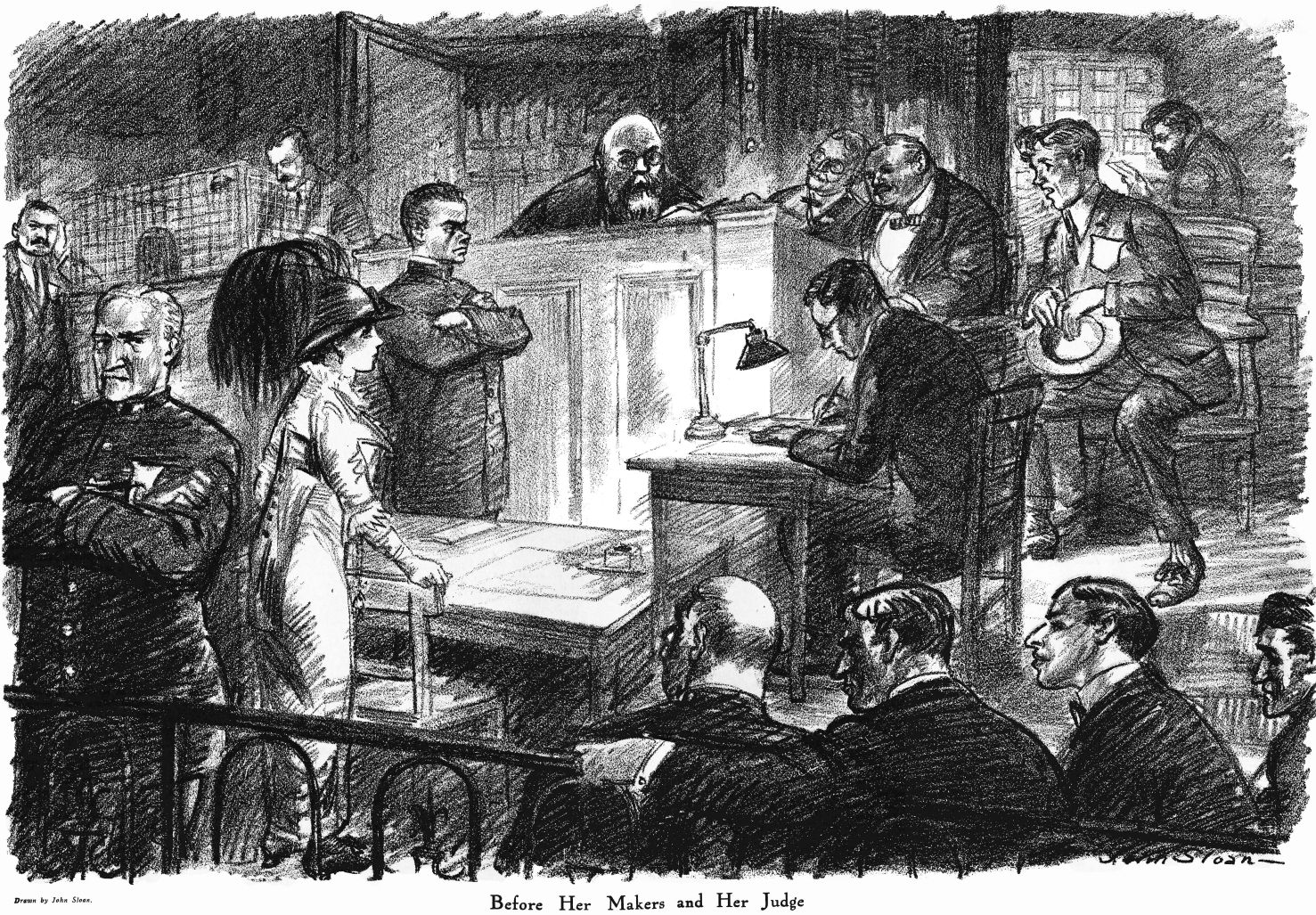
Now matter how we might try and avoid it, in our daily lives working people will bump up against the forces of law and order. An ISR editorial of advice from Charles H. Kerr, himself dismissed from jury service in 1906 for asserting he would not vote to ‘convict’ a guilty person of a law he thought unjust.
‘Socialists, Police, Courts, and Juries’ by Charles H. Kerr from International Socialist Review. Vol. 14 No. 5. November, 1913.
No reform, nor any series of reforms, N is going to end wage slavery. No reform is of any consequence compared with the overthrow of the capitalist class. And so long as the capitalist class controls the United States courts, no state nor municipality will be allowed to carry out any reform that will diminish the profits of the capitalist class. Lastly, not to be misunderstood, we repeat for the thousandth time that the main task of the Socialist movement is to educate and organize the wage-workers of the civilized world for the overthrow of the whole profit system.
Yet when all is said, we can not sidestep the question of reform, and this for two reasons. First, because the initiative and referendum are coming into general use and Socialists, like other people, will need to vote yes or no on a mass of new legislation. Second, because Socialists are and will be in control of certain municipalities, and our success or failure in so running these as to improve the condition of the wage-workers who live in them will be a fair test of our sincerity and our ability to do bigger things.
There are reforms and reforms. Some reforms benefit property owners exclusively, as for example to stop graft and reduce taxes. We need not pause over a discussion of any reform that would benefit the wage workers exclusively, since any such reform would certainly be “unconstitutional.” But most reforms lie between these two extremes, and whether we, as revolutionists, should support or oppose any particular reform depends on whether it will benefit the wage-workers MORE or LESS than the capitalists.
The one government institution which is most glaringly mismanaged in nearly every American city is the police system. Capitalist papers can defend it only by concealing its rottenness. Every little while one of them, as lately the Chicago Tribune, breaks out into a spasm of indignation over some of the abuses, but little or nothing is done, and things go on as before. And the fact remains that the police system is an extremely ineffective protection to even the property of all but the biggest capitalists, while it is a constant menace to the lives of a large portion of the working class.
The offense for which the largest number of arrests is made is drunkenness. For this offense most city ordinances impose a fine of from one to a hundred dollars in the discretion of the court. If a prisoner has the money he can pay the fine and go. If he has not, he is imprisoned, usually, we understand, at the rate of a day for each fifty cents of the fine. Even on paper this looks like a pretty hard arrangement for the man without money, but in practice it is worse. The police stations in working-class districts of large cities are usually unsanitary, without proper ventilation, and overcrowded with unfortunate prisoners suffering from all varieties of diseases. One night in such a place is not only torture to any one not accustomed to such surroundings, but is also a serious menace to health. Consequently the average policeman in the exercise of his discretion is careful not to arrest anyone with money or a “pull,” and saloonkeepers exercise their “pull” in behalf of regular customers, so that the ordinance fails of accomplishing its nominal purpose of suppressing drunkenness in public. But the unfortunate with no money and no “pull,” after the perilous night in the police station, is confronted with a jail sentence for lack of money to pay his fine. If he has a wife and children, they are dependent on public or private charity until he has served his term and found a new job. A few such experiences naturally go far toward transforming a man from an aggressive wage-worker with fighting possibilities in him into a down-and-outer who can be used to break strikes or do the dirty work for old-party politicians.
This whole system is an outrage on wage-workers. If that were all, it would doubtless last as long as capitalism lasts. But incidentally, it is also a very wasteful system for the capitalist. It handicaps a highly organized manufacturing plant to some of its trained workers locked up in disease-breeding cells where their “efficiency” is being impaired. So in Germany they have found a better way of managing these things.
The sensible way to run the police department, in the light of German experience, would seem to be to take a man home instead of to a police station, when he is merely helpless from drink. The expense of so-doing might be assessed on the saloon-keeper who sold him his last drink, or if the judge thinks it necessary to fine the drinker, the fine might be taken out of his next pay envelope instead of locking up where he can’t work.
The important thing is to insist that all offenders, those with and those without money, shall be treated alike. Make this an issue in a municipal campaign and it will be very hard for the other side to make an argument against you that will appeal to wage-workers. Live up to the platform when elected, and you will help keep the issue clear-cut between the wage-workers and the capitalists.
And don’t forget to watch the workings of the jury system when wage-workers are placed on trial for life or liberty. In most large cities the juries are deliberately packed in the interest of the capitalist class, and no protest is made in behalf of the wage-workers. How is this managed in your town? How would your Local manage it if your members were elected to run the county government?
The jury system is a bigger question than many Socialists realize. Within the next few years the manner in which jurors are chosen may mean all the difference between life and death to some of us. Trial by jury, the right to which was wrested by our ancestors from English kings, implies that the names of jurors should be drawn by lot from the polling-lists, not picked out by officials to suit themselves or their masters. If the juries in your county are picked out by county officials, get up and protest.
Lastly, and this is something YOU can do any time YOU are drawn on a jury, don’t vote to convict a wage-worker for injuring a corporation, unless you think his act is injurious to other wageworkers. Don’t vote to convict unless you think that the conviction of the man on trial will benefit the working class. Get out of your head, and if possible get out of the heads of your fellow jurors, the idea that there is anything sacred about capitalist law. Remember that as a juror you are judge of the law as well as the facts. The judge will tell you this isn’t so. All the same, he can not send a man to prison if you and the other jurors vote to acquit him.
Stormy times will come before capitalism ends. Juries will be a defensive weapon well worth looking after. Let us not neglect them.
The International Socialist Review (ISR) was published monthly in Chicago from 1900 until 1918 by Charles H. Kerr and critically loyal to the Socialist Party of America. It is one of the essential publications in U.S. left history. During the editorship of A.M. Simons it was largely theoretical and moderate. In 1908, Charles H. Kerr took over as editor with strong influence from Mary E Marcy. The magazine became the foremost proponent of the SP’s left wing growing to tens of thousands of subscribers. It remained revolutionary in outlook and anti-militarist during World War One. It liberally used photographs and images, with news, theory, arts and organizing in its pages. It articles, reports and essays are an invaluable record of the U.S. class struggle and the development of Marxism in the decades before the Soviet experience. It was closed down in government repression in 1918.
PDF of full issue: https://www.marxists.org/history/usa/pubs/isr/v14n05-nov-1913-ISR-riaz-ocr.pdf
 Revolution's Newsstand