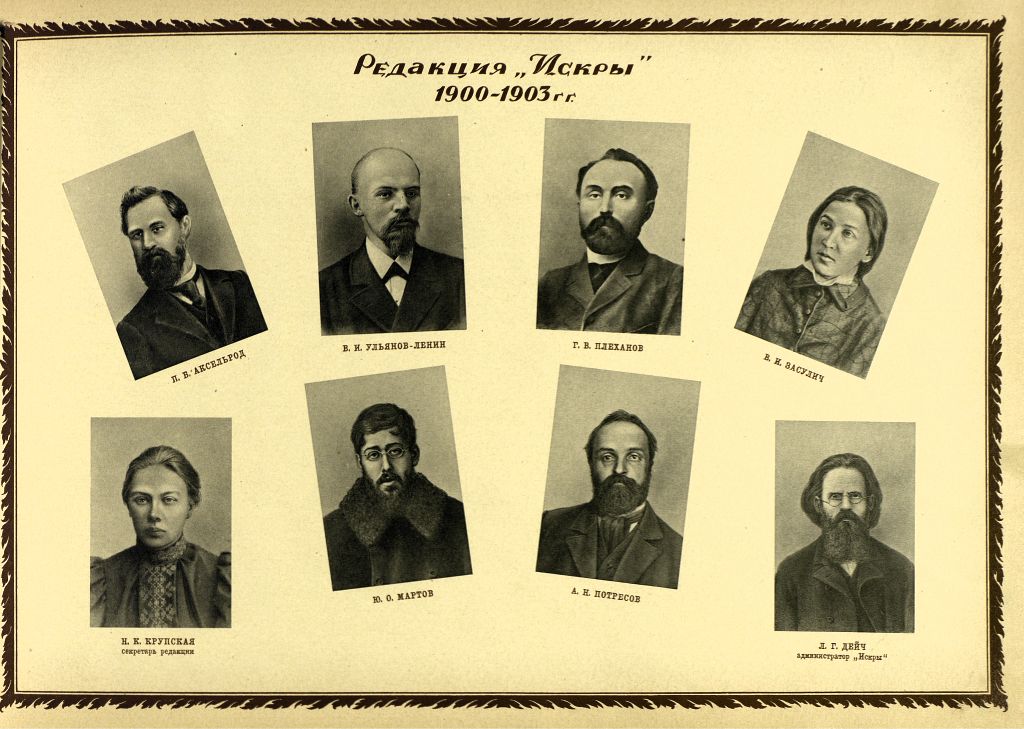
Lenin explains the reasons for Iskra‘s launch and its perspectives in this October, 1900 leaflet.
‘Declaration by the Editorial Board of Iskra’ (1900) by V.I. Lenin from Selected Works, Vol. 4. International Publishers, New York. 1929.
IN undertaking the publication of a political newspaper, Iskra, we consider it necessary to say a few words concerning our aims and our tasks.
We are at the present time passing through an extremely important period in the history of the Russian labour movement, and of Russian Social-Democracy. The past few years have been marked by an astonishingly rapid spread of Social-Democratic ideas among our intelligentsia, and meeting this tendency of public opinion is the independent movement of the industrial proletariat, which is beginning to unite and to fight against its oppressors, and is eagerly striving towards Socialism. Circles of workers and Social-Democratic intelligentsia are springing up everywhere; local agitation leaflets are beginning to appear, the demand for Social-Democratic literature is increasing, and is far outstripping the supply, while the intensified persecution by the government is powerless to restrain this movement. The prisons and the places of exile are filled to overflowing. Hardly a month goes by without our hearing of Socialists being “discovered” in all parts of Russia, of the capture of literature-carriers, and the confiscation of literature and printing presses–but the movement goes on and grows, spreads to wider regions, penetrates more and more deeply into the working class, and attracts increasing public attention to itself. The entire economic development of Russia, the history of the development of social ideas in Russia and of the Russian revolutionary movement serve as a guarantee that the Russian Social-Democratic labour movement will grow and surmount all the obstacles that confront it.
On the other hand, the principal feature of our movement, and one which has become particularly marked in recent times, is its state of disunity and its primitive character–if one may so express it. Local circles spring up and function independently of circles in other districts and–what is particularly important–of circles which have functioned and now function simultaneously in the same districts. Traditions are not established and continuity is not maintained; the local literature entirely reflects this disunity, and lacks contact with what Russian Social-Democracy has already created.
This state of disunity runs counter to the requirements called forth by the strength and breadth of the movement, and this, in our opinion, marks a critical moment in its history. In the movement itself the need is felt for consolidation and for definite form and organisation; yet active Social-Democrats do not by a long way yet realise the need for the movement’s passing to a higher form. On the contrary, among wide circles there is manifested an ideological wavering, an absorption in the fashionable “criticism of Marxism” and “revisionism,” in spreading the views of the so-called Economist tendency, and what is inseparably connected with it the effort to keep the movement at its present low stage, an effort to push into the background the task of forming a revolutionary party to lead the struggle at the head of the whole people. It is a fact that such an ideological wavering is observed among Russian Social-Democrats, that narrow practical work is carried on without a theoretical conception of the movement as a whole and threatens to divert the movement to a false path. No one who has direct knowledge of the state of affairs in the majority of our organisations has any doubt whatever on that score. Moreover, literary productions exist which confirm this. It is sufficient to mention the Credo which has already evoked legitimate protest, the Special Supplement to Rabochaya Mysl (September, 1899), which brought out in such bold relief the tendency with which the Rabochaya Mysl is thoroughly imbued, and finally, the Manifesto of the St. Petersburg Self-Emancipation of the Working Class group, drawn up in the spirit of Economism. The assertions made by Rabocheye Dyelo to the effect that the Credo merely represents the opinions of individuals, that the tendency represented by Rabochaya Mysl reflects merely the confusion of mind, and the tactlessness of its editors, and not a special tendency in the progress of the Russian labour movement, are absolutely untrue.
Simultaneously with this, the works of authors whom the reading public has with more or less reason regarded up till now as the prominent representatives of “legal” Marxism more and more reveal a turn towards views approaching those of bourgeois apologists. As a result of all this, we have the confusion and anarchy which enabled the ex-Marxist, or, to speak more correctly, the ex-Socialist, Bernstein, in recounting his successes, to declare unchallenged in the press that the majority of Social-Democrats active in Russia were his followers.
We do not desire to exaggerate the danger of the situation, but to shut our eyes to it would be immeasurably more harmful than exaggeration. That is why we welcome with all our heart the decision of the Emancipation of Labour group to resume its literary activity, and commence a systematic struggle against the attempts to corrupt and vulgarise Social-Democracy.
The practical conclusion to be drawn from all this is as follows: We Russian Social-Democrats must combine and direct all our efforts towards the formation of a strong party which must lead the struggle under the united banner of revolutionary Social-Democracy. This is precisely the task that was outlined by the Congress in 1898 at which the Russian Social-Democratic Labour party was formed, and which published its Manifesto.
We regard ourselves as members of this party; we entirely agree with the fundamental ideas contained in the Manifesto, and attach extreme importance to it as a public declaration of its aims. Consequently, we, as members of the party, present the question as to what our immediate and direct tasks are, as follows: What plan of activity must we adopt in order to revive the party on the firmest possible basis?
The reply usually made to this question is that it is necessary to elect a central party institution once more and to instruct that body to resume the publication of the party organ. But, in the confused period through which we are now passing such a simple method is hardly adequate.
To establish and consolidate the party means to establish and consolidate unity among all Russian Social-Democrats, and, for the reasons indicated above, such unity cannot be brought about by simply giving orders; it cannot be brought about by, let us say, a meeting of representatives passing resolutions. Definite work must be done to bring it about. In the first place, it is necessary to bring about unity of ideas which will remove the differences of opinion and confusion that–we will be frank–reign among Russian Social-Democrats at the present time. This unity of ideas must be fortified by a unified party programme. Secondly, an organisation must be set up especially for the purpose of maintaining contact among all the centres of the movement, for supplying complete and timely information about the movement and for supplying it regularly to the periodical press in all parts of Russia. Only when we have established such an organisation, only when we have established a Russian Socialist mailing system, will the party have a chance of permanent existence and only then will it become a real factor and consequently a mighty political force. To the first half of this task, i.e., establishing a common literature, consistent in principle, and capable of ideologically uniting revolutionary Social-Democracy, we intend to devote our efforts, for we regard this to be one of the pressing tasks of the present-day movement and a necessary preliminary measure towards the resumption of party activity.
As we have said already, the intellectual unity of Russian Social-Democrats has still to be established, and in order to achieve this it is necessary, in our opinion, to have an open and thorough discussion of the fundamental principles and tactical questions raised by the present-day Economists, revisionists, and “critics.” Before we can unite, and in order that we may unite, we must first of all firmly and definitely draw the lines of demarcation between the various groups. Otherwise, our unity will be merely a fictitious unity, which will conceal the prevailing confusion and prevent its dispersion. Therefore, we do not intend to utilise our publication merely as a storehouse for various views. On the contrary, we shall conduct it along the lines of a strictly defined tendency. This tendency can be expressed by the word Marxism, and there is hardly need to add that we stand for the consistent development of the ideas of Marx and Engels, and utterly reject the half and half, vague and opportunistic emendations which have now become so fashionable as a result of the legerdemain of Ed. Bernstein, P. Struve and many others. But while discussing all questions from our own definite point of view, we shall give space in our columns to polemics between comrades. Open polemics within the sight and hearing of all Russian Social-Democrats and class-conscious workers are necessary and desirable, in order to explain the profound differences that exist, to obtain a comprehensive discussion of disputed questions, and to combat the extremes into which not only the representatives of various views, but also of various localities or various “crafts” in the revolutionary movement inevitably fall. As has already been stated, we also regard one of the drawbacks of the present-day movement to be the absence of open polemics between avowedly differing views; an effort to conceal the differences that exist over extremely serious questions.
We will not enumerate in detail all the questions and themes included in the programme of our publication, for this programme automatically emerges from our conception of what a political newspaper, published under present conditions, should be.
We shall exert every effort to persuade every Russian comrade to regard our publication as his own, as one to which every group should communicate information concerning the movement, in which to relate their experiences, express their views, their literary requirements, their opinions concerning Social-Democratic publications, in fact to make it the medium through which they can make their contribution to the movement and receive what the movement can give them. Only in this way will it be possible to establish a genuine All-Russian organ of Social-Democracy. Only such an organ will be capable of leading the movement onto the high road of the political struggle. “Push out the framework and broaden the content of our propaganda, agitational and organisational activity”— these words uttered by P.B. Axelrod must serve as our slogan defining the activities of Russian Social-Democrats in the immediate future, and we adopt this slogan in the programme of our organ.
We appeal not only to Socialists and class-conscious workers; we also call upon all those who are oppressed by the present political system. We place the columns of our publication at their disposal in order that they may expose all the abominations of the Russian autocracy.
Those who regard Social-Democracy as an organisation serving exclusively the spontaneous struggle of the proletariat may remain satisfied with merely local agitation and “pure and simple” labour literature. We do not regard Social-Democracy in this way; we regard it as a revolutionary party, inseparably linked up with the labour movement and directed against absolutism. Only when organised in such a party will the proletariat–the most revolutionary class in modern Russia–be in a position to fulfil the historical task that confronts it, namely, to unite under its banner all the democratic elements in the country and to crown the stubborn fight conducted by fallen generations with the final triumph over the hated régime.
The size of the newspaper will range from one to two printed signatures. In view of the conditions under which the Russian underground press has to work, there will be no regular date of publication.
We have been promised contributions by a number of prominent representatives of international Social-Democracy, the close co- operation of the Emancipation of Labour group (G.V. Plekhanov, P.B. Axelrod and V.I. Zasulich), the support of several organisations of the Russian Social-Democratic Labour Party and also of separate groups of Russian Social-Democrats.
International Publishers was formed in 1923 for the purpose of translating and disseminating international Marxist texts and headed by Alexander Trachtenberg. It quickly outgrew that mission to be the main book publisher, while Workers Library continued to be the pamphlet publisher of the Communist Party.
PDF of book: https://archive.org/download/collectedworksof0000vlad/collectedworksof0000vlad.pdf
 Revolution's Newsstand