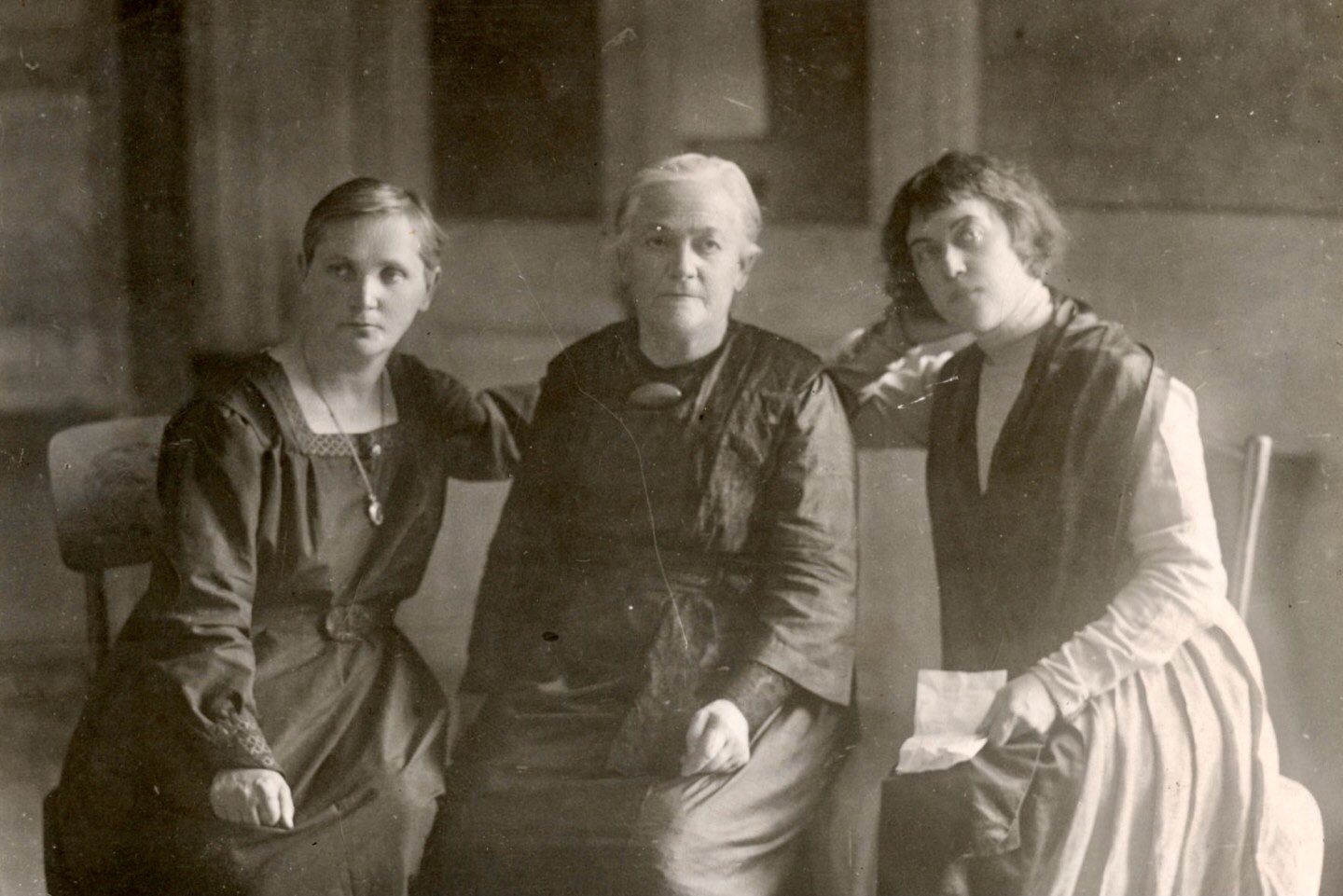
Heading towards its close, the conference hears from Zlata Lilina, veteran Bolshevik and wife of Zinoviev, on the dictatorship of the proletariat with discussion from German and Austrian comrades of their revolutionary experiences.
‘Report of the Sixth Session of the Second International Conference of Communist Women’ from Moscow. No. 21. June 18, 1921.
Comrade Lilina continued her speech on the dictatorship of the proletariat.
“Third Communist International has placed before itself the clear and definite aim of overthrowing the capital stem and establishing the dictatorship of the proletariat.
“The spreading of the world revolution and recent events have brought forward the action wither a dictatorship of the bourgeoisie or a dictatorship of the proletariat.
“The word trend of events after the war is expressed in the following manner: women, taking the place of men during the war, weakened the strength of the organized proletariat and this to a certain degree caused extraordinary high prices and over production. Under these circumstances, immediately after the war there was a series of potent mass movements in many countries. Thus in Germany during 1918 and 1919 the government fell into the hands of the social-democrats and trade unions, a Soviet Republic was established in Bavaria, a strong movement for seizing factories and establishing workers control developed in Italy. Throughout the whole of Europe there was a wide strike movement. But the social patriots and trade union bureaucrats reduced to naught the revolutionary enthusiasm of the proletariat and by this means the first attempts of the proletariat to finish with bourgeois rule were without result. This year we witnessed a new rise in the movement. World capitalism has not only failed in its attempt to strengthen itself, but is showing its incompetency in being unable to solve its economic problems. Unemployment is rife to a tremendous extent in all the capitalist countries. In England for example there are today over 5 million unemployed; in the textile industry alone 20% of the workers are idle. We ask, are the struggles of those fighting against capitalism to be just as fruitless as they were in the recent after war period? Capitalism has assumed the offensive along the whole line. It compels the suffering proletariat to work for reduced wages and longer hours. It is attacking the workers trade unions organisations. Its sole aim is to destroy the fighting spirit of the proletariat and to reduce it to its former state of slavery. But the working class everywhere is rising. In Norway we had a general strike, in which 120,000 men took part, in Italy the solid strike of civil servants. In England the irreconcilable! miners’ strike, and now that of the textile workers. In Bavaria the strike movement is becoming strengthened more and more.
“In order not to allow the present struggles of the proletariat to be as fruitless as those which have passed before, it is necessary to follow the tactics of the Third Communist International, to keep up the spirit of the masses, continually exhorting them to seize power and to expose all reformists who attempt to drag the proletariat down.
“The role of the women communists in this movement is extremely great. We can emphasize this as a fact that in all those countries where there was a split in the socialist movement the women inevitably go over to the communists. And this is not surprising. During and after the war the woman worker suffered more than anyone else.”
Comrade Lilina illustrated the capitalist regime by quoting from a book published in London by Russian White Guard servants. In this book are exposed the horrors of the exploitation of child labour in England. So that whilst in Soviet Russia no child under the age of 18 is allowed to work, children of 10 and 11 years of age in England are employed in all branches of industry. For example, children of 11 and 12 and 15 work in the textile industry from 6 a.m. to 9p.m., i.e. 15 hours at a stretch.
The problems of women communists in bourgeois countries must be agitation and propaganda among the masses, keeping in view their chief aim the conquest of political power. Municipal councils, the press and meetings must all be made use of in the widest possible manner to spread this idea. The discontent of the proletariat must be made use of, not in order to create a satisfied proletariat in the midst of a capitalist system, but to demonstrate the futility of reform as means of solving any economic or domestic problems; to expose the social-compromisers and, not to call for the reestablishment of the crumbling capitalist system, but to call for its complete destruction and the establishment of the workers’ dictatorship. With this object in view all those parties which are affiliated to the Third International must cleanse themselves of any doubtful elements and devote all their energies not to secure increase in the membership but to perfecting the quality of vanguard units.
Comrade Lilina acquainted the foreign delegates with their colossal revolutionary and creative work which was accomplished by the Russian women workers from the July days of 1917 and also the legislative work of the Soviet Government in the sphere of protecting woman and child labour.
In concluding her speech she said “that fight which is now being waged in the West and East must not be in vain, and I believe that in will not be so. In the name of this conference and under that banner of the Third Communist International let us march on to the dictatorship of the proletariat.
Comrade Gerten said: Before dealing with any report I wish to state a few preliminary remarks. To describe the conditions of the struggle for the dictatorship of the proletariat in Western Europe and America. I would have to gather a considerable amount of material. Therefore I will base myself on conditions in Germany, where the woman communist movement is more developed. According to all indications Germany is nearer than ever to the establishment of the proletarian dictatorship. For the women the dictatorship of the proletarian is even more a vital necessity than for men because it will free them from a double yoke–capitalism and the family. Although actual conditions drive the women into the revolutionary struggle, subjectively she belongs, as yet, to a backward strata. This is because even the factory woman is drawn into a triple circle of contradictory obligations–as a wage worker, a housewife and mother. Instead of 8 hours, her working day is 15 hours. She has neither the time, nor the strength to devote herself to political or social work. On the other hand, the State is trying its best to keep her in ignorance. The Church, even in Russia, as yet has its stupefying effect upon the women, especially upon the peasant woman. What shall we say then, about the capitalistic countries, where the Church is the organ of State?
The reactionary parties are trying with all their might, to convince the woman that all her suffering, the high cost of living, unemployment etc., are due to the workers, who are turbulent, strike and present impossible demands. The social democrats and other tacitly reactionary parties try to convince her that the vote is a panacea for all her troubles. A good deal has been done for the women by the German trade union, the unions which would have a woman in a responsible position. Sometimes, even in communistic circles, there is a certain prejudice against the woman’s right to vote. Surely, this point of view is wrong. It is necessary for the women to get her full equal rights in order that they may be convinced through experience, that the communist party in their only redeemer, that everywhere, as yet, is the woman drawn into revolutionary struggle. Therefore, we are so delighted with Soviet Russia, where the woman frequently have advanced even ahead of the man. We must, by all means, overcome the passivity of woman. Propaganda and agitation must be turned into direct action, to show the working woman, that her fate is shared by milliards of proletarians the world over, and that high cost of living, unemployment, child mortality, etc. obtains in all capitalist countries.
In this way we shall be able to overcome the backwardness of women, and imbue them with the will of the struggle. The women themselves must come out actively in defence of their vital demands. From their own experience they must convince themselves that they will not achieve their demands under the capitalistic regime. The position of the women is made even worse because of her competition within her own class. In Germany, in time of crisis, not women, but men are the first to be thrown out into the streets, because it is more profitable for the factory owners to retain women. In some unions the question arose of preventing women, who had husbands to keep them, from working in the factories. We had a tremendous struggle to prove that it was necessary to have women as wage workers. We are planning now to fight for equal pay for men and women, protection of woman’s labour, and protection of motherhood as a social function of women to nullify which strenuous efforts have been made recently. All this leads to one thing, to the emancipation of women, which is impossible without the overthrow of capitalism and the establishment of the dictatorship of the proletariat. Gradually this is being realised by the woman. For instance, after the German revolution, free help to lying in woman was declined, only because the social democratic government was short of money. Facts like these show clearly to the working women, that they have nothing to expect from the bourgeoisie, the so-called socialist parties. The strength of the woman grows with her struggle. In March of this year, in many places many women came out together with men. It is necessary to prepare the women for decisive struggle between labour and capital. The women’s movement must not be limited to specific women’s questions.
The woman communist must be assured of her right of initiative.
The woman is wakening up now. The miners’ strike in England is proceeding successfully, only because the women workers and the workers’ wives actively showed their sympathies to the striking miners. In Germany during March the women at any enterprises came out on strike together with men, and together with the men were thrown out on the street. The communist parties should exert all their efforts to make use of the women during the revolutionary struggle. They can serve as messengers, and scouts and so forth. Attention should be paid to the domestic servants. As a whole they have up till now been in spiritual bondage to their mistresses, whereas domestic servants could be of much service to the party. In the event of revolutionary fighting, it is necessary to create cadres of Red nurses, in order not to have a repetition of what occurred in Bavaria during the deposition of the Soviet Government, when doctors and nurses refused on principle to attend to our wounded. It is time moreover, to forget the pacifist prejudices that women are unable to wield arms. They can and they should take an active part in the revolutionary fighting. It was in Berlin in January where the communist women managed the machine guns, it was so at Munich, where they took part in defending the city and a number of other places. In the event of any new revolutionary outburst in Germany, a part of the working women will be with us, a part will remain neutral, and part will be frankly hostile. Our duty, the duty of the women communist, is to make the first larger than the second and the third. It is necessary to maintain the closest contact between the communist women’s movement and the general Communist movement. It is absolutely imperative that women take part in political life. The communist women should take part in the solution of all political questions both of national and international character. The Communist Women’s Conference should give its opinion on the questions of principles of the communist movement.
Comrade Gerten then gave a detailed elucidation of the March events in Germany and drew a parallel between them and the Kapp revolt, expressing the conviction that the defeat of the proletariat in active fight always in the end, signifies the strengthening of its forces. She entertained no doubt that every such test will serve to the advantage of the Communist Party of Germany, that it will emerge victorious in the present situation and its very errors, recognised and rectified, will be to the advantage of the international movement.
After the interval the floor was granted to comrade Wertheimer (Austria).
Comrade Wertheimer dealt only with the first part of Gerten’s report on the role of the women in the German revolution. She said: it is necessary to discriminate between the two conceptions–the economic position of the country, which gives rise to revolutionary feeling, and the maturity of the proletariat for revolution. The economic position in Central Europe is already ripe for a communist revolution, but the proletariat is not sufficiently prepared for determined action. One of the causes of its immaturity is the backward state of the women. Our task is to raise the class consciousness of the working women and draw them into the fight. Various methods have been suggested here, but they should not only deal with the organisation side of the question; they should indicate the very form of action.
Comrade Wertheimer disagreed with comrade Gerten, who pointed out two diverse methods; the method of agitation and the method of activity. Comrade Wertheimer declared that no line must be drawn between these two methods, Propaganda and action are one inseparable whole, mutually complementing each other. In the revolutionary struggle, the working women should not set up their own specific aims, they should simply take up their stand as revolutionary fighters for the Dictatorship of the Proletariat. Our duty is to raise the revolutionary consciousness of the working women and prepare them for the seizure of power by the proletariat. At present the proletariat has not yet succeeded in manifesting a sufficiently strong determination to fight. Its inertness should be overcome, and this is primarily the task of the women; this is her chief role in the proletarian revolution.
Comrade Wolnaya emphasizes the correctness of Kollontai’s statement about the necessity of applying different methods in conformity with the different social groupings of the working woman. There must be a special method of approach to the housewife, the factory woman, and the peasant woman. No attention has been paid up till now to another point–to the difference of age between the women workers. There is a group of women workers that is not only economically but psychologically more susceptible to revolutionary propaganda and more fit for the fight and that is the young working women.
Comrade Wolnaya pointed to the vast importance of the Young Communist League in Belgium. The young communist organisations sometimes are even stronger than the communist parties. Therefore work among the young women should be conducted through the young communist organisations, which possess a remarkable capacity for inspiring the working women with their enthusiasm.
Comrade Wolnaya expressed the hope that the resolution on contact between the Women’s Sections and the Young Communist League which will be submitted by the Executive of the Young International will be sympathetically accepted by the Conference and carried out.
Comrade Shtremer (Austria): Returning to the question touched at yesterday’s sitting comrade Shtremer, replied to the charges levelled at the Austrian Party, because of the practical demands put forward, as an agitational method for drawing the women workers into the Party struggle. They are called opportunists. Comrade Shtremer emphatically denied the charge of opportunism. She said that demands of a practical character, are of interest not only to women, but to the working class as a whole. In dealing with the concrete demands of the Proletariat, we can approach them the more easily and thus gain its confidence. Further, comrade Shtremer remarked that if one studies the Austrian movement, one must take into consideration the peculiar situation of Austria. The charge that revolutionary ardour is absent, is unjust. It is not the will that the proletariat of Austria lacks. Apart from the extremely difficult conditions that Austria labours under, she is in a very peculiar international position. No movement of the Austrian proletariat can be successful, unless it is supported by the German proletariat. Theoretically, we do not withdraw from activities. The Communist Party of Austria must first gain the confidence of the proletariat. We must take into consideration the state of preparedness of the masses, in putting forward practical demands, we must not opportunism, but a practical way of approaching the masses. We are educating them for the Revolution, and must hope that when the moment arrives, our proletariat will be in its place in the ranks of the fighters for this dictatorship.
Comrade Helfke (Germany), Germany just now is passing through a very sharp civil war, therefore it is absolutely essential just now, to draw the women into the common revolutionary struggle. In that we have already been successful. In the first place, we must educate the women Communists so, that they can carry of the permanent work of the party, according to their powers and abilities. Those women who have already attached themselves to our party, understand excellently that only through civil war, can they attain the Dictatorship of the Proletariat They have no illusions as to the sacrifice that will entail. In the days of the Kapp rising, our comrades particularly in the Rhine provinces, and in Westphalia carried out duties of a various kind. They were at the front as rank and file fighters as nurses, arranged food centres for fugitives, and conducted a very active agitational propaganda. The German revolution has already lasted more than two years, and throughout this period we suffered a number of heavy defeats, an still our women Communists have not lost their valour. Their theoretical training is very weak, but they feel and act as real revolutionaries, they realise that there is no other way.
Comrade Gerten in closing the debate said that the very brevity of the discussion proves the unanimity of the Conference on the questions of fundamental principles. Dealing with individual speakers she supported the comrade from Young Communist League and expressed her complete agreement with view that we ought to render all possible aid to the Young Communist League. She further supported Comrade Shtremer in the opinion that the women’s demands should be specially supported, not only in words, but in deeds by the whole apparatus of the Communist Party. Apart from that, she insisted that women’s organisations examine all general principal questions, and in detail those that will be discussed at the Congress of the Comintern.
In conclusion, she expressed the hope that the resolutions adopted at this Conference will not remain mere paper resolutions.
Moscow was the English-language newspapers of the Communist International’s Third Congress held in Moscow during 1921. Edited by T. L. Axelrod, the paper began on May 25, a month before the Congress, to July 12.
PDF of full issue: https://www.marxists.org/history/international/comintern/3rd-congress/moscow/Moscow%20issue%2021.pdf
 Revolution's Newsstand