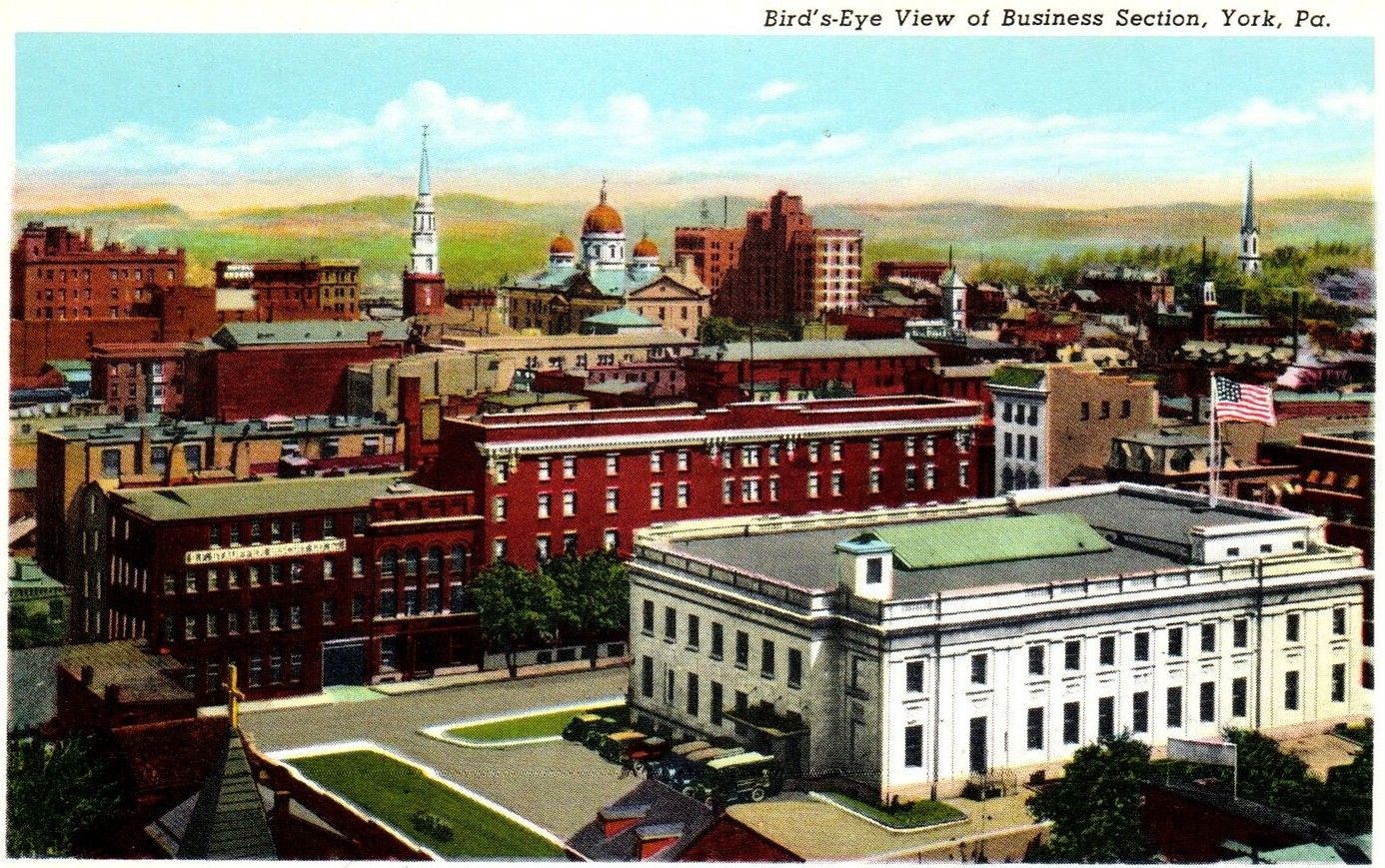
Joseph Freeman on the industrial poisoning of 102 of 124 workers at G.E.’s York, Pennsylvania plant, killing two.
‘General Electric’s House of Poison’ by Joseph Freeman from Health and Hygiene Vol. 3 No. 3. March, 1936.
DEATH by poison, a slow and horrible corrosion of the body, killed two in the General Electric plant of York, Pa., and affected 102 others, as well as members of their families.
Fumes from a commercial preparation known as Hallowax, used for insulating wires and cables ordered by the United States Navy, was responsible for a horrible disease which eats down into the very entrails of its victims.
I looked into the faces of many who are suffering from this dread malady. They include robust young men, their youthful wives, their children, even babies in arms. For the poison carried by soiled clothing, easily transferable, corrodes all it touches.
The York General Electric plant was closed by state authorities following innumerable complaints. Known as the House of Death, it was reopened a few weeks ago. In spite of terror and widespread suffering, nothing was done by the company or the authorities to remedy the situation, which rivals in the scope of disaster and official callousness the silicosis tragedy for profit at Gauley Bridge, West Virginia.
For at least a year the workers of the G.E. plant in York have been suffering from the effects of some chemical poison. They did not know what ailed them, except that they broke out in an acne-like rash which spread over the exposed parts of the body. They were not examined by a company physician and nothing was done to halt the spread of the disease.
On October 15, 1935, the state authorities received a letter signed by a mysterious “Mrs. Green.”
“Dear Sirs,” it said, “the General Electric Company in York, Pa., are using a compound which is injuring the health and skin of the employees. You were informed about this be- fore. Kindly do something about it.”
Three days later, Dr. William B. Fulton, of the state’s industrial hygiene laboratory, arrived to investigate the York plant. The General Electric officials here told Dr. Fulton that he might not investigate the mysterious skin disease that was infecting and terrorizing the workers until “the home office” gave permission! Finally, on November 25, the state health authorities were permitted to investigate.
Meanwhile the spread of the poison was veiled in an official conspiracy of silence. Neither the state authorities, nor the company, nor the local press published Mrs. Green’s warning. The workers did not know what was ailing them, except the unknown poison struck hardest at those who worked at night, especially cleaning kettles of Hallowax.
Toward the end of last year, a foreman in the General Electric plant named Bender was taken to the hospital. It was said that he was dying of infected teeth. But one of the young workers under him heard otherwise. He was a young Irishman of twenty-two named John Fallon, who had come from Philadelphia only three years before with his twenty-one- year-old bride. Bender told Fallon in the hospital: “John, I’ve got it.”
It meant the strange industrial poison which was spreading from the galleries where they made wire and cable to the shipping room and even to the office help.
Vapors from an insulating compound were settling on skin and clothes. They cooled, hardened, poisoned. Bender died. His epitaph was “infected teeth.”
Then Johnny Fallon himself got IT. I saw Johnny’s mother-in-law and she told me the story. Mrs. Wolfe is a buxom, blue-eyed woman, strong and clever. She runs a shoe repair shop in the workers’ section of York. Her husband runs another.
She told me how Johnny had come to live with them when he married her daughter Eunice, three years ago. They were both kids, only eighteen.
“Johnny got his first job in the G.E. plant,” she said. “He was in perfect health, a wiry little Irishman. They examined him at the plant and again six months later, and both times they said he was fit as a fiddle. He worked at night in the gallery mixing the kettles, forty cents an hour for forty hours a week, sixteen dollars. And he was working a rewinding machine, rewinding cables.
“Then he got a burning sensation in his stomach. Boils broke out all over him, and when you squeezed them wax came out. He was worried. Other boys had it. Billy Baldwin had it before him, and the company said, if you talk you’ll be fired.
“We took Johnny to the hospital on January 6. He was in such pain he screamed like a wild man. They had to handcuff him to the bed. His whole body was swollen, all the way around, right up to his chin, like a balloon. The last six hours he yelled all the time, tossing in his bed. Then he died.”
The company did nothing for Johnny Fallon, Mrs. Wolfe said. When the boy died, Dr. Charles Rea of the York Hospital called in the young widow, Eunice Fallon. He told her that the doctors had done their best for him, but apparently the real cause of death had not been located. To help other workers in the plant, an autopsy would be necessary. Would Eunice Fallon consent to have one made?
Eunice consented. Her husband had lived and died a Catholic, opposed on principle to autopsies, but he had himself asked for one–“to help the other boys find what this is.”
The bill for the autopsy was not paid by General Electric. Eunice Fallon paid for it, ten dollars out of the meager savings her husband had left her. And after she paid for it, Dr. Rea refused to tell her the results of the autopsy.
“You are one of those grasping widows,” he said gruffly to the twenty-one-year-old girl. “But what did he die of, doctor?” “Oh, this and that and the other.” One day a gentleman called on Eunice Fallon, representing himself as a state inspector.
“Did your husband ever have syphilis?” he asked. “Did you ever have syphilis? Did your parents ever have syphilis?”
“My God,” Mrs. Wolfe exclaimed in telling me the story. “John was never a run-around. He lived in my house for three years. He knew Eunice since they were babies, and I know he was as clean a boy as ever lived. Imagine the nerve of them trying to get away with that!”
Later Fallon’s relatives heard that the alleged state inspector was a doctor sent down by the General Electric Company from New York.
“What did the company do for the men who have this poison?” I asked.
“They told them to take shower baths and to use cold cream,” Mrs. Wolfe said. “But it did no good.”
John Fallon’s death on January 10 was not immediately reported in the local press. The first paper which referred to it was The Organizer, an eight-page mimeographed bulletin issued by the International Hodcarriers, Building Trades and Common Laborers Union, Local 536. In its issue of January 13, The Organizer reported Fallon’s death and added:
“In this factory all the men working on a certain spraying job get this so-called ‘complication of diseases.’ A few of these men are known to be dying. Others have developed lumps and abscesses that you can draw a cupful of from. Their life is a living death.”
THIS report of Fallon’s death forced the situation into the open. On January 21, Governor Earle of Pennsylvania requested the General Electric Company to close their York plant. The request was based on a report by Secretary of Labor and Industry Ralph Bashore that Fallon’s death on January 10 might have resulted from chemicals used in the plant.
Bashore informed the governor that 102 out of 124 employees examined at the G.E. plant suffered in varying degrees from a skin condition resulting “from the use of cholorodiphenyl and chlorinated naphthalene.” The state authorities attributed Fallon’s death to “yellow atrophy of the liver, suspected to have resulted from the same chemicals.” They indicated that Bender probably died from the same causes.
In the face of exposure, the company closed the plant temporarily.
On January 24, the Farmer-Labor Party of York County, whose chairman is Bernard Child, business agent of the Hodcarriers’ union, sent a delegation to the York City Council. They demanded that the City Council and the city health authorities investigate.
The city council abruptly terminated the discussion. At this writing it has done nothing about the General Electric plant tragedy. Neither has the York health department.
Meantime, the Farmer-Labor Party has prevailed upon local civic and labor leaders to write about York’s industrial tragedy to Representative Vito Marcantonio, Republican, New York, who heads the congressional committee now investigating the Gauley Bridge silicosis disaster.
JOHN DIFFENDORFER, 220 Patterson Street, twenty-five, is a stocky young man with a fine head, quite good-looking.
He pointed to his face, classic in outline, now warped by a mass of blisters. His hands have the same kind of acidy scars. He used to weigh 195 pounds, but has lost at least thirty since the poison entered his body.
“I went to the company,” he told me. “I told them they had to do something about it. So the company doctor shoots something into my arm. And he won’t even come here. I have to go there three times a week, sick as I am.”
“What good is it doing you?” I asked. “I can’t see any good. I go to the drug store and get something to take the itch out of me.”
His whole face glistened with some creamy salve, and the skin was deathly yellow under the grease and the boils.
He picked up his son, James Joseph, who will be three in May. Little Jimmy, blond, blue-eyed, sturdy in his denim overalls, looked gravely at us. His fair skin was red with the deadly rash.
“I’m no hothead,” his father said quietly, “but this stuff gets me. I’m disgusted. They’re not doing a damned thing.” Then, for the first time his voice became tense. “Ain’t it a crime,” he said, putting his hand on his son’s head, “to ruin a kid up like that?”
Mrs. Diffendorfer, only twenty-one, was standing against the kitchen door, smiling nervously. The rash was already beginning to spread on her face. Over the face, too, of her eleven-months-old daughter, Patricia, who lay in her arms.
THE substance of the official report made public by Governor Earle follows: The material used at the plant is a com- pound which contains chlorinated-naphthalene and cholorodiphenyl. Any contact with these two substances will produce an acne-like rash. Out of 124 employees examined in the General Electric plant in York, 102 are definitely affected with this skin trouble. There are 160 employees in the plant. Thirty-six have not yet been examined.
The affliction is transmissible to families by contact with soiled clothing. It results even though the employee is not engaged directly in the work.
The manufactured wire is sold to various individuals, municipalities and the United States government. It is feared that contact with the manufactured articles may produce the skin disease prevalent in the York plants of the General Electric.
These are the sensational charges made by the health authorities of the State of Pennsylvania. The rest of the report seeks to white-wash the General Electric by saying that the company is making necessary improvements, that the authorities are continuing their “intensive studies,” and that present legislation is inadequate for dealing with the wholesale poisoning of the workers.
The company has established a separate room where the Hallowax process is carried on. It has issued overalls to the workers-which most of them must launder at their own expense. But all the steps taken are useless in face of the state authorities’ own admission that any contact with the impregnated wires, cables or fumes is likely to infect.
General Electric seeks to escape responsibility for the deaths of Fallon and Bender and the poisoning of 102 others by claiming that Pennsylvania workmen’s compensation law does not cover skin diseases. The state health authorities support this contention by stressing the need for additional legislation. Yet this same report admits that John Fallon died not of a skin disease but of yellow atrophy of the liver–presumably covered by existing law.
Health was the precursor to Health and Hygiene and the creation of Dr. Paul Luttinger. Only three issues were published before Health and Hygiene was published monthly under the direction of the Communist Party USA’s ‘Daily Worker Medical Advisory Board Panel’ in New York City between 1934 and 1939. An invaluable resource for those interested in the history history of medicine, occupational health and safety, advertising, socialized health, etc.
PDF of full issue: https://www.marxists.org/history/usa/pubs/health/v3n3-mar-1936-health-hygiene.pdf
 Revolution's Newsstand